In the land of the free, you cannot make this shit up. How intrinsically corrupt the police departments are. No, these things are not happening in Russia, China, Or Iran; they are happening in America.
A Hawaii driver who was falsely arrested for drunk driving in November says a police officer told him to deny further examination at a Pearl City police station. According to Hawaii News Now, the officer gave Ammon Fepuleai that advice under the pretense of saving him time while being booked for the arrest, which proved to be false and ended with prosecutors dropping the case for lack of evidence.
The U.S. is recording alarmingly high cases of false DUI arrests; for the last few years, police departments nationwide have conducted more “emphasis patrols” to curb drunk driving. But these DUI checkpoints are often federally-funded, and the overtime hours they provide are paid for by state and federal agencies rather than the police departments carrying out the patrols
HNN investigated the case, compiling information from Fepuleai’s arrest documents as well as video and audio footage from the officer’s body cam, which the patrolman turned off at one point — a violation of the Honolulu Police Department’s arrest procedures.
What is most striking about the incident is how rote the DUI stop goes, and how blithely police dismissed evidence they collected, which suggested Fepuleai was, indeed, not drunk. It’s almost as if the police knew he was telling the truth, but arrested and processed him anyway just to raise their arrest stats. Per HNN
Right after Fepuleai was cuffed and put in the patrol car, the transporting officer appears to turn off the body camera, even though policy requires it stay on during the ride.
Fepuleai said that’s important because on the way to the Pearl City substation, he said the officer told him to refuse further tests in an effort to save time.
Fepuleai said he listened and posted $500 bail.
He now regrets listening to the officer. “He shouldn’t have given me that advice and I hope that they’re not giving other innocent people the same advice,” Fepuleai said.
[…]
Jonathan Burge, an attorney who specializes in traffic cases, said he has heard from multiple other clients that officers are giving that advice.
Burge said some officers want to get back out to make more arrests.
“When you do the roadblocks, you’re expected to get a DUI arrest because they’re paying overtime,” Burge said, adding “there is pressure for stats.”
DUI checkpoints are often federally-funded.
And similar police behavior has been recorded in other places, such as Fort Collins, Colorado. An investigation carried out by the Coloradoan found that an officer tasked with catching drunk drivers nearly doubled his arrests year-over-year from 50 DUI arrests in 202o, to 90 in 2021, then 190 in 2022.
After a series of lawsuits for wrongful arrests, the officer resigned before the department could fire him for improper conduct — which is encouraged both implicitly and explicitly by the funding tied to these DUI patrols.
Defence attorneys representing three Washington police officers on trial for the murder of a Black man have accused the victim of “creating his own death.” Tacoma officers Matthew Collins, 40 and Christopher Burbank, 38 are facing second-degree murder and manslaughter charges in connection with the 3 March 2020 death of Manuel Ellis. A third officer, 34-year-old Timothy Rankine, is charged with manslaughter in the case. Throughout the nine weeks of trial, jurors have heard from prosecutors that the officers knocked Ellis to the ground, punched and choked him and shot him with a taser until he died. Before he was killed, Ellis whispered to the officers: “Can’t breathe, sir.” Closing arguments started on Monday, with the state arguing that Ellis would be alive today if the officers had done what most people would do if someone was struggling to breathe.
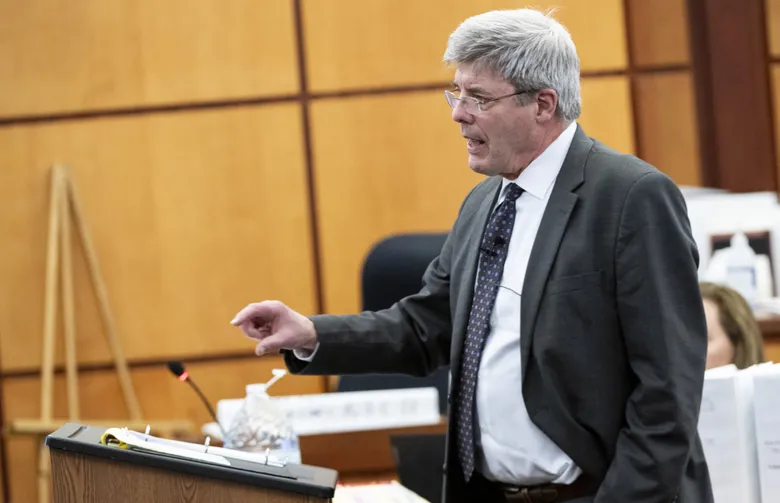
Wayne Fricke
Special prosecutor Patty Eakes said on Tuesday that the officers had “chosen to treat [Ellis] like an animal, in the most dehumanizing position you can imagine.” The defendants’ attorneys have since made controversial characterizations of the circumstances surrounding Ellis’ death, directly blaming him for being “paranoid” and ultimately “[causing] his own death.” “This is a situation where he created his own death,” defense attorney Wayne Fricke claimed during closing arguments on Wednesday, per CBS News. “It was his behavior that forced the officers to use force against him because he created a situation that required them to act.”
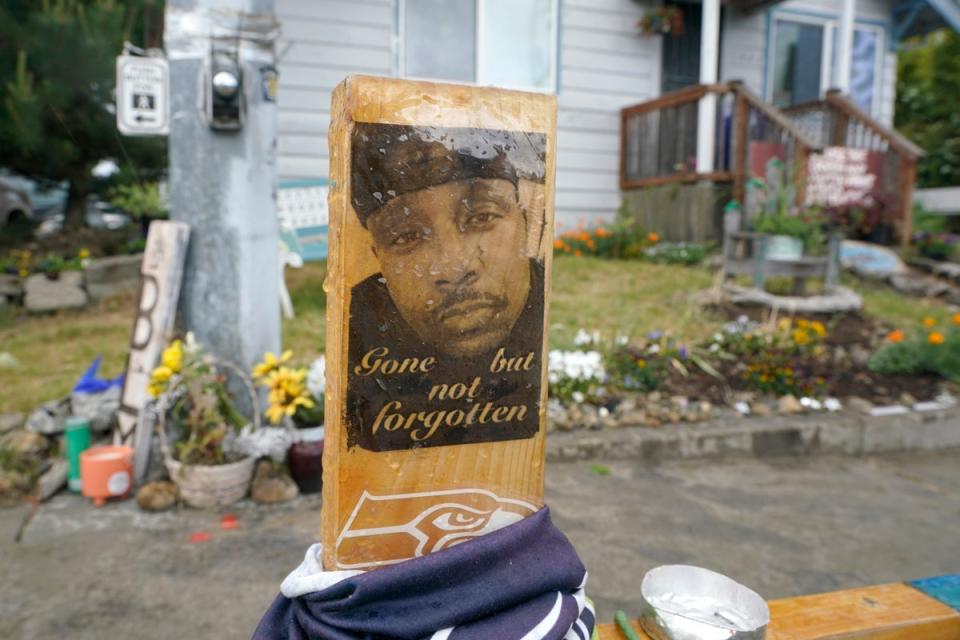
A sign is displayed at a memorial in Tacoma, Washington, where Manuel “Manny” Ellis died (Copyright 2021 The Associated Press. All rights reserved.)
Ellis’ cause and manner of death were ruled a homicide caused by lack of oxygen due to physical restraint. Ellis was on his stomach, with both his legs and arms tied and his body pressed against the concrete while the officers rested their weight on him, The News Tribune reports. However, the defence has focused on methamphetamine levels present in Ellis’ body at the time of his death and an enlarged heart noted in the autopsy report. The defence has said that Ellis was the aggressor and that he attacked the officers with “super-human strength” and eventually died of a drug overdose and a damaged heart. Witness testimony and video presented at the trial suggest otherwise. Three witnesses said they saw the officers sitting in their patrol car as Ellis approached and walked to the passenger side. When Ellis turned to leave, Burbank threw open the door and knocked Ellis to the ground, according to the witnesses. Prosecutors also played video recorded by the witnesses for the jury.
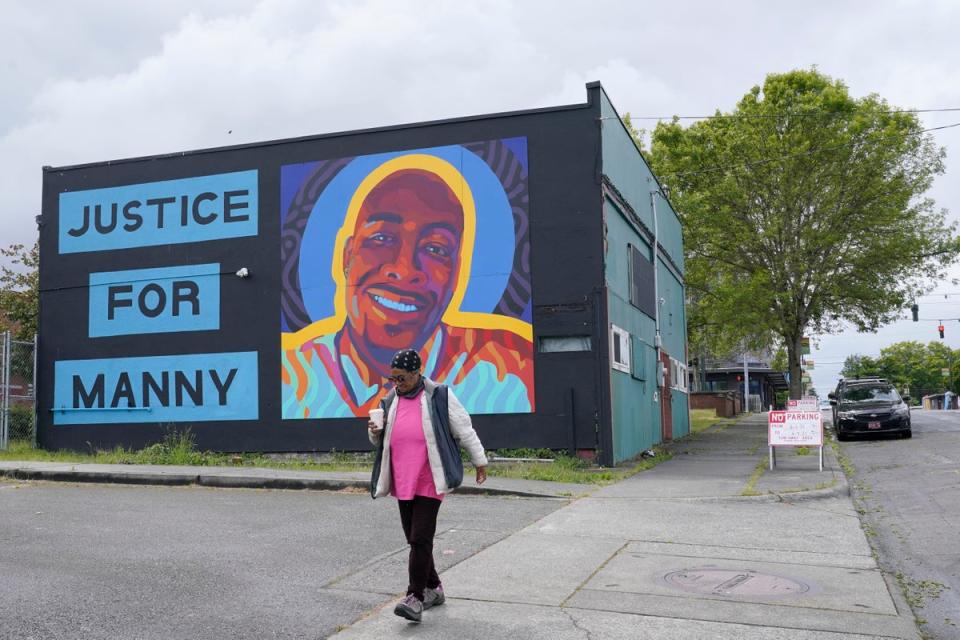
A woman walks past a mural honoring Ellis (Copyright 2021 The Associated Press. All rights reserved.)
Mr Burbank and Mr Collins gave their official statements before they knew there was audio and video of the encounter, Ms Eakes said. They claimed Ellis attacked them violently and relentlessly and didn’t say a coherent word. “But you know that’s not true,” Ms Eakes told the jury. “He did speak after he was pinned to the ground. He said he couldn’t breathe, sir, politely and nicely.” When Mr Rankine showed up and pinned Ellis to the ground, even though he was in handcuffs, Ellis said he couldn’t breathe three more times. Mr Rankine responded by saying, “If you’re talking to me you can breathe just fine.”
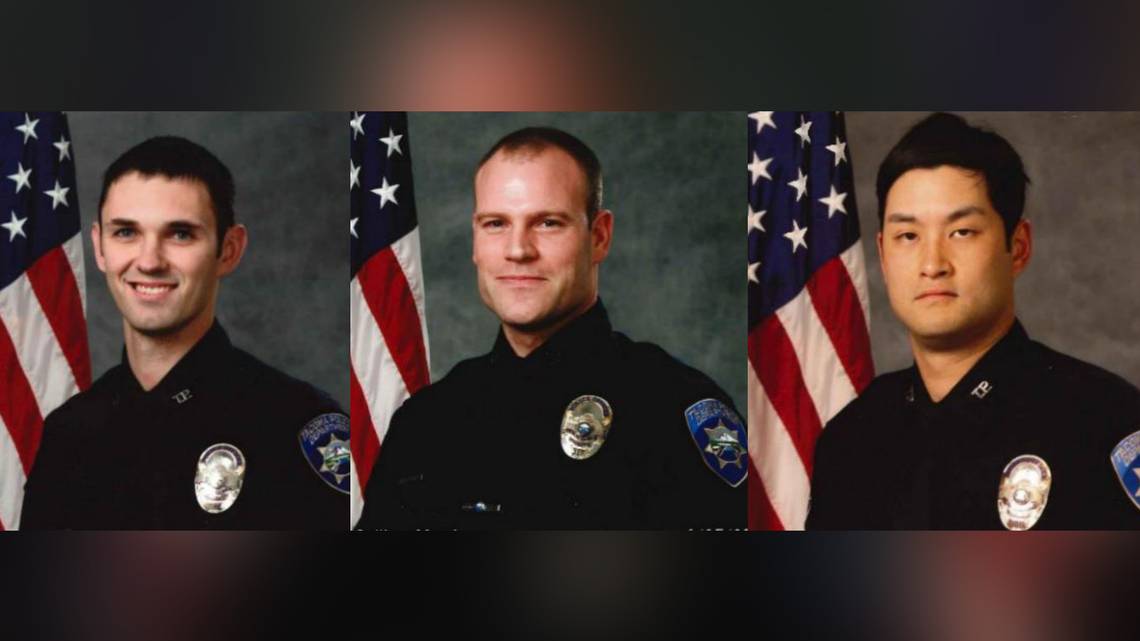
The three murderers
After that, they put hobbles on Ellis’ ankles and connected them to his handcuffs. The second-degree murder charges filed against Mr Burbank and Mr Collins, also called “felony murder,” mean a felony was being committed and someone died. In this case, the prosecution argues the officers committed the felony of unlawful imprisonment or assault. Ms Eakes told the jury that they don’t need to unanimously agree on which felony was committed to find the two officers guilty, only that Ellis died during the commission of a felony. They also have the option of manslaughter, which is the charge Mr Rankine faces. Closing arguments continued on Wednesday. The prosecution is now expected to present a rebuttal.
A Mississippi grand jury has declined to indict a police officer who responded to a call, and shot and wounded an unarmed 11-year-old boy inside the home.
The grand jury found that Indianola Police Sgt. Greg Capers did not engage in criminal conduct when he shot Aderrien Murry in the chest on May 20 while responding to a domestic dispute. Murry was hospitalized for five days with a collapsed lung, lacerated liver and fractured ribs from the gunshot wound in his chest.
The Mississippi Attorney General’s Office, who presented the case to a Sunflower County grand jury, announced the decision Thursday. In a written statement, Carlos Moore, Murry’s attorney, said the family would seek accountability through a federal civil lawsuit.
“While the grand jury has spoken, we firmly believe that there are unanswered questions and that the shooting of Aderrien Murry was not justified,” Moore said. “We are committed to seeking justice for Aderrien and his family.”
Reached by phone Thursday, Michael Carr, Capers’ attorney, said the officer had suffered personally and financially due to the case and that the grand jury made the right decision.
“Sgt. Capers is relieved at the result, and he is glad that the citizens of Sunflower County reached the fair and correct result,” Carr said. “He is looking forward to continuing to serve the citizens of Sunflower County and the city of Indianola.”
The Indianola Board of Aldermen voted in June to place Capers on unpaid administrative leave. Capers cannot return to work and get paid unless the Board votes to take him off leave, Carr said.
Indianola is a town of about 9,300 residents in the rural Mississippi Delta, about 95 miles (153 kilometers) northwest of Jackson.
On the May evening of the shooting, Nakala Murry asked her son to call the police around 4 a.m. when the father of one of her other children showed up at her home, Moore said. Two officers went to the home, and one kicked the front door before Nakala Murry opened it. She told them the man they called about had left, and that three children were inside the home, Moore said.
According to Nakala Murry, Capers yelled into the home and ordered anyone inside to come out with their hands up, Moore said. He said Aderrien Murry walked into the living room with nothing in his hands, and Capers shot him in the chest.
The Murry family has filed a federal lawsuit against Indianola, the police chief and Capers. The lawsuit, which seeks at least $5 million, says Indianola failed to properly train the officer and that Capers used excessive force.
With the grand jury’s decision, the Attorney General’s Office said no further criminal action at the state level would be taken against Capers. ___This story has been corrected to show that the grand jury found that Capers did not engage in criminal conduct, not that he had engaged in criminal conduct.
The Jamaica Constabulary Force once had as its Core function three things: (1) The Prevention And Detection Of Crime, The Preservation Of Peace And Good Order, and (3) The Protection Of Life And Property. Long ago, when I served, those were the operating tenets… I must admit it has been many years since I departed, and the Force has gone through many changes even though the fundamental need for police remains under the umbrella of those three foundational principles. If the police department becomes good at those three principles, the nation’s violent crime rate will decrease despite the many attendant contributors to crime.
The Jamaica Constabulary Force has never been good at anything, least of all harnessing the skills of the people within the department to benefit the service. It has never been good at continuity; it has been particularly derelict in dealing with crime and could reasonably be accused of resting on its laurels, awaiting good outcomes. The best thing that has happened to the JCF has been the talented, brave officers who have been a part of the agency from its inception. The worst thing to happen to the JCF has been the ineptitude of the leadership since its inception. I am not naïve to the ever-present and obligatory dark shadow that has hovered over the force that has exponentially hindered the force from carrying out its mandate. This dark shadow of political interference has been both by co-mission and omission. Direct interference, on the one hand, and refusal to pass adequate laws to aid in the reduction of crime have been the crimes of both political parties in our country. The police department must operate under the rule of the constitution with respect for all rights, but the police [must]have a free hand to enforce the laws impartially without favor, malice, or ill will.
The Jamaica Constabulary Force has never had the option of operating without the ever-present dark shadow of political interference. Within Jamaican society, there is a plethora of ticky-ticky fish who harbor the notion that the laws do not apply to them. The list includes politicians, judges, lawyers, public sector workers, their friends and family, and ever damn Tom, Dick, and Harry who knows somebody who knows somebody. Ultimately, there is hardly anyone left for the police to arrest. This has not gone unnoticed by the powerless who don’t know anyone who knows anyone. And so, our little island has become a criminal-free-for-all, a paradise for criminals, police included in the mix. Having said that, the police department can do a much better job than it has done, all things considered. After all, much of what the police are tasked with doing has been done before, and there is a wealth of information on how to do the job more effectively. It has gotten so bad for the country because of the ineptitude of the JCF that murderers now videotape themselves burying the corpses of the people they kill and then do voice recordings explaining the why, what, and how of their actions. The JCF was never an agency that was ever ahead of the criminal networks in our country, mainly because the criminal networks have always had political cover and poor police leadership. Successes of the police over the decades have never been a consequence of top-down leadership and policies but a result of individual officers who laid it all on the line for the country’s good. It made sense, therefore, that the heads of the criminal networks that the nation was rid of were made possible by The American Government and the hard work of the Rank and file of the JCF. I challenge anyone to point me to a major crime syndicate head being chopped off by the Jamaican Government or the High Command of the Police Department. In fact, the Jamaican Government has steadfastly stood in the way of both the hard-working police officers and the American’s effort to root out known crime syndicate heads.
We are in 2023, about to step into a new year, and the most basic steps necessary in law enforcement are still not being pursued by the JCF hierarchy. The nation’s roads are race tracks for taxi drivers, minibusses, and private motorists who overtake long traffic lines around corners, downhill, uphill, and on the sidewalks at breakneck speeds without police crackdown. The Government and the Police commissioner have all but ceded the streets to the lawless drivers. Driving on Jamaican roads is the equivalent of playing Russian Roulette. Every year, hundreds are killed in traffic crashes that the pathetic media calls traffic accidents. Accidents are caused by circumstances outside the victim’s control. Crashes are caused by direct action or inaction of offenders, resulting in the end result. Speeding, and other breaches of the Road Traffic Act. Last year, 2022, 488 Jamaicans perished on the Island’s roads and highways largely because of the actions of moronic Jackasses who breach the road traffic laws without consequence. Where are the traffic cops? As of November 27th, 2023, a total of 373 lives were extinguished on the nation’s roads. This unnecessary loss of life and the trauma is a consequence of excessive speeds, overtaking around corners, driving too fast on wet roads, and driving motorcycles at high speeds without helmets are the main reasons why we are having these fatal collisions,’ on ACP of police told the press. Still no remedial action of note other than begging drivers to stop. The same strategy is employed as it relates to violent crimes. The police have been relegated to begging criminals to stop. Reminds me of Nancy Reagan’s strategy for drug users, ‘just say no’. Laughable.
I am mindful of the concerns of some of my former colleagues, who will chastize me for being so hard on the police when of course, there are other players that are seriously driving the nation’s crime rate, notably the communist judges who seem to have sworn an oath to destroy the country. From the highest perch to the lowest court these communists that emerged from the Norman Manley Law School are dead set on ensuring that dangerous murderers are returned to the streets. More to say about that.…..
.
.
.
.
Mike Beckles is a former Police Detective, businessman, freelance writer, black achiever honoree, and creator of the blog mikebeckles.com.Check mike out on Youtube @ Mikebeckles
America is a free country. Well, think carefully when you think you are free if you smoke a joint because this is likely to happen to you if you are Black and accused of smelling like you smoked a joint. You don’t have to be smoking or have been in possession of marijuana. It doesn’t matter that you may have only been close to someone who had smoked some of the weed. You could be badly beaten by police in America .…. or worse. All of this while tons of cocaine and other dangerous drugs are flooding the streets daily. What the slave catchers are focused on are black people who smell like they smoked a joint.
Police Chief Jonny Jennings
A police officer who repeatedly punched a Black woman during an arrest in North Carolina last month was suspended Tuesday after authorities released new video of the encounter that showed a broader view of what happened than bystander footage shared on social media.
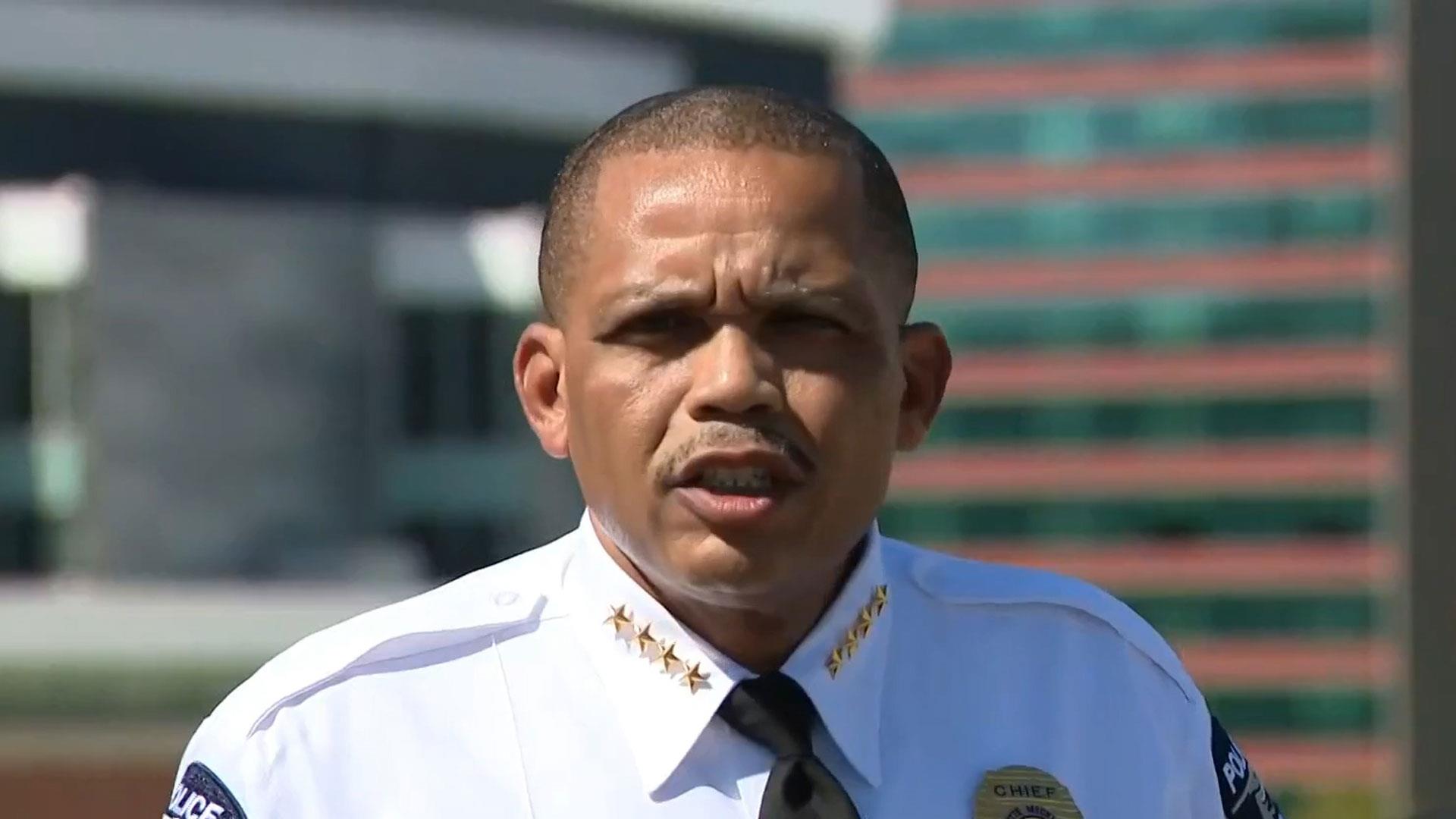
Charlotte-Mecklenburg Police Chief Johnny Jennings told reporters at a news conference that Officer Vincent Pistone received a 40-hour suspension after an internal affairs investigation determined that he used excessive force during the Nov. 13 confrontation. The probe determined that six other officers involved were justified in their actions.
The newly released body camera and bystander videos show different angles and what led to the encounter at a Charlotte bus stop that sparked public outrage. They show that the woman struck an officer in the face and that he responded by hitting her back and knocking her off her feet.
Pistone, who was not the officer involved in that initial exchange of blows, is seen on the video repeatedly striking the woman with a closed fist while four other officers are kneeling and holding her down. As it was happening, bystanders shouted at the officers to stop. After a few seconds, the officers stood and led the woman to a squad SUV with her arms behind her back.
Police previously said that Pistone, who responded that day as backup, delivered seven knee strikes and 10 punches to the woman’s thigh. Jennings said Tuesday that all but the first three blows were excessive.
“Fourteen strikes to the female’s leg came after her hands were behind her back,” the chief said in a statement. “These strikes were not deemed justified. If the officer made an assessment after three leg strikes, he would have seen that they were effective, and the female’s hands were behind her back.”
Jennings said Pistone will also receive additional training. A professional organization for officers, the Charlotte-Mecklenburg Fraternal Order of Police Lodge #9, did not immediately respond to email and voice messages seeking comment and asking whether Pistone had a representative who could speak on his behalf.
Prior to the internal probe, a police spokesman said that Pistone’s blows were consistent with his training and intended to get the woman to comply with commands by striking a nerve in the leg. Police have declined to release information on the officers’ races.
When asked by a reporter if the officer who punched the woman in the face was justified in doing so, Jennings said that action was warranted given that the officer had been struck twice.
“We’re not robots. If there’s an expectation that we’ll always say and do the right things, then I think that’s something that’ll never happen,” Jennings said.
Police body camera footage released Tuesday shows that officers approached the woman and a man as they were sitting at a bus stop in front of a Bojangles restaurant. The pair explained that they had just gotten off work, and the woman asked what they had done wrong.
One officer said it smelled like the two were smoking marijuana, to which the pair said they were smoking a legal cannabis compound they had bought from a smoke shop. Marijuana is not legal in North Carolina, but sales of certain types of related products are.
An officer then leaned down, took the man’s arm and said, “Do me a favor, put your hands behind your back.”
The woman moved toward that officer demanding to know what he was doing, and a second officer took her arm and pulled her away from the bus stop bench, telling her to put her hands behind her back. His body camera the fell to the ground and was facing skyward as he pulled the woman by her arm. The woman could be heard screaming “Why are you touching me? Stop!” And as they struggled and moved into and out of the camera’s view, she could be seen striking the officer.
A video taken by a bystander from across a parking lot shows the exchange of punches between the woman and the officer. In it, the bystander could be heard saying, “I’m pretty sure you’re not allowed to do that to police.”
In another video, a crowd of onlookers and coworkers of the two being arrested shouted at officers who had gathered around the woman on the sidewalk. “You punched the hell out of a woman like that. How you going to punch the hell out of a woman like that, bruh?” one onlooker asked.
In other videos, an officer could be seen using a knee and fist to strike the woman’s thigh repeatedly as she was being asked to put her hands behind her back while laying on the ground. A chaotic blend of voices grew in the background as more officers arrived. “Quit kneeing her, man! Quit it! Quit it!” an onlooker yelled as police walked the male coworker away.
The man and woman, who was identified in court documents as a 24-year-old Black woman from Charlotte, were both arrested after the confrontation that day. He was charged with carrying a concealed weapon and she was charged with assaulting a government official. Both were also charged with resisting officers and marijuana possession. All of the charges were later dropped.
Power in the hands of fools is always a dangerous thing. Almost unchecked power in the hands of fools who cannot think and are giddy about using power is even more dangerous. Add qualified immunity (government carte blanch protection) to the two scenarios, and you get American policing. The most disgusting of all is that when they make stupid decisions because they have the power and protection to do whatever they want to citizens, they claim it is their policy. Truthfully, it is government policy to have its agents do whatever they want to the average citizen, including death, so that it can retain [control]. This kind of unchecked power and unrestrained immunity is then unleashed against the poorest and most vulnerable Americans. This group is usually Black. In the same breath, on the rare occasion that the robotic androids step out of line and do the same to a white woman, and her fragility is disturbed, the rules change.…..At least for the highest court. One of the enduring inconsistencies in American legal thinking on policing is that younger people, particularly younger people of color, are undeserving of the same protections under the laws as older, frailer citizens. Every citizen is entitled to the constitutionally protected doctrine of innocent until found guilty. Therefore, police have no legal authority to summarily and arbitrarily determine someone’s innocence or guilt even before a traffic stop is completed based on how they look or the color of their skin. But doing so is standard policing practice in America. It is time for qualified immunity to go. (Editor)
Elise Brown was a little over five feet tall and weighed 117 pounds when she was ordered out of her blue Oldsmobile by police in California in 2019. She was also 83 years old. The officers who pulled Brown over thought the car she was driving had been stolen – mistakenly, it turns out – and, following their protocol, they drew their handguns, handcuffed Brown, and forced her to her knees. A federal appeals court this year ruled that Brown could sue the police for excessive force, waiving a legal doctrine known as qualified immunity that protects police from liability for civil rights violations in many circumstances. On Monday, the Supreme Court let that lower court ruling stand, keeping Brown’s lawsuit alive. At a time when the nation is grappling with fatal police confrontations, the Supreme Court has mostly balked at lawsuits questioning the legal immunity extended to officers. Police organizations have long countered that officers need immunity in cases when they must defend themselves, and split-second decisions can lead to unforeseen tragedy. The Chino Police Department officers argue they were following protocols: traffic stops for potentially stolen vehicles are “high-risk” under city and state standards, they said. Brown was required to kneel for no more than twenty seconds and was in handcuffs for approximately three minutes, they said.
The officers “deployed firearms in states of readiness consistent with their responsibilities on the scene of a high-risk stop,” the police told the Supreme Court. Brown, police said, appeared to “be in her 50s or early 60s” and “appeared not to need any accommodation due to health or frailty.” Brown sued in 2020, claiming the police used excessive force and unreasonably detained her. “Ms. Brown was terrified, humiliated, and emotionally traumatized,” her lawyer told the Supreme Court. “That conduct was not reasonable; it was extraordinarily dangerous and flatly inconsistent with the Fourth Amendment’s prohibition on excessive force.”
NBA referees are ancillary to the games they officiate. In actuality, no one cares who officiates any given game. Fans of the games are there to see their favorite players and teams play, not to see referees make the game about themselves. Weak white men who cannot play the game become referees, so they act out police tendencies.…… It is time that Scott Foster be sent packing.
Sports is a subject that I seldom ever write on, even though I remain an avid sports fan. Major sports in the United States have been phenomenal in lifting talented young African Americans out of poverty for decades. One major star, Michael Jordon, has even moved on to join the coveted billionaires club. Unfortunately and maybe even predictably, some have squandered their wealth and have returned to abject poverty, and, in some cases, even ended up in prison. Having said that, the team sports that have dominated American and worldwide attention have been sports dominated by Black athletes. Basketball, American football, Boxing, and now even soccer, which America stubbornly refused to participate in at the national level until it realized that the entire world played the game, which is the most popular game in the world. Having been kept out of Baseball until Jackie Robinson broke that barrier, black players entered and dominated the game, then basically left the game up to foreign players of color. Some of the greatest to ever play the game have been black men. Many of those men are still alive today.
Chris Paul
It is no secret, then, that black people dominate whatever field they are allowed to participate in. It is also no surprise that those who hold power would do everything in their power to keep blacks away from competing with whites on the playing fields and in the board rooms. In the instances where they have been allowed, they are forced to play to different rules than their white counterparts. Having watched the National Basketball Association and having been an avid fan of the game for decades, I must confess that I stopped watching the games for years now. Not because of the players who have gotten more talented and fun to watch but because of the leverage given to game officials by the (NBA) to treat players like second-class citizens in a sport they dominate. I stopped watching the National Football League as well because of the way Colin Kaepernick was treated like a slave on a plantation by wealthy white racist billionaires who own the teams at the behest of an amoral, immoral, despicable, poor excuse for a member of the human species.https://www.gwinnettdailypost.com/arena/sports_illustrated/adam-silver-addresses-chris-paul-scott-foster-beef-after-recent-run-in/article_94edcde0-fe8b-5d83-91f9-42f343744abf.html
Like others before him, Scott Foster has demonstrated that he does not have the character to work in a predominantly black sports league in which he is not a star and no one cares to see…
I have been a fan of the game for decades but have been turned off from the NBA because of referees like Scott Foster, the retired Steve Javi, and others, some of whom have betted on games and ejected players in order to further their criminal schemes. Some act like the dirty cops on the streets toward the league’s players, who are overwhelmingly Black. Steve Javie would toss guys like Dennis Rodman, Rasheed Wallace, and others from games for simply questioning a call and looking at him in ways he felt were disrespectful to him. No one ever goes to a game to see a referee. As such, the referee should never make himself an issue in the game. This is about the players; no one cares about who referees a game, but they pay good money to see stars like CP3. Adam Silver is a shell of David Stern, and Stern was far from being the best he could be. Adam Silver should sit Foster down and explain that he is in the game to referee and nothing more. If Scott Foster cannot do so without drawing attention to himself, he should be made to go home. The league and the game is about the players and their fans.
Nobody cares that Scott Foster is good at referring, and nobody cares; nobody shows up to see him. He is paid to do a job, nothing more, nothing less. Fans pay good money to see Star players like Chris Paul play. The NBA should eliminate egomaniacal wannabe stars like Scott Foster, but it won’t because Adam Silver is an empty suit. For decades, NBA referees have acted on the court like thug warrior cops on America’s streets toward NBA players. It is time for the NBA players to stand up and put an end to this thuggery from this group of tyrants. There is ample evidence that NBA referees have bet on games they officiate. There is evidence they have bourne grudges for many players, including Allen Iverson-players who did not bow down and kiss their white asses. It is time that Scott Foster be sent packing for the good of the game. .…… .
.
.
.
.
Mike Beckles is a former Police Detective, businessman, freelance writer, black achiever honoree, and creator of the blog mikebeckles.com.
The violence you see in the actions of these state agents is protected and made possible by the highest courts and paid for with your tax dollars.
The story of Isat Buchanan’s two-year suspension and fines should be no surprise to anyone paying attention to his behavior. The General Legal Council cannot save face with this suspension and paltry fines. It was the GLC that made Isat Buchanan a lawyer. It was the GLC that ignored the rules and allowed a twice-convicted felon to become a lawyer. The GLC conduct in the Isat Buchanan saga was a textbook example of corruption. Corruption of ignoring the rules and giving special consideration to an individual who was undeserving based on his past conduct. This is the corruption that has become a cancer in our country; it has stifled its growth and has our nation floundering like a ship without a rudder. There is not a single Jamaican (yaad or abraad) who has never heard the term, ‘when dish claat tun table cover’… That old Jamaican saying is the perfect for for describing the twice-convicted drug mule turned attorney and university lecturer Isat Buchanan. Isat Buchanan had all of the talents many young Jamaican men have been blessed with.
Smarts and intellect. He may have even been better off than many of his peers financially growing up, being the son of one of the Island’s most revered DJs, Manley Augustus Buchanan, better known as ‘Big Youth’. But rather than walk the straight and narrow, Isat Buchanan chose a life of crime. And so he was convicted of a drug crime in Jamaica. However, corruption and money allowed Isat Buchanan to avoid prison time and was allowed to travel to the United States after corrupt Jamaican officials expunged his felony criminal record. Those are the corruption components that earn nations’ failed state designations on the world stage. But Jamaican public officials are some of the most shameless currs in the world, so they care only about currying favor and stuffing their pockets. Isat Buchanan did not learn anything from his first drug courier conviction. He continued that path in the United States, where he discovered that America and Jamaica are two different kettles of fish. He was convicted on drug courier charges. On that occasion, he found out that his daddy’s name and a little cash were not going to save his ass when he received a lengthy prison term. See the Observer Article here.https://www.jamaicaobserver.com/news/suspended‑6/
After serving the greater part of his sentence, he was deported to Jamaica, where he had a supposed come-to-Jesus introspection and decided to change his ways. One of the most notable character flaws Isat Buchanan displayed after his two convictions was his continued lie that he was innocent of the crimes he was convicted of in two different countries. The rest is history; he attended school and earned a law degree at the intellectual ghetto. Commendable right? To become a lawyer in Jamaica, a person has to qualify academically in college and then sit the bar exams to be admitted to the bar to practice as a lawyer. There is one other small issue: the applicant must be of impeccable character to be admitted to practice law (become an officer of the court). Isat Buchanan was a twice-convicted criminal. So he could teach law but not be admitted to the Bar, right? Nah, we are talking about Jamaica, where corruption and lack of accountability by those with power is the rule, not the exception. After much pretense at adjudication, the General Legal Council ignored the rules and admitted Isat Buchan to practice law. I do not have time nor inclination to see the shit this criminal has gotten himself into since this act of corruption by the (GLC). A Google search of his name will suffice.
This writer has written on this issue several times, including an article that went viral. I will include that article below, and I will include links to others as well. Needless to say the chickens have come home to roost, and Isat Buchana has been suspended for conduct unbecoming. I have provided a link to that story in one of the Jamaican daily publications. Here is that article.
One of the things that I have written about over the years is the danger inherent in allowing the inmates to run the asylum. Whenever I invoke the inherent danger in that idea, I always do so in a metaphorical sense. Unfortunately, today we are at the place where the inmates are literally running the asylum. We are in trouble. Societies are made up of individual homes; the values we teach our children and those that we adhere to in our individual homes will inexorably determine the quality of the broader society in which we live. As I wrote recently, I grew up in a Christian Conservative home in rural North East Saint Catherine. In that home, it was God, family, and country, in that order. As a child growing up, I did not know anyone who had been to prison except a cousin who was arrested for growing marijuana. Not many Jamaicans can claim those values today. As a consequence, the societal ills we are witnessing today may be traced right back to the breakdown of the rules, and the relaxing of standards, under new and contrived methods of operation, many of which have been derived from [foreign] countries. It is a slippery slope when we not only relax established rules but throw out tried and proven norms and replace them with new and fashionable ones. Once the Genie is out of the bottle, there is no putting it back in.
In a recent interview given to a Radio Jamaica evening program, [Attorney] Isat Buchanan, in making a case for individuals detained under the emergency powers given the security forces as a consequence of the inordinately high crime rate, derided and broad-brushed the entire Jamaica Constabulary Force as, quote; (uneducated with five CXC subjects”). The learned Attorney made no distinction as to whether he was speaking of a specific individual officer when he made those incendiary and disrespectful comments. What the [learned Attorney] also did to demonstrate to the country that the colonialists’ mentality that has characterized Jamaica since its independence and has continued the caste system to the present-day is alive and well. That education would be viewed as confined to degrees verified by a piece of paper, by this [learned attorney] and professor, is proof that we should consider the very meaning of the word [learned]. That we still have a long way to go in understanding how societies work. The very tropes that are at the center of Buchanan’s unlearned tirade have been at the very heart of the ills from which he has been extricated and allowed to sit. Buchanan’s story is one that should never have been possible, but the rules were relaxed, the standards lowered, and the gates opened to allow a dishtowel to become a tablecloth.
Over the years, I have pointed to the damage being done across the entire Caribbean region by the University Of The West Indies, the far left-leaning out-of-control liberal cesspool of propaganda and elitism. [Isat Buchanan] leaned into the police department. “The unconstitutional aspect, to put it in layman’s terms, is that the minister is not allowed to twiddle his thumbs or drink his coffee and decide who will I detain today and who will I say can never go home until I say so. The constitution, as you know, is the don of all dons…what was certainly put before the court today and the decision of the court is that you cannot arbitrarily take away the liberty of the citizens of this country because you are acting on the whim of uneducated police officers with their five CXC subjects — unacceptable, and I am very unapologetic about saying that, because all the information that the minister flicks with his pen comes from the foot soldiers who sometimes have personal vendettas against these young men, and we cannot turn ordinary men and women into criminals. That is not what the drafters of our constitution, the Charter of Rights, which is recent, would have envisioned.”
One of the things that have changed over the last several years is that the old tropes and dog-whistles that once were leveraged against the JCF can no longer be used with any degree of truth. Sure there are dumb cops, dumb doctors, dumb politicians, and dumb teachers’ and we all know that there are dumb lawyers. Isat Buchanan had no obligation to convince us. In response to Buchanan’s ignorance, the head of the Police Officers Association, Senior Superintendent Wayne Cameron, shot back. “No convicted felon has the moral authority to refer to the police as uneducated.” “We have members of the JCF who are lawyers. We have members with PhDs. We have lawyers at various ranks, from constable to deputy commissioner of police. Any policeman in the country today can make the decision to go to law school once he or she satisfies the prerequisites… I dare Mr. Buchanan to join the JCF because no one with a criminal record can be enlisted in the Jamaica Constabulary Force. No individual, irrespective of your status in life in this country. It doesn’t matter. You cannot become a member of the Jamaica Constabulary Force with a criminal record, so he cannot become a police officer. We can join the legal fraternity any day,” SSP Cameron said. “Yes, he has angered some persons here. He said he was unapologetic about it, and we are unapologetic about anything we are saying now.”
Shots fired, hahaha, I love this JCF; this is the part of the JCF that I fought and lobbied for during my short tenure; this is the JCF I fight for today. Isat Buchanan’s outburst tells us exactly who he is, his true character came out in that interview, and it demonstrated to the country that the actions taken by the authorities to allow him access to the Jamaican bar were a grave miscarriage of justice and a precedent which ought to be struck down forthwith. Isat Buchanan is a convicted Drug mule convicted in Jamaica and had his criminal record expunged. He was convicted in the United States similarly and spent ten (10) years in an American prison for being a drug mule. Isat Buchanan is a lawyer in Jamaica and a teacher at the University of the West Indies’ (intellectual ghetto). This example of societal disintegration manifested through this ignorant drug dealer is that when there are no societal standards society suffers immensely. But Buchanan, though [unapologetic] in throwing stones, was the predictable coward any real police officer would imagine.
“…I said I was unapologetic about making that statement — the statement is that the constitution is the don of all dons. Meaning, that if you are not in line with the constitution, whatever you are doing is wrong. In relation to the constitution, the officers are not educated in the constitution. They have not received the right training. I could extend further by saying I am still learning the Constitution, and I do law. The ‘uneducated’ was not to say that the police officers are dunces. I never said that. If anybody knows Isat Buchanan, I’m an educator; I teach at the Faculty of Law [at The UWI]; my classmates were police officers, and some of my students are police officers.” “I have the highest respect for the police force. I have the maximum amount of love and would never, in my existence, disrespect a police officer. Similarly, all I am saying is when it comes to my use of the word uneducated, it was not about whether you have a degree. It is about the constitution in terms of being learned in the constitution. My use of the word was the very English definition in the Oxford Dictionary of uneducated and not about whether you went to school or not. Most clearly, I would never call a police officer a dunce. A lot of my court protocols I have learned from the respectable members of the JCF. Those members of the JCF who are within the precincts of the court have taught me a lot in terms of how to handle myself in court. So I am a student of members of the JCF. I would never set out to disrespect them.“ If any police officer is offended, I am completely, unequivocally saying I am sorry for offending because that was not the context in which I used the word uneducated, particularly with five CXC subjects. It was to say that you have not been trained in matters of the constitution, and that excludes lawyers who are police officers and other persons. This is the assumption that I am beginning therewith. I was not painting a broad brush on the JCF, and I would never do that. Anybody who knows me knows I am a human rights attorney. I never discriminate.”
The definition of being a man is to own up, fess up, and take responsibility for one’s actions. What a punk ass bitch, he couldn’t. He went on digging, and with every syllable, he dug himself a deeper hole. As a detective, I believed in letting people talk, they will tell you who they are, and in the silt and sand, you may find little nuggets of gold. We have found the little nuggets of gold in the statements of this twice-convicted drug dealer. He is virulently anti-police, which is his right; after all, it was police officers that arrested him twice and had him prosecuted for his crimes; why wouldn’t he hate them? His venom as an attorney and supposed lecturer is where the problem lies. (This one rotten apple) is in a position to exponentially corrupt and spoil the whole barrel.
NARRATIVE Mr. Isat A. Buchanan (“the Applicant”) graduated from the Norman Manley Law School in September 2017 and shortly thereafter applied to the Council for a Qualifying Certificate and a Certificate pursuant to section 6 of the Legal Profession Act. His application was supported by voluntary declarations or character reference letters from eleven persons (“the Referees”).
The Applicant’s Voluntary Declaration disclosed that he had been twice convicted for a criminal offence:
a) In 1997 when he was 17 years old, the Applicant was convicted in the Half-Way-Tree Resident Magistrates Court of possession of cocaine, dealing in cocaine, and taking steps to export cocaine. He was ordered to pay a fine and serve 21 days imprisonment. He paid the fine and served the 21 days (“the Jamaican conviction”).
b) In 2000, the Applicant was convicted in the United States for conspiracy to import cocaine. He was sentenced to 10 years imprisonment and was released after serving 81⁄2 years (“the US conviction”).
In 2014, the Jamaican Conviction was expunged from his police record pursuant to a decision by the Criminal Records (Rehabilitation of Offenders) Board.
In view of these previous convictions, Council did not treat his application as a hearing on paper as it did with the other applications. It deferred his application and required the Applicant to attend a meeting of the Council. It also invited him to bring counsel to represent him and any witnesses as he thought fit.
On November 22, 2017, the Applicant and his counsel, Mr. Bert Samuels, attended a meeting of Council. The Applicant and seven of the Referees made oral statements and responded to questions by members of Council. Mr. Samuels made legal submissions.
THELAW
6. The General Legal Counsel is the Education Authority pursuant to section 2 of the Legal Profession Act (“the Act”). Section 6 (1) of the Act provides that:
A person shall be qualified for enrolment if he holds a qualifying certificate and satisfies the Council that he has attained the age of twenty-one years, is not an alien, and is of good character.
2|Page
Section 9 (3) of the Act provides that:The [Legal Education] Authority shall issue to any person who has satisfied the [Legal Education] Authority that:(a) he has obtained adequate practical experience in law, and (b) he is otherwise qualified to practise law a certificate to that effect (in this act, referred to as a qualifying certificate).
The Applicant had met the academic requirements to be entitled to a qualifying certificate, had attained the age of twenty-one years, and is a citizen of Jamaica. The only issue, therefore, was whether he had satisfied the Council that he was of good character.
In Council’s view, the applicable law was that set out by the Eastern Caribbean Court of Appeal in Re Joseph Ewart Layne1. In 1986, Mr. Layne was convicted of ten counts of murder. He had been the Operational Commander of the People’s Revolutionary Army (“PRA”) and was the one who had issued the directive to recapture the PRA’s military headquarters, which culminated in the execution-style murder of a number of Grenadian citizens, including the then Prime Minister, Maurice Bishop, and several of his cabinet colleagues.
Mr. Layne was sentenced to death. However, following a decision by the Privy Council that the mandatory death sentence which had been imposed on him was unconstitutional, Mr. Layne’s death sentence was commuted to 40 years in prison. Based on remission of sentence earned
1 GD 2015 CA 4
3|Page
for exemplary conduct in prison, he was released after having spent approximately 23 years in prison.
While incarcerated, Mr. Layne earned three academic degrees, including a bachelor’s and master’s in law. After his release, he was admitted to the Hugh Wooding Law School, where he graduated with a certificate of merit. He applied to the Supreme Court of Grenada to be admitted to the bar in that country.
Section 17(1)(a) of the Legal Profession Act of Grenada was in similar terms to section 6 of the Jamaican Act. It is provided in relevant part:
Subject to the provisions of this Act, a person who makes an application to
the Supreme Court, and satisfies the Supreme Court that he– (a) is of good character; and either (i) holds the qualifications prescribed by law, or…shall be eligible to be admitted by the Court to practise as an attorney-at-law in Grenada.
13. As is the case with the present application, Mr. Layne held the qualifications prescribed by law. The only issue was whether Mr. Layne had satisfied the court that he was of good character. The court reviewed a number of Commonwealth decisions and concluded that an applicant in these circumstances had to satisfy two tests:
a) A subjective test that considers “whether the applicant is a person of integrity, honesty, and reliability”2 (this would involve a consideration as to whether the applicant has been rehabilitated) and
b) An objective test that considers the effect admitting the applicant would have on the reputation of the profession.
2 Paragraph 11
4|Page
14. The learned judge at first instance concluded that Mr. Layne had satisfied the first test but not the second, and she, therefore, dismissed his application. The Court of Appeal refused to interfere with the first instance judge’s exercise of her discretion3.
THEEVIDENCE
The Council considered voluntary declarations or character reference letters and oral statements by the Applicant, Hon Mr. Justice C Dennis Morrison, Dr. Janeille Matthews, Miss Dorcas White, Miss Tracy Robinson, Dr. Leighton Jackson, Mr. Vuraldo Barnett, and Mr Andre Smith. Council also considered character reference letters from Dr. Brian Heap, Dr. Imani Tafari-Ama, Miss Myrna McKenzie, and Dr. Nuklan Hugh.
In summary, the Applicant stated that:
a) In relation to the Jamaican Conviction, a neighbour had asked him to take a package to the United States, telling him that the package contained money in excess of US$10,000.00. When he was searched at the airport in Jamaica, it was discovered that the package, in fact, contained cocaine. He was not aware of its contents.
b) In relation to the US Conviction, he was travelling with a friend, and the friend was carrying cocaine. This was discovered when they arrived in the United States. He was not aware that the friend was carrying cocaine. The friend, however, said that the cocaine must have been the Applicants.
3 See, e.g., paragraph 71
5|Page
The Applicant said that he has taken full responsibility for the outcome of both matters and that he has learned valuable life lessons. He said that in the years since the convictions, he had made volunteerism an integral part of his life, especially activities geared towards mentoring and guiding youth at risk.
Most of the Referees had taught the Applicant at the University of the West Indies or the Norman Manley Law School. Others had interacted with him in various capacities. For example, Mr. Barnett is the manager of the Trench Town Restorative Justice Centre, where the Applicant served as a voluntary trainer.
Mr. Smith and his twin brother (who was also present) were high school dropouts who had no interest in pursuing further studies, but as a result of being mentored by the Applicant, they resumed studies and are now studying engineering at the University of the West Indies.
Dr. Jackson (who is the Dean of the Faculty of Law at Mona and practises law in Jamaica and in the state of New York) also stated that the transcript of the evidence and judgments in relation to the US Conviction indicated that:
a) The Jamaican Conviction was the main evidence that the prosecution had relied on, in particular, because the prohibited substances were not found on the Applicant;
b) The prohibited substances were found in the luggage of the Applicant’s co-defendant, but his defence was that they belonged to the Applicant. He gave evidence for the prosecution of the Applicant’s previous conviction.
6|Page
c) The co-defendant was acquitted even though he was the one who had physical possession of the prohibited substances.
The referees spoke to the Applicant’s brilliance, social conscience, love of and commitment to the law, and his willingness to assist others. Some referred to his humility, his polite manner, and his gentlemanly deportment. The Applicant had voluntarily disclosed his past convictions to all of them.
Some Referees observed that the Applicant was a very young man at the time of the convictions and that in the almost two decades since then, he had led an unblemished and, in many ways, exemplary life.
Many expressed the view that in all the circumstances, he was fully rehabilitated and that his admission to the bar would not adversely affect the reputation of the legal profession. Some felt that, in fact, many persons would consider the Applicant’s history an inspirational example of rehabilitation and redemption.
CONCLUSION
After considering all the evidence, Council concluded (by a majority) that both the subjective test and the objective test had been satisfied. As regards the subjective test, members were in no doubt that the Applicant had been fully rehabilitated and did not pose any undue risk to the public.
The objective test was more challenging. Council recognized that some members of the legal profession and of the public generally might consider that admitting the Applicant would adversely affect the reputation of the
7|Page
profession, but concluded that most would share its view that in all the circumstances, the Applicant would be an asset to the profession.
26. For these reasons, the Council decided by a majority to approve the application and to issue the Applicant a qualifying certificate and a certificate pursuant to section 6 of the Legal Profession Act.
B. St. Michael Hylton, Q.C.
»»»»»»»»»»»»»
The referees spoke to the Applicant’s brilliance, social conscience, love of, and commitment to the law.….…… This is probably the most glaring statement from this narrative of events. Remember that based on these recommendations and the decision to stretch credulity, a man who was twice-convicted for huge quantities of schedule A drugs, imprisoned for ten years, still hasn’t taken responsibility for his actions, was allowed at the Bar, and is now not only a professor of law but an officer of the courts. Let that sink in! The first commitment to the law that I can think of is the decision to obey them, not to profit from them, not to purportedly teach them. I thank God that despite all of its challenges to date, no known [convicted felon] has ever been admitted into the JCF; for that those who serve today and those who served and left are incredibly proud and can hold their heads high. Earning degrees is noble; it is good to get a job but are they really being educated, that’s the real question? This guy’s story should never be twisted to conform to the notion of redemption and a second chance. It should never be allowed to be misrepresented as an example of virtuosity and the nobility of rehabilitation. It is the very manifestation of corruption and politics; it is a clear example of how our most sacred institutions can be corrupted when those entrusted with power, those given stewardship over our institutions that are pillars of our budding democracy and the rule of law, trade them away on the altar of cheap expediency. His story is made possible only on the basis of a people in love with the ignoble celebrity derived from blatant criminality. Because of these incendiary and corrosive practices, even as I am for a new Constitution that gets rid of the British monarchs our overlords, I am equally opposed to the Caribbean Court of Justice as the final court of appeals for Jamaica.
.
.
.
.
.
Mike Beckles is a former Police Detective, businessman, freelance writer, black achiever honoree, and creator of the blog mikebeckles.com.
An Alabama police officer is on leave after a video posted on social media showed her cursing at and using a stun gun on a man who was handcuffed and crying. The video begins with a handcuffed man lying in the street as an officer with the Reform Police Department tells him to stand up. The officer then walks the man over to a car, the footage shows. “Stay still,” the officer says as she pushes him against the hood of the car and holds her stun gun to his back. “I ain’t doing s — , bro,” the man responds. “I got a gun right there.” As the officer removes the gun from the man’s pants, she laughs and says, “oh yeah!” “What you saying ‘oh, yeah’ for?” the man asks. The officer responds by using her stun gun on the man, the video shows. “Shut the f— up,” she says.
The man starts crying. “OK, OK, OK,” he repeats. “Oh my God.” “You want it again?” the officer asks as the man continues to cry. “Shut the f— up. You was big and bad, shut your b — - a– up.” The video then ends. It’s unclear what happened before or after the 45-second clip posted to Facebook, and the Reform Police Department has shared very little information about the Dec. 2 incident. In a brief statement, police Chief Richard Black and Reform Mayor Melody Davis said they were aware of the video, and the department is “in the process of turning over all materials related to this arrest to the Alabama State Bureau of Investigation.” “In accordance with City Policy, the officer involved has been placed on administrative leave while the investigation is conducted,” the statement said. Further questions about the incident were directed to the State Bureau of Investigation. NBC affiliate WVTM of Birmingham, Alabama, identified the man as Micah Washington, 24, of Tuscaloosa. His girlfriend, Jalexis Rice, said the officer pulled up as Washington and two other people were changing a tire on their car. Rice said the video made her upset.
“When I seen it, I couldn’t do nothing but cry,” she told the news station. “I couldn’t do nothing but cry.” Online jail records show that Washington was charged with resisting arrest, obstructing governmental operations, possession of marijuana, drug trafficking, and an ex-felon being in possession of a firearm. He is being held at the Pickens County jail on a $505,000 bond, according to jail records. On Monday night, Washington’s loved ones and members of the community gathered near the city hall to protest the arrest and demand accountability, according to WVTM. Black and Davis said they have requested a thorough investigation into the incident.
One notable characteristic about us Jamaicans is our belief in our own smartness. And please do not tell us anything if we managed to earn a liberal arts degree because then we become an authority on all things, and we will let anyone forget that we have one. Unfortunately, for the masses who never managed to earn one of these degrees that the intellectual ghetto hands out each year; they look up to those who have one as the ‘bigger heads’, laugh. My idea of many of them is closer to ‘logger heads’ but I digress.…Much of our claim to being smart are as credible as a snowball’s claim to having survived a raging fire. We have very short attention spans. Or as my grand daddy used to say, we are like cream soda, we raise up and die down. No continuation. How can a country pay members of parliament who do not show up for the work for which they are being paid? Why are the people not demanding accountability? Can an ordinary working Jamaican be absent from work up to 80% of the time and still be employed if their job isn’t of political patronage? PNP’s Hugh Graham has been absent from more than 60% of House sittings since the start of this year. He is a first-term MP who has signaled that he will not seek a second term after his term expires in 2025. Graham has also resigned from the PNP’s shadow cabinet. He should also step aside or be booted from the House. There are rules that allow for this scalawag to be booted from the house; why is he still there. Peter Phillips, former leader of the PNP, and Mike Henry, longtime JLP dinosaurs, are also mostly absent from their jobs while still being paid according to one local reporting. The word is that they are sick. But for the police officers, nurses, teachers, and other public sector workers, there is a strict timeline as to when they [must] return to work. Many police officers who have been shot or otherwise seriously wounded on the job have been forced out of their jobs. These offcers are not people who are old and sick, but people who are shot on the job. Why are the rules different for these political parasites who suck the blood of the people?
Hugh Graham MP
Jamaica is a country without leadershipit seem. The country hasn’t seen effective leadership since Hugh Shearer. On foreign and domestic matters, Hugh Lawson Shearer stood head and shoulders above every single one who succeded him. He makes them seem smaller than junior varsity. As the country continue to drown in its own blood the leadership refuses to pass strong laws to protect the country. As I have said repeatedly over the years, a government’s first and most sacred duty is to protect the people. I have also said it is the reason that even as far back as the dark ages rulers built high walls, moats and other fortifications around their cities,yet Jamaican politicians do not understand these simple concepts today. The people in the government represents the best and brightest the nation has to offer I believe. If I am corect Jamaica is in deep shit.
The Andrew Holness led JLP Government better not think that it will be seeing power again anytime soon when it is booted from office. No one will be interested in hearing from them on the seminal issue of crime. They have the numbers to ram through legislation that will make the changes needed to secure the nation. Rather than act as a true government,the Holness administration has done nothing to stop the bunch of morons the intellectual ghetto releases on the nation who parade as judges. -Theyse judges contribute heavily to the carnage and bloodshed by releasing onto the streets repeat murderers and other violent offenders. When will this madness of releasing murder-accused on bail stop? When will the nation decide that the taking of life is significant enough to warrant removal from society? Despite clear evidence that most of the murders being committed in our country are being committed by people who have killed before and did short stints in prison, or are out on bail awaiting trial, the Holness Government has done nothing to put an end to this. This Government along with the worthless PNP Opposition has betrayed the will of the people and allowed this dastardly bloodletting to continue.
.
.
.
Mike Beckles is a former Police Detective, businessman, freelance writer, black achiever honoree, and creator of the blog mikebeckles.com.
Leaders are not born; they are made.…..at least, that’s what we are told. Unless, of course, you are a believer in power handed down ancestrally in a monarchistic system. Hardly anyone to whom I have spoken over the last couple of years believed that Elizabeth (Liz) Cheney, the Daughter of former Wyoming Congressman and Vice President to George W. Bush, would emerge as a true leader and, for all intents and purposes, a hero in my view. I have matured enough to use the (H) word to describe a Republican, something I previously thought was as paradoxical as walking in an east-westerly direction. Liz Cheney was the Number three Republican in the House Republican caucus. She hails from a ruby-red state that has no Democrat elected statewide. Wyoming is a Republican stronghold in presidential elections, having voted Democratic just once since 1952, that was the 1964 Presidential landslide victory of Lyndon Johnson over Barry Goldwater. Apart from not wanting to live in an autocratic society ruled by Donald Trump, Liz Chaney had no reason to sacrifice her seat in Congress and her lofty position in American politics. But she did.
In the entire Republican Caucus that lived through the terror of the Donald Trump-directed neanderthal horde that swarmed through the nation’s seat of Power on January 6th, 2021, only ten (10) had the courage to vote to impeach Trump. Liz Chaney and Adam Kizinger are probably the two most well-known of the lot. Of the ten who honored their oaths and defended the Constitution, not one remains in Congress; they have all been voted out by Republican voters in their respective states. The others are Rep. Tom Rice, South Carolina’s 7th Congressional District: Rep. Dan Newhouse, Washington’s 4th: Rep. Anthony Gonzalez, Ohio’s 16th: Rep. Fred Upton, Michigan’s 6th: Rep. Jaime Herrera Beutler, Washington’s 3rd: Rep. Peter Meijer, Michigan’s 3rd: Rep. John Katko, New York’s 24th: Rep. David Valadao, California’s 21st: Plausibly, it is arguable that from New York to California and states in between, Republican voters have demonstrated that they are either too stupid to recognize clear and present danger or they crave it. This is the reason that people like Cheney, Kinzinger, Rice, and others are heroes in my book, even though I would not cast a vote for either one for elected office because of the party to which they are affiliated. When functionaries within a political movement are willing to overthrow the established order solely for the purpose of holding power, that political movement is a danger to the country. The Republican party is a danger to America!!!!
“A Republican House majority in 2025 would be a “threat” to the country because of the way Republicans have disregarded the Constitution to back former President Donald Trump.” (Liz Cheney) The former Republican leader was speaking to CBS News Sunday morning when she gave the dire warning. Cheney told the program host the House of Representatives must not be overseen by a Republican majority in 2025. The shocking reality is that not only is the Republican party run-away primary leader, Donald Trump is poised to be re-nominated as their standard bearer for the presidency in 2024 despite 91 felony charges pending against him, but the entire party poses a severe threat to the world democracy and stability. Cheney warned that if Donald Trump were ever given the chance to be president again, he would never leave office. Based on his past and present behavior, the one-term twice-impeached, Trump has demonstrated that that is his intention. This is not a situation where people flock to a certain person because he or she has a magnetic personality. It is even that they clamor for this clown because he is smart, intelligent, and convincing. The man has the personality of a frog. So, what is the reason that Republican voters are clamoring once again to place the nuclear codes in the hands of this dunce and are willing to destroy the constitutional order to do so? But why? Is this purely that Republican voters are willing to live in a dictatorship as long as the dictatorship is run by the Republican party, the party of their choice? They have made it clear that that is not it. By getting rid of Cheney, Kinzinger et al. Republican voters from coast to coast have shown that they will eat their own if they do not stick to the cult of Donald Trump. What is it about Trump that they like so much?
Not in generations has a Republican running for the presidency been as openly racist and xenophobic as Trump. His voters dream of a time when whites did as they pleased to other Americans not like them without consequence. They are ready to jettison the Constitution and live under an autocratic régime run by a tin pan, a semi-literate tyrant with the morals of a brothel madam. Trump’s voters, older, white, non-college-educated, are not a majority in the nation of 230 million, but there are more than enough selfish, stupid, unfocused others with a vote that are not focused on what’s important. Therein lies the problem..
.
.
Mike Beckles is a former Police Detective, businessman, freelance writer, black achiever honoree, and creator of the blog mikebeckles.com.
RANKINCOUNTY, Miss. — For nearly two decades, a loose band of sheriff’s deputies roamed impoverished neighborhoods across a central Mississippi county, meting out their own version of justice.
Narcotics detectives and patrol officers, some who called themselves the Goon Squad, barged into homes in the middle of the night, accusing people inside of dealing drugs. Then they handcuffed or held them at gunpoint and tortured them into confessing or providing information, according to dozens of people who say they endured or witnessed the assaults.
They described violence that sometimes went on for hours and seemed intended to strike terror into the deputies’ targets.
In the pursuit of drug arrests, deputies of the Rankin County Sheriff’s Department shocked Robert Jones with a Taser in 2018 while he lay submerged in a flooded ditch, then rammed a stick down his throat until he vomited blood, he said.
During a raid the same year, deputies choked Mitchell Hobson with a lamp cord and waterboarded him to simulate drowning, he said, then beat him until the walls were spattered with his blood. That raid took place at the home of Rick Loveday, a sheriff’s deputy in a neighboring county, who said he was dragged half-naked from his bed at gunpoint, before deputies jabbed a flashlight threateningly at his buttocks and then pummeled him relentlessly.
The string of violence might have continued unchecked if not for one near-fatal raid in January.
According to a Justice Department investigation, deputies broke into the home of two Black men, Michael Jenkins and Eddie Parker, shocked them with Tasers and threatened to rape them. Deputy Hunter Elward shoved the barrel of a gun into Jenkins’ mouth, not realizing a bullet was in the chamber, and pulled the trigger. Jenkins was grievously injured, the incident was thrust into the national spotlight, and in August five deputies and a police officer pleaded guilty to criminal charges.
Rankin County Sheriff Bryan Bailey said in a news conference this summer that he was stunned to learn of the “horrendous crimes” committed by his deputies. “Never in my life did I think it would happen in this department.”
But an investigation by The New York Times and the Mississippi Center for Investigative Reporting at Mississippi Today reveals a history of blatant and brutal incidents stretching back to at least 2004.
Reporters examined hundreds of pages of court records and sheriff’s office reports and interviewed more than 50 people who say they witnessed or experienced torture at the hands of the Rankin County Sheriff’s Department. What emerged was a pattern of violence that was neither confined to a small group of deputies nor hidden from department leaders.
Many of those who said they experienced violence filed lawsuits or formal complaints, detailing their encounters with the department. A few said they had contacted Bailey directly, only to be ignored.
The Times and Mississippi Today identified 20 deputies who were present at one or more of the incidents — many assigned to narcotics or the night patrol — but also several high-ranking officials: a former undersheriff, former detectives and a former deputy who is now a local police chief.
Brett McAlpin, former chief investigator for the department, was involved in at least 13 of the arrests and was repeatedly described by witnesses as leading the raids. He was named in at least four lawsuits and six complaints going back to 2004. Even so, Bailey named him investigator of the year in 2013. This year, he pleaded guilty to criminal charges for his role in the January raid.
Taken together, the reporting shows how Rankin deputies were allowed to operate with impunity, while racking up arrests for relatively minor drug infractions and leaving entire neighborhoods in fear of violent raids.
Among the dozens of allegations reviewed, the Times and Mississippi Today were able to corroborate 17 incidents involving 22 victims based on witness interviews, medical records, photographs of injuries and other documents.
In nearly half the cases, Taser logs obtained from the department through a public records request helped corroborate the allegations. Electronically recorded dates and times of Taser triggers lined up with witness accounts and suggested that deputies repeatedly shocked people for longer than is considered safe.
The Taser logs also suggest that the scope of the violence may extend much further.
At least 32 times over the past decade, Rankin deputies fired their Tasers more than five times in under an hour, activating them for at least 30 seconds in total — double the recommended limit. Experts in Taser use who reviewed the logs called these incidents highly suspicious.
“This is not typical Taser use,” said Seth Stoughton, faculty director of the Excellence in Policing & Public Safety program at the University of South Carolina. “There’s just no justification for that.”
It is impossible to tell from the logs alone whether a series of shocks were aimed at one target, and whether they all made contact. Incident reports by the deputies offer little clarity, because in nearly every case they failed to mention that a Taser was used at all.
Over the past year, the Times and Mississippi Today have investigated how powerful sheriffs in rural Mississippi have dodged accountability in the face of misconduct allegations. The reporting exposed numerous sexual abuse accusations against two sheriffs in counties near Rankin, along with evidence that Bailey obtained subpoenas to surveil his girlfriend’s phone calls.
Bailey has faced increased scrutiny since the Justice Department began to investigate his deputies’ conduct this year, and the NAACP and local activist groups have called for his resignation. After 12 years as sheriff, he was reelected in November when he ran unopposed.
The deputies accused of being involved in violent arrests declined to comment or did not respond to repeated requests for interviews.
It is not always clear what actions individual deputies took during the incidents. Witnesses often did not know their names and many of the deputies did not wear uniforms or name tags during the raids.
Jason Dare, a lawyer for the department, declined to comment on the Times and Mississippi Today’s findings.
During a brief phone interview Sunday, Bailey repeatedly declined to comment. Told that several high-ranking deputies were involved in arrests that had sparked accusations of brutal treatment, he said, “I have 240 employees, there’s no way I can be with them each and every day.”
On Tuesday, the department announced that it had updated its internal policies and that deputies would receive training on federal civil rights laws.
A statement from the department that referred to the January assault without acknowledging a broader pattern said, “Even though the prior actions were abnormal and extreme, we will make every effort to ensure that they do not occur in the future.”
New Problems, Old Tactics
For most of its history, Rankin County was a rural area dominated by farmland and forests.
That began to change when white flight reached the capital city of Jackson in the 1960s and Rankin’s fields gave way to subdivisions and strip malls.
But tucked among the stately homes and manicured lawns, some of the county’s most impoverished residents live in run-down trailers and makeshift shacks, a few without running water or electricity.
These neighborhoods were hit hard in the early 2000s as meth — cheap, highly addictive and easy to manufacture in isolated places — spread across rural America like wildfire.
Local sheriffs, even in small departments, set up special narcotics units and joined state and federal task forces in the war on drugs. The Rankin County Sheriff’s Department responded by targeting low-income communities and policing them relentlessly.
In an area called Robinhood, residents said home raids became routine and it felt as if they couldn’t go to the corner store without being stopped and searched.
“Once they start picking on you,” said a former resident, Matasha Harris, “they will not leave you alone.”
Though Rankin deputies appear to have targeted people based on suspected drug use, not race — most of their accusers were white — their tactics could have been pulled from the Jim Crow era, when sheriffs and their deputies harassed and beat Black Southerners and civil rights activists.
During that period, deputies coerced false confessions, sometimes using cattle prods or “the water cure”: pouring water into suspects’ nostrils until they complied.
Priscilla Perkins, co-president of the John & Vera Mae Perkins Foundation, a nonprofit based in Jackson that promotes racial reconciliation, said the Goon Squad’s acts reminded her of the reign of terror against civil rights activists that often involved law enforcement officers.
“It’s the hidden shame of Mississippi and America,” she said. “People are still trying to cover it up.”
Among the officers of that era accused of beating Black residents was Lloyd Jones, a state trooper who would become sheriff in nearby Simpson County.
A Justice Department investigation long after his death found that he had bragged to a colleague about fatally shooting a Black man, Benjamin Brown, in the back during a 1967 standoff between police officers and civil rights protesters.
In 1970, Jones participated in the beating of the Rev. John Perkins in the Rankin County jail, which culminated with a deputy jabbing a fork up his nose, according to the pastor and witnesses who testified against the officers.
As sheriff, he gave Bryan Bailey his first job in law enforcement.
“He is on my life’s wall of gratitude and had a huge impact on who I am,” Bailey wrote on Facebook in 2015. “Not a day goes by that I don’t think about him or recall something that he taught me.”
Bailey called him a mentor. But years before, Simpson County residents had begun calling him something else: “Goon” Jones.
Scope of Abuse
It’s unclear when Rankin County deputies adopted their nickname, but last year, they ordered commemorative coins emblazoned with cartoonish gangsters and the words “Lt. Middleton’s Goon Squad.” Lt. Jeffrey Middleton was the squad’s supervisor. He is among the five deputies who pleaded guilty to criminal charges stemming from the January raid on Parker and Jenkins.
A Justice Department investigation this year found that Rankin County deputies chose the name Goon Squad “because of their willingness to use excessive force and not report it.”
The investigation found that McAlpin, along with a narcotics detective, Christian Dedmon, and Goon Squad members burst into Parker’s home, tortured and humiliated the men while demanding to know where drugs were, and then disposed of the evidence.
Across the 17 cases for which reporters found corroborating witnesses and evidence, accusers described similar tactics by deputies, almost always over small drug busts.
Deputies held people down while punching and kicking them or shocked them repeatedly with Tasers. They shoved gun barrels into people’s mouths. Three people said deputies had waterboarded them until they thought they would suffocate. Five said deputies had told them to move out of the county.
Many of the targets teetered on the edge of homelessness and were caught with a few grams of meth or with only drug paraphernalia — a glass pipe or used syringe. Several people sat in jail for days or weeks only to have their charges dropped.
The largest bust among the incidents examined was for a $420 heroin sale.
In 2018, a confidential informant arranged an $80 meth deal at Jerry Manning’s home. Manning, who denies being part of the sale, said he heard deputies burst into his trailer and scream his name.
When he went to investigate, deputies pinned him to the floor. They said they wanted to test their new Tasers on him to see which hurt more, he said.
“They got me in my private parts, they got me in my head,” Manning said. “They kept tasing and tasing and tasing.”
Taser logs indicate that two of the nine deputies involved that night, James Rayborn and Cody Grogan, together triggered their Tasers at least 15 times during the 2 1/2‑hour raid.
As the deputies ransacked his home looking for drugs, Manning said, they wrapped a pair of jeans around his head and punched him repeatedly in the face before using a blowtorch to melt a metal nutcracker handle onto his bare leg as he screamed. On McAlpin’s orders, Manning said, a deputy then forced him to sit, pulled a belt around his neck and yanked it upward, choking him until he believed he would suffocate.
Three other men in the trailer that night described violent attacks. Garry Curro, 64, an Air Force veteran, said deputies handcuffed, beat and shocked him. Adam Porter says McAlpin threw him into a glass mirror, then took Porter’s pocketknife and sliced his pants to ribbons, demanding to know where the drugs were. Manning’s roommate, James Lynch, said McAlpin dragged a blowtorch flame across his feet while interrogating him.
People’s accounts of the raids shared striking similarities, beyond the patterns in the violence.
At least 12 of the 17 cases began as Manning’s did, with a suspect being set up by a confidential informant, someone the deputies had persuaded to stage a drug buy while they waited nearby.
In six cases, people said deputies threatened to continue assaulting them until they disclosed either the name of a drug dealer or the location of drugs. Five people said the deputies ransacked their kitchens and destroyed their food or used it to humiliate them — smashing a cake into a man’s face before arresting him, dumping flour and rice onto a kitchen floor, pouring milk into a freshly cooked dinner. Every Black accuser said deputies had hurled racial slurs at them.
Most of the targets were men in their 30s or 40s with a history of drug use. But in 2009, McAlpin knocked out 19-year-old Christopher Hillhouse’s tooth with a Maglite, he and his mother say. The next year, deputies beat and shocked Dustin Hale, then 17, until he urinated on himself while his girlfriend watched, he said. When his mother and grandmother went to the county jail to pick him up, they said, they hardly recognized him through the bruises and swelling.
The story of Jeremy Travis Paige, who was targeted in 2018, fits a typical pattern described by the accusers.
Paige, a 41-year-old with several arrests, was pulling up to his home in a working-class neighborhood outside Jackson when he realized deputies were there waiting for him, he said.
He drove away, hoping they wouldn’t notice. But McAlpin chased him and pulled him over, then deputies beat him unconscious in the intersection, Paige alleged in a lawsuit against the county.
The suit claimed that he regained consciousness as the deputies dragged him, handcuffed, into his home. McAlpin and another deputy then pummeled him in the living room for nearly an hour, according to Paige and a witness who spoke on the condition of anonymity, fearing retribution from the deputies.
In interviews, Paige said the deputies pulled him into his roommate’s bedroom and sat him upright on the bed, where he felt someone press a knee into his back and stretch a washcloth across his mouth. Then, he said, deputies poured gallon after gallon of water over his face. As he struggled to breathe, he said, one of them pressed a lit cigarette into his thigh.
All the while, they shocked his groin intermittently with Tasers, Paige said. Taser logs show that one of the four deputies who reported being at the scene triggered his Taser during the arrest.
Three people, including Paige, said they had been shocked not only with gun-shaped Tasers — the type issued by the department — but also with small, rectangular ones, suggesting that some deputies used personal stun guns that were not being tracked.
“They had the devil in them,” Paige said. “I thought they was going to kill me.”
Deputies ordered him to send Facebook messages to friends asking to buy drugs. He struck out, and the deputies took him to jail.
Before leaving, they stuffed the blood- and water-soaked bedding in trash bags and removed them from the house, Paige said.
The next day, when Paige was in jail, his son Trace visited the house. He found evidence of the violence, he said, including a bent bed frame where his father had been held down by deputies and a puddle of blood on the floor.
Pictures taken by Paige’s roommate show the bed stripped of linens and blood spattered on the wall.
McAlpin wrote in his report that deputies restrained Paige after he tried to kick them during the arrest, but the detective did not mention the use of Tasers or other force that might explain the blood.
During Paige’s trial for drug sale charges, McAlpin testified that deputies might have injured Paige when they pulled him out of his car, because he was resisting. He denied hurting Paige in his home.
Paige was sentenced to five years in prison. When he sued the sheriff’s department, no lawyer would take his case and he resorted to representing himself. He wrote a letter to the judge explaining that he had only a seventh grade education.
“I don’t know how to present big words or anything like that,” he wrote. “But I do know the truth.”
After he missed several court deadlines, the judge dismissed his case.
Who Knew
Over the years, more than a dozen people have directly confronted Bailey and his command staff about the deputies’ brutal methods, according to court records and interviews with accusers and their families.
At least five people have sued the department alleging beatings, chokings and other abuses by deputies associated with the Goon Squad.
The department settled two of those cases. Two others, including Paige’s, were dismissed over procedural errors by accusers representing themselves.
But the mounting allegations signaled that something was profoundly wrong in the narcotics unit of Bailey’s department.
McAlpin, the department’s former chief investigator who led most of the raids reviewed by reporters, was involved in at least four arrests that prompted lawsuits, court records show.
According to one suit that was settled, McAlpin kicked 19-year-old Brett Gerhart in the face and pressed a pistol to his temple in 2010 during a mistaken raid at the wrong address. In a 2012 case, tossed out because of missed court deadlines, Gary Michael Frith claimed that he had been beaten and choked in the back of a squad car during a drug bust; records show that McAlpin was one of the arresting officers.
McAlpin also figured prominently in complaints lodged with the department. Seven people told reporters they had mailed letters, filed formal complaints or called the sheriff personally to tell him about the abuse they experienced.
Joshua Rushing said he wrote several letters to the department in 2020, after McAlpin and Dedmon drove him to an isolated dead-end road and shocked and beat him. He said he never heard back.
Nicole Brock said that when she went to the sheriff’s office to submit a formal complaint against McAlpin for ransacking her car during a search, he tore up the form, threw it in the garbage and arrested her for a syringe he had found during the car search.
Brock said she left several messages on Bailey’s office phone to report the deputy’s behavior, but he never returned her calls.
Dare, the department lawyer, declined to provide copies of complaints, saying they were considered personnel records protected by state law. When asked to confirm the existence of the seven complaints described by accusers, he said he could not immediately provide it.
Chuck Wexler, executive director of the Police Executive Research Forum, said this long list of complaints and lawsuits should have prompted investigations by the sheriff.
“If you’re getting multiple complaints about the same officers, from different sources, that’s a red flag,” he said. “If you don’t do anything about it, you’re in denial.”
Despite the allegations against him, McAlpin continued to rise through the ranks of the department, winning Investigator of the Year and eventually being promoted to the top investigator position.
Until this year, the Rankin County Sheriff’s Department did not have anyone assigned full time to handle complaints. Instead, supervisors were responsible for investigating the deputies they oversaw, according to four former employees who spoke on the condition of anonymity because they feared retribution from the department.
Among those supervisors were McAlpin and Middleton, who both pleaded guilty in August for their roles in the assault of Jenkins and Parker.
On Tuesday, Bailey announced that the department would allow residents to file complaints against deputies on the department’s website.
Beyond the lawsuits and complaints, there were other obvious signs of the violence, including injuries that would have been visible to jail workers and court officials who saw the injured shortly after their encounters.
Hospital records show that Hobson was treated for a gash over his eye after a 2018 raid in which he says deputies waterboarded him and punched him repeatedly. His face is bandaged in his jail booking photo.
Robert Jones, the man who said deputies rammed a stick down his throat, arrived at the jail with a swollen and mud-streaked face after deputies beat him and threw him into a ditch.
Many of the mug shots from the Rankin County jail feature bandaged faces, swollen cheeks and black eyes associated with drug-related arrests.
But the most glaring evidence of the violence inflicted by deputies has been collecting in the department’s computer files for more than two decades.
The Taser Logs
Every time a Taser is fired, the device keeps a record of it. In Rankin County, deputies upload this data to a computer, compiling detailed departmentwide logs that allow supervisors to monitor deputy Taser use.
The data, reviewed by the Times and Mississippi Today, contained tens of thousands of Taser triggers stretching back 24 years.
The logs supported the accounts of nine people who described being shocked by deputies while handcuffed or held down. In all but three of these cases, the deputies did not report their Taser use, violating department policy.
“I don’t believe I’ve ever come across an agency in which it would be acceptable for an officer to deploy a Taser and not report it in some way,” said Ashley Heiberger, a retired officer and an expert in police use of force.
After several studies linking prolonged Taser exposure to severe medical problems and even death, the Police Executive Research Forum developed national guidelines advising against shocking a person for more than 15 seconds during an encounter.
The logs contain dozens of instances of Tasers being fired for at least double the recommended time limit over the course of an hour. In April 2016, a device assigned to a deputy who participated in Goon Squad raids was triggered nine times in four minutes, delivering 31 seconds of current.
Several experts in police use of force said the logs showed abnormal Taser use that was hard to explain. Seth Stoughton, from the University of South Carolina, said the frequency of the deputies’ Taser triggers suggested they were not using the weapons for their intended purpose: to quickly subdue a combative person.
“It just doesn’t suggest that the Taser is actually being used to induce compliance,” he said.
By comparing the logs to department records, reporters identified four people who claim they were at the receiving end of Taser shocks recorded in the data.
In 2016, Deputy James Rayborn fired his Taser for 20 seconds over the course of 20 minutes during a raid of Samuel Carter’s home.
Carter, 64, an Army veteran, had had previous run-ins with Rankin sheriff’s deputies over alleged drug use. On the night of the raid, he said, deputies dragged him to his bedroom, shocked him and demanded that he open a safe where they expected to find drugs and cash.
Instead, deputies found a tub of cake frosting he had stashed in the safe to hide from houseguests with a sweet tooth.
Carter said they became enraged and shocked him again until his leg began to bleed.
Down the hall, Christopher Holloway, a 26-year-old who had been helping Carter maintain his property, was beaten and shocked until he defecated on himself, he said. Then they dragged him outside and threatened to push him, handcuffed, into Carter’s pool.
Holloway and Carter were charged with paraphernalia and drug possession — Holloway for marijuana, Carter for several grams of methamphetamine.
Like many people targeted by Rankin deputies, Carter said the first raid was just the beginning. Three months later, deputies arrested him again, this time for drinking in front of his home, Carter said. He was arrested four more times over the next year, department records show, mostly for drug or paraphernalia possession.
Ballooning legal fees left Carter unable to pay his bills.
“They had the power,” he said. “And they used it.”
‘I Lost My Life’
The Goon Squad has left a long trail of shattered lives in its wake. Some people who said they were brutalized are jolted awake by nightmares after their encounters with deputies. Four said they fled the county for good. Several are serving lengthy prison terms.
In 2015, Ron Shinstock was struggling with a methamphetamine addiction, even as he raised a family with his wife and ran a mechanic shop with his brother.
Everything changed, he said, after McAlpin led a violent raid of his home, holding his children at gunpoint and forcing him to strip naked in his backyard. The arrest led to a 40-year prison sentence for a $260 meth sale within 1,500 feet of a church.
Shinstock’s wife left him. He is scheduled to be released in 2056, two months before his 82nd birthday.
“I lost my family, I lost my home,” Shinstock said. “I lost my life.”
Andrea Dettore, a former resident of Rankin County, witnessed deputies brutalize three people in two incidents. She said she was there in 2018 when the Goon Squad attacked Loveday, the former deputy, and Hobson.
During a raid on her own home in January, she said, she heard deputies beat her friend, Robert Grozier, behind a closed door, and saw a deputy, Christian Dedmon, shove a sex toy into his mouth, threatening to shock him with a Taser if he spat it out.
Dettore and Grozier were each fined several hundred dollars, and she has since left Rankin County. Hobson sat in jail for six months before his charges were dropped, and Loveday lost his job as a sheriff’s deputy. Court records show he was never convicted of a crime.
After McAlpin arrested Loveday and accused him of consorting with drug dealers, he ordered him to leave town. Loveday fled the state, fearing he would be targeted again. He couldn’t forget that night.
“If they did that to me, how many other people have they done it to?” he wondered.
Before he left Mississippi, Loveday said, he called Bailey personally to warn him about his deputies’ behavior.
But Bailey wouldn’t listen, he said. He called Loveday a dirty cop and accused him of secretly recording the call.
A woman who was shocked in the back with a Taser while lying on the ground in Pueblo, Colorado, last year is suing the police officer who stunned her and the city’s police chief, accusing the police department of failing to report excessive force by the officer to state regulators.
The federal lawsuit filed Sunday by Cristy Gonzales, who was suspected of stealing a vehicle, says the police department found Cpl. Bennie Villanueva used excessive force against Gonzales and another person several weeks later. However, it says the agency withheld the information from a state board which oversees who is qualified to serve in law enforcement. If it had been reported, Villanueva would have lost his certification to work as a police officer for at least a year, the lawsuit said. Gonzales was suspected of stealing a truck in February 2022, and didn’t stop for Villanueva, according to a police investigation. Eventually the vehicle ran out of gas, according to the lawsuit. After she got out of the truck, Villanueva pulled up and ordered her to get onto the ground, according to body camera footage released by Gonzales’ lawyer. After another officer grabbed one of her arms, she got down on her knees and then appeared to be pushed to the ground, when Villanueva deployed his Taser into her back.
According to the lawsuit, Gonzales was hit with two probes in the small of her back near her spine. It says she continues to have numbness and difficulty using her right hand since the Taser was used on her. Telephone messages left for Pueblo police Chief Chris Noeller and the city’s police union were not returned Monday. Villanueva could not be located for comment. After seeing the video of Gonzales’ arrest, the assistant district attorney prosecuting the vehicle theft filed an excessive force complaint, prompting an internal police investigation, according to the lawsuit. After the investigation, Noeller issued a letter of reprimand against Villanueva for his conduct in the Gonzales case as well as for violating department policies in two other cases. In the letter, provided by Gonzales’ lawyer, Kevin Mehr, Noeller said Villanueva appeared to use the Taser on Gonzales “for no apparent reason.” However, he also said that the use of the Taser appeared to be “a result of your reaction to a highly stressful call for service after having been away from patrol duty work for several years.” In a second case, Noeller said Villanueva deployed his Taser on a suspect a second time apparently accidentally while attempting to issue a “warning arc” to get the suspect to comply. In a third case cited in the letter, Villanueva threatened to use a Taser on a suspect in custody who was not cooperating with medical personnel but he did not end up deploying it.
Each year, police departments are required to report to Colorado’s Peace Officer Standards and Training board whether their officers have had any “disqualifying incidents”, including a finding of excessive force, that would disqualify them from being certified to work as police officers in the state, according to the lawsuit. It claims the Pueblo Police Department did not report any such incidents for any of its officers in 2022. “The Pueblo Police Department lied to the POST board, just plain and simple,” Mehr said.
Former Minneapolis police officer Derek Chauvin, who was convicted of killing George Floyd, was stabbed in prison on Friday and is seriously injured, the Associated Press reported, citing an unnamed source. The Bureau of Prisons confirmed to the AP that an inmate was assaulted at FCI Tucson around 12:30 p.m., though the agency did not name the inmate. The BOP also said prison employees performed “life-saving measures” and that the inmate was taken to a hospital. The Bureau of Prisons did not immediately respond to Business Insider’s request for comment on Friday evening.
After the ad was discovered, digital rights advocates ran an experiment testing the limits of Facebook’s machine-learning moderation.
By Sam Biddle
A SERIESOF advertisements dehumanizing and calling for violence against Palestinians, intended to test Facebook’s content moderation standards, were all approved by the social network, according to materials shared with The Intercept.
The submitted ads, in both Hebrew and Arabic, included flagrant violations of policies for Facebook and its parent company Meta. Some contained violent content directly calling for the murder of Palestinian civilians, like ads demanding a “holocaust for the Palestinians” and to wipe out “Gazan women and children and the elderly.” Others posts, like those describing kids from Gaza as “future terrorists” and a reference to “Arab pigs,” contained dehumanizing language.
“The approval of these ads is just the latest in a series of Meta’s failures towards the Palestinian people.”
“The approval of these ads is just the latest in a series of Meta’s failures towards the Palestinian people,” Nadim Nashif, founder of the Palestinian social media research and advocacy group 7amleh, which submitted the test ads, told The Intercept. “Throughout this crisis, we have seen a continued pattern of Meta’s clear bias and discrimination against Palestinians.”
7amleh’s idea to test Facebook’s machine-learning censorship apparatus arose last month, when Nashif discovered an ad on his Facebook feed explicitly calling for the assassination of American activist Paul Larudee, a co-founder of the Free Gaza Movement. Facebook’s automatic translation of the text ad read: “It’s time to assassinate Paul Larudi [sic], the anti-Semitic and ‘human rights’ terrorist from the United States.” Nashif reported the ad to Facebook, and it was taken down.
The ad had been placed by Ad Kan, a right-wing Israeli group founded by former Israel Defense Force and intelligence officers to combat “anti-Israeli organizations” whose funding comes from purportedly antisemitic sources, according to its website. (Neither Larudee nor Ad Kan immediately responded to requests for comment.)
Calling for the assassination of a political activist is a violation of Facebook’s advertising rules. That the post sponsored by Ad Kan appeared on the platform indicates Facebook approved it despite those rules. The ad likely passed through filtering by Facebook’s automated process, based on machine-learning, that allows its global advertising business to operate at a rapid clip
“Our ad review system is designed to review all ads before they go live,” according to a Facebook ad policy overview. As Meta’s human-based moderation, which historically relied almost entirely on outsourced contractor labor, has drawn greater scrutiny and criticism, the company has come to lean more heavily on automated text-scanning software to enforce its speech rules and censorship policies.
While these technologies allow the company to skirt the labor issues associated with human moderators, they also obscure how moderation decisions are made behind secret algorithms.
Last year, an external audit commissioned by Meta found that while the company was routinely using algorithmic censorship to delete Arabic posts, the company had no equivalent algorithm in place to detect “Hebrew hostile speech” like racist rhetoric and violent incitement. Following the audit, Meta claimed it had “launched a Hebrew ‘hostile speech’ classifier to help us proactively detect more violating Hebrew content.” Content, that is, like an ad espousing murder
Incitement to Violence on Facebook
Amid the Israeli war on Palestinians in Gaza, Nashif was troubled enough by the explicit call in the ad to murder Larudee that he worried similar paid posts might contribute to violence against Palestinians.
Large-scale incitement to violence jumping from social media into the real world is not a mere hypothetical: In 2018, United Nations investigators found violently inflammatory Facebook posts played a “determining role” in Myanmar’s Rohingya genocide. (Last year, another group ran test ads inciting against Rohingya, a project along the same lines as 7amleh’s experiment; in that case, all the ads were also approved.)
The quick removal of the Larudee post didn’t explain how the ad was approved in the first place. In light of assurances from Facebook that safeguards were in place, Nashif and 7amleh, which formally partners with Meta on censorship and free expression issues, were puzzled.
“Meta has a track record of not doing enough to protect marginalized communities.”
Curious if the approval was a fluke, 7amleh created and submitted 19 ads, in both Hebrew and Arabic, with text deliberately, flagrantly violating company rules — a test for Meta and Facebook. 7amleh’s ads were designed to test the approval process and see whether Meta’s ability to automatically screen violent and racist incitement had gotten better, even with unambiguous examples of violent incitement.
“We knew from the example of what happened to the Rohingya in Myanmar that Meta has a track record of not doing enough to protect marginalized communities,” Nashif said, “and that their ads manager system was particularly vulnerable.”
Meta’s appears to have failed 7amleh’s test.
The company’s Community Standards rulebook — which ads are supposed to comply with to be approved — prohibit not just text advocating for violence, but also any dehumanizing statements against people based on their race, ethnicity, religion, or nationality. Despite this, confirmation emails shared with The Intercept show Facebook approved every single ad.
Though 7amleh told The Intercept the organization had no intention to actually run these ads and was going to pull them before they were scheduled to appear, it believes their approval demonstrates the social platform remains fundamentally myopic around non-English speech — languages used by a great majority of its over 4 billion users. (Meta retroactively rejected 7amleh’s Hebrew ads after The Intercept brought them to the company’s attention, but the Arabic versions remain approved within Facebook’s ad system.)
Facebook spokesperson Erin McPike confirmed the ads had been approved accidentally. “Despite our ongoing investments, we know that there will be examples of things we miss or we take down in error, as both machines and people make mistakes,” she said. “That’s why ads can be reviewed multiple times, including once they go live.”
Related
TikTok, Instagram Target Outlet Covering Israel – Palestine Amid Siege on Gaza
Just days after its own experimental ads were approved, 7amleh discovered an Arabic ad run by a group calling itself “Migrate Now” calling on “Arabs in Judea and Sumaria” — the name Israelis, particularly settlers, use to refer to the occupied Palestinian West Bank — to relocate to Jordan.
According to Facebook documentation, automated, software-based screening is the “primary method” used to approve or deny ads. But it’s unclear if the “hostile speech” algorithms used to detect violent or racist posts are also used in the ad approval process. In its official response to last year’s audit, Facebook said its new Hebrew-language classifier would “significantly improve” its ability to handle “major spikes in violating content,” such as around flare-ups of conflict between Israel and Palestine. Based on 7amleh’s experiment, however, this classifier either doesn’t work very well or is for some reason not being used to screen advertisements. (McPike did not answer when asked if the approval of 7amleh’s ads reflected an underlying issue with the hostile speech classifier.)
Either way, according to Nashif, the fact that these ads were approved points to an overall problem: Meta claims it can effectively use machine learning to deter explicit incitement to violence, while it clearly cannot.
“We know that Meta’s Hebrew classifiers are not operating effectively, and we have not seen the company respond to almost any of our concerns,” Nashif said in his statement. “Due to this lack of action, we feel that Meta may hold at least partial responsibility for some of the harm and violence Palestinians are suffering on the ground.”
The approval of the Arabic versions of the ads come as a particular surprise following a recent report by the Wall Street Journal that Meta had lowered the level of certainty its algorithmic censorship system needed to remove Arabic posts — from 80 percent confidence that the post broke the rules, to just 25 percent. In other words, Meta was less sure that the Arabic posts it was suppressing or deleting actually contained policy violations.
Nashif said, “There have been sustained actions resulting in the silencing of Palestinian voices.”
A federal appeals court issued a ruling Monday that could gut the Voting Rights Act, saying only the federal government — not private citizens or civil rights groups — can sue under a crucial section of the landmark civil rights law. The decision of the 8th Circuit will almost certainly be appealed to the Supreme Court. But should it stand, it would mark a dramatic rollback of the enforcement of the law that led to increased minority representation in American politics. The appellate court ruled that there is no “private right of action” for Section 2 of the law — which prohibits voting practices that discriminate based on race. That, in practice, would severely limit the scope of protections in the act. For decades, private parties — including civil rights groups, individual voters, and political parties — have brought Section 2 challenges on everything from redistricting to voter ID requirements.
Private parties file the vast majority of Voting Rights Act cases. For instance, the case that prompted the Supreme Court earlier this year to strike down Alabama’s congressional map was originally filed by a coalition of civil rights groups. Monday’s decision upheld a 2022 ruling from U.S. District Judge Lee Rudofsky, an Arkansas federal judge appointed by former Republican President Donald Trump that only the U.S. attorney general is empowered to file lawsuits under section 2 of the Voting Rights Act. That provision prohibits voting rules that are racially discriminatory. In a 2 – 1 decision, the 8th Circuit Court of Appeals said the text of the Voting Rights Act does not lay out a “private right of action,” even though courts, including the Supreme Court, have taken on such cases for decades. “Assuming their existence, and even discussing them, is different from actually deciding that a private right of action exists,” Circuit Judge David Stras wrote for the majority. Stras, a Trump appointee, was joined by Circuit Judge Raymond Gruender, who was appointed by former Republican President George W. Bush. In a dissent, Chief Judge Lavenski Smith, also a Bush appointee, said he would have followed existing precedent unless Congress or the Supreme Court said otherwise.(Politico)
My friend was livid yesterday about the sentences handed down in the trial of double murderer Richard Brown, who confessed to the killing of Phillip Paulwell’s 10-month-old child and her mother, Toshyna Patterson. My friend does not feel that the sentence fits the crime; I concur. The depraved beast had the gall to pen a letter to the court claiming he was sorry for the heinous act he was a part of committing with the sole intent of exploiting the well-known irrational leniency with which the courts mete out sentences. It worked!!! Thirty (30) years is absolutely not anyone’s idea of a decisive sentence for a man who, with depraved indifference, murdered a young mother and her 10-month-old infant child. If you thought the thirty-year sentence was a slap in the face of our country and the grieving family, Richard Brown was additionally sentenced to one year and ten (10) months imprisonment at hard labor for the kidnapping of the mother and baby. On the kidnapping alone, he should have been given a life sentence, not to mention the double murder.
The sordid tale of the murder of the young 27-year-old mother and her infant child has been all over the media like a soap opera. It involved an American National who happened to be a member of that country’s armed services, a powerful Jamaican politician, jealousy, hatred, and young men and women easily lured into crime by the specter of easy money. And so Toshyna Patterson and her infant child became the victims of jealousy and depraved minds who are quite willing to ‘kill and collect, drink and forget.” For almost two decades, this writer has written hundreds of articles speaking to the lack of real sentencing in Jamaica, a phenomenon that has helped exponentially to embolden the nation’s heartless killers. Additionally, the fact that US Navy Culinary Specialist Seaman Leoda Bradshaw, who also has an eight-year-old daughter with Paulwell and has been charged in the matter, thought she would get away with contracting murder for hire and simply walk away speaks to how they view Jamaica’s justice system… But who can blame them for thinking the Police are dumb or that the judges are in love with murderers? Brown’s accomplice, Roshane Miller, was sentenced to seven-and-a-half years in prison for two counts of accessory before the fact of murder for his role in the crimes. Additionally, he was sentenced to two years and ten months imprisonment at hard labor for conspiracy to kidnap and one year and 10 months at hard labor for misprison of a felony. The sentences are to run concurrently.
This is justice Jamaican style, and please don’t get me started on the high-priced lawyers that these monsters are able to hire when they are caught. Jamaica simply cannot continue this way, but this is a wonderful opportunity for the PNP’s Phillip Paulwell to champion legislation in the House to add teeth to crimes exactly like these. Paulwell, tongue in cheek, issued a statement about being sad at the events. We don’t need Paulwell and the PNP to be sad; we need them to help with legislation with teeth. Stop supporting criminals by blocking tough legislation that would send strong messages that we will no longer tolerate these acts of criminality. Talk is cheap; this is the opportunity for Pualwell to step up or shut up; talk is cheap. We need mandatory minimum sentences of life without parole for crimes of depraved indifference like this one. We do not need judges handing down sentences of 71⁄2 years for conspiracy to murder, which in actuality is murder. We do not need judges handing down sentences of two years and ten months imprisonment at hard labor for conspiracy to kidnap and one year and ten months at hard labor for misprison of a felony. This is a damn disgrace.….
.
.
.
.
Mike Beckles is a former Police Detective, businessman, freelance writer, black achiever honoree, and creator of the blog mikebeckles.com.