On Friday, a Trump-appointed Federal Judge in the state of Texas, Matthew Kacsmarryk, halted the Food &Drug Administration’s approval of the Abortion pill mifepristone. The decision was expected for weeks, and so was the decision handed down by the right winger. Following in line with the decision of the right-wingers on the Supreme Court who struck down the almost five decades old Rove V Wade decision that legalized a woman’s right to choose on Friday, June 24, 2022.
In this fight in which the Republican party and its caved-welling supporters believe they have a right to dictate to people what to do with their own bodies, among other things, I have an idea. The majority of the American people believe that Roe V Wade was improperly struck down. Yet, the right-wing cabal on the Supreme Court upended almost five decades of precedent most Americans alive have enjoyed. This was the unelected body taking away rights, something the court should be restoring to the American people. That said, how about the women who love dictatorship live in the red states where white men get to control their bodies, determine how they spend the wealth their fathers leave them as it was in times past and control all aspects of their lives? Oh, and while we are at it, how about they are not allowed into Democratic-run states for any reason? I believe most people living in California, Colorado, New York, New Jersey, Washington State, and other Democrat-run states would have no problem not visiting those red states, now veritable mini dictatorships. Sounds unreasonable? Well, so is the idea of a group of people in the minority determining how the majority live their lives.
Here we go again with these hammers; everything is a nail. The first option the next option and the last option is to unholster their weapons and open fire. The end results are innocent people dead, even in the sacred sanctum of their homes, having committed no crimes. How long is this society going to pretend that this is normal? In what other society are state agents allowed to murder people in their own homes and pretend all is well? This is a sick, broken system with trigger-happy morons parading as police officers wreaking havoc on a badly broken society.(mb)
Farmington Police Chief Steve Hebbe
Police in New Mexico fatally shot a man Wednesday night after responding to the wrong house during a domestic violence call, authorities said, in what the police chief described as a “chaotic scene.” The shooting took place shortly before midnight on Wednesday as officers from the local Farmington Police department responded to the call, according to a statement released by the state’s Department of Public Safety. The statement said the New Mexico State Police Investigations Bureau had been asked to investigate the incident. “Once on scene, officers mistakenly approached” the wrong address and knocked on the door. The statement from the state public safety authority said the officers identified themselves as police, but no one answered. The statement said officer body camera video shows that as the officers backed away from house, the homeowner opened the screen door armed with a handgun. One or multiple officers fired at least one round, striking the homeowner, who police identified as 52-year-old Robert Dotson.
After Dotson was shot, his wife emerged in the doorway and opened fire with a handgun, the public safety agency said, prompting return fire from the officers. “Once she realized that the individuals outside the residence were officers, she put the gun down and complied with the officer’s commands,” according to the statement. Dotson was pronounced dead at the scene by the Office of the Medical Investigator. His wife, who was uninjured, has not been charged with a crime. In a video statement, Farmington Police Chief Steve Hebbe acknowledged the mistake and said he was “heartbroken by the circumstances.” He said after the officers release statements, body camera video will be released within a few days, showing a “chaotic scene.” Hebbe said it was a “very dark day” for the Dotson family, the community and the police department. “I extend nothing but my deepest condolences to the Dotson family,” he said. “There’s nothing I can say that will make this better. It’s a terrible event, and I’m heartbroken by it.”
Supreme Court Justice Clarence Thomas pushed back Friday against criticism after a report revealed he had secretly accepted lavish trips funded by a GOP donor over the past two decades but had failed to report them, a possible violation of federal law. In a statement, Thomas acknowledged that he and his wife, Ginni Thomas, had joined billionaire GOP megadonor Harlan Crow and his wife Kathy on a number of “family trips” during the more than a quarter century they have known them. He described the couple as “among our dearest friends.” “Early in my tenure at the court, I sought guidance from my colleagues and others in the judiciary, and was advised that this sort of personal hospitality from close personal friends, who did not have business before the court, was not reportable,” Thomas said. “I have endeavored to follow that counsel throughout my tenure and have always sought to comply with the disclosure guidelines,” he said. Read the story here https://news.yahoo.com/supreme-court-justice-clarence-thomas-153855948.html
The complaint comes months after the Justice Department announced an investigation into the police department’s employment practices.
A 21-year veteran of the Kansas City, Mo., Police Department filed a lawsuit last month against the agency, alleging that he was forced to meet illegal ticket quotas and target minority communities. The complaint came months after the Department of Justice announced an investigation into the police department’s employment practices and alleged discrimination against Black officers. Edward Williams, a white man, alleges that over the last seven years, the department has threatened to demote officers to the overnight shift if they didn’t fulfill ticket quotas. “When I first was contacted in regards to this matter, I had to look into it, because I didn’t know that ticket quotas were not legal,” Gerald Gray, Williams’s attorney, told Yahoo News. Ticket quotas have been illegal in Missouri since August 2016. The law states: “No political subdivision or law enforcement agency shall have a policy requiring or encouraging an employee to issue a certain number of citations for traffic violations on a daily, weekly, monthly, quarterly, yearly, or another quota basis.” “But even with these laws in place, there’s either subtle or overt ticket quotas that are occurring all the time,” Jay Beeber, director of policy and research at the National Motorists Association, told Yahoo News.
Demonstrators at police headquarters in downtown Kansas City, Mo., in June 2020 protest the death of George Floyd. (Charlie Riedel/AP)
According to Williams’s lawsuit, KCPD sergeants ranked officers by their ticket counts and reprimanded officers with low ticket numbers by taking away their duties and benefits and giving them unsatisfactory marks on evaluations. While ticket quotas are illegal in several states, Beeber says, they still exist behind closed doors because of the revenue they bring in. “There are lots of examples around the country where a lot of [cities’] budget comes from tickets, and so for their officers, that’s their main job,” Beeber said. In 2016, Kansas City police wrote approximately 18,000 traffic tickets each month. From 2021 to 2022, Kansas City’s budget included $6.6 million from traffic violations. The Kansas City Star reported that “a drop of 25% would cost the city more than $1.6 million in revenue.” Other cities also use ticketing to fund their budgets. For instance, in Chicago, ticketing brought in nearly $264 million in 2016, adding up to about 7% of the city’s operating budget. And experts say ticket quotas hit marginalized communities the hardest. “They are creating a huge financial burden in these communities,” Beeber said.
In Missouri, Black people make up only 11% of the population, but they “are subjected to more than 42% of traffic stops. In contrast, white people in Missouri make up 80% of the state’s population and account for less than 25% of all traffic stops,” Tom Bastian, deputy director for communications for the ACLU of Missouri, told Yahoo News. According to legal experts, Missourians have been concerned with bias in traffic enforcement for decades. In 2000, the state passed a law that created the annual Vehicle Stops Report to track disparities in who is pulled over by police. In 2021, a report found that Black drivers were pulled over at a higher rate than white drivers. “Part of that is a socioeconomic thing; those neighborhoods tend to be poor,” Benjamin Easter, a Kansas City criminal defense lawyer, told Yahoo News. “And so people are going to have cars with more things wrong with them. They’re going to have more registration issues with their car, etc.”
Officers deploy to confront protesters demanding police reforms who have gathered outside Kansas City police headquarters in July 2020. (Charlie Riedel/AP)
But Easter says the root of the problem is that police in Kansas City aren’t accountable to the local residents. While most cities control their police departments, the KCPD is run by a five-member board of police commissioners, four of whom are appointed by the Missouri governor and one of whom is the mayor. “This is just another strong case [for] why we need local control of the police here in Kansas City. The police chief and the local police are appointed by the state committee rather than a local entity,” Easter said. Kansas City Police Chief Stacey Graves denied Williams’s allegations in a statement released on March 22. “Our department is dedicated to policing that is both equitable and fair in all aspects of our duties. We do not direct enforcement activities based on demographics. We do direct traffic enforcement in high crash locations as well as citizen traffic complaint locations,” Graves said. “I find these allegations very concerning and will immediately ensure the Traffic Division is reminded to operate and enforce laws appropriately.” But legal experts say ticket quotas are not uncommon in the U.S., and they doubt things will change anytime soon. “I personally have a hard time believing that [illegal ticket quotas are] going to stop without some drastic change in leadership at the Kansas City Police Department,” Spencer Webster, a local attorney, told Yahoo News. Williams is requesting a trial by jury and seeking multiple damages.
Many of you who bother to pay attention or are old enough will remember the so-called central park five. It was a case on April 19, 1989, in which a white woman Trisha Meili was sexually assaulted as she jogged in New York’s Central Park. The New York Police Department arrested five young black and Latino teenagers. Donald Trump took out ads in local papers demanding the death penalty for teenagers. They were convicted for a crime they did not commit and were released years later after the real assailant was arrested and convicted.
Donald Trump called for locking up Hillary Clinton, his Democratic opponent in the 2016 presidential cycle. Even though there have since been several fishing expeditions in the Republican-controlled House, most notably the so-called Benghazi hearings spearheaded by fascist pit bulls Trey Goudy and Gym Jordon[sic], there has emerged not one scintilla of evidence to charge former Secretary Clinton with any crimes. Whether one believes in God or a higher power or not, it doesn’t change the fact that our world is set up on principles that keep things even keel. Whatever you sow, that shall you also reap. Whether Donald Trump will be convicted on any of these 34 felony charges is a long way off, and whether The Fulton County Georgia Grand Jury will indict him is yet to be determined. And finally, whether the United States Attorney General will indict Donald Trump in the myriad investigations into his conduct in Classified Documents, Espionage, Seditious conspiracy, or any other is up in the air. One thing is certain; the twice-impeached single-term loser will go down in infamy as the first to be indicted for any offense, much less 34 felonies.
I have heard some ludicrous reasons coming from the political right as to why this Teflon slitherer should not have been indicted, including one frothing-mouth mongrel who asked, ‘How dare DA Alvin Bragg indict a former president, how dare he indict someone who sat in the chair occupied by Lincoln, Reagan and others”? My response to the frothing-mouth idiotic bigot is this; it always takes a black man or woman to do what’s right. None of the presidents of the past you named were men of honor or character, so suck it. The fact that you find it more important to demonize the upholder of the law than the vile creature who breaks them tells us all we need to know about you. Finally, the country is becoming a better version of itself with this indictment. Oh, did I say suck it?
.
.
Mike Beckles is a former Police Detective, businessman, freelance writer, black achiever honoree, and creator of the blog mikebeckles.com.
The federal lawsuit over the controversial 2019 police killing of Danquirs Franklin outside a Burger King in west Charlotte may be heard by a jury after all. In a powerful and unanimous reversal Tuesday, three judges from the U.S. Fourth Circuit Court of Appeals overturned a lower court decision in Charlotte last year that granted immunity to Wende Kerl, the Charlotte-Mecklenburg officer who fatally shot Franklin. In his November 2022 decision to dismiss the complaint filed by Franklin’s mother, Deborah, Senior U.S. District Judge Graham Mullen said Kerl likely made a mistake when she fatally shot Franklin on March 25, 2019. “But because a court must not judge (police actions) with the ‘20÷20 vision of hindsight,’ the question is whether Officer Kerl’s mistake in shooting Franklin was reasonable. The answer is yes,” Mullen wrote.
Graham Mullen, these are the old white men giving police a pass to murder without consequence.
Likewise, the appeals court cited Kerl for errors in how she and a fellow officer responded to the call at the Burger King four years ago. Unlike Mullen, however, the three judges from the country’s second-highest court said those errors were so serious that they disqualified Kerl from receiving the qualified immunity that Mullen had granted.“It is not lost on us that we issue this decision from the calm of a courthouse,” Chief Judge Roger Gregory wrote. “In making our decision, we have had the opportunity to replay the unfortunate events of that March 2019 morning. Unlike us, Officer Kerl could not press pause or rewind before determining whether Franklin posed an imminent threat. “Still, we remain resolute that qualified immunity is not appropriate for the disposition of this case. The officers rushed headlong onto a scene that had subsided, established no dialogue, and shouted at Franklin loudly enough that they did not hear him try to communicate back.
“In their zeal to disarm Franklin, it hardly occurred to the officers that their commands defied reality. As a result, Franklin faced a catch-22: obey and risk death or disobey and risk death. “These facts entitle a jury of community members to decide whether Officer Kerl shot Franklin unlawfully.” Deborah Franklin’s attorney, Luke Largess of Charlotte, welcomed the ruling. “We are very grateful for the decision and hope we can get the matter resolved or have a trial if we cannot,” he said in an email to The Charlotte Observer. Lori Keeton, who represents Kerl, did not immediately respond Tuesday to an email seeking comment. While the opinion upheld Mullen’s decision to throw out one of Deborah Franklin’s claims against the City of Charlotte, it restored the claims against the city for negligence and wrongful death. Lawrence Coley, a spokesman for the City of Charlotte, told the Observer in an email that the city does not publicly comment on pending legal matters. More significantly, the appellate panel found that “a reasonable jury could conclude that Franklin did not pose an imminent threat to the officers or anyone else. “Under those circumstances, we conclude that Officer Kerl violated the Fourth Amendment.”
Qualified immunity
The appeals court decision reopens one of Charlotte’s most controversial police shootings. It also returns the city to a nationwide debate over the broad court protections afforded police use of deadly force. By law — and based largely on a Supreme Court ruling in a Charlotte case — police can use their firearms when they face a “reasonable” threat of death or serious injury, a highly subjective standard at times. In August, for one example, the Cabarrus County District Attorney’s Office declined to prosecute a former Concord police officer, finding that Timothy Larson acted reasonably and within the law when he shot an unarmed man behind the wheel of Larson’s patrol vehicle four times in February 2022. Larson called his department to report the incident, then opened fire again. Nonetheless, the appeals court’s decision Tuesday placed limits on the use of “qualified immunity,” a legal principle that grants police and other government officials immunity from civil suits unless the complaints can show that the officials violated “clearly established statutory or constitutional rights of which a reasonable person would have known.”
Supporters say the principle recognizes the volatile, life-or-death nature of police work. Critics contend that some courts have used qualified immunity as an overly broad shield against police lawsuits.While he joined the decision to revive the Franklin lawsuit, Fourth Circuit Judge Harvey Wilkinson, a conservative legal icon, also vouched for qualified immunity, describing it as a “tenable compromise” between the “reactive” dynamics of police work vs. the deliberations of the courts. “The chance to deliberate, though essential, brings with it the temptation to second-guess,” Wilkinson wrote in his concurring opinion. “Qualified Immunity places a brake upon the judgment that days and hours may impose upon minutes and seconds, thus assuring that the different rhythms of the chambers and the street may be fruitfully reconciled.” The Franklin case was one of three lawsuits arising from controversial police shootings that were dismissed by Charlotte federal judges in the past year before they could be heard by a jury.In the other two lawsuits, the judges ruled that police officers acted reasonably in fatally shooting Ruben Galindo of Charlotte and wounding Timothy Caraway of Pineville. Both cases have been appealed to the Fourth Circuit in Richmond, Va.
‘In a blink’
The Franklin shooting divided the city. District Attorney Spencer Merriweather declined to prosecute Kerl, saying in August 2019 that he couldn’t prove that the officer had been unreasonable in viewing Franklin as a potential deadly threat. However, the city’s Citizen Review Board, for only the second time in its 23-year history, went against the police department’s decision not to discipline Kerl. “CMPD clearly erred in finding the Franklin shooting justified,” board chair Tonya Jameson said at the time. The deadly confrontation on March 25, 2019, arose after an enraged and erratic Franklin stormed into the Burger King that morning searching for the new boyfriend of the mother of Franklin’s children. Franklin, brandishing his pistol, chased the boyfriend out a kitchen door. Later, he pushed his former girlfriend to the ground and punched the glass of the front door, crying out in anger. Kerl and Officer Larry Deal answered the 911 call in separate cars. By the time they arrived, according to the lawsuit, Franklin had calmed down, crying and praying in the parking lot with the restaurant general manager, who was sitting in his car as Franklin squatted nearby. Deal arrived at the scene, angled his car, hid behind the driver’s door and yelled at Franklin to show his hands.
Kerl walked in front of Deal’s car, leaving herself fully exposed, and pointed her gun at Franklin. Both officers yelled repeatedly for Franklin to drop his weapon, which was not exposed at the time. Kerl’s body camera video showed Franklin slowly pulling the gun from his jacket, pointing the barrel away from the officers while he lowered the weapon to the ground. Kerl fired twice. Franklin, mortally wounded, looked at Kerl in apparent disbelief. “You told me to …” he said. In its ruling, the appellate judges ruled that Kerl and Deal reignited what had been a de-escalating incident. “Watching the events unfold, one cannot help noticing that the intensity of the situation emanated not from Franklin, but from the volume and vigor of the officer’s commands,” Gregory wrote. “Officer Kerl expected to confront a gun-wielding man threatening the public. Instead, she encountered Danquirs Franklin, crouching quietly and disturbing no one … Even so, for forty-three seconds the officers shouted unremittent commands to drop a weapon no one could see. “As Franklin retrieved a firearm from inside his jacket and it fell to the ground, Officer Kerl shot Franklin twice. “In a blink, Franklin was dead.”(from yahoo)
An indicted Donald Trump is set to be arraigned in Manhattan On Tuesday afternoon on charges handed down by a Manhattan Grand Jury. This will be the first time a former President of the United States will be arraigned. Donald Trump is no stranger to firsts, however. He is the only president in history to instigate a Coup d’étatto hold onto power after he lost the presidential election, fair and square. He is still to face justice for those acts of sedition and treason. He was the first to get indicted in history, and while we are on the subject of firsts, the mainstream media can now drop the term unprecedented. There is precedent for it now, so please stop already with the ‘this is unprecedented.’ Donald Trump made sure of that. Trump loves to be first; in fact, he relishes the idea that he is constantly talked about in the media, even if the coverage is negative. To him, there is no such thing as bad publicity. How else are we to define this guy who managed to get himself impeached twice in a single four-year — term, another first? Look, one doesn’t have to be a clinical psychologist to understand that there is something fundamentally wrong with Trump. If you set aside his hatred for Black people, Muslims, Mexicans, the poor, immigrants, and everyone, not a rich Caucasian willing to kiss his bulbous ass, I guess someone may find something redemptive about the guy.
Donald Trump
The Racist zealots who bow down to him arguably believe that this guy is some Messiah sent to them by some god. I kid you not. At the same time, it is important to remember that this con artist could care less about them. They are only useful to him because they count numerically; their numbers are important for him to threaten the rest of the country with violence. He fundraises from them and pockets the money. I guess every idiot has other idiots under them. So I heard that he would be fingerprinted at his arrangement but not photographed. (special privileges other Americans who allegedly break the laws are not allowed to have. Whether this is true or not, I cannot verify; I guess we will see; of course, the very rich and powerful are always known to have special privileges, usually old white men. It will come as no surprise if he is arraigned without a mugshot. Oh, don’t forget that the lying sycophants who drink at the bitter well of deceit and racist bigotry will tell you that America has one system of justice- you know, because they are smarter than you are, and you should not believe your own eyes.
The idea that a sitting president cannot be indicted for alleged crimes, a former president should not be prosecuted for alleged crimes, and a person running for the presidency should not be prosecuted for alleged crimes lays bare the idea of equal treatment under the laws. It is time that they understand we are not all fools. The people who vote for this grabber of female genitalia who brags about it may be a god to them, but he isn’t one to the rest of us.
.
.
Mike Beckles is a former Police Detective, businessman, freelance writer, black achiever honoree, and creator of the blog mikebeckles.com.
A police officer has been found guilty of sexual assault after he pulled a woman out of a hotel bed by her hair. PC Joseph McCabe, 27, based in Harrogate with North Yorkshire Police, was spared jail on Friday during his sentencing at York Magistrates’ Court. He was sentenced to six months in prison, suspended for two years, on condition he undergoes a rehab programme. He was also subjected to a three-year restraining order aimed at protecting the victim. McCabe is currently suspended from duty, but North Yorkshire Police said an accelerated misconduct hearing will now be considered at a “future date”. McCabe had denied sexually assaulting the woman last summer, but was convicted in February following a trial The court heard McCabe and the victim were known to each other and were sharing a hotel room after a social event. The victim said McCabe picked her up during the night and put her on his bed, then stroked her arm.
Police officer Joseph McCabe was found guilty of sexual assault after pulling a woman from a hotel bed by her hair. (SWNS)
She returned to her own bed, but later McCabe pulled her hair with such force she fell out of bed, the court heard. The court was told he also shouted at the victim several times to get into bed with him. McCabe was later interviewed and subsequently charged, the force said. North Yorkshire Police deputy chief constable Mabs Hussain said: “Our communities need to know that they can have complete trust in their police, and that we demand the highest level of integrity from our officers and staff. “McCabe’s disgraceful actions fell far below that standard. “I commend the victim for her courage in coming forward so we could take action. “I also hope the case sends a clear message that there is no place for this behavior in policing – and that we will secure justice against perpetrators, no matter who they are.” (From Yahoonews)
MOREPOLICENEWS
Minneapolis and state agree to revamp policing post-Floyd
Minneapolis Mayor Jacob Frey, right, pats the shoulder of Minneapolis Police Chief Brian O’Hara after O’ Hara spoke during a press conference announcing approval of a sweeping plan to reform policing that aims to reverse years of systemic racial bias Friday, March 31, 2023, at the Minneapolis Public Service Building in Minneapolis. The Minneapolis City Council on Friday approved an agreement with the state to revamp policing nearly three years after a city officer killed George Floyd. (David Joles/Star Tribune via AP) ASSOCIATEDPRESS
The city of Minneapolis and the Minnesota Department of Human Rights signed a “court-enforceable settlement agreement” Friday to revamp policing in the city where George Floyd was murdered by an officer nearly three years ago. The agency issued a blistering report last year after an investigation found the police department had engaged in a pattern of race discrimination for at least a decade. The City Council approved the settlement in an 11 – 0 vote. Mayor Jacob Frey and Minnesota Human Rights Commissioner Rebecca Lucero signed it soon after. “The agreement isn’t change, in and of itself, but it charts a clear roadmap to it,” Frey said at a news conference. Lucero said: “This agreement serves as a model for how cities, police departments and community members across the country can work together to address race-based policing and strengthen public safety.”
The state agency launched its investigation shortly after Derek Chauvin, a white police officer, knelt on Floyd’s neck for 9 1⁄2 minutes on May 25, 2020, disregarding the Black man’s fading pleas that he couldn’t breathe. Floyd’s death sparked mass protests around the world, forced a national reckoning on racial injustice, and compelled a Minneapolis Police Department overhaul. Chauvin was convicted of murder. He and three other officers on the scene are serving prison terms. “We didn’t get here overnight, and change also won’t happen overnight,” Frey said. “This problem that we now face, it has taken hold over many generations, many administrations, mayors and chiefs, and clearly our Black and brown communities have taken the brunt of this.” Lucero said the legally binding agreement requires the city and the police department to make “transformational changes” to fix the organizational culture at the heart of race-based policing. She said it includes measures to ensure force is used “only when it is objectively reasonable, necessary and proportional” and never “to punish or retaliate.” Officers must de-escalate conflicts when possible. There will be limits on when and how officers can use chemical irritants and Tasers.
And training in the disputed condition of excited delirium — a key issue in the confrontation that led to Floyd’s death — will be banned. Stops for broken lights and searches based on the alleged smell of marijuana are banned. Frey, Lucero, and Police Chief Brian O’Hara said the agreement reflects feedback from and the concerns of the community and police officers. “The court-enforceable agreement does not prohibit officers from relying on reasonable, articulable suspicion or probable cause of criminal activity to enforce the law. We want officers to do their jobs,” Lucero said. Civil rights attorney Ben Crump and other lawyers who won a $27 million settlement for the Floyd family called the agreement “monumental” and the “culmination of years of heartbreak and advocacy by those impacted by the poor policies and practices of the Minneapolis Police Department.”The U.S. Department of Justice is still investigating whether Minneapolis police engaged in a pattern or practice of discrimination. That investigation could lead to a separate agreement with the city known as a consent decree. City officials couldn’t provide information on where that stands.
Several police departments nationwide operate under federal consent decrees. Justice Department and city officials asked a judge Tuesday to end most federal oversight of the Seattle police department, saying its sustained, decade-long reform efforts are a model for other cities. The Minneapolis settlement, which requires court approval, also governs the use of body-worn and dashboard cameras, officer wellness, and response to mental health and behavioral crises. An independent evaluator must be appointed to monitor compliance. Several council members criticized the police department and other city leaders. “The lack of political will to take responsibility for MPD is why we are in this position today,” council member Robin Wonsley said. “This legal settlement formally and legally prevents city leadership from deferring that responsibility anymore. And I hope this settlement is a wake-up call for city leaders, who the public has watched rubber-stamp poor labor contracts, have signed off on endless misconduct settlements, and then shrugged their shoulders when residents asked why we have a dysfunctional police department.”
Some activists were upset that the agreement wasn’t posted publicly until after the vote. Michelle Gross, president of Communities United Against Police Brutality, said she would ask the state data practices office whether the council acted legally. She said her group must study the agreement before commenting on its merits. “This is not the way to start this process and vote on something the community’s going to have to live with for the next five or six years,” Gross said. Even council members had only about a day to study and discuss the document. “This is something we’ve been waiting for for a long time, and my hope is the city will act with fidelity, the city will act with integrity, and the city will follow through.” civil rights attorney Nekima Levy Armstrong said. (From Yahoo)
It’s been exactly three years since California Highway Patrol officers pulled over Edward Bronstein for a traffic stop and he died in police custody as he screamed, “I can’t breathe!” while officers restrained him to take a blood sample. You likely noticed the case sounds very similar to the murder of George Floyd? Only difference is that it occurred less than two months before Floyd was killed by police officers in Minneapolis as he also screamed, “I can’t breathe.
On Wednesday, Los Angeles County District Attorney George Goscón chargedseven California Highway Patrol officers and a nurse with involuntary manslaughter over the death of Bronstein. According to the Los Angeles County coroner, Bronstein’s death was caused by “acute methamphetamine intoxication during restraint by law enforcement” But, Goscón argued during a press conference that officers had a “legal duty to Mr. Bronstein” and he believes that “they failed their duty and their failure was criminally negligent, causing his death.”
On March 31, 2020, Bronstein was driving on Interstate 5 in Burbank when Officers Osmanson and Terry pulled him over for suspected driving under the influence. The officers then took Bronstein to a nearby CHP parking lot and obtained a warrant to draw his blood. Bronstein initially refused the blood draw but then agreed to comply as officers pushed him to the ground
The officers charged are accused of pinning Bronstein to the ground as a nurse drew his blood. While he was being forcefully restrained, Bronstein notified officers multiple times that he couldn’t breathe, to the point where he became unresponsive. Nearly 10 minutes after he became unresponsive, the officers attempted CPR, but Bronstein never regained consciousness and was later pronounced dead, according to the Los Angeles County District Attorney’s Office.
Also similar to the murder of George Floyd, an 18-minute video was released a year ago showing what led to Bronstein’s death.
If convicted, the officers face up to four years in prison.
Florida Governor Ron DeSantis answers questions from the media during a press conference at Christopher Columbus High School on Monday, March 27, 2023, in Miami, Fla.
The Florida chapters of the NAACP has warned Black people to not move to or visit the state of Florida amidst their aggressive legislation against African American studies, per NBC Miami. Their concern is that these education bills may roll over into socioeconomic legislation affecting Black people.
“Our question to Governor DeSantis is, ‘What sort of future are you fostering for Black Americans throughout Florida while eradicating our historical contributions to this nation?’ There is no ‘feel good’ version of the horrors and inequalities that Black Americans have faced or continue to face,” said NAACP Florida State Conference Chair Adora Obi Nweze. “Slavery, Jim Crow and lynchings followed by ongoing school segregation, mass incarceration, police brutality, housing discrimination, health care disparities, and wage gap are all tough truths to face. Misrepresenting the reality of our history promotes ignorance and apathy.”
Last week, DeSantis shut down the idea of the travel advisory all together.
“What a joke,” the governor said. “What a joke. Yeah, we’ll see how effective that is.”
“Our country, you know, it goes through all these – we get involved in these stupid fights,” DeSantis added. “This is a stunt to try to do that. It’s a pure stunt, and fine if you want to waste your time on a stunt, that’s fine. Look, I mean, I’m not wasting my time on your stunts. OK. I’m gonna make sure that we’re getting good things done here. And we’re gonna continue to make this state a great state.”
Think about it. So far, Florida has attacked history courses with the Stop WOKE Act which endorses the (further) whitewashing of American history. DeSantis banned the new AP course on Black studies before it was even introduced to schools and even advocated for the ban of DEI programs which may affect Black Greek organizations. Aside from students, lawmakers are also introducing more restrictions of voting including identification requirements and more hurdles to requesting a mail-in ballot, per POLITICO.
The two biggest things that drove the Black community’s fight toward racial equality was education and the right to vote. DeSantis may be as ridiculous as the bills he signs but he knows what he’s doing.
This story appeared @Yahoonews today. This case exemplifies why the Fascist Republican party continues to push for states’ rights as they try to demonize the federal Government. The idea is to continue the system of oppression and abuse that the United States has engaged in since the start of the Republic. More importantly, the story speaks to the unchecked power placed in the hands of police to make decisions they are not qualified to make but decisions that are extremely dangerous to people they want to use the color of the law to oppress.
»»»»»>
A Georgia couple say they are grappling with “indescribable pain” of losing custody of their five children — ages 7, 6, 3, 2 and 4 months — after a traffic stop by the Tennessee Highway Patrol that civil rights organizations have called “targeted.”
“I’m used to waking up every two to three hours to breastfeed or when it’s time to go to school, waking the kids up, going to school, going to the bus stop. We alternate,” Bianca Clayborne, the mother of the children, told Yahoo News. “When it’s time to come from school, we see the bus. It’s painful because our kids are not coming off the bus.”
More than a month ago, on Feb. 17, a Tennessee state trooper pulled over Deonte Williams, the children’s father, for an alleged traffic violation. The family had been traveling from their home near Atlanta to Chicago for a relative’s funeral. Police say that he was stopped because he had dark-tinted windows and was driving in a left lane without actively passing. The state trooper searched the car after saying they smelled marijuana and claimed to have found five grams of it. The trooper arrested Williams, while Clayborne was cited and released.
According to court records,Tennessee’s Department of Children’s Services approached Clayborne’s car in the parking lot of the Coffee County Justice Center where she followed Williams after he was arrested. They tried, unsuccessfully, to get the mother to submit a urine test while shewaited with her children in the parking lot.
“The mother became very defiant and locked herself and the children in the vehicle,” court records stated. “Officer Crabtree then placed spike strips around the vehicle so the mother would not leave the premises.”
Hours later, as Clayborne was sitting down at the justice center waiting for Williams’s release, DCS personnel approached her and removed her children. The agency says that the children were “dependent and neglected” and there was “no less drastic alternative to removal available.”
Court records from Coffee County show that the couple was charged with simple possession of a controlled substance, a misdemeanor in Tennessee, on Feb. 21.
According to the Tennessee Lookout, the parents were asked to submit urine drug tests when they appeared before a Coffee County juvenile judge. Williams tested positive for THC, the active ingredient in marijuana, on a urine drug screen administered Feb. 23. Clayborne tested negative for THC.
One of the most important underpinnings that gird police violence in the United States is district, appellate, and the supreme court’s willingness to move the goalpost to accommodate police violence. Police officers and their departments know this, so when citizens stand on their constitutional rights, police blatantly tell them they do not care about what they do. Not only are they unfazed by the fact that even if successfully sued, they themselves will not pay a penny of the judgment they are über-confident they will not be prosecuted for their crimes, and if prosecuted, judges will go as far as to vacate a jury verdict to favor them. The calculus for the courts seems to be that despite what the constitution says and how right the citizens are about their rights under the constitution, the right of the state to control the citizenry is more important. Despite the hundreds of thousands of videos on social media that show police clearly brutalizing and murdering citizens, only a minuscule number of them are held accountable, and even when convicted, they are given a slap on the wrist compared to the penalties handed down to ordinary citizens. Black citizens are at even greater peril. Starting with 2015, the average prosecution of criminal cops is up to roughly 13 a year — meaning cops are now prosecuted in less than 2 percent of fatal shootings, up from less than 1 percent. But convictions haven’t increased much yet. Still, even the cases that result in charges are a tiny fraction of fatal police shootings. Even as the United States castigate and penalize other less powerful nations for alleged human rights abuse in their security forces, American police consistently continue to be among the words most lethal and abusive. Mapping Police violence collected data on nearly 1,200 killings by police in 2022. “We compiled this information from media reports, obituaries, public records, and databases like The Gun Violence Archive and the Washington Post. As such, this report represents the most comprehensive public accounting of deadly police violence in 2022. Our analysis suggests a substantial proportion of all killings by police in 2022 could have been prevented and that specific policies and practices might prevent police killings in the future”.(https://policeviolencereport.org)
Additionally, prosecutors’ unwillingness to prosecute crimes committed by the police further emboldens officers to be brazen with their brutality. Some experts looking at this issue have argued prosecutors’ close working relationship with police colors their judgment as it pertains to the prosecution of police officers. I believe it goes much deeper than mere working relationships. Politics and ideology are significant contributors to that dynamic. In June 2020, the New York Times reviewed national dispatch data from the FBI and found that just 4% of officers’ time is devoted to violent crime. Fighting and investigating violent crimes is hardly high on the agenda because it does not generate revenue for cities and municipalities. In fact, it can reasonably be argued cops are more interested in traffic stops to get the identification of drivers so they may generate revenue and check for warrants. This is the feeding tube to the for-profit prisons. So while many violent crimes, including murders and missing person reports, go unsolved, police are busy pulling drivers over because they failed to signal before making a turn. As you digest that, remember that your wonderful supreme court ruled that police have no specific obligation to protect. In its 1989 decision in DeShaney v.Winnebago County Department of Social Services. Yet in another decision, the court ruled local governments don’t owe duties to protect particular individuals,” they owe a duty to the public to protect. But that means that as a community, we have a right for the police to protect us.” The logic here is that collectively, citizens have a right to police protection, but individually we are on our own. It makes a lot of sense, — — –not.
.
.
.
Mike Beckles is a former Police Detective, businessman, freelance writer, black achiever honoree, and creator of the blog mikebeckles.com.
The young woman with long pink hair claimed to be from Washington state. One day during the summer of 2020, she walked into the Chinook Center, a community space for left-wing activists in Colorado Springs, Colorado, and offered to volunteer.
“She dressed in a way that was sort of noticeable,” said Samantha Christiansen, a co-founder of the Chinook Center. But no one among the activists found that unusual or alarming; everyone has their own style. They accepted her into the community.
The pink-haired woman said her name was Chelsie. She also dropped regular hints about her chosen profession.
“She implied over the course of getting to know her that she was a sex worker,” said Jon Christiansen, Samantha’s husband and another co-founder of the Chinook Center.
“I think somebody else had told me that, and I just was like, ‘Oh, OK. That makes sense,’” said Autum Carter-Wallace, an activist in Colorado Springs. “I never questioned it.”
But Chelsie’s identity was as fake as her long pink hair. The young woman, whose real name is April Rogers, is a detective at the Colorado Springs Police Department. The FBI enlisted her to infiltrate and spy on racial justice groups during the summer of 2020.
April Rogers, left, a police officer who went undercover for the FBI in the Colorado Springs activist community, participating in a housing-rights march during which several activists were arrested. Photo courtesy of Chinook Center.
The work of Rogers, or “Chelsie,” is a direct offshoot of the FBI’s summer of 2020 investigation in Denver, where Mickey Windecker, a paid FBI informant, drove a silver hearse, rose to a leadership role in the racial justice movement, and encouraged activists to become violent. Windecker provided information to the FBI about an activist who attended demonstrations in both Denver and Colorado Springs, prompting federal agents to launch a new investigation in the smaller Colorado city. I tell the story of Windecker and his FBI work, as well as the investigation in Colorado Springs, in “Alphabet Boys,” a 10-episode documentary podcast from Western Sound and iHeartPodcasts.
As the FBI’s Colorado Springs investigation reveals, Denver wasn’t the only city where federal agents infiltrated racial justice groups that summer. Working through the Joint Terrorism Task Force, a partnership with local police, the FBI assembled files on local activists using information secretly gathered by Rogers.
Once Rogers gained trust among the activists, she tried to set up at least two young men in gun-running conspiracies. Her tactics mirrored those of Windecker, who tried to entrap two Denver racial justice activists in crimes, including an FBI-engineered plot to assassinate Colorado Attorney General Phil Weiser that went nowhere.
To reveal what happened in Colorado Springs, I obtained search warrant applications, body-camera video from local police assisting the FBI investigation, and recordings of conversations involving federal agents; reviewed hundreds of pages of internal FBI records about Social Media Exploitation, a program federal agents used to monitor racial justice activists nationwide; and interviewed about a dozen activists who were targeted in the federal probe.
The FBI declined to be interviewed about the Colorado Springs investigation and refused to respond in writing to a list of questions. The Colorado Springs Police Department also declined to comment, referring all questions to the FBI.
For her part, April Rogers won’t say anything. When called as a witness in a state court hearing, she testified that the Justice Department instructed her not to answer questions about the FBI investigation. “I’ve been told to respond, ‘I respectfully decline to answer,’” Rogers said under oath. The Colorado Springs Police Department declined to make her available for an interview.
This FBI investigation in Colorado Springs, 70 miles south of Denver, shows that federal law enforcement had embarked on a broad, and until now, secret strategy to spy on racial justice groups and try to entrap activists in crimes. “It’s disturbing, but not surprising, to learn the FBI’s reported targeting of racial justice activists in 2020 wasn’t limited to Denver,” Sen. Ron Wyden, D‑Ore., told The Intercept. “It is a clear abuse of authority for the FBI to use undercover agents, informants, and local law enforcement to spy on and entrap people engaged in peaceful First Amendment-protected activities without any evidence of criminal activity or violent intent.”
The probe in Colorado Springs also raises questions about FBI priorities and the bureau’s perceptions of threats. As federal agents investigated political activists there, they also launched, and promptly dropped, an investigation of a man running a neo-Nazi website — a decision that would have deadly consequences.
A protester confronts a Colorado Springs police officer about the death of De’Von Bailey, 19, who was shot and killed by police in 2019, during a 2020 protest against police brutality in Colorado Springs, Colo. Photo: Chancey Bush/The Gazette via AP
“Nowhere Is Safe”
The murder of George Floyd sparked protests in Colorado Springs, as in cities across the nation in the summer of 2020. Activists there were angered not only by Floyd’s death, but also by the killing of a local man, De’Von Bailey, who was shot in the back by police officers in 2019.
On August 3, 2020, as racial justice demonstrations roiled the nation, Colorado Springs activists organized a protest outside the suburban home of Alan Van’t Land, one of the officers involved in Bailey’s death.
“Alan Van’t Land, we are calling you a murderer,” a demonstrator yelled into a bullhorn.
“Murderer!” the other demonstrators repeated.
“Alan Van’t Land, we are calling you an assassin,” the man with the bullhorn continued. “Alan Van’t Land, we are calling you a racist. Alan Van’t Land, you are a pig.”
“Pig!” the demonstrators chanted. “Pig!”
They blocked the road through the neighborhood, and the protest escalated. A driver trying to pass through got into a verbal altercation with Charles Johnson, a Black activist and college student. Following the argument, Johnson allegedly swatted the driver’s phone out of his hands.
Other demonstrators recorded the encounter, and that and other footage from the protest circulated among far-right social media accounts as examples of the apparent dangers of racial justice and antifascist activists. Michelle Malkin, a conspiracy theorist who lives in Colorado Springs, tweeted: “Nowhere is safe.”
Most of the protesters wore face masks due to the pandemic, making it difficult for police to identify them, but the FBI had a source on the inside: Rogers, the young detective who suggested that she was a sex worker named Chelsie. The day after the demonstration, Rogers contacted Jon Christiansen. She said she had a filing cabinet to donate.
“And I was like, ‘Yeah, sure. We need all kinds of stuff,’” Christiansen remembered telling her.
A couple of days later, Rogers dropped off the cabinet.
“This giant filing cabinet,” Christiansen told me, pointing to it inside the Chinook Center. “In retrospect, after the fact, we’re like, ‘Right, that looks like a filing cabinet that would be in a police station.’”
Rogers began volunteering regularly to help with administrative tasks. Several organizations used the Chinook Center as an office, including a local tenants’ union and a group that organized racial justice demonstrations, and Rogers had access to their membership records and email accounts. Christiansen didn’t know that Rogers, rifling through various files, was feeding information to the FBI.
For a year, Rogers went unnoticed as she spied on activists from the inside.
On July 31, 2021, the Chinook Center activists organized a housing rights rally to coincide with the city’s 150th-anniversary celebration. Rogers and other demonstrators marched down the city’s streets, many carrying “Rent Is Theft” signs and wearing red shirts that read “Housing Is a Human Right.”
The activists did not know that Colorado Springs police, working with the FBI, planned to arrest several of them that day.
In body-camera footage, Colorado Springs police Officer Scott Alamo revealed an intelligence report filled with pictures of local activists taken from social media. Credit: Colorado Springs Police Department.
“Boot to the Face”
Sitting in a police cruiser, Officer Scott Alamo waited for the protesters. His body camera recorded him talking to other officers in the car.
“Well, boys,” Alamo said. “We sit, we wait, we get paid.”
Alamo pulled out a report with pictures of the activists they intended to arrest. The report, which Alamo accidentally revealed on his body camera, appeared to be a product of an FBI program known as Social Media Exploitation, or SOMEX, which allows the FBI and local police to mine social media for information about individual Americans without warrants. The photos in the report weren’t mugshots; they were images from social media, including Facebook, Instagram, and LinkedIn
Internal records obtained by The Intercept last year revealed that the FBI and the Chicago Police Department used SOMEX to collect information about racial justice demonstrators in that city. Additional documents obtained by the national security-oriented transparency nonprofit Property of the People show that the FBI monitored social media activity, including Twitter posts and Facebook event pages, of racial justice activists in Washington, D.C., and Seattle. These internal documents also revealed that the FBI wanted to keep its social media activity secret. One document described the FBI’s need for new software solutions that could provide more invasive data mining of social media while maintaining “the lowest digital footprint.”
As Alamo looked at the SOMEX report, he focused on a photo of Jon Christiansen taken from one of his social media profiles.
“Professor?” Alamo asked his colleagues in the car, referring to Christiansen’s position as a sociology professor at a local college. He continued flipping through the report. “Boot to the face,” Alamo announced gleefully. “It’s going to happen.”
And it did. More than a dozen cops stormed into the housing march looking for activists whose photos they’d seen, including Christiansen and Johnson, the man who’d gotten into the altercation at the demonstration a year earlier.
Jacqueline Armendariz Unzueta, an activist and Colorado-based staffer for Democratic U.S. Sen. Michael Bennet at the time, was walking her bike just beyond the mêlée. “And I see what I thought was a bunch of cops dog-piled on the entire crowd,” she recalled. “And I was like, ‘Holy shit, they’re coming for everybody, then? What the fuck?’ Just shell-shocked.”
As she turned around, Armendariz Unzueta saw a police officer dressed in riot gear charging toward her. Her fight-or-flight response kicked in. Another officer’s body camera captured the encounter.
“I just threw my bike down and was like, ‘Bitch, you’re coming for me?’” Armendariz Unzueta said. “That’s the honest truth.”
The bike’s bell gave off a short ring as it hit the concrete, landing between Armendariz Unzueta and the charging officer. The bike did not touch the officer, who sidestepped it and continued toward the crowd of demonstrators.
“I just reacted,” Armendariz Unzueta told me.
Armendariz Unzueta was wearing a bike helmet, oversized sunglasses, and a face mask, making her difficult to identify from the video. But police, working with the FBI, knew where to look — no warrant needed — for their most-wanted cyclist: social media.
“Sometimes You’ve Got to Laugh to Keep From Crying”
A Colorado Springs detective assigned to the Joint Terrorism Task Force started looking for the mysterious masked woman with the bicycle. Daniel Summey pulled up the social media accounts of known Chinook Center activists and then searched their friends lists. From there, Summey found Armendariz Unzueta’s accounts, including photos in which she wore the same shoes and helmet that could be seen in the police body-camera footage.
“I Never Saw Any Grenades”
Rogers, meanwhile, began to invite young male activists to her apartment. In a recording I obtained, an FBI agent in Colorado Springs confirmed that meetings between Rogers and at least two activists occurred. Although the possibility of a sexual encounter appeared to be implicit in the invitations, the meetings took unexpected turns.
One of the activists lured to a meeting with Rogers described walking into the apartment. “And there’s two guys sitting there with her,” he said. The activist asked not to be identified because he feared that being publicly associated with an FBI investigation could cost him his job.
Rogers asked if he could find her an illegal gun to buy, the activist recalled. “I’m not going to sell one to you illegally,” the activist, a firearms enthusiast, told Rogers and her two companions. He then left.
Rogers invited over a second man, Gabriel Palcic, who was active in the tenants’ union that kept its paperwork at the Chinook Center. Like the first activist, Palcic entered the apartment to find two men with Rogers. They said their names were Mike and Omar. “Mike was missing his left leg from the knee down. Omar was kind of a Middle Eastern-looking guy with a big beard,” Palcic told me. “Both had tattoos. Both were very buff.”
Palcic said Mike and Omar claimed to be truckers who trafficked in illegal weapons. They told him they could get grenades, TNT, and AK-47s, and they asked if he wanted to buy anything.
Intrigued, Palcic met Mike and Omar several more times; during one encounter, they showed Palcic what they claimed was a fully automatic AK-47. “I never saw any grenades or TNT or any of that other shit they were talking about,” Palcic told me.
Palcic continued to hang around with Mike and Omar because they were generous, buying him meals, drinks, and cigars when they met. “There were a few times where they were obviously pumping drinks into me,” Palcic remembered. “‘Yeah, do you want another double shot of that 16-year Scotch?’”
But Palcic eventually told the two men he didn’t want any weapons and stopped returning their calls and text messages. Palcic has not been charged with a crime, according to publicly available court records.
Not long after, Armendariz Unzueta, the woman accused of assaulting a police officer with her bike, was granted access to the evidence in her case, which included police body-camera video from the day of the incident. Among the footage was the recording from Alamo’s body camera, which captured the officer flipping through the report filled with social media photos of activists.
Alamo’s body camera captured something else that day. In the recording, he mentioned that there were police officers secretly among the protesters at the housing march. He said there were two undercover cops and four plainclothes officers. He then looked at a photo on his phone.
“A picture of April, with her giant boobs,” Alamo said and laughed, apparently referring to one of the undercover officers in the crowd.
The activists at the Chinook Center watched the video. At the time, they didn’t know who April Rogers was. “There was a process of elimination,” Jon Christiansen said. “And then eventually we were able to triangulate that April Rogers was Chelsie.”
Here is a typical example of the Racism we talk about, when the highest court is so immoral and corrupt that it leaves in place the shooting death of a naked, unarmed human being by state agents. How does a country move forward or even speak to injustice in others when it is so rotten at its own core? (mb)
Supreme Court rejects case of Oklahoma teen killed by police
The Supreme Court won’t hear a civil rights case brought by the parents of a teenager who was naked and unarmed when he was fatally shot by an Oklahoma police officer in 2019. The high court on Monday rejected without comment the lawsuit bought by the parents of Isaiah Lewis. Police have said that the 17-year-old was shot after he broke into a home in Edmond and attacked two officers. They have said that a stun gun had no effect on him. Lewis’ lawyers wrote that on the day he was shot he had inadvertently smoked marijuana laced with PCP. His parents argued that he was experiencing a mental health crisis and that police used excessive force. An autopsy report found Lewis suffered a total of four gunshot wounds to his face, thighs and groin. A federal trial court judge had allowed the lawsuit against the officer who shot Lewis to go forward, but a three-judge panel of the 10th U.S. Circuit Court of Appeals in Denver reversed that ruling. The Supreme Court’s decision not to take the case leaves the appeals court ruling in place.
»»»»»»»
Police chief fires officer, releases video of shooting death.
Fairfax County Police Chief Kevin Davis addresses reporters Thursday, March 23, 2023 in Fairfax, Va., after releasing video footage showing police fatally shooting Timothy McCree Johnson outside a shopping mall last month. (AP Photo/Matthew Barakat)ASSOCIATEDPRESS
A northern Virginia police officer was fired Thursday after fatally shooting a man last month who had allegedly stolen two pairs of sunglasses from a busy shopping mall. Police also released video of the deadly encounter. Fairfax County Police Chief Kevin Davis announced the dismissal at a press conference where he also played body camera footage showing the shooting of Timothy McCree Johnson outside Tysons Corner Center on Feb. 22. Two officers who chased Johnson that night fired their weapons, Davis said. The one who fired the fatal round into his chest has been dismissed from the department, and the other officer remains on restricted duty as the investigation continues. The officer who was fired, Sgt. Wesley Shifflett, exhibited “a failure to live up to the expectations of our agency, in particular use of force policies,” Davis said.
Caleb Kershner, an attorney for Shifflett, said his client will appeal his dismissal and expects to be exonerated. He said Shifflett acted as he was trained to do, using lethal force if he has a reasonable belief his life is in danger. Kershner said Shifflett saw Johnson reaching for his waistband as though reaching for a weapon. “You have to make a split-second decision, and it’s a life-or-death split-second decision,” Kershner said. The video itself shows a nighttime chase that lasted less than two minutes, with the officers running after him out of the mall, through a parking garage, across a street and into a wooded area. In a slow-motion version of the video that police played at Thursday’s press conference, it sounds as though two shots were fired after an officer yelled “get on the ground” but just before shouting “stop reaching.” A third shot is also heard. The video is dimly lit and it is difficult to see Johnson in any detail once they are out of the mall.
Johnson’s family was shown the video on Wednesday, a day ahead of it public release. After viewing it, family attorney Carl Crews called Johnson’s death “an execution by a Fairfax County police officer.” On Thursday, he said the family will continue to seek justice. “The administrative separation of the officer by Chief Davis corroborates what I saw in footage which was several violations of police procedures. However, Justice for Timothy continues (because) no one has been charged with his murder,” he said. Johnson’s mother, Melissa Johnson, on Wednesday said Davis “painted a negative half-truth about our son” when he described Johnson immediately after the shooting as someone with a “significant violent criminal history.” Johnson had no criminal record in Fairfax County, court records show. He did have assault and gun convictions against him in Maryland and the District of Columbia.
At Thursday’s press conference, Davis apologized for how he characterized Johnson the night of the shooting. He said he was trying to anticipate reporters’ questions about whether Johnson had a criminal history. “I should have answered it with much greater sensitivity than I did,” he said. Davis said the agency has gone back through eight years of records, and this is the only time officers fired shots at a suspect during a foot chase. He said he wants to develop a policy specific to officer conduct during a foot chase that takes into account the training they already receive. Preliminary research shows that only 18 police departments across the country have such a policy in place, he said. “There is no shining best practice out there,” he said. No charges have been filed against the officers. Fairfax County Commonwealth’s Attorney Steve Descano has said he is reviewing the case and will make a decision in the coming weeks.
Fairfax County Board of Supervisors Chairman Jeff McKay issued a statement Thursday calling the video “disturbing to say the least.” “Under no circumstances should suspicion of shoplifting alone lead to the tragic loss of human life,” McKay said. The video’s release comes as seven Virginia sheriff’s deputies in Henrico County, near Richmond, and three hospital workers have been charged with second-degree murder in the death of a Black inmate with mental-health issues. Irvo Otieno died while being transferred to a state hospital; video released Tuesday in Otieno’s case shows the deputies and workers surrounding and pinning Otieno to the floor.
LAPDSWAT raid wrecked this man’s print shop. He can’t get
compensation
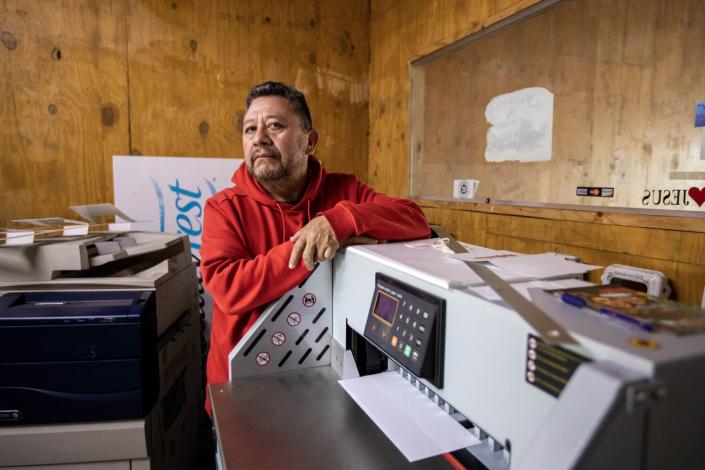
Print shop owner Carlos Pena is dealing with the damage caused by a SWAT raid after a fugitive holed up in his North Hollywood store. (Brian van der Brug /Los Angeles Times)For 13 years, Carlos Pena has run NoHo Printing & Graphics in North Hollywood. He has stayed here even as this stretch of Lankershim Boulevard became sketchier, even as the COVID-19 pandemic forced him to lay off all his employees. “It’s a very creative field of work, but not very profitable,” the Salvadoran immigrant told me half-jokingly as we walked inside his shop. “But it’s mine.” What was once the showroom was now stripped down to nails, plywood and beams. Industrial-sized air conditioner units and fans sat where display cases and T‑shirt racks once were, a reminder of the day last summer when Pena’s life changed forever
On Aug. 3 just after lunch, the 55-year-old was working on an order when he heard what sounded like a helicopter and someone on a megaphone. Pena opened the back door, looked toward the street and saw U.S. Marshals Service agents yelling and gesturing his way. Before he could shut the door, a man hit him on the shoulder with a metal object, kicked him out, then holed up inside.
YouTube footage shows marshals with heavy artillery and bulletproof vests taking positions around NoHo Printing and on nearby rooftops. They then stand down when Los Angeles Police Department SWAT vehicles roll into the parking lot behind the shop. Popping sounds soon give way to plumes of tear gas.
For 13 hours, Pena waited in a nearby restaurant as the standoff continued with someone the cops said was a fugitive. He waited so long that the restaurant eventually asked him to leave because it needed to close.
“It was like a movie,” said Pena, shaking his head, his voice world-weary. “Out of 10 million businesses, that stupid dude chose mine.”
Two days later, marshals let Pena return to NoHo Printing. Client projects were strewn across the floor. Holes were smashed into doors, walls and even the ceiling, which the fugitive climbed into by placing a ladder on a copier. He had somehow escaped.
“Look, look,” Pena kept repeating while swiping through photos on his smartphone. “This is a $9,000 printer that the fugitive stood on and broke.”
The worst part, he said, was the stench of tear gas. “You couldn’t be next to it for even a minute without gagging.”
No neighboring businesses suffered damage. Pena had to toss out all his materials — ink toners, vinyl rolls, packing materials. His landlord had to strip out all the drywall and insulation. The claim Pena filed with the U.S. Marshals Service stated that although the fugitive did destroy equipment, it was SWAT’s tear gas that left NoHo Printing “[un]inhabitable.”
A few years earlier, Pena had switched to a cheaper insurer, who said events like this weren’t covered under his policy. The L.A. city attorney’s office denied his claim in August with no explanation. The U.S. Marshals Service initially rejected his claim, saying he hadn’t asked for a specific amount. When he replied with a detailed invoice for about $60,000, the agency denied him again.
Though marshals had pursued the fugitive to NoHo Printing, they argued that LAPDSWAT had engaged in the standoff, not them. The certified letter ended by providing Pena with the LAPD’s address and the suggestion to “pursue your claim directly with” the department.
In response to my query, the U.S. Marshals Service said, “Our office cannot offer substantive comments regarding adjudication” of Pena’s claim. When I called up the LAPD’s media department to confirm details of the Aug. 3 raid, Officer Drake Madison suggested I file a public records request.
When I sent a list of questions about Pena’s case and also asked what the LAPD policy was when officers damage a business in the search for a suspect, LAPD Capt. Kelly Muniz replied that while Pena’s claims “are under consideration, we are unable to comment further.”
Pena had to toss out all his materials — ink toners, vinyl rolls, packing materials. His landlord had to strip out all the drywall and insulation. (Brian van der Brug /Los Angeles Times)
Since the U.S. Marshals Service and the LAPD wouldn’t give me any answers, I called up two people who would.
Attorney Arnoldo Casillas, who specializes in police misconduct, doesn’t see too many cases like Pena’s but considers them “my pro bono responsibility” because they are so hard to pursue.
LAPD Chief Michel Moore quickly apologized, but “they’re fighting tooth and nail to not pay anything,” Casillas said. “I’m not suggesting [Pena’s case] is at the same level, but $60,000 in damages is not a small amount.”
State and federal statutes “give police a certain amount of discretion” when pursuing suspects. “Some dishes are going to break,” he said, so the damage “has to be egregious to the point that it’s malicious.”
Pena’s claim with the U.S. Marshals Service stated that SWAT fired 31 tear gas canisters inside his shop, which sure sounds egregious to me.
It’s hard to get compensation without knowing the intricacies of the system — victims need to file a specific claim within six months of the incident and file it the right way, Casillas said.
“I’ve seen cases where a lawsuit is filed, and the police say they only received a complaint, not a claim, and the lawsuit can’t go anywhere. It’s a petty bulls— way getting around to not paying anything. They truly don’t care.”
Tanishia G. Wright, director of the L.A. County district attorney’s office’s Bureau of Victim Services, called Pena’s case “a very tricky one. … [LAPD] really put him at an extreme injustice for that.”
She said her office “luckily” doesn’t see many similar cases. It refers people to the California Victims Resource Center, which offers reimbursement for qualifying damages. Wright’s office has an unclaimed victim restitution fund, and “we can tap into that” to try to make up any difference, she said.
When I asked about the LAPD’s policy when officers damage the property of innocent people, Wright stayed silent.
“I can’t tell you,” she replied. “Honestly, I should know. I’m curious to know. We may have victims that might have these questions.”
Both Casillas and Wright offered to speak to Pena about his case.
Pena with one of the few machines not damaged during the Aug. 3 raid. (Brian van der Brug /Los Angeles Times)
Pena is enough of a neighborhood fixture that customers such as Eric Walter have tried to help him navigate the ordeal.
“In an ideal world, he should get compensation for lost revenue,” said Walter, a retired athletic director for the nearby Oakwood School who has been a customer for nearly a decade. “But at this point, he’d be happy just to get back to business.”
“My claim is going to be denied,” Pena said. His piercing blue eyes had a thousand-yard stare. “If that happens, I’m going to have to sell my house. My business is finally going to be dead.”
We walked to the back room, cluttered with messy cabinets, a desk and a tub of T‑shirts with an air-tight seal that saved it from the raid.
Pena now works from home, going to his shop only to use the two machines that survived the raid — a cutter, along with a copier that needs a $1,200 part he can’t afford.
His landlord is pursuing claims with the LAPD and an insurer and isn’t charging any rent in the meantime.
“Everyone else gets help,” Pena replied, referring to the recent bribery scandals that have plagued City Hall. “Look at all the money going around the city, and they can’t do anything to help?”
We now stood outside his storefront. A stenciled ad on his window offered a special: Anything printed on a T‑shirt for $6.50.
Pena let out a bitter laugh. It has been a rough couple of years. His father was suffering health issues. He lost his mother to COVID-19 in 2020, while he was battling the disease himself. Even though they were in the same hospital, doctors didn’t allow him to say goodbye.
“When doors are closed, they all shut down for you,” he said. “I’ve been going through hell and back. Everything is pouring down on me.”
Deputies accused of shoving guns in mouths of 2 Black men
Michael Corey Jenkins stands outside Taylor Hill Church in Braxton, Miss., March 18, 2023. The police shooting of Jenkins, who sustained critical injuries after he says a deputy put a gun in his mouth and fired, led the Justice Department to open a civil rights investigation into the Rankin County Sheriff’s Office. Deputies said Jenkins was shot after he pointed a gun at them. (AP Photo/HG Biggs) ASSOCIATEDPRESS
Several deputies from a Mississippi sheriff’s department being investigated by the Justice Department for possible civil rights violations have been involved in at least four violent encounters with Black men since 2019 that left two dead and another with lasting injuries, an Associated Press investigation found.
Two of the men allege that Rankin County sheriff’s deputies shoved guns into their mouths during separate encounters. In one case, the deputy pulled the trigger, leaving the man with wounds that required parts of his tongue to be sewn back together. In one of the two fatal confrontations, the man’s mother said a deputy kneeled on her son’s neck while he told them he couldn’t breathe.
Police and court records obtained by the AP show that several deputies who were accepted to the sheriff’s office’s Special Response Team — a tactical unit whose members receive advanced training — were involved in each of the four encounters. In three of them, the heavily redacted documents don’t indicate if they were serving in their normal capacity as deputies or as members of the unit.
Such units have drawn scrutiny since the January killing of Tyre Nichols, a Black father who died days after being severely beaten by Black members of a special police team in Memphis, Tennessee. Nichols’ death led to a Justice Department probe of similar squads around the country that comes amid the broader public reckoning over race and policing sparked by the 2020 police murder of George Floyd in Minneapolis.
In Mississippi, the police shooting of Michael Corey Jenkins led the Justice Department to open a civil rights investigation into the Rankin County Sheriff’s Department. Jenkins said six white deputies burst into a home where he was visiting a friend, and one put a gun in his mouth and fired. Jenkins’ hospital records, parts of which he shared with AP, show he had a lacerated tongue and broken jaw.
Deputies said Jenkins was shot after he pointed a gun at them; department officials have not answered multiple inquiries from the AP asking whether a weapon was found at the scene. Jenkins’ attorney, Malik Shabazz, said his client didn’t have a gun.
“They had complete control of him the entire time. Six officers had full and complete control of Michael the entire time,” Shabazz said. “So that’s just a fabrication.”
Rankin County, which has about 120 sheriff’s deputies serving its roughly 160,000 people, is predominantly white and just east of the state capital, Jackson, home to one of the highest percentages of Black residents of any major U.S. city. In the county seat of Brandon, a towering granite-and-marble monument topped by a statue of a Confederate soldier stands across the street from the sheriff’s office.
In a notice of an upcoming lawsuit, attorneys for Jenkins and his friend Eddie Terrell Parker said on the night of Jan. 24 the deputies suddenly came into the home and proceeded to handcuff and beat them. They said the deputies stunned them with Tasers repeatedly over roughly 90 minutes and, at one point, forced them to lie on their backs as the deputies poured milk over their faces. The men restated the allegations in separate interviews with the AP.
When a Taser is used, it’s automatically logged into the device’s memory. The AP obtained the automated Taser records from the evening of Jan. 24. They show that deputies first fired one of the stun guns at 10:04 p.m. and fired one at least three more times over the next 65 minutes. However, those unredacted records might not paint a complete picture, as redacted records show that Tasers were turned on, turned off or used dozens more times during that period.
The Mississippi Bureau of Investigation was brought in to investigate the encounter. Its summary says a deputy shot Jenkins at approximately 11:45 p.m., or about 90 minutes after a Taser was first used, which matches the timeframe given by Parker and Jenkins. The deputy’s name was not disclosed by the bureau.
Police say the raid was prompted by a report of drug activity at the home. Jenkins was charged with possessing between 2 and 10 grams of methamphetamine and aggravated assault on a police officer. Parker was charged with two misdemeanors — possession of paraphernalia and disorderly conduct. Jenkins and Parker say the raid came to a head when the deputy shot Jenkins through the mouth. He still has difficulty speaking and eating.
Another Black man, Carvis Johnson, alleged in a federal lawsuit filed in 2020 that a Rankin County deputy placed a gun into his mouth during a 2019 drug bust. Johnson was not shot.
There is no reason for an officer to place a gun in a suspect’s mouth, and to have allegations of two such incidents is telling, said Samuel Walker, emeritus professor of criminal justice at the University of Nebraska.
“If there are incidents with the same kind of pattern of behavior, they have their own set of rules,” he said. “So these are not just chance experiences. It looks like a very clear pattern.”
Jenkins doesn’t know the name of the deputy who shot him. In the heavily redacted incident report, an unidentified deputy wrote, “I noticed a gun.” The unredacted sections don’t say who shot Jenkins, only that he was taken to a hospital. Deputy Hunter Elward swore in a separate court document that Jenkins pointed the gun at him.
Elward’s name also appears in police reports and court records from the two incidents in which suspects were killed.
The sheriff’s department refused repeated interview requests and denied access to any of the deputies who were involved in the violent confrontations. The department has not said whether deputies presented a search warrant, and it’s unclear if any have been disciplined or are still members of the special unit.
The news outlet Insider has been investigating the sheriff’s department and persuaded a county judge to order the sheriff to turn over documents related to the deaths of four men in 2021. Chancery Judge Troy Farrell Odom expressed bewilderment that the department had refused to make the documents public.
“(The) day that our law enforcement officers start shielding this information from the public, all the while repeating, ‘Trust us. We’re from the government,’ is the day that should startle all Americans,” Odom wrote.
The AP requested body camera or dashcam footage from the night of the Jenkins raid. Jason Dare, an attorney for the sheriff’s department, said there was no record of either.
Mississippi doesn’t require police officers to wear body cameras. Incident reports and court records tie deputies from the raid to three other violent encounters with Black men.
During a 2019 standoff, Elward said Pierre Woods pointed a gun at him while running at deputies. Deputies then shot and killed him. In a statement to the Mississippi Bureau of Investigation obtained by the AP, Elward said he fired at Woods eight times. Police say they recovered a handgun at the scene of the Woods shooting.
Court records place Christian Dedmon, another deputy who shot at Woods, at the Jenkins raid.
Dedmon was also among deputies involved in a 2019 arrest of Johnson, according to the lawsuit Johnson filed alleging that one of the deputies put a gun in his mouth as they searched him for drugs. Johnson is currently imprisoned for selling methamphetamine.
Other documents obtained by the AP detail another violent confrontation between Elward and Damien Cameron, a 29-year-old man with a history of mental illness. He died in July 2021 after being arrested by Elward and Deputy Luke Stickman, who also opened fire on Woods during the 2019 standoff. A grand jury declined to bring charges in the case last October.
In an incident report, Elward wrote that while responding to a vandalism call, he repeatedly shocked Cameron with a Taser, punched and grappled with Cameron at the home of his mother, Monica Lee. He said after getting Cameron to his squad car, he again stunned him to get him to pull his legs into the vehicle.
After going back inside to retrieve his Taser, deputies returned to find Cameron unresponsive. Elward wrote that he pulled Cameron from the car and performed CPR, but Cameron was later declared dead at a hospital.
Lee, who witnessed the confrontation, told the AP that after subduing her son, Elward kneeled on his back for several minutes. She said when Stickman arrived, he kneeled on her son’s neck while handcuffing him, and that her son complained he couldn’t breathe.
Lee said she later went outside, hoping to talk to her son before the deputies drove him away.
“I walked outside to tell him goodbye and that I loved him, and that I would try to see him the next day. That’s when I noticed they were on the driver’s side of the car doing CPR on him,” Lee said. “I fell to the ground screaming and hollering.”
We use cookies on our website to give you the most relevant experience by remembering your preferences and repeat visits. By clicking “Accept All”, you consent to the use of ALL the cookies. However, you may visit "Cookie Settings" to provide a controlled consent.
This website uses cookies to improve your experience while you navigate through the website. Out of these cookies, the cookies that are categorized as necessary are stored on your browser as they are essential for the working of basic functionalities of the website. We also use third-party cookies that help us analyze and understand how you use this website. These cookies will be stored in your browser only with your consent. You also have the option to opt-out of these cookies. But opting out of some of these cookies may have an effect on your browsing experience.
Necessary cookies are absolutely essential for the website to function properly. This category only includes cookies that ensures basic functionalities and security features of the website. These cookies do not store any personal information.
Any cookies that may not be particularly necessary for the website to function and is used specifically to collect user personal data via analytics, ads, other embedded contents are termed as non-necessary cookies. It is mandatory to procure user consent prior to running these cookies on your website.