Sheesh…

mb
mb

You may have noticed that from time to time I argue that the police can do a bet­ter job despite the myr­i­ad prob­lems of want which seem to char­ac­ter­ize the force.
Oh we can’t do our jobs because we want this and we want that.
Whatever!!!
Some of the small­est issue becomes mam­moth prob­lems sim­ply because the police are sim­ply too stu­pid to do the sim­ple things .
I refer here to a report in one of the Jamaican dai­ly papers on Thursday May 26th 2016.
Roughly 17 per cent of the almost 800 street lights that were installed less than a year ago at a cost of $248.5 mil­lion along the 17-kilo­me­tre cor­ri­dor, which runs from the Sangster International Airport round­about to Lilliput, were out of ser­vice because speed­ing motorists are crash­ing into them.

According to the National Works Agency spokesper­son a deci­sion was tak­en to recov­er the cost of the dam­age from the insur­ance of the cul­pa­ble motorists.
A series of mea­sures were also insti­tut­ed which includ­ed the instal­la­tion of rum­ble strips as well as ceram­ic road markings .
Read sto­ry here : http://​www​.jamaicaob​serv​er​.com/​w​e​s​t​e​r​n​n​e​w​s​/​L​i​g​h​t​s​-​o​u​t​_​6​1​973

I real­ly don’t want to talk too much about this rather sim­ple issue which seem to be cre­at­ing heart­burn for the NWA, the Police , the Utility com­pa­ny and oth­er stake hold­ers at this so called “Elegant corridor”.
According to those inter­viewed includ­ing a police offi­cer who does not want to be named “the num­ber of acci­dents on this par­tic­u­lar strip is frightening.”

So there you have it !!!
Here is a clas­sic exam­ple of small total­ly man­age­able blis­ters being allowed to fes­ter until they become huge sores even­tu­al­ly requir­ing amputation .
According to the police they will con­cen­trate more patrols in the area.
Wrong solution.
This does not require patrols what it requires is police traf­fic units sta­tioned there with radar guns . Make the speed­ers become a source of rev­enue , the coun­try needs the revenue.
Two real­ly sim­ple proposals.
(1) Static Police units round the clock and make the strip a tick­et bonanza.
(2) Adjust the road traf­fic fines and oth­er puni­tive mea­sures. Offenders dri­ving at a cer­tain rate of speed and repeat offend­ers lose their licence for a cer­tain peri­od of time.
Impound their vehi­cles and levy painful fines for the recov­ery of their return. Make the monies derived from those fines avail­able to improv­ing law enforce­ment capa­bil­i­ties. They will get the mes­sage when you hit them in their pock­et­books, it’s a great source of rev­enue and it saves lives.
This is a eco­nom­ic bonan­za for tow­ing com­pa­nies around the area and more rev­enue for the nation’s coffers .
If peo­ple decide they want to con­tin­ue on a path of law­less­ness the nation must make sure that their activ­i­ties come at tremen­dous cost .
Problem solved , you may now take this sim­ple strat­e­gy nationwide.
Sheeesh!!!

Judge Finds Baltimore Police Officer Not Guilty In Death Of Freddie Gray

Baltimore Police Officer Edward Nero was found not guilty on Monday for his alleged role in the death of 25-year-old Freddie Gray a year ago.

Nero, 30, was fac­ing mis­de­meanor charges of sec­ond-degree assault and two counts of mis­con­duct in office for his part in Gray’s arrest. He was also charged with reck­less endan­ger­ment for shack­ling Gray and plac­ing him in a police van with­out buck­ling his seat­belt. He plead­ed not guilty to all charges.

Nero is the sec­ond of six offi­cers to stand tri­al in con­nec­tion to the death of Gray, a black man who sus­tained a fatal spinal cord injury in police cus­tody on April 12, 2015. Gray died from his injuries a week lat­er, on April 19, spark­ing city­wide protests against police bru­tal­i­ty. After his funer­al on April 27, the unrest inten­si­fied — res­i­dents loot­ed stores and set fires, and pro­test­ers threw rocks and oth­er items at police lines.

Baltimore Police Officer William Porter was the first to stand tri­al, in December, but the jury could not reach a ver­dict. Unlike Porter, Nero opt­ed for a bench trial.

Some res­i­dents, accord­ing to a local Fox affil­i­ate, won­dered if the reac­tion to Nero’s ver­dict would be as intense as that to Gray’s funeral.

It just comes down to, you don’t want anoth­er out­break of peo­ple loot­ing and what­not,” Andrew Murphy, a Baltimore res­i­dent, told Fox 5 DC. “Hopefully it comes to a peace­ful resolve.”

Rep. Elijah Cummings (D‑Md.) asked res­i­dents on Friday to put aside their per­son­al feel­ings and hon­or the verdict.

The future of our com­mu­ni­ty will not be defined at the moment of the ver­dict, but in the days and years that will fol­low,” Cummings said dur­ing a press con­fer­ence.

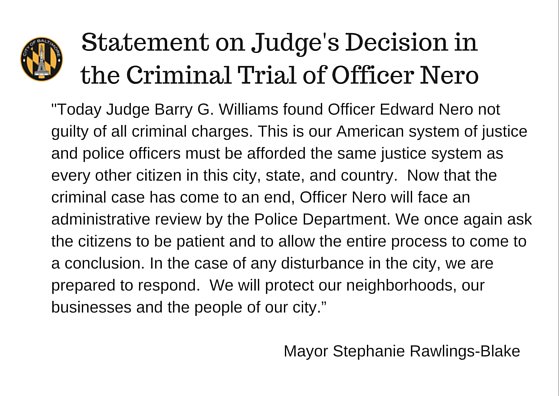
Baltimore Mayor Stephanie Rawlings-Blake also released a state­ment ask­ing res­i­dents to keep the peace.

The Baltimore Police Department beefed up secu­ri­ty around the cour­t­house in prepa­ra­tion for the verdict.

Although the crim­i­nal case against Officer Edward Nero has come to a close, the inter­nal inves­ti­ga­tion has not. With that, Officer Nero’s sta­tus will remain unchanged. He will remain in an admin­is­tra­tive capac­i­ty while this inves­ti­ga­tion con­tin­ues,” the depart­ment stat­ed in a release. “The inter­nal inves­ti­ga­tion is being han­dled by oth­er police depart­ments. The inter­nal inves­ti­ga­tion will not be com­plet­ed until all of the crim­i­nal cas­es against the oth­er five offi­cers are com­plet­ed because they will like­ly be wit­ness­es in each case.” http://​www​.huff​in​g​ton​post​.com/​e​n​t​r​y​/​e​d​w​a​r​d​-​n​e​r​o​-​v​e​r​d​i​c​t​-​f​r​e​d​d​i​e​-​g​r​a​y​_​u​s​_​5​7​4​2​1​8​e​7​e​4​b​0​0​e​0​9​e​8​9​f​5​4​6​c​?​u​t​m​_​h​p​_​r​e​f​=​p​o​l​i​t​ics

One Thousand Dead Or Anything Close Is Way Too Many Dead Jamaicans

1725162_10205433897906528_7234427120561380515_n

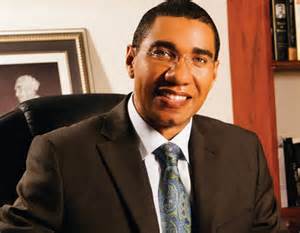
Opposition leader Andrew Holness
Andrew Holness PM
I am going to hold the commissioner to account for bringing that murder rate to below 1,000, and I am going to hold the minister (of national security) for putting in place the policy and supporting the commissioner. I also have to appeal to the conscience of Jamaicans, to that young man in the inner city, to say yes, I know you feel as if you have no stake in Jamaica but I want you to understand that you have a prime minister that believes in you and will put the programs in place for you to help you to make that change in your life,” Holness said Tuesday night.
“You will understand that you have a prime minister that will own the issues, that will deal with the issues, not back away from the issues, not try to pass the buck.

The prime Minister uttered those words as he addressed the third in a series of island­wide town hall meet­ings, host­ed by the secu­ri­ty min­is­ter, at the Montego Bay Cultural Centre in Sam Sharpe Square, Montego Bay.

National Security Minister Robert Montague urged those who do not wish the commissioner to succeed in the fight against crime to come and see him.
National Security Minister Robert Montague urged those who do not wish the com­mis­sion­er to suc­ceed in the fight against crime to come and see him.

According to the police and as was report­ed in the Jamaican press, mur­ders stood at 1,207, which was 202, more than the 1,005 report­ed the pre­vi­ous year. The high­est num­ber of homi­cides ever report­ed to police was in 2005 when over 1600 peo­ple were report­ed murdered.

The Prime Minister did not announce any spe­cif­ic ini­tia­tive he would under­take out­side his gen­er­al inten­tion to hold him­self and oth­ers accountable.
The new Prime Minister referred to him­self as the chief account­ing offi­cer for the Government yet what I per­son­al­ly would have liked to hear from him are con­cise strate­gies which he would pur­sue which would enable the Minister and Commissioner to car­ry out their mandates.

Yes , yes I know it’s the Minister’s remit to deal with pol­i­cy minu­tia, but any pol­i­cy ini­tia­tive to be under­tak­en bears more weight if it is announced and sup­port­ed by the chief exec­u­tive offi­cer of the country.

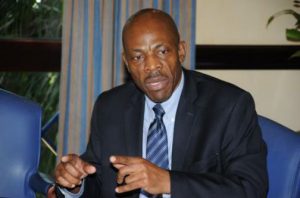
Commissioner of Police Dr Carl Williams

These Town Halls can be a good lis­ten­ing tour , they may also be an edu­ca­tion­al tour to sen­si­tize peo­ple that the old ways of doing things are no longer sustainable.
Every Jamaican opposed to crime is a stake-hold­er who must be edu­cat­ed in the many ways crime is reduc­ing the qual­i­ty of their lives, if not tak­ing their lives alltogether.
The Prime Minister has not equiv­o­cat­ed on any of the pol­i­cy deci­sions he has announced in his stat­ed goal to turn the Island from pover­ty to a path of prosperity.
Yet he is naïve at best if he believes he can waf­fle on crime and expect the pros­per­i­ty he speak of to hap­pen in the atmos­phere of dai­ly blood­shed which present­ly exist.

The Prime Minister can only expect pos­i­tive result from the peo­ple to whom the con­sti­tu­tion del­e­gates the respon­si­bil­i­ties of min­is­ter of nation­al secu­ri­ty and chief con­sta­ble if he as the chief exec­u­tive ensures that they are giv­en the tools with which to get the job done.
Words are just that , “words”. The Prime Minister is in the best posi­tion of any Jamaican to do some­thing about crime, his par­ty has the major­i­ty in the 63 seat legislature .
This is the time to draft tough anti crime leg­is­la­tion and table it in the Parliament, use the media to sell the plan and if the oppo­si­tion does not want to sign on then let them sign their death war­rant as the par­ty which sup­port crim­i­nals on the Island.

This can be a zero sum game , draft a tough anti-crime bill and dare them to oppose it which is their right to do but if they do they own the issue .
Asking the Commissioner of police to hold homi­cides to a num­ber tol­er­a­ble to the Prime Minister is not a nation­al secu­ri­ty pol­i­cy, it is a cop out . Without tough back­ing it is giv­ing the Commissioner bas­ket to car­ry water.
At the same time the offi­cer corps of the police force can stop being lap­dogs and grow some balls.
Why are they not demand­ing from the admin­is­tra­tion the tools to do their jobs?
Where is the fed­er­a­tion in demand­ing the leg­is­la­tion nec­es­sary to bring crime under control?

Obviously the Prime Minister can live with the high homi­cide rate as long as it’s under a thou­sand dead Jamaicans , the Jamaican peo­ple and the police should accept no such arrangement.

Jamaica To Get German Help To Develop National Park

Blue Mountains (file photo)
Blue Mountains (file photo)

KINGSTON, Jamaica (JIS) — Jamaica is to ben­e­fit from the tech­ni­cal exper­tise of a team from Germany to devel­op the Blue and John Crow Mountains National Park.

The team is from the Bavarian Forest National Park, locat­ed in south-east­ern Germany, which has utilised the con­cept of com­mu­ni­ty tourism to dri­ve socio-eco­nom­ic devel­op­ment. The Jamaica Conservation and Development Trust (JCDT), which man­ages the Blue and John Crow Mountains National Park, is seek­ing to part­ner with the Bavarian Forest National Park to imple­ment this approach. Speaking at a JCDT work­shop at the Hotel Four Seasons in Kingston on May 19, Director of the Visitor Centre at the Bavarian Forest National Park, Christian Binder, said the team is look­ing for­ward to work­ing with the JCDT to explore the “many oppor­tu­ni­ties to devel­op the nature park.”

Binder and the Manager for Tourism at the Bavarian Forest National Park, Erik Aschenbrand, are in Jamaica shar­ing rel­e­vant infor­ma­tion with sev­er­al stake­hold­ers, includ­ing Maroon communities.

During the work­shop, themed: ‘National Parks as Drivers for Socio-eco­nom­ic Development and Nature Conservation’, the team pro­vid­ed advice on how local com­mu­ni­ties could repli­cate the expe­ri­ences of Germany’s nation­al park.

In the mean­time, Minister with­out Portfolio in the Ministry of Economic Growth and Job Creation, Hon. Daryl Vaz, wel­comed the part­ner­ship, not­ing that Jamaica is “hop­ing to fol­low the lead” of the Bavarian Forest National Park.

We look for­ward to a con­tin­ued work­ing rela­tion­ship and hope­ful­ly we can dupli­cate, on a small­er scale, what (you have accom­plished),” he said.

Vaz said the Blue and John Crow Mountains inscrip­tion on the United Nations Educational, Scientific and Cultural Organization (UNESCO) World Heritage List opens up new socio-eco­nom­ic oppor­tu­ni­ties for com­mu­ni­ties in and around the site.

He added that the Blue and John Crow Mountains National Park could become a prime area for busi­ness and income gen­er­a­tion through the devel­op­ment of var­i­ous tourist attractions.

The park presents a high val­ue mar­ket tourism oppor­tu­ni­ty which would be sup­port­ed by the devel­op­ment of envi­ron­men­tal­ly friend­ly attrac­tions. These could include a zipline, pic­nic areas, nature trails, off-road tours and sem­i­nars on the bio­di­ver­si­ty, includ­ing indige­nous plants (as well as) cave explo­ration,” the Minister said.

Vaz not­ed that the park also pro­vides count­less oppor­tu­ni­ties for his­tor­i­cal, cul­tur­al and nat­ur­al research, par­tic­u­lar­ly in nutraceuticals.

The work­shop was held in asso­ci­a­tion with the Caribbean Aqua-Terrestrial Solutions (CATS) Project, which is oper­at­ed by the German Development Coöperation and the Caribbean Public Health Agency on behalf of the German Federal Ministry for Economic Coöperation and Development and the Caribbean Community.

The CATS project is also fund­ing the work­shops and activ­i­ties asso­ci­at­ed with the prepa­ra­tion of an updat­ed man­age­ment plan for the nation­al park and World Heritage site. http://​www​.jamaicaob​serv​er​.com/​n​e​w​s​/​J​a​m​a​i​c​a​-​t​o​-​g​e​t​-​G​e​r​m​a​n​-​h​e​l​p​-​t​o​-​d​e​v​e​l​o​p​-​n​a​t​i​o​n​a​l​-​p​ark

Murdered: Anti-Government Protestor Seen Being Beaten And Stomped Has Died In Hospital.…

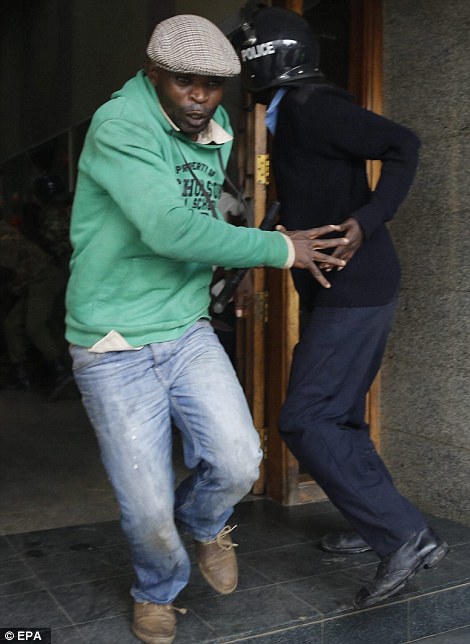
The male pro­test­er who was seen being bru­tal­ly beat­en by Kenyan riot police dur­ing a protest in Nairobi on Monday, has died in hos­pi­tal. The unnamed man was pic­tured flee­ing from a build­ing as a police­man in riot gear first beat him with a wood­en baton, before fol­low­ing him into the street, kick­ing him as he lay on the ground, before appear­ing to stamp on his head. Shocking scenes of vio­lence erupt­ed on Monday as police fired tear gas to break up demon­stra­tions urg­ing elec­toral reforms ahead of the gen­er­al elec­tions next year.  http://​www​.dai​ly​mail​.co​.uk/​n​e​w​s​/​a​r​t​i​c​l​e​-​3​5​9​4​9​4​4​/​A​n​t​i​-​g​o​v​e​r​n​m​e​n​t​-​p​r​o​t​e​s​t​e​r​-​s​e​e​n​-​k​i​c​k​e​d​-​s​t​a​m​p​e​d​-​K​e​n​y​a​n​-​r​i​o​t​-​p​o​l​i​c​e​-​p​h​o​t​o​g​r​a​p​h​s​-​s​h​o​c​k​e​d​-​w​o​r​l​d​-​d​i​e​d​-​h​o​s​p​i​t​a​l​.​h​tml 

The man is seen running out of a building as he is chased by baton-wielding police officers during a protest staged by supporters of the opposition Coalition for Reforms and Democracy (CORD) against Independent Electoral and Boundaries Commission (IEBC) in downtown Nairobi, Kenya Read more: http://www.dailymail.co.uk/news/article-3594944/Anti-government-protester-seen-kicked-stamped-Kenyan-riot-police-photographs-shocked-world-died-hospital.html#ixzz48wiIS1QZ Follow us: @MailOnline on Twitter | DailyMail on Facebook
The man is seen run­ning out of a build­ing as he is chased by baton-wield­ing police offi­cers dur­ing a protest staged by sup­port­ers of the oppo­si­tion Coalition for Reforms and Democracy (CORD) against Independent Electoral and Boundaries Commission (IEBC) in down­town Nairobi, Kenya.

343E25AE00000578-0-image-m-47_1463495017158

The Lie Surrounding The Death Penalty.……

mb
mb

One of the things peo­ple who believe in the rule of law has allowed the crim­i­nal cod­dling bleed­ing-heart talk­ing heads to get away with is the con­tin­ued lie that “the death penal­ty is not the answer”.
The peo­ple who acqui­esce to crim­i­nal con­duct have done a ter­rif­ic job of mis­in­form­ing the pub­lic on why we should do noth­ing about the scourge of crime because crime is def­i­nite­ly a prod­uct of pover­ty, inequal­i­ty and want. This bunch of cocka­mamie has been allowed to stand because those of us who have fought in the trench­es against mur­der­ers rapists and thieves know quite well that there is pre­cious lit­tle truth to those assertions.
So before we pro­ceed fur­ther lets ask the ques­tion ” The death penal­ty is not the answer to what ?

Jamaicans always want­i­ng to show the world just how advanced they are has con­sis­tent­ly been on the fore­front of these con­ver­sa­tions regard­ing the death penal­ty . Unfortunately Jamaica has one of the high­est per-capi­ta mur­der rates in the entire world. In the year 2005 Jamaica peaked as the coun­try with the high­est mur­der rate on plan­et earth. Since then the homi­cide num­bers has sub­sided some but have remained ter­ri­fy­ing­ly high when com­pared to the rest of the world, includ­ing coun­tries active­ly engaged in civ­il wars./
So the debate rages and the prog­nos­ti­ca­tors con­tin­ue to make the false argu­ment that “the death penal­ty is not the answer” .
Hence my ques­tion to that mis­lead­ing pre­sump­tion, “not the answer to what”?
Recently one Jamaica prog­nos­ti­ca­tor wrote an exhaus­tive Article in the Jamaica Daily Gleaner titled “The death penal­ty is not the answer!
In the Article he cit­ed research data from the United States a nation which active­ly and vig­or­ous­ly track and pun­ish crim­i­nals to the full extent of the law.
A mas­sive nation of 308 mil­lion peo­ple with the death penal­ty still being enforced today in the major­i­ty of the fifty (50) states.

He argued that A study performed in the United States of America in 2008 found that 88 per cent of the nation’s leading criminologists did not believe that the death penalty is an effective deterrent. Subsequently, a report released in 2012 by the National Research Council of the National Academies, based on a review of more than three decades of research, concluded that studies claiming a deterrent effect on murder rates from the death penalty are fundamentally flawed.
The report read: “The committee concludes that research to date on the effect of capital punishment on homicide is not informative about whether capital punishment decreases, increases, or has no effect on homicide rates. Therefore, the committee recommends that these studies not be used to inform deliberations requiring judgments about the effect of the death penalty on homicide.”
Indeed, in that country, states that have death-penalty laws do not have lower crime or murder rates than states without such laws, and states that have abolished capital punishment show no significant changes in either crime or murder rates.
Apart from the absence of convincing evidence demonstrating deterrence, capital punishment presents several other issues. The death penalty violates the right to life. When a person takes the life of another, one may claim that they have forfeited their right to live, a view held by many.
Unfortunately, the death penalty is also discriminatory, and is often used against the most vulnerable in society, including the poor, the illiterate and people with mental disabilities.
http://​jamaica​-glean​er​.com/​a​r​t​i​c​l​e​/​c​o​m​m​e​n​t​a​r​y​/​2​0​1​6​0​5​1​6​/​m​i​c​h​a​e​l​-​a​b​r​a​h​a​m​s​-​d​e​a​t​h​-​p​e​n​a​l​t​y​-​n​o​t​-​a​n​s​wer

In the United States any­one may com­mis­sion a report to say any­thing he/​she wants. I may com­mis­sion a report which will bol­ster my claim that the sky is green instead of blue. One sim­ply needs moti­va­tion and money.
So when a report comes out mak­ing a cer­tain claim the very first ques­tion which must be asked is, who com­mis­sioned that report?
Most reports are tai­lored to sup­port the point of view of those who com­mis­sioned said report.
To some­one liv­ing out­side the United States it may appear that such research data are irrefutable gospel, to oth­ers they are junk science .
The data to which the writer refers and to which the lib­er­al blue states with­in the United States sub­scribe is indeed a ter­rif­ic met­ric that the death penal­ty does work.
Those blue states in which the death penal­ty is not prac­ticed are the most vio­lent states with the high­est mur­der rates and indeed the states in which the most vio­lent crimes are committed.

It’s impor­tant to note that even in the states where the death penal­ty is not prac­ticed there are tough non-lethal laws such as the Rico statutes, as well as oth­ers like the Rockefeller three strikes laws in New York State which effec­tive­ly removes crim­i­nals from the streets for good where they may not harm inno­cent peo­ple anymore.
It’s is naïveté’and or mali­cious to use sta­tis­tic gleaned from a coun­try like the United States to make an argu­ment for Jamaica in which law enforce­ment is large­ly non-exis­tent and where the laws actu­al­ly are geared toward the pro­tec­tion of crim­i­nals at the expense of the innocent.

Many of the homi­cides in Jamaica are being com­mit­ted by offend­ers who have mul­ti­ple killings under their belt. In fact killing has become so fash­ion­able it is a part of the pop culture.Young men are revered for “mak­ing dup­py” a col­lo­qui­al term for some­one who has tak­en human life.
Many have killed over a dozen peo­ple and have paid no price for their actions.
If these men are caught, tried and exe­cut­ed how can any­one make the argu­ment that their demise has no impact on crime when they have no pos­si­bil­i­ty of return­ing to kill again?

The argu­ments about the way the death penal­ty as it is being applied in the United States are argu­ments which goes to fair­ness, the equi­table and just appli­ca­tion of the law and not the death penal­ty itself.
Those con­ver­sa­tions are not argu­ments against the death penal­ty, they ought to be about deal­ing with racism and inequal­i­ty wher­ev­er they may exist,.
How does one know what the mur­der fig­ures would be in Texas a state in which the death penal­ty is car­ried out with utter dis­patch? Could be much high­er , or not!
Conversely how does one know what the mur­der fig­ures would be in New York a lib­er­al state in which the death penal­ty is not used?Could be low­er or not!
The answer is that no one knows.
So when we argue that the death penal­ty does not work , lets estab­lish that it does work against those who would kill over and over as is the case in Jamaica where there are so many mass mur­der­ers walk­ing the streets with no fear of ever being held accountable.

It’s about time some­one push back against that lib­er­al lie .
The death penal­ty is not a panacea to stomp­ing out crime, noth­ing is .The real­i­ty is that it’s one more tool in the tool-box which should nev­er be discarded.
As a famous General once said “when you go to war take all your weapons , use them and go home” (Colin Powell, for­mer chair­man of the joint chiefs and for­mer sec­re­tary of state of the United States of America).
I am tired of the grand­stand­ing and the pos­tur­ing on crime by arm­chair gen­er­als and key-board prog­nos­ti­ca­tors whom have nev­er faced the busi­ness end of a gun.

The Jamaica Human Rights Gravy Train.……

mb
mb
Remarkably ‚as the killings continue in Jamaica the very same old hustlers move around like deck chairs on the sinking Titanic to “eat a food”.
Our country has always been a nation of hustlers God bless us . ‘I guess the safest thing to do with the criminals in Jamaica is to join them if you can’t beat them.
Frankly if I had my way of really fixing this Jamaican crime situation my approach would land me in the Hague.

How many groups are there now that have sprung up over the years sup­pos­ed­ly ded­i­cat­ed to the cause of human rights? Seriously this is big busi­ness almost as big as the funer­al par­lor busi­ness, extor­tion and the legal crim­i­nal defense industry.
I seri­ous­ly can­not name them ‚Amnesty International is there, Jamaicans for jus­tice, fam­i­lies against state ter­ror­ism, the inter American coun­cil on human rights, the peace man­age­ment unit and on and on .….
I seri­ous­ly haven’t begun to scratch the sur­face, it’s a major busi­ness crime defense is, fun­ni­ly they bitch and com­plain when their sor­ry crim­i­nal lov­ing behinds get turned around when they try to vis­it oth­er islands.

Horace Levy
Horace Levy

If these cheap hus­tlers spent a frac­tion of the ener­gy they expend in defend­ing crim­i­nals into edu­cat­ing them to obey the laws and help­ing law enforce­ment what a real par­adise the Island would be.
Carolyn Gomes had her fling at it, in the end she walked away with incred­i­ble fame and a National hon­or to boot.
In 2008, Gomes received the pres­ti­gious United Nations Prize in the Field of Human Rights…
Not want­i­ng to miss an oppor­tu­ni­ty to hon­or those who active­ly enhances the cause of crim­i­nals on the Island the Government bestowed on her the Order of Jamaica.
Carolyn Gomes would lat­er resign in dis­grace after the crim­i­nal sup­port­ing Agency JFJ she head­ed inap­pro­pri­ate­ly dis­trib­uted homo­sex­u­al and oth­er sex­u­al­ly explic­it mate­ri­als to a num­ber of pri­vate chil­dren’s homes.

Carolyn Gomes
Carolyn Gomes

So much for those awards , they were nev­er worth crap anyway.
As for the Order of Jamaica those are hand­ed out to polit­i­cal hacks, friends and par­ty loyalists.

It’s true you can’t make this stuff up, most of these black run nations all oper­ate much the same way, under­neath the thin lay­er of veneer, (like that which exist in Jamaica) they are no bet­ter than the despots in sub-Saharan Africa.

Before her Flo O’Connor made a name for her­self all at help­ing out the lit­tle folks and ah yes, keep­ing a watch­ful eye on the evil Babylon”.
It’s a fool who does the same thing while expect­ing a dif­fer­ent result. If demo­niz­ing police and cozy­ing-up to crim­i­nals has­n’t brought an end to the blood-shed since the 70’s why would they still believe that approach will work today.

It’s remark­able how they all start off demo­niz­ing the police, nev­er speak­ing out against the vile crea­tures who cal­lous­ly take life with unre­strained barbarism.
Horace Levy weaseled his way to the feed­ing trough pre­tend­ing to be a peace-mak­er as head of the so-called Peace-man­age­ment unit.
Such irony , what would they do if the idiots who kill each oth­er over pol­i­tics or turf or what­ev­er rea­sons they kill each oth­er for , sim­ply stop ?
What would these par­a­sit­i­cal vul­tures do ?

Earl Witter
Earl Witter

Am I say­ing that Human Rights advo­ca­cy is a nui­sance or not a noble endeav­or? I believe most peo­ple who know me will read­i­ly say of course not !
What I believe how­ev­er is this.
There are no greater human rights than the right to life , lib­er­ty and the abil­i­ty to be secure in one’s per­son. I also believe one of the great­est imped­i­ment to those aspi­ra­tions of any peo­ple is the con­stant threat of vio­lent death by maraud­ing killers who have absolute­ly no regard for the sanc­ti­ty of life much less any­thing else.
On that basis soci­ety must cor­ral those sav­ages using all avail­able means.

Getting caught up in the fin­ery of advanced soci­eties which years pre­vi­ous did the hard work of lay­ing the ground-work for their sta­ble soci­eties is stu­pid­i­ty and” fal­la fashin”, (good old Jamaican vernacular).
The val­ue sys­tem which rules Jamaica has brought immense hard­ships to the Island, its time to dis­card the ide­ol­o­gy which comes out of that place up in Mona , the ide­ol­o­gy which gets con­sum­mat­ed in the lit­tle Kiwanis and Rotary clubs where they get to act out their fan­tasies as they com­mu­ni­cate in alien accents.
Most Jamaicans do not live that way, and do not even have access to these lit­tle enclaves of the pen­ny mil­lion­aire elit­ist class.
Yet they are the ones dying in num­bers while the self appoint­ed elites act as lord supe­ri­or over the peasantry .
It’s time for this to come to an end.…..

Unions Strong-arm Tactics ‚extortion, And Uppity Attitudes Drove Out Businesses :now Jamaicans Talk Boycott.…

mb
mb

We can speak on political issues without being partial or disagreeable, however we all know some people are incapable of doing either. What we cannot change however are historical data which bear out the truth.
Jamaica experienced it’s greatest period of economic growth in the 60’s after Independence under the leadership of Hugh Lawson Shearer. However the pressing and stubborn problem of land distribution among the population remained a significant issue then.
According to http://​coun​trys​tud​ies​.us/​c​a​r​i​b​b​e​a​n​-​i​s​l​a​nds, Chronic unemployment and recession coexisted with high inflation during the 1970s, causing stagflation. Unemployment averaged roughly 25 percent during the 1975 – 85 period, affecting women and urban youth the hardest. The country also faced rapid urbanization as economic opportunities in rural areas deteriorated.
Carreras property was placed on the market for $395m...
Carreras prop­er­ty was placed on the mar­ket for $395m…

During the 1960’s Jamaica’s man­u­fac­tur­ing sec­tor was a bee-hive of activ­i­ty, the coun­try lit­er­al­ly had a fac­to­ry which pro­duced lit­er­al­ly every­thing we need­ed as a nation. The entire Twickenham Park area was a ver­i­ta­ble indus­tri­al com­plex not to men­tion the new­port-east and new­port west facil­i­ties which churned out prod­ucts much the same way China does today on a larg­er scale.
Had Jamaica main­tained the mech­a­nisms which ini­ti­at­ed that peri­od of man­u­fac­tur­ing and indus­tri­al growth the con­ver­sa­tion we would be hav­ing today would be envi­ron­men­tal not economical.

Unfortunately despite the gains of the 60’s the peo­ple allowed them­selves to be con­vinced that their lives were hor­ri­ble and they need­ed a change .The pop­u­lar nar­ra­tive was that “bet­ter must come”. The fact of the mat­ter is that at that time Jamaicans expe­ri­enced a far bet­ter stan­dard of liv­ing that their coun­ter­parts in Latin and Central America as well as their Caribbean neigh­bors in Trinidad and Tobago Barbados and the others.
What hap­pened to the peri­od of rel­a­tive pros­per­i­ty of the 60’s and the sense of well-being Jamaicans expe­ri­enced dur­ing the Shearer Years?
Beginning in the mid-1970s, infla­tion was gen­er­al­ly dou­ble-dig­it, caused pri­mar­i­ly by the increase in world oil prices, expan­sion­ary fis­cal poli­cies, and entrenched labor unions. Chronic unem­ploy­ment and reces­sion coex­ist­ed with high infla­tion dur­ing the 1970s, caus­ing stagfla­tion. Unemployment aver­aged rough­ly 25 per­cent dur­ing the 1975 – 85 peri­od, affect­ing women and urban youth the hardest.(country stud­ies us.)

How did a coun­try set on the right course after it’s inde­pen­dence gets so dan­ger­ous­ly off course? The answer to that ques­tion may be sim­pler than we imagine .
POLITICS !!!
Both polit­i­cal par­ties have brought some degree of ruina­tion and squashed the dream of our peo­ple, but there are vary­ing degrees of cul­pa­bil­i­ty and pro­por­tion­al blame to go around.
Well lets here from the peo­ple who actu­al­ly know, let them tell it. Here’s PNP Councillor Vanesha Phillips..

People’s National Party (PNP) councillor Venesha Phillips
People’s National Party (PNP) coun­cil­lor Venesha Phillips
We have not really been true to the cause because self-worth and pride have been gutted from our people and deliberately so.“Our people today are not recipients of empowerment but instead they have become pawns used in the games by those who wish to create the PNP that they want to exist in,”. “… Instead of empowering them… we use money as a weapon and we have brought our people to their knees just so we can establish our own cause,”

Well there you have it.….…

THE LITTLE ISSUE OF TRADE WARS AND PRODUCT BOYCOTT

Jamaicans have been stew­ing about the treat­ment about our nation­als when they vis­it oth­er Caribbean com­mu­ni­ty Islands (CARICOM). According to CARICOM rules nation­als with­in the com­mu­ni­ty should have free access to oth­er Islands .
At the cen­ter of the dis­qui­et among Jamaicans is what they char­ac­ter­ize as the shod­dy treat­ment they receive when they attempt to tra­verse the Caribbean com­mu­ni­ty as allowed by the CARICOM treaty.

Member states so accused points to crimes alleged­ly being com­mit­ted in their coun­tries by Jamaicans resid­ing in their coun­try . Additionally they com­plain about Jamaicans over­stay­ing their wel­come when they vis­it and in many cas­es arriv­ing in their coun­tries with­out any means of sup­port­ing them­selves and sub­se­quent­ly becom­ing a bur­den to their host coun­tries. Other Caribbean Islands have also barred Jamaican reg­gae enter­tain­ers from their ter­ri­to­ries for what they char­ac­ter­ize as the vio­lent con­tent of their music lyrics(murder music).
In November 2013, it was esti­mat­ed that 16,958 Jamaicans could be resid­ing ille­gal­ly in Trinidad & Tobago, as accord­ing to the records of the Office of the Chief Immigration Officer, their entry cer­tifi­cates would have since expired. By October 2014, it was esti­mat­ed that the num­ber of Jamaicans resid­ing ille­gal­ly in Trinidad and Tobago had reached a record 19,000.

In recent times the ten­sion between Jamaica and it’s neigh­bors Barbados and in par­tic­u­lar Trinidad and Tobago has been ratch­eted up over what Jamaicans claim are repeat­ed instances of bad treat­ment when they vis­it Trinidad in particular.
Trinidad has stuck to it’s guns claim­ing that Jamaicans are over­stay­ing their wel­come, com­mit­ting crimes and are being a bur­den to their tax-pay­ers. A for­mer Trinidad and Tobago National secu­ri­ty Official said that the CARICOM treaty did not super­sede the con­sti­tu­tion of the twin Island Republic.
For it’s part Jamaica has also act­ed in it’s own best inter­est when it sent Yasin Abu Bakr, Leader of the the Radical Trinidadian Muslim group Jamaat al Muslemeen pack­ing in 2014.

Jamaican Government Exactly Right On Abu Bakr

The treat­ment of Jamaican Nationals though regret­table can­not be divorced from the poor way Jamaicans have allowed pol­i­tics to destroy the Island’s once bur­geon­ing econ­o­my,. Neither is it removed from our behav­ior , our propen­si­ty to engage in crim­i­nal activ­i­ties and our vio­lent nature.
No coun­try is going to adjust their behav­ior to suit Jamaica , a coun­try which was once the leader in the region but is now looked at as a bur­den to it’s neighbors.
Jamaicans can rail all they want about boy­cotts, many of the prod­ucts Jamaicans are now con­sum­ing which are com­ing out of Trinidad were once pro­duced right there in Jamaica.
gang­ster style Union tac­tics which backed delin­quent work­ers, strikes and unrea­son­able demands for more wages and oth­er perks forced man­u­fac­tur­ers to take their busi­ness­es to oth­er less hos­tile Islands.
Trinidad was less hostile .…

I sus­pect that not every alleged inci­dent of mal­treat­ment of Jamaicans in oth­er Caribbean Islands is unfound­ed, in the same way I don’t believe every Jamaican accused of over­stay­ing their wel­come and engag­ing in crim­i­nal activ­i­ties are lies.
Whether we want to accept these real­i­ties is nei­ther here nor there, this is the new nor­mal , at present there are thou­sands of Jamaicans back on the Island who once resided in Canada the US and even England who are back because they ran afoul of their host coun­try’s laws.
More and more coun­tries are using these exact­ing cri­te­rias as a way to cleanse their soci­eties of peo­ple they deem unfit.
No one pre­vents Jamaica from doing the same. Jamaicans can threat­en boy­cott all they want , they can also decide to stop shield­ing crim­i­nals , stop engag­ing in crim­i­nal activ­i­ties and clean­ing up their behavior.

Lets face it Trinidad cer­tain­ly needs the trade it does with Jamaica but so does Jamaica needs what­ev­er lit­tle trade it does with Trinidad and it’s oth­er neigh­bors. We are nev­er going to change atti­tudes because we decide to boy­cott prod­ucts we need. We were once a peo­ple whom all Caribbean peo­ple emu­lat­ed and want­ed to be.
Across the globe we were revered and respect­ed , every Caribbean accent was called Jamaican, and the peo­ple speak­ing them nev­er both­ered to cor­rect the mistake.
They want­ed to be us.
We reck­less­ly squan­dered over four decades of our poten­tial pros­per­i­ty on whim­si­cal flights of fan­cy which has seen us fall from rub­bing shoul­ders with Kings to being reviled shunned and hat­ed by beg­gars and paupers.

Prince Dies At 57: Iconic Musical Genius Found Dead In Paisley Park

Prince died ear­li­er today (April 21) at age 57 at his Paisley Park home and stu­dio in Minneapolis, his pub­li­cist con­firmed to the Associated PressTMZ first report­ed the news.

According to a press release sent from the Carver County Sheriff’s Department this after­noon, deputies arrived at Paisley Park at 9:43 a.m. and found Prince unre­spon­sive in the ele­va­tor. After CPR attempts were unsuc­cess­ful, he was pro­nounced dead at 10:07 a.m. The cause of death has not yet been deter­mined, and Carver County with assis­tance from Hennepin County Sheriffs and the Midwest Medical Examiner’s Office are investigating.

Gone But Not Forgotten: In Memoriam 2016

Prince was hos­pi­tal­ized last week after his plane for was forced to make an emer­gency land­ing in Moline, Ill. Released a few hours lat­er, a rep told TMZ that he had been bat­tling a bad case of the flu.

One of the most icon­ic musi­cians in music his­to­ry, Prince’s exten­sive career grew out of the music scene of his native Minneapolis, where he lived his entire life. His 1978 debut album For You and self-titled sec­ond LP, released in October 1979, kicked off an incred­i­bly pro­lif­ic run of albums that includ­ed 1999, Purple Rain, Around The World In A Day, Sign O The Times and Batman, among oth­ers, through­out the 1980s at a clip of near­ly one per year, evolv­ing with each release.

R.I.P. Prince: 11 Deep Cuts From the Purple One’s Vast Catalog

It was 1984’s Purple Rain — his first No. 1 album on the Billboard 200 — released in con­junc­tion with the film of the same name, that cement­ed him as one of the great­est artists of his gen­er­a­tion, earn­ing him two Grammys, and Oscar and a vic­to­ry over Michael Jackson’s Thriller for Favorite Pop/​Rock Album at the 1985 American Music Awards. In total he would receive sev­en Grammy Awards from 32 nom­i­na­tions between 1984 and 2010. Along the way, he worked with sev­er­al bands under a series of pseu­do­nyms, includ­ing The Time, the New Power Generation and The Revolution, as both front­man and producer.

Prince was also known for his epony­mous Love Symbol, cre­at­ed in protest against his long­time record label Warner Bros., under which he released an album in 1992. His 18th and final album for the label, 1996’s Chaos and Disorder, final­ly released him from his contract.

As a record­ing artist, Prince was leg­endary for his pro­lif­ic and per­fec­tion­ist nature which allowed him to release a steady slew of mate­r­i­al as he exper­i­ment­ed in the stu­dio; as a result, unre­leased b‑sides and bootlegs have become high­ly sought-after col­lectibles for die-hard fans, and his infa­mous “vault” of record­ings has become the stuff of leg­end. Yet he was also tru­ly tran­scen­dent as a per­former, reg­u­lar­ly stretch­ing his shows beyond the three-hour mark and show­cas­ing his stun­ning gui­tar work, which became an under­rat­ed part of his lega­cy, often over­shad­owed by his icon­ic singing voice and abil­i­ties as a song­writer and bandleader.

Over his 35-plus-year career, he released 39 solo stu­dio albums and nev­er stopped releas­ing new mate­r­i­al; since September 2014, he put out four new full-length records with his lat­est band, 3rd Eye Girl, con­tin­u­ous­ly exper­i­ment­ing with psy­che­del­ic rock and inter­galac­tic funk.

Prince’s lega­cy as a musi­cian, a singer, a style icon and an end­less­ly cre­ative mind is near­ly unpar­al­leled, and his influ­ence stretch­es from pop to R&B to funk to hip-hop and every­where in between. Purple Rain was the first of four No. 1 albums on the Billboard 200; an addi­tion­al 12 LPs peaked in the top 10 in four dif­fer­ent decades. The first sin­gle from his self-titled LP, “I Wanna Be Your Lover,” topped the Billboard R&B chart and he would go on to land 19 top 10 hits on the Hot 100, includ­ing No. 1s “When Doves Cry,” “Let’s Go Crazy,” “Kiss,” “Batdance” and “Cream.“Prince Dies at 57: Iconic Musical Genius Found Dead in Paisley Park

15-foot Alligator Caught Eating Cattle Is Killed In Okeechobee, Florida

Am I the only person believing that this magnificent animal could have been saved? It seem to me that the natural thing for an animal, any animal to do is hunt for it’s food.
The reason this magnificent animal was killed was because it was allegedly in a cattle pond and for that they murdered it. After they shot it they supposedly found bits of cattle carcasses . So the death penalty was passed on this creature before it was even determined it had done anything wrong.
Isn’t this the way these people have behaved for hundreds of years?
Killing and pillaging and wreaking havoc on God’s earth , when will it stop?

Gone fish­ing’! Two Florida hunters say they’ve caught the largest alli­ga­tor they’ve ever found: near­ly 15 feet long and 800 pounds.Lee Lightsey, the own­er of Outwest Farms in Okeechobee, and guide Blake Godwin were hunt­ing over the week­end when they dis­cov­ered the gator in one of their cat­tle ponds, Godwintold Fox 13. The two men saw the gator from about 20 feet away, at which point Lightsey shot it as it came out of the water. They used a farm trac­tor to pull it to shore. “We also dis­cov­ered the remains what we deter­mined to be cat­tle in the water,” Godwin said. “We deter­mined that he was in fact attack­ing our live­stock as they came to drink.” Outwest Farms plans to donate the alligator’s meat to char­i­ty and stuff the rest of the ani­mal to dis­play at hunt­ing shows. “It is hard to believe that some­thing this big exists in the wild,” Godwin told the TV sta­tion. “Hunting is a way of life for us and we are very proud of it.” 15-foot alli­ga­tor caught eat­ing cat­tle is killed in Okeechobee, Florida

Public-Private Partnership Being Explored To Expand Train Service

On April 16, 2011, Mike Henry (right), who was minister of transport and works at the time, launched the return of the railway system. The moment was shared with fellow government ministers Olivia ‘Babsy’ Grange and Andrew Holness, along with chairman of the Jamaica Railway Corporation, Barry Bonitto (left).
On April 16, 2011, Mike Henry (right), who was min­is­ter of trans­port and works at the time, launched the return of the rail­way sys­tem. The moment was shared with fel­low gov­ern­ment min­is­ters Olivia ‘Babsy’ Grange and Andrew Holness, along with chair­man of the Jamaica Railway Corporation, Barry Bonitto (left).

Among his first tasks as the new­ly appoint­ed min­is­ter of trans­port and min­ing, Mike Henry said he was explor­ing a pub­lic-pri­vate part­ner­ship for the reha­bil­i­ta­tion of the rail­way ser­vice. Minister Henry said that Jamaica, in adopt­ing a mod­ern-day inte­grat­ed mul­ti-modal trans­port sys­tem, of which the rail­way is a key com­po­nent, would be embrac­ing the real­i­ty of the chang­ing and fast-paced world in which we live. “The rail­way is the most impor­tant ele­ment of trans­port any­where in the world, and Jamaica has the sec­ond old­est rail­way in the world, con­nect­ing every port in Jamaica. We exist in a just-in-time world where you need to deliv­er goods and ser­vices as ear­ly as pos­si­ble, in order to be on top of the niche mar­kets and be able to grow your econ­o­my,” he explained. “This means that if the econ­o­my must grow, it must get its goods and ser­vices right there. We are, there­fore, going to con­nect rail, sea and air,” the min­is­ter added.

FAST-PACED WORLD

Henry said the rail­way cur­rent­ly runs from Pechon Street in down­town Kingston to Vernamfield in Clarendon, but not into any of the inter­na­tion­al air­ports, and this would facil­i­tate the move­ment of car­go into the pro­posed Vernamfield devel­op­ment. He said that a dis­tin­guish­ing fea­ture of many mod­ern coun­tries, as they embrace the fast-paced world, is the build­ing of under­ground rail­ways to facil­i­tate the nec­es­sary ele­ments of con­nec­tiv­i­ty. “You must move from rail to sea to air, so the rail­way must be re-estab­lished,” he empha­sised. The min­is­ter said that the numer­ous hous­ing devel­op­ments in the Old Harbour area that are not linked to the high­way present an oppor­tu­ni­ty for pas­sen­ger trains. “We should not be afraid of inte­grat­ing these ser­vices to the eco­nom­ic devel­op­ment of the peo­ple and the coun­try, so I am now explor­ing a rail­way devel­op­ment very urgent­ly,” he said. In 2011, as the min­is­ter of trans­port and works, Henry was instru­men­tal in the reha­bil­i­ta­tion and return of the train ser­vice to Jamaica, which had been dor­mant for 19 years.: http://​jamaica​glean​er​.com/​a​r​t​i​c​l​e​/​n​e​w​s​/​2​0​1​6​0​3​1​7​/​p​u​b​l​i​c​-​p​r​i​v​a​t​e​-​p​a​r​t​n​e​r​s​h​i​p​-​b​e​i​n​g​-​e​x​p​l​o​r​e​d​-​e​x​p​a​n​d​-​t​r​a​i​n​-​s​e​r​v​ice

Dwight Nelson’s Security Detail Still Intact

Dwight Nelson
Dwight Nelson

KINGSTON, Jamaica — The security detail for former National Security Minister, Dwight Nelson, remained intact yesterday, after he took to social media to complain about its removal without prior warning.Minister of State for National Security, Senator Pearnel Charles Jnr, confirmed yesterday that police security was still assigned to the former minister.

Nelson, who served as Minister of National Security dur­ing the 2007 – 2011 Jamaica Labour Party (JLP) admin­is­tra­tion, post­ed the loss of his secu­ri­ty detail on Facebook on Sunday, com­plain­ing that he had been with­drawn with­out notice. However, Charles said yes­ter­day that the action would have been tak­en by the police, and that he and Minister of National Security, Robert Montague, were unaware of the issue until Nelson made it pub­lic. He said that since then the mat­ter has been dis­cussed with the Commissioner and the min­istry made aware that the secu­ri­ty was reas­signed yes­ter­day morn­ing. Nelson had stat­ed on his Facebook page that he still gets death threats from high pro­file pris­on­ers impris­oned while he was Minister, and that a Superintendent of Police had warned him that of the pos­si­bil­i­ty of crim­i­nals invad­ing his home. See more here: Dwight Nelson’s secu­ri­ty detail still intact

Montague Defends Police Commissioner

National Security Minister Robert Montague urged those who do not wish the commissioner to succeed in the fight against crime to come and see him.
National Security Minister Robert Montague urged those who do not wish the com­mis­sion­er to suc­ceed in the fight against crime to come and see him.

National Security Minister Robert Montague says there appears to be an attempt to embar­rass Police Commissioner Dr Carl Williams.

He was speak­ing in rela­tion to a post on for­mer secu­ri­ty min­is­ter Dwight Nelson’s Facebook page yes­ter­day. In that post, Nelson named a mem­ber of the Jamaica Constabulary Force, who he alleges to be a Labourite, and blamed him for the removal of his secu­ri­ty detail.

READ: My secu­ri­ty detail was removed with­out notice, says for­mer Security Minister

In respond­ing to the post, Montague said he had made checks in rela­tion to the mat­ter. He assured the for­mer min­is­ter that the offi­cer in ques­tion was not respon­si­ble for the removal of the secu­ri­ty detail. According to Montague, the han­dling of Nelson’s secu­ri­ty detail and the open­ing of Parliament last week point to a pos­si­ble attempt to shame Dr Williams.

He said bar­ri­ers for crowd con­trol were placed right along­side Gordon House at last week’s open­ing of Parliament. However, the min­is­ter said there should be no gath­er­ing with­in 200 yards of Gordon House. There were sev­er­al reports of rau­cous sup­port­ers who hurled insults at sev­er­al mem­bers of par­lia­ment and at least one jour­nal­ist was report­ed­ly threat­ened with phys­i­cal vio­lence. The Security Minister used the medi­um to com­mend the police com­mis­sion­er and the Police High Command for their pro­fes­sion­al­ism. He urged those who do not wish the com­mis­sion­er to suc­ceed in the fight against crime to come and see him. He said he is will­ing to dis­cuss any issues or prob­lems. : sto­ry orig­i­nat­ed here. Montague Defends Police Commissioner

My Security Detail Was Removed Without Notice, Says Former Security Minister

Former National Security Minister Dwight Nelson said as a former security minister he had been assigned one security officer during the last People's National Party administration.
Former National Security Minister Dwight Nelson said as a for­mer secu­ri­ty min­is­ter he had been assigned one secu­ri­ty offi­cer dur­ing the last People’s National Party administration.
Former National Security Minister, Dwight Nelson, says he has been left defense­less as his secu­ri­ty detail has been removed.

In a post on his face­book page yes­ter­day, Nelson said as a for­mer secu­ri­ty min­is­ter he had been assigned one secu­ri­ty offi­cer dur­ing the last People’s National Party admin­is­tra­tion. Jamaica Labour Party now forms the gov­ern­ment. The for­mer secu­ri­ty min­is­ter said his secu­ri­ty detail was removed last Friday with­out pri­or notice. In a response to the face­book post, the coun­try’s cur­rent National Security Minister, Robert Montague, said he was unaware of the removal. He said he has informed the Police Commissioner of the mat­ter. He sought to assure that the mat­ter will be dealt with. Story orig­i­nat­ed here: My Security Detail Was Removed Without Notice, Says Former Security Minister

What Does Geography Have To Do With Love .….

10734218_10203187417145913_1187502936954276739_n-e1456464036486-64x90

Many estimates suggest there are more Jamaicans living abroad than there are Jamaicans living at home. Two of the many jokes at our expense is that we can be found in every nook and cranny of the Globe and we generally tend to have several jobs.
As a Jamaican living in the diaspora I am particularly proud of those jabs even when they are directed pejoratively.

Instead of hang­ing my head in shame I glee­ful­ly embrace the fact that as Jamaicans we are unafraid to fol­low our dreams wher­ev­er they lead and we do what we must to pro­vide for our imme­di­ate and extend­ed fam­i­lies as well as lend a hand some­times to oth­ers we don’t even know.
One of the rea­sons I per­son­al­ly argued for a change of Government is that since 1972 Jamaica has been ruled large­ly by one polit­i­cal par­ty with the excep­tion of two breaks, one for eight years(8) and the oth­er for four(4).
Despite hav­ing con­trol of the coun­try for 32 of those forty four years the People’s National Party has not been able to place the Island on a foot­ing that would con­vince non-par­ti­san objec­tive observers that the coun­try was head­ed in the right direction.
On that basis it was impos­si­ble to see what that par­ty could poten­tial­ly offer that it had­n’t offered over the pre­vi­ous thir­ty two years.

I want to see Jamaicans run­ning back home to make larg­er con­tri­bu­tions to Jamaica instead of run­ning away from the Island.
Unfortunately the crime and cor­rup­tion which has char­ac­ter­ized Jamaica’s recent his­to­ry made it impos­si­ble for that to hap­pen in any sig­nif­i­cant way.
Since the Manley years which saw a dra­mat­ic eco­nom­ic and intel­lec­tu­al drain, Jamaicans have con­tin­ued to leave the Island in droves. Unlike the 1970’s when the man­u­fac­tur­ing sec­tor sim­ply uproot­ed their busi­ness­es and left, Jamaicans who emi­grat­ed between the sec­ond Manley for­ay in 88 left with hard­ly any mon­ey , they left with their edu­ca­tion and exper­tise. They sim­ply had no mon­ey to run with.

JAMAICANS IN DIASPORA IN NO HURRY TO RETURN HOME

No Country can be com­pet­i­tive if it con­tin­ue to lose it’s best and bright­est peo­ple to oth­er coun­tries. Unfortunately dur­ing the recent­ly con­clud­ed elec­tion cam­paign one PNP politi­cian bragged that under his par­ty’s lead­er­ship more Jamaicans were able to source Visas to leave the coun­try. You sim­ply can­not make these things up.
Having left the Island how­ev­er, Jamaicans liv­ing over­seas have been exem­plary in their com­mit­ment to the Island’s well-being.
Recent esti­mates sug­gest that the Diaspora send back in excess of $2 bil­lion each year. This is a major source of invest­ment and wealth for the island. It accounts for more than 13 per­cent of GDP. The Bank of Jamaica says retirees who move back home are a key fac­tor, esti­mat­ing that their pen­sions pro­vide 15 per­cent of the inflow of for­eign cur­ren­cy. (Yahoo News)

Most Major nations in the world have nation­als liv­ing in oth­er coun­tries all across the Globe. It is unclear whether these nation­als are as keen about send­ing back mon­ey to help sus­tain their rel­a­tives and friends liv­ing at home in their coun­tries of birth as Jamaicans do.
Jamaicans abroad send back in excess of $20 bil­lion dol­lars each decade. Yet one of the most astound­ing thing which has come out of that kind­ness and ded­i­ca­tion is a sense of enti­tle­ment and ungrate­ful­ness com­ing from far too many Jamaicans.
Lets face it Jamaica is not exact­ly a teem­ing caul­dron of eco­nom­ic activ­i­ty, the mon­ey the dias­po­ra send home is crit­i­cal to the Island’s eco­nom­ic life.
In fact Remittance is the Island’s sec­ond for­eign exchange earn­er, that is noth­ing to scoff at. Remove that 13 per­cent of the Gross Domestic Product and 15 per­cent of the net for­eign exchange inflow into the Island and the end result is finan­cial collapse.

I write this Article because there is a mis­guid­ed bunch of self-appoint­ed Nativists in Jamaica who sub­scribe to a idi­ot­ic phi­los­o­phy that in order for one to love Jamaica one has to live in Jamaica.
They nev­er con­sid­er the impact the over two bil­lion dol­lar sent back each year has on their lives when they pon­tif­i­cate about lov­ing country.
For the most part peo­ple in the dias­po­ra have a far more sig­nif­i­cant impact on Jamaica that those liv­ing at home.
Jamaicans liv­ing abroad does not, or hard­ly ben­e­fit from Police , schools, hos­pi­tals, fire-ser­vice, roads and bridges or any ser­vices the mon­ey they send back pro­vide. In oth­er words the dias­po­ra is large­ly made up of mak­ers not takers.

Unfortunately some who place them­selves in posi­tions to influ­ence oth­ers use that abil­i­ty to spread igno­rance. They per­pet­u­ate a nar­row parochial nar­ra­tive that peo­ple liv­ing abroad can­not love their coun­try. I nev­er quite under­stood what geog­ra­phy had to do with love.
According to (Merraim-Webster ) Love may be defined sim­ply as unselfish loy­al and benev­o­lent con­cern for the good of anoth­er: as ie : the father­ly con­cern of God for humankind.
There is noth­ing in this rather descrip­tive char­ac­ter­i­za­tion which remote­ly speaks to geog­ra­phy as a com­po­nent of love. It is against that back­ground that I am offend­ed at the notion Jamaicans liv­ing abroad have sworn alle­giance to oth­er coun­tries and as such they can­not love Jamaica.
Now I under­stood not every per­son who applied for visas were suc­cess­ful . I also know many peo­ple did not have rel­a­tives to peti­tion on their behalf. Then there are those who left and because of their behav­ior or bad luck they are sent back. None of that should cause those who nev­er left or want­ed to, to be bel­liger­ent , resent­ful, or even envi­ous of peo­ple who left so they may bet­ter their lives and that of their families.

Literally every polit­i­cal rep­re­sen­ta­tive and busi­ness leader in Jamaica own for­eign Visas, in some cas­es dual cit­i­zen­ship’s and green cards.
Lets dis­pense with the envi­ous bullshit.
There are many Jamaicans who has/​had the oppor­tu­ni­ty to leave and set­tle else­where but chose not to. That’s com­mend­able, those are per­son­al deci­sions which indi­vid­u­als make for them­selves . They do not speak to love of coun­try in any degree as it relates to the per­son­al deci­sions of oth­ers who made alter­na­tive choices.
Living in Jamaica may deter­mine one’s love for stay­ing at home but it does­n’t dis­prove some­one else’s love because they chose to leave home.
Many Jamaicans left and were sent back and yes many nev­er had the oppor­tu­ni­ty to leave.
Over the years this has cre­at­ed a sense of envy which has caused count­less Jamaicans who returned home their lives.
This mind­set was born of an intrin­sic envy which comes out of the mouths of even some of those who pur­port to teach the word of God.
Lets get this straight the emo­tion you feel is not love, it’s envy, there is a sig­nif­i­cant dif­fer­ence between those two emotions.
We should nev­er allow envy and bad mind­ed­ness to pass as patri­o­tism , it isn’t.

Many peo­ple liv­ing abroad are mak­ing and have made sig­nif­i­cant con­tri­bu­tions out­side mon­e­tary con­tri­bu­tions ‚which far exceeds what the self pro­claimed native patri­ots can only dream of.
There is a rea­son that some of those parochial thinkers can­not reach for the stars, their brains are too firm­ly plant­ed in the ground.
Get over your­selves and your envy.

Goodnight, And Good Luck

The core prin­ci­ple dri­ving the jour­nal­ism that dis­tin­guished Al Jazeera America online as a unique voice in a clut­tered news land­scape was the sim­ple — yet rad­i­cal — propo­si­tion that no sin­gle human life is worth less than any other.

Whether it was Trayvon Martin or Michael Brown, teenage African-Americans killed in their prime; Syrian refugee child Alan Kurdi, whose life­less body washed up on a Turkish beach; Palestinian baby Ali Dawabshe, who died in the flames of his fire­bombed home in a vil­lage under Israeli occu­pa­tion; Nicaraguan peas­ant farmer Carlos Wilson Bilis con­tem­plat­ing the destruc­tion of his liveli­hood by an epic canal project; or LeeAnne Walters rais­ing the alarm over the poi­soned water pour­ing from the taps in Flint, Michigan, their sto­ries deserved to be told. Their names need­ed to be known and their voic­es heard. Their plight, like those of so many hun­dreds fea­tured in our cov­er­age, revealed the human impact of deci­sions made — or evad­ed — in the cor­ri­dors of power.

And when ordi­nary peo­ple stood up and took action to trans­form their fates, we paid atten­tion. Whether it was Priestess Bearstop and her strug­gle to steer clear of Minneapolis gang life or Pamela Dominguez and her Dreamer com­pañeros fight­ing for the dig­ni­ty of cit­i­zen­ship or St. Louis fast-food work­er Olivia Roffle orga­niz­ing for a liv­ing wage or Mexican stu­dent Salvador Castro Fernandez and his friends search­ing for jus­tice for their 43 Ayotzinapa class­mates who went miss­ing dur­ing a protest, we believed our read­ers need­ed to hear their voices.

Our pas­sion for telling their sto­ries and set­ting them in con­text renewed our sense of pur­pose each day. When build­ings teeter and col­lapse as the ground beneath them is shak­en by vio­lent spasms, we call that an earth­quake — sig­nal­ing that the sound and fury expe­ri­enced at the scene could be under­stood only by ref­er­ence to the unseen move­ment of tec­ton­ic plates. Our goal, when­ev­er pos­si­ble, was to pro­vide the con­text, not­ing the tec­ton­ic shifts dri­ving the dra­mas of the every­day news cycle.

For Al Jazeera America online, no human tragedy could be reduced to a sta­tis­tic or dis­missed as the col­lat­er­al dam­age of another’s self-defense or an inevitable con­se­quence of geog­ra­phy, pol­i­tics, class, race, sect or eth­nic­i­ty. Poverty, vio­lence and envi­ron­men­tal degra­da­tion are not immutable forces of nature; they are the prod­uct of choic­es made by those in pow­er. The media’s func­tion in a democ­ra­cy is to enable the pub­lic to make informed choic­es, which in turn requires lay­ing bare the human con­se­quences of pol­i­cy deci­sions. That was a chal­lenge we accept­ed with rel­ish. Freed of com­mer­cial pres­sure to serve up click­bait, we could focus on sto­ries that need­ed telling.

Resonating through our sto­ries are the cadences of ordi­nary Americans engaged in an urgent nation­al con­ver­sa­tion. And, mind­ful of the idea that jour­nal­ists write history’s first draft, we con­stant­ly remind­ed our­selves that America’s social progress is, first and fore­most, a sto­ry of the courage and sac­ri­fice of ordi­nary women and men will­ing to put their bod­ies on the line to face down injus­tice. From slave revolts to suf­fragettes, Selma to Stonewall, from the epic min­ing and rail­road strikes of the late 19th cen­tu­ry to the Delano farm­work­ers’ strike of the 1960s and more, it was the courage of ordi­nary Americans will­ing to defy injus­tice that earned us the rights and dig­ni­ty we take for grant­ed today.

Black Lives Matter mat­tered to Al Jazeera America online not only because it high­light­ed the intol­er­a­ble epi­dem­ic of police shoot­ings of young peo­ple of col­or but also because it tapped into that tra­di­tion of active cit­i­zen­ship. So did the immi­gra­tion reform cam­paign of the Dreamers. Our approach to pol­i­tics was always cen­tered far beyond the Beltway.

Our award-win­ning opin­ion page con­sis­tent­ly punched above its weight, lead­ing and shap­ing nation­al con­ver­sa­tions by going beyond the banal polar­i­ties of polit­i­cal par­ti­san­ship. Our inter­na­tion­al cov­er­age was guid­ed by a belief in glob­al cit­i­zen­ship, equal­i­ty and shared respon­si­bil­i­ty for a con­nect­ed world rather than nar­rat­ed from the per­spec­tive of any one country’s for­eign pol­i­cy estab­lish­ment. Awards came in recog­ni­tion of our doc­u­men­tary-pho­tog­ra­phy sto­ry­telling and our excep­tion­al use of mul­ti­me­dia devices — even a com­ic on pri­va­cy and dig­i­tal sur­veil­lance. And of course, day in and day out, our news desk weighed in on break­ing news dra­mas with rare depth, breadth and perspective.

We set our­selves high stan­dards on ques­tions of race, class and gen­der bias­es in our report­ing, always ques­tion­ing from whose real­i­ty and expe­ri­ence a sto­ry was told, think­ing about not only what was being said but also who was say­ing it. Much of the time, we knew we could do bet­ter. But the AJAM dif­fer­ence, for many of us, was that we sought to mea­sure our­selves by those stan­dards in the first place, try­ing amid the tur­bu­lence of an every­day American news­room to ques­tion inher­it­ed assump­tions about pow­er and priv­i­lege in how sto­ries are reported.

AJAM online’s lega­cy, some of it cap­tured on these pages, is a jour­nal­ism of val­ue and of val­ues not tied to any ide­ol­o­gy or polit­i­cal enti­ty but moral­ly com­mit­ted when con­front­ed by racism and big­otry, vio­lence against the inno­cent, injus­tice and inequal­i­ty, sex­ism and homophobia.

We tried in our brief tenure to uphold the fine tra­di­tion of an American jour­nal­ism that com­forts the afflict­ed and afflicts the com­fort­able. Tradition long pre­dates AJAM and will hope­ful­ly long out­live it. But AJAM offered us a brief, inspi­ra­tional taste of a world where tal­ent­ed jour­nal­ists are unleashed to pur­sue the profession’s best tra­di­tions with­out com­mer­cial pressure.

We are proud and hon­ored to have been a part of it.Goodnight, and good luck

YEEEEEEESSSSS !!!!!

10734218_10203187417145913_1187502936954276739_n-e1456464036486-64x90

I am simply saying that when people in 2016 are getting an income tax relief of $600,000 they’re being short-changed, because that is less than half of what it was in January 1980 in real terms,” (Bruce Golding).

The econ­o­mist and for­mer Prime Minister was address­ing media ques­tions regard­ing whether it was doable or prac­ti­cal to allow work­ers to go home with­out pay­ing any income tax if they earn under $1.5 mil­lion annually.
However Golding said :  The mea­sure has to be imple­ment­ed in such a way that there are no anom­alies. “You can’t have some­body tak­ing home less pay because he earns more mon­ey than some­body else. Wherever that might arise, mar­gin­al relief has to be pro­vid­ed, or else nobody is going to want to be pro­mot­ed, nobody is going to want to do any over­time. But it can be done. It’s done in var­i­ous countries,”.

Golding said he thought peo­ple prob­a­bly over­stat­ed the extent of the Opposition’s offer to work­ers as there was only a mar­gin­al amount of work­ers who fall with­in that win­dow.  If I’m unem­ployed, or I do hus­tling, or I’m already earn­ing less than $500,000, then it real­ly meant noth­ing to me. So it was just those per­sons in that brack­et ($1.5 mil­lion annu­al­ly), among whom it would have had some impact,” he said. “$1.5 mil­lion tax free is not as extrav­a­gant as it sounds, or as peo­ple have made it out to be,”.

Golding spoke to the notion that the plan was extrav­a­gant using the sci­ence of num­bers to make the point that work­ers who fell in the dis­cussed brack­et were actu­al­ly being short­changed in terms of the relief they received. This is the crit­i­cal brack­et which include Teachers, nurs­es, police offi­cers, fire­men , mem­bers of the mil­i­tary and others.
“I am sim­ply say­ing that when peo­ple in 2016 are get­ting an income tax relief of $600,000 they’re being short-changed, because that is less than half of what it was in January 1980 in real terms,”.

Most of all I thought Bruce Golding nailed his argu­ment by say­ing this. The fact of the mat­ter is, if peo­ple are tak­ing home more mon­ey, most of that mon­ey, if not all of it, is going to be spent, which means that there’s a GCT component”.

Here’s the crit­i­cal para­graph that this hum­ble writer has been ham­mer­ing home for four years.

This will have a sig­nif­i­cant impact on the econ­o­my by stim­u­lat­ing mar­ket activ­i­ty. “If peo­ple can’t spend mon­ey, investors are not going to invest, because what’s the point of invest­ing if there is no mon­ey to buy the prod­uct,” he said, adding that with­out that cir­cu­la­tion of mon­ey, jobs will not be cre­at­ed. “So it’s an impor­tant part of the eco­nom­ic dynam­ics that I think the PNP Government didn’t ful­ly appreciate,”.

YEEEEEEESSSSS !!!!!
HAVE BEEN SHOUTING THIS FOR YEARS, THAT IS SIMPLY HOWMARKET ECONOMY WORK.

What is so hard to understand?

But an admin­is­tra­tion can­not make it work if it does­n’t under­stand the basic fun­da­men­tals of how the mar­ket work with­out Government control.
The mar­ket takes care of itself but the People’s National Party was nev­er privy to this sim­ple con­cept . The PNP came from a phi­los­o­phy of State con­trol of every­thing includ­ing the econ­o­my . Al la Venezuela, Cuba, Nicaragua etal.
Even the com­mu­nist Bastion China as well as Russia have tak­en sig­nif­i­cant steps to ease their Government con­trolled economies into 21st cen­tu­ry mar­ket dri­ven economies with mea­sur­able pos­i­tive effect.

Looking Back

160229_r27746illuweb-690x355-1455926944

By Geffery Toobin :Jeffrey Toobin has been a staff writer at The New Yorker since 1993 and the senior legal ana­lyst for CNN since 2002.

Atonin Scalia, who died this month, after near­ly three decades on the Supreme Court, devot­ed his pro­fes­sion­al life to mak­ing the United States a less fair, less tol­er­ant, and less admirable democ­ra­cy. Fortunately, he most­ly failed. Belligerent with his col­leagues, dis­mis­sive of his crit­ics, nos­tal­gic for a world where out­siders knew their place and stayed there, Scalia rep­re­sents a per­fect mod­el for every­thing that President Obama should avoid in a suc­ces­sor. The great Justices of the Supreme Court have always looked for­ward; their words both antic­i­pat­ed and helped shape the nation that the United States was becom­ing. Chief Justice John Marshall read the new Constitution to allow for a vibrant and pro­gres­sive fed­er­al gov­ern­ment. Louis Brandeis under­stood the need for that gov­ern­ment to reg­u­late an indus­tri­al­iz­ing econ­o­my. Earl Warren saw that seg­re­ga­tion was poi­son in the mod­ern world. Scalia, in con­trast, looked backward.

His revul­sion toward homo­sex­u­al­i­ty, a touch­stone of his world view, appeared straight out of his shel­tered, nine­teen-for­ties boy­hood. When, in 2003, the Court ruled that gay peo­ple could no longer be thrown in prison for hav­ing con­sen­su­al sex, Scalia dis­sent­ed, and wrote, “Today’s opin­ion is the prod­uct of a Court, which is the prod­uct of a law-pro­fes­sion cul­ture, that has large­ly signed on to the so-called homo­sex­u­al agen­da, by which I mean the agen­da pro­mot­ed by some homo­sex­u­al activists direct­ed at elim­i­nat­ing the moral oppro­bri­um that has tra­di­tion­al­ly attached to homo­sex­u­al con­duct.” He went on, “Many Americans do not want per­sons who open­ly engage in homo­sex­u­al con­duct as part­ners in their busi­ness, as scout­mas­ters for their chil­dren, as teach­ers in their children’s schools, or as board­ers in their home. They view this as pro­tect­ing them­selves and their fam­i­lies from a life style that they believe to be immoral and destructive.”
But it was in his jurispru­dence that Scalia most self-con­scious­ly looked to the past. He pio­neered “orig­i­nal­ism,” a the­o­ry hold­ing that the Constitution should be inter­pret­ed in line with the beliefs of the white men, many of them slave own­ers, who rat­i­fied it in the late eigh­teenth cen­tu­ry. During Scalia’s first two decades as a Justice, Chief Justice William H. Rehnquist rarely gave him impor­tant con­sti­tu­tion­al cas­es to write for the Court; the Chief feared that Scalia’s extreme views would repel Sandra Day O’Connor, the Court’s swing vote, who had a tox­ic rela­tion­ship with him dur­ing their ear­ly days as col­leagues. (Scalia’s clash­es with O’Connor were far more sig­nif­i­cant than his much chron­i­cled friend­ship with Ruth Bader Ginsburg.) It was not until 2008, after John G. Roberts, Jr., had suc­ceed­ed Rehnquist, that Scalia final­ly got a block­buster: District of Columbia v. Heller, about the Second Amendment. Scalia spent thou­sands of words plumb­ing the psy­ches of the Framers, to con­clude (wrong­ly, as John Paul Stevens point­ed out in his dis­sent) that they had meant that indi­vid­u­als, not just mem­bers of “well-reg­u­lat­ed” state mili­tias, had the right to own hand­guns. Even Scalia’s ide­o­log­i­cal allies rec­og­nized the fol­ly of try­ing to divine the “intent” of the authors of the Constitution con­cern­ing ques­tions that those bewigged wor­thies could nev­er have antic­i­pat­ed. During the oral argu­ment of a chal­lenge to a California law that required, among oth­er things, warn­ing labels on vio­lent video games, Justice Samuel Alito inter­rupt­ed Scalia’s harangue of a lawyer by quip­ping, “I think what Justice Scalia wants to know is what James Madison thought about video games. Did he enjoy them?”

Scalia described him­self as an advo­cate of judi­cial restraint, who believed that the courts should defer to the demo­c­ra­t­i­cal­ly elect­ed branch­es of gov­ern­ment. In real­i­ty, he lunged at oppor­tu­ni­ties to over­rule the work of Presidents and of leg­is­la­tors, espe­cial­ly Democrats. Scalia helped gut the Voting Rights Act, over­turn McCain-Feingold and oth­er cam­paign-finance rules, and, in his last offi­cial act, block President Obama’s cli­mate-change reg­u­la­tions. Scalia’s rep­u­ta­tion, like the Supreme Court’s, is also stained by his role in the major­i­ty in Bush v. Gore. His oft-repeat­ed advice to crit­ics of the deci­sion was “Get over it.”

Not long ago, Scalia told an inter­view­er that he had can­celled his sub­scrip­tion to the Washington Post and received his news from the Wall Street Journal, the Washington Times (owned by the Reverend Sun Myung Moon’s Unification Church), and con­ser­v­a­tive talk radio. In this, as in his jurispru­dence, he showed that he lived with­in the sealed bub­ble of con­tem­po­rary con­ser­v­a­tive thought. That bub­ble also helps explain the Republican response to the new vacan­cy on the Court. Within hours of Scalia’s death, Mitch McConnell, the Senate Majority Leader, announced that the Senate will refuse even to allow a vote on Obama’s nom­i­nee, regard­less of who he or she turns out to be. Though oth­er Republican sen­a­tors have indi­cat­ed that they might be a lit­tle more flex­i­ble, at least on hear­ing out a nom­i­nee, the chances of a con­fir­ma­tion before the end of Obama’s term appear to be close to nil.
This Republican intran­si­gence is a sign of pan­ic, not of pow­er. The Court now con­sists of four lib­er­als (Ginsburg, Stephen Breyer, Sonia Sotomayor, and Elena Kagan) and three hard-core con­ser­v­a­tives (Roberts, Clarence Thomas, and Alito), plus Anthony Kennedy, who usu­al­ly but not always sides with the con­ser­v­a­tives. With Scalia’s death, there is a real­is­tic pos­si­bil­i­ty of a lib­er­al major­i­ty for the first time in two gen­er­a­tions, since the last days of the Warren Court. A Democratic vic­to­ry in November will all but assure this trans­for­ma­tion. Republicans are head­ing to the bar­ri­cades; Democrats were appar­ent­ly too blind­sided to rec­og­nize good news when they got it.

Like Nick Carraway, Scalia “want­ed the world to be in uni­form and at a sort of moral atten­tion for­ev­er.” The world didn’t coöper­ate. Scalia won a great deal more than he lost, and he and his allies suc­ceed­ed in trans­form­ing American pol­i­tics into a cash bazaar, with seats all but put up for bid­ding. But even though Scalia led a con­ser­v­a­tive major­i­ty on the Court for vir­tu­al­ly his entire tenure, he nev­er achieved his fond­est hopes — thanks first to O’Connor and then to Kennedy. Roe v. Wade endures. Affirmative action sur­vives. Obamacare lives. Gay rights are ascen­dant; the death penal­ty is not. (These posi­tions are con­tin­gent, of course, and cas­es this year may weak­en the Court’s resolve.) For all that Presidents shape the Court, the Justices rarely stray too far from pub­lic opin­ion. And, on the social issues where the Court has the final word, the real prob­lem for Scalia’s heirs is that they are out of step with the rest of the nation. The pub­lic wants diver­si­ty, not intol­er­ance; more mar­riages and few­er exe­cu­tions; less mon­ey in pol­i­tics, not more. Justice Scalia’s views — pas­sion­ate­ly felt and pun­gent­ly expressed though they were — now seem like so many boats against the cur­rent, borne back cease­less­ly into the past.Looking Back