
Stiffer Penalties Do Nothing To Deter Criminals/What Idiot Would Say That?
For the record:
7:32 a.m. March 11, 2023: An earlier version of this article said that at a protest on May 30, 2020, in the Fairfax district of Los Angeles, a police car was several blocks away from Deon Jones. The car was across the street from Jones.
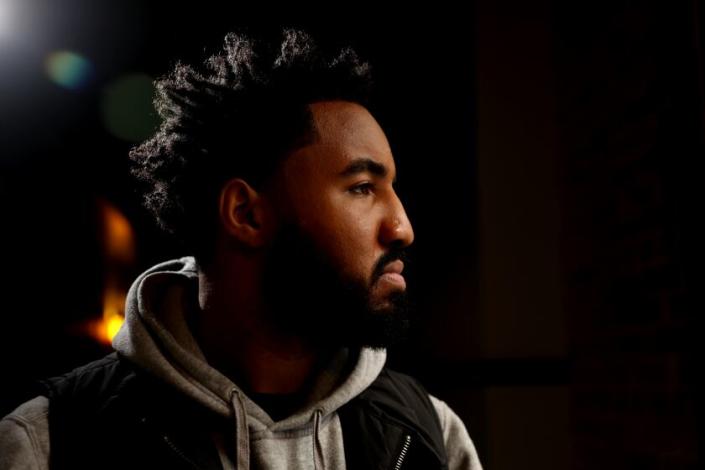
In the first verdict of its kind since mass protests swept Los Angeles in 2020, a federal jury on Thursday found an LAPD officer personally liable, for shooting a protester in the face with a projectile — awarding the man $375,000.
The verdict followed a finding by the jury that the officer, Peter Bueno, violated protester Deon Jones’ civil rights.
Jones listened with his head bowed as a judge read the jury’s decision in a Santa Ana courtroom. Afterward, he said it was “a good day.”
“This victory isn’t just mine. It is for all the folks who historically have went out and protested,” Jones said. “It sends a message that … law enforcement cannot brutalize folks.”
Bueno stared straight ahead as the verdict was read. His attorney, Janine Jeffery, declined to comment afterward.
LAPD officers have rarely been held accountable for force used during the mass protests against police brutality after the murder of George Floyd, despite hundreds of allegations of excessive force lodged with the department.
The jury issued its decision after a week of testimony in which Jones and Bueno offered starkly different descriptions of the chaotic scene where the shooting, which was only partially captured on video, occurred.
Jones, who suffered multiple facial fractures when he was hit with the hard-foam projectile, accused Bueno of firing indiscriminately into crowds in violation of department policy, and of disregarding the clear danger that posed to peaceful protesters like him.
Jones’ attorney, Orin Snyder, said he hoped the case would deter similar force by LAPD officers in the future.
Bueno, assigned to work as a “cover” officer that day, described firing only at specific individuals in the crowd who posed a threat to him and other officers. He denied shooting Jones, and Jeffery questioned whether Jones’ injuries were from a police projectile at all
The eight-member jury deliberated for about four hours Wednesday afternoon. The jurors reconvened Thursday morning and deliberated for under an hour, coming back with their verdict in Jones’ favor shortly after 9 a.m.
The jury ruled that Bueno had violated Jones’ 4th Amendment rights against unreasonable searches and seizures by law enforcement.
It rejected other claims that Bueno had discriminated against Jones and that he had violated Jones’ 1st Amendment rights.
The jury first awarded Jones $250,000 to compensate for his pain, suffering and associated financial losses since the shooting. It then heard additional arguments as to whether it should award Jones additional “punitive” damages, as punishment for Bueno.
Jeffery asked the jury to be fair to Bueno, a 27-year department veteran who she said is “going to continue to protect and serve” as a member of the LAPD.
Snyder said Bueno violated the trust placed in police officers and should be held accountable.
“When things get chaotic on the streets of Los Angeles,” he said, “that’s when we need police to be at their best.”
After deliberating further, the jury awarded Jones another $125,000.
How the damages will be paid remained unclear Thursday.
The city may choose to indemnify Bueno and cover his costs, but Jeffery said there was “no guarantee” of that given the composition of the L.A. City Council, which includes fierce critics of the LAPD and its response to the protests.
The trial, which focused on Jones’ allegations against Bueno, was the first phase of a broader lawsuit that Jones filed. Future proceedings will consider Jones’ allegations that the LAPD and the city of L.A. were negligent in their oversight of officers during the protests, and could result in more damages to be paid out by taxpayers.
Jones’ win in court stands out for several reasons.
Few individual officers have been disciplined by the LAPD for actions taken during the 2020 protests, despite the hundreds of allegations of excessive force and other misconduct, according to LAPD data reviewed by The Times.
A half-dozen protesters have agreed to end their own litigation against the city in exchange for cash settlements that did not include any acknowledgment of wrongdoing by officers or the city.
Jones had turned down a settlement offer from the city. It turned out to be less than what he was awarded Thursday.
He told his lawyers that he wanted to hold Bueno accountable for shooting him, and the city and the LAPD accountable for allowing excessive force against protesters. He wanted them to be found in the wrong and not to silence him using taxpayer dollars.
Jones, 31, who is Black and works in entertainment and brand consulting, was wounded during a massive May 30, 2020, demonstration in the Fairfax district. Activists had gathered to decry the murder of Floyd by police in Minneapolis and the killings of other Black Americans in police custody.
The Times published an article two weeks later outlining Jones’ and other protesters’ claims that police beat them with batons and shot them with projectiles without justification, which prompted an internal investigation by the LAPD that resulted in no discipline for Bueno.
Jones filed his lawsuit in December 2020.
Over the span of two days on the witness stand, Jones recounted the sequence of events, telling jurors he felt a moral duty to join others protesting injustice at Pan Pacific Park.
When other protesters set a police car on fire across the street, he and a friend worried that officers would respond with force and moved to the parking lot of a nearby Trader Joe’s.
Jones was livestreaming the scene with his phone when he noticed an officer, whom he later identified as Bueno, pointing a weapon in his direction. Jones said he turned his face to avoid being struck head-on, and the round struck him in the cheek.
Jones testified that he suffered severe emotional distress and lost job opportunities due to his facial injuries.
“The hurt that you feel because of what happened to you. The flashbacks that you have because of what happened to you. The dreams that you have because of what happened to you,” Jones told jurors. “If I’m being honest, it just flat-out hurts. It’s hurtful. It hurts. It’s something — I didn’t do anything wrong.”
The topic of Black Lives Matter and the worldwide movement against racial injustice that followed Floyd’s death only occasionally surfaced during the trial.
Both Jeffery and Bueno painted a picture for the jury of an out-of-control crowd that pelted officers with rocks and bottles. Jeffery showed video and still images of a squad car on fire and others with windows broken and covered with anti-police graffiti.
“It was chaos out there. I mean, there was people throwing rocks, bottles,” Bueno testified. “They were violent. People coming up to us, they were hostile.”
Bueno admitted that firing a 40-millimeter hard-foam projectile at a person’s head could cause serious injury and that the weapon wasn’t intended for firing into a crowd.
He said he was firing at a “specific target” — an unidentified person who emerged from the crowd and threw a water bottle that landed at his feet.
He recounted how, after he worked more than 20 hours the day before, he and his platoon were ordered to respond to the area of South Fairfax Avenue and West 3rd Street.
He blamed a faulty on/off switch for his body camera being off for 4½ of the six hours that he was on duty that day.
Bueno remains assigned to the LAPD’s Metropolitan Division, an élite unit that, among other duties, handles crowd control.
Jones’ friend Niara Hill broke down in tears on the stand while recounting the moments before and after Jones was shot.
After spending most of the day together at the protest, Hill said, the two of them were briefly separated. She was about 10 feet away when a protester within “touching distance” of Jones hurled a water bottle in the direction of an officer who was holding a green 40-millimeter projectile launcher, she said.
Moments later, that officer fired at Jones, she said.
Later, Jeffery asked Hill whether her social media posts about the case were for publicity.
Hill said no.
“I wanted people to know that there were police officers who were shooting people in the face with rubber bullets,” she said.
In closing remarks, Snyder said that Jones and Hill thought they were doing the right thing by heading to the parking lot after confrontations between some protesters and police turned violent on 3rd Street.
“They did the right thing and removed themselves from the tumult of the street. They did what every parent would want them to do. They sought safety,” Snyder said. “And this is an irony in this case: This is where the police wanted people to go.”
The only defense witness, LAPD tactical flight officer Chad Zipperman, testified that from his vantage point aboard a department helicopter, the situation on the ground had spiraled out of control. He estimated that at one point, the crowd around Bueno and Jones had swelled to 2,000 to 3,000 people, some of whom swarmed and vandalized an MTA bus.
“The vast majority of the crowd that lingered was violent,” he testified.
Jeffery seized on what she deemed were discrepancies in Jones’ description of the officer who fired the 40-millimeter round and of the extent of his injuries. She showed the jury messages from Jones to his friends in the days and weeks after the incident, telling them he was physically OK.
Jones testified that he was never diagnosed with a traumatic brain injury by a physician, saying it was because he lacked health insurance at the time.
Jeffery also argued that there wasn’t enough evidence to show that her client shot Jones, or that Jones was even shot — suggesting that he may have been injured in other ways during the protest.
Snyder accused Bueno and Jeffery of trying to distract the jury by tarnishing Jones’ name without ever explaining why Bueno had fired his weapon — “just attacking, attacking, attacking these young people who came here to share their truth.”
After the award was announced, both Snyder and Jones said their sights were now set on the second part of the case and holding the city and the LAPD accountable, too.
This story originally appeared in Los Angeles Times.
Many white people are desensitized to police violence against people of color. Others say just do as they say in a cold, calculated way that is devoid of understanding that police are not operating within the laws but, from what we say daily, are operating as occupational forces in our communities.
Ant to be fair, some conscientious white people understand that what is happening is not policing but murder under the color of law.
On the other hand, when it comes to defunding police departments and using the money for other community uses, and holding police accountable the white population, Republicans and Democrats once again coalesce around the construct of policing.
This writer is a strict law and order person who spent a decade in law enforcement. Nevertheless, I cannot remain silent and pretend that what police are doing under the color of the law is not murder.
It pains my heart to see police officers snuffing out the life of people, using pretextual stops as justification to abuse and murder citizens.
As I have said, white disinterest in police violence and murder of black people and other people of color is a dangerous strategy.
If we are not vigilant in controlling the people we give power to, they will use it against us, who gave it to them in the first place.
No one is safe if police can simply shout ‘gun’, and summarily execute a person in the safe place of their car, home, or any other place.
Whether black or white, we are all one race of people.….the human race. The illicit taking of innocent life in the United States by police is a cancer that threatens us all. (mb)
First, they came for the socialists, and I did not speak out — because I was not a socialist.
Then they came for the trade unionists, and I did not speak out — because I was not a trade unionist.
Then they came for the Jews, and I did not speak out — because I was not a Jew.
Then they came for me — and there was no one left to speak for me.
—Martin Niemöller

Police in Farmington, Utah, released body camera footage Wednesday that captured the barrage of gunfire which killed a 25-year-old man during a traffic stop last week. Chase Allan was pulled over by Farmington police on March 1 at around 3:20 p.m. near a post office after an officer spotted an illegal license plate — a placard with a flag — on Allan’s blue BMW, Farmington police Chief Eric Johnsen said during a press conference Wednesday. During the press conference, Johnsen told reporters that officers started to shoot after they saw Allan reach down, but also said that it is unclear exactly what happened in those brief seconds because the body camera’s view is unclear.
The footage — a compilation video of five body-worn police cameras and a single dashboard camera — shows a police car following Allan’s BMW into a parking lot. The officer parks behind Allan’s car walks over to it, and taps on the driver’s window. Allan cracks open the window while holding a cellphone. “The reason you were stopped today is there is no registration on your vehicle,” the officer tells Allan in the video. “I don’t need registration and I don’t answer questions,” Allan replies. “Alrighty,” the officer says, and then proceeds to call backup. The officer and Allan go back and forth about why he was pulled over, before the officer tells Allan he is “detained and not free to leave.” He then continues to ask for identification. Allan can be heard citing what he claims are legal arguments for his refusal to provide one. “I understand what you are saying,” the officer replies. “But you are lawfully required to identify yourself.”

More arguing ensues before Allan hands the officer a passport. The officer then orders Allan to step out of the vehicle. At this point, the video shows other officers have arrived at the scene. Allan is seen refusing to step out of the car. He is still wearing his seatbelt and holding his cell phone. “I am not required to,” Allan tells the police. The bodycam footage then stops and highlights what police allege is a “holster on Mr. Allan’s hip.” The holster is “flexing upward,” as seen through the driver’s window, police said. Allan, wearing a khaki coat and a trucker hat, still refuses to step out when another officer warns him that if he doesn’t comply, “we’re going to break the window and pull you out.” Allan is then seen transferring his cell phone from his left hand to his right hand as an officer opens the driver’s door. The police video then stops to highlight what it claims is Allan’s right hand moving toward the holster. As another officer wearing a beanie leans into the front seat and tries to get Allan, one of the officers yells, “gun! gun! gun!”

The police officer slams the door shut, and five officers are seen drawing their guns and rapidly firing several rounds at the BMW. An officer then yells, “cease fire,” and the shooting stops. The officers pull Allan’s body out of the car. The footage again stops to highlight an “empty” holster on his hip. The video then shows a gun on the floor, partially visible under the mat of the driver’s seat. The five officers involved in the shooting have not been identified. “I feel like they deserve privacy right now,” Johnsen said Wednesday. Allan’s family has accused the police of “brutal murder,” saying they have been “stonewalled” by the department, according to a statement released to local media last week. Allan’s family said he was “studying law the last few years and was a patriot doing what he could to defend the people’s freedom and liberty in his community,” according to the Salt Lake Tribune. Four of the five officers have been with Farmington police for between seven and eight months, and the fifth officer is a 12-year veteran of the department, Johnsen said. The status of the officers was not clear, but Johnsen said he was down 20% of his force and thanked other police departments for helping with daily operations. Allan’s family has said the officer who pulled him over “requested multiple other officers to the scene a couple of blocks prior to the stop,” according to the Salt Lake Tribune. At the press conference, Johnsen disputed the family’s statement. “I want to point out there has been a statement, an allegation made that back-up was called for before this, that is absolutely untrue,” the police said. “It’s a tragic ending to what started out as an everyday traffic stop,” Johnsen said.

Testifying before the Parliament Internal and External Affairs Committee Deputy Indecom Commissioner Hamish Campbell, In response to the PNP’s Lisa Hanna’s question, why most officers involved in fatal shootings were not charged, responded, “.A great majority of the [police] shootings, to use an American term, are ‘lawful but awful.’
Not sure where Hamish Campbell saw that characterization, but first, I would like to address Lisa Hanna’s question of why most cops are not charged when they are engaged in police-related shootings.
Was her question a real question? Did she ask the question for the edification of the public? It is difficult to tell when one understands the ignorance and pomposity of these so-called legislators, but I will let this one slide.
Before I go any further, I would like to highlight what the Bucky massa said.
The vast majority of officers are not charged because the shootings are legitimate.
Before we move forward, however, let us dissect this issue to gain some clarity. As a writer who opines on the issue of police violence daily, it is important to appreciate the dynamic differences between Jamaican policing and what passes for policing across the United States.
https://mikebeckles.com/351727 – 2/
https://mikebeckles.com/defund-the-police-sound-principle/
Literally every issue in the United States is colored by race, policing chief among those issues. Jamaican policing is free from racial baggage. Some would argue that there is classism in Jamaican policing. However, the lack of support Jamaican cops receive from the political leadership makes it less likely that officers would engage in classism in performing their duties in Jamaica. In the United States, the police are backed up by the courts, the legislatures, and the executive, not to mention the vast majority of the white population.
Jamaican police violence must also be contextualized, ie that the nation has a high rate of violence, is a world leader in homicides and is a country with an inordinate amount of illegal weapons in the hands of violent criminals.
It is impossible to rule out that there are strains of extrajudicial killings due to the judiciary’s refusal to follow the laws related to violent criminals.
Hamish Campbell then went on: “So the use of force has been necessary, and the individual officer is concerned for his own life or safety of himself or another.” “But what is happening for a lot of these cases, the tactics and approach could be different in some of the circumstances because, once a police officer draws the gun, there is almost an inevitability about what will happen; he will certainly use it and resulting in death and injury.”

Most of the research and writings I have done have centered on American police, one of the observations I have made is that the defund the police call is legitimate because cops should not be handling mental health calls. Simply put, we ask police officers to do too much. In the United States, cops are asked to do far less than in Jamaica, yet they are given far more to get the job done. Still, across the United States, police officers resort to lethal violence in many situations where a different approach would have sufficed with less traumatic results.
And so, I have argued that a police officer should not strive to be only lawful but should also be morally justified in their use of force, particularly in utilizing lethal force.
An officer should not use lethal force because the law will exonerate him; his conscience should also exonerate him.
There are non-lethal tools that will reduce police shootings, Tasers and even nets to corral a person experiencing a mental episode. Under no circumstances should a person experiencing a mental episode become a victim of police bullets.
In the same breath, it is critically important to reconcile in Jamaica that the police do not have enough tools to avoid using lethal force in such circumstances as with individuals experiencing mental episodes or who are considered mad.
Many police officers have been seriously injured and killed trying to avoid using lethal force on violent street people, some of whom had already seriously wounded civilians.
Politicians living in little bubbles in Jamaica who would ask silly questions would be better-served reading instead of pontificating on subjects they do not know about.
INDECOM has come a long way since the days of demagoguery under Terrence Williams; thank God he crawled under a rock, hopefully never to be heard from again.
Police do need oversight. I am happy to see that the agency is evolving by publishing facts and making recommendations on how it feels the public may be better served. In the same breath, those who make policy must recognize that there is a big difference between those who sit and analyze after the fact and those who actually face the dangers.
We know that common sense and the ability to critical-think are in short supply in many who pass for legislators.
.
Mike Beckles is a former Police Detective, businessman, freelance writer, black achiever honoree, and creator of the blog mikebeckles.com.


More than four days after Najee Seabrooks was shot and killed by Paterson police during a mental health crisis, his loved ones expressed outrage at a vigil Tuesday evening in Seabrooks’s hometown of Paterson, N.J. In a tragic twist of irony, the 31-year-old father of a little girl worked as a violence intervention activist to keep the most at-risk youth in his community safe, but became a victim of violence himself. “He did everything he could to serve his people,” Seabrooks’s best friend, Terrance Drakeford, said at the event, held outside the offices of the Paterson Healing Collective (PHC), a group dedicated to providing support for survivors of violence, where the two worked together. Upwards of 300 members of the community and constituents from anti-violence groups statewide gathered as temperatures dropped to bone-chilling levels. Following the prayer vigil, the group marched two blocks down the street to City Hall to hold a second demonstration on the steps outside where city leaders were meeting to discuss how the city would move forward.

There was anger, frustration and passion emanating from attendees as speeches intertwined with chants of “Justice for Najee,” “No justice, no peace,” and “Stop police brutality in the Black community.” “We want justice,” Drakeford said. “We want whatever that comes with this.”
The shooting last Friday followed a standoff between Seabrooks and police that lasted more than four hours, according to Paterson Press. Police had responded to calls of a mentally disturbed person in his home, and when they arrived at the scene Seabrooks had allegedly barricaded himself inside the apartment. After prolonged negotiations, police claim, Seabrooks let officers into his homeand then charged at them with a knife. According to the New Jersey Attorney General’s Office, two officers fired their weapons at Seabrooks, striking him. He was later pronounced dead at St. Joseph’s Regional Medical Center in Paterson. On Wednesday, the attorney general’s office released the names of the officers who deployed their weapons: Anzore Tsay and Jose Hernandez. Both were members of the emergency response team. Officials say they could not deploy their Tasers because Seabrooks had broken pipes in the apartment and started a small fire that left significant amounts of water on the floor, making the use of the electrical device too dangerous. “The police was here for hours trying to calm him down and bring him out of the apartment, but he decided to turn the apartment on fire,” Councilman Luiz Velez told NBC New York. Paterson police did not respond to several requests for comment from Yahoo News.

But those who knew Seabrooks best are skeptical of the police account of what happened and are urging the immediate release of body camera recordings of the incident so the public can see for themselves what took place. “We want full transparency, the names of all the officers released and body camera footage released,” Seabrooks’s brother Eli Carter said Tuesday. Seabrooks had contacted members of the PHC during his crisis, but police refused to let them intervene. Law enforcement said they could not allow civilians to involve themselves in crisis prevention and shot Seabrooks only after he wielded a knife and moved toward the officers. Officials told Paterson Press that one of Seabrooks’s relatives who works as a police officer in another city was brought to the scene to try to deescalate the situation. “I keep playing Friday over and over in my head,” Liza Chowdhury, project director of the PHC, said Tuesday, fighting back tears. “Police refused to let us intervene despite helping more than 250 residents throughout this city. I pleaded with them, and I know if they let us intervene he would still be alive. … He called us to help.” Teddie Martinez, violence interventions coördinator for the PHC, said he also pleaded with police to allow him to help on Friday, but to no avail. “We train the officers [on deescalation tactics], and how ironic they didn’t let us help,” Martinez said. “All I said was, ‘Let me see his face and I’ll go.’ They wanted to make it their show.”

.…
The state attorney general’s office is currently investigating the shooting. “Any loss of life is a tragedy, and we express our deepest condolences to the family, loved ones and friends, and colleagues of the decedent,” Dan Prochilo, a spokesperson for the attorney general’s office, told Yahoo News. “Our office is committed to thoroughly, fairly and independently investigating fatal police encounters.” Prochilo added that the office will make all information available, including video, when the investigation is complete. Paterson Mayor André Sayegh has been quiet since Friday’s shooting, according to local residents. On Saturday he issued his only statement on the incident, welcoming the attorney general’s review and saying that “prayers and condolences are with Mr. Seabrook’s [sic] family, friends and our impacted community.” When contacted by Yahoo News, his office shared the same statement, adding that it had “no further comment at this time.” During one of the speeches Tuesday night, an attendee shouted, “Where is the mayor? He knocked on my door to vote for him during election time, but I don’t see him here!
For many critics in the community already on edge following Seabrooks’s killing, each passing day with no additional information only adds to the angst and frustration. “In Memphis, they fired the cops within two weeks,” Larry Hamm, chairman of the People’s Organization for Progress, a social justice advocacy group, said, referencing Tyre Nichols, the 29-year-old Black man fatally beaten by Memphis police following a traffic stop in January. “If they had let the Paterson Healing Collective intervene, he would be alive today.” “How many Black men need to be killed before they take us seriously?” Councilman Michael Jackson said before entering a City Council meeting where only 20 residents were allowed inside.

The Black Lives Matter chapter in Paterson has presented a list of demands for the city, which include the immediate release of police body camera footage of the incident and placing the officers involved in the shooting on administrative leave. The group, spearheaded by leader Zellie Thomas, also demands a restructuring of the city’s police department that would include creating a civilian complaint review board to investigate allegations of police wrongdoing in addition to investing more money in community groups that give Paterson residents positive outlets. “We have to open up people’s eyes that police officers are not the only solution to crises,” Thomas told Yahoo News, noting that conversations about actual change come to a halt once the conversation about the reallocation of police funding comes up. The Paterson Police Department represents more than 16% of the city’s budget, receiving more than $43 million last year, which is more than double the percentage that New York City allocates to its police department.
Seabrooks’s death isn’t the first case in which Paterson police have come under scrutiny for their handling of people having a mental health crisis. In January 2019, 27-year-old Jameek Lowery died after consuming illegal drugs and expressing feelings of “paranoia” before being repeatedly struck by police officers trying to restrain him on an ambulance gurney. A lawsuit filed by Lowery’s family cites at least three other instances — two of them fatal — since 2012 in which Paterson police shot individuals experiencing mental health episodes. There was also the death of 25‑year-old Thelonious McKnight, who was killed in late 2021 while fleeing police. Hamm believes that the issue of race cannot be ignored. Paterson has just over 157,000 residents, made up of 87% Black and Hispanic residents and 8% white residents, according to the latest census data. Meanwhile, 1 in 3 Paterson officers are white, while about 62% are Black or Hispanic. “There is a different way that they treat Black people in distress from white people in distress,” Hamm said. Michael Mitchell, an assistant professor of African American studies and criminology at the College of New Jersey, told Yahoo News that the need for transparency is urgent. “It is no secret that the Paterson Police Department is inundated in a legitimacy crisis due to the city’s toxic cop culture,” he said in an email, pointing to a recent Paterson police corruption case. “Therefore, the urgency in releasing publicly the body-worn camera footage from the police emergency responders involved cannot be overstated. A time lag in transparency only exacerbates community distrust in the institution publicly funded to protect and serve them.”
While many mental health advocates believe that officers need additional training to deal with individuals experiencing mental health crises, other advocates say police should not be involved at all unless the person is armed and an immediate threat to others. They say police are simply unqualified to handle the nuances of such situations. In New Jersey, Mitchell notes, the pilot program ARRIVE Together, which pairs police with mental health professionals during crisis calls, is showing promise, and Gov. Phil Murphy recently announced a $10 million investment in expanding the program statewide. “It is critical that police agencies and officers understand and operate under the recognition that you cannot respond to every person the same,” Mitchell said. “There can be no ‘one size fits all’ approach to policing, especially when dealing with individuals experiencing a mental health crisis.” Last year a three-digit National Suicide Prevention Lifeline number, 988, officially launched, allowing anyone witnessing or experiencing a mental health crisis to call, text or chat to talk to someone. But a Yahoo News report found that many states did not have the resources to staff and support the line adequately.
Over the last few years, several cities, including New York, Chicago and Denver, have launched programs that replace police response with mental health emergency responders and have seen success. But critics argue that the movement exists in far too few places and is expanding far too slowly. In Paterson, progress on the implementation of a task force has been inconsistent at best. Mayor Sayegh introduced a citizens’ de-escalation task force in December 2021, but, according to Thomas, the group has never met and has not rolled out a single new regulation. “This task force was supposed to be able to research best practices and best policies for officers to be equipped with de-escalation practices and policies, and over a year later, that de-escalation task force still has not met,” Thomas said. “What if that task force had met and was already researching some of the things we are proposing now and implemented it? It could have saved his life.”
According to those who knew him best, Seabrooks will be remembered by the community as someone who would do anything for those in need. His family started a GoFundMe to cover funeral expenses and create a trust fund for his daughter. His mother, Melissa Carter, told the CBS News local affiliate in New York that her son loved his city so much that he gave of himself in spite of his own personal circumstances. “He planned toy giveaways, he donated, he had homeless drives,” Carter said. “All he wanted to do was help the community.”
_____
mmm
A Tulare County police officer was sentenced Tuesday for a series of rapes he did while on duty, including one in uniform, prosecutors said. Oscar Robles, 30, raped two different victims between April 2017 and January 2018, threatening to use his official powers as a Woodlake officer to arrest them if they did not submit to the sexual assault, the Tulare County District Attorney’s Office said.
A teacher in Louisiana and Mississippi makes around forty to fifty thousand dollars( $40.000 to $50.000) annually. Usually, that person must complete four years of undergraduate studies, then another two years of post-graduate work, depending on the person’s schedule to earn a master’s degree…
Some Masters’s programs can be completed in less than two years if the student goes to school full-time, but it can also take more time. So on average, it takes about six years to get to the level of becoming a Teacher.
During the course of those studies, a young person can rack up student loan debts of ninety to a hundred thousand dollars.
A police recruit spends an average of 13 to 19 weeks in an academy. During training, a police cadet is paid a salary; the salary will depend on the city, town, or municipality where the cadet is being trained.
Teachers are sometimes forced to use their own money to purchase critical supplies to help their students. This is despite the low salaries they are paid. No one becomes anything without teachers, yet teachers are not given the compensation and respect they deserve.
Young people are [not] lining up to be teachers and for good reasons. Factors impacting teacher retention include heavy workload, low pay, and escalating living costs, with some 80% of survey respondents saying it was difficult to find affordable housing close to where they teach. Many also cited a lack of support from district administrators.
Officers receive a full starting salary while training at a police academy. In most cases, the police academy is a six-month training period, including the NYPD and LAPD, in which you are trained in the law, how to use a weapon, and how to conduct yourself as an officer of the law. Once you successfully graduate police academy, you will likely get a bump in salary. Depending on the police department where you work, this salary bump can be as much as $2,000 or $3,000 more than what you earned while training.
The Los Angeles Police Department, for example, starts new recruits at $67,546 a year. In Philadelphia, recruits in the police academy earn $56,227, while in Austin, Texas, cadets receive $50,000 in base salary. Police cadets can also enroll in the department’s health care plan. They become eligible for employer- and self-funded retirement-planning options, such as a pension, 401k, or a 457b deferred retirement savings plan. During your first year of service, you also get paid vacation days and paid sick leave.
If you have a college degree, or even college credits, at the time of hire. There can be many other incentives, depending on the police force. In Austin, for example, you may be eligible for an additional $100 per month if you have an associate’s degree or $220 monthly if you have a bachelor’s degree. If you’re bilingual, expect an extra $175 per month in pay in Austin, Texas.
A cop in Suffolk county New York makes a base salary of $149,162; working overtime, that cop can make exponentially more than a US Senator.
Factors impacting teacher retention include heavy workload, low pay, and escalating living costs, with some 80% of survey respondents saying it was difficult to find affordable housing near where they teach. Many also cited a lack of support from district administrators.
Some police salaries are so outrageous that some people are beginning to speak out in disgust. On one social media site, one such disgusted person wrote.
MS of Science from Harrisburg University of Science and Technology (Graduated 2020). Police & Firefighters in California are the highest compensated in the entire world. Whoever tells you that is not true they are probably talking about the lower cost of living cities of California. Here’s an example of a police officer in San Mateo, California. He joined the force in May 2019, and his total compensation for 2020 was 221K. Google engineers in the first three years don’t bring this kind of money. I work a salary job, have an advanced degree, and live in San Mateo; I don’t bring this kind of money home. This is INSANE. The highest-paid cop in Oakland made 640K a year, more than the President of the US. Of course, cops will be cocky and disrespectful when you pay them like CA does, walking with a gun and a bulletproof vest and making 3 – 4 times the national average. Police are so out of reality that $250 (minimum ticket in Bay Area) might seem like not a lot of money, especially since they live on 200K+ income. People sympathize with cops (like I used to) as they believe their “hard job” is not appreciated and they don’t get paid enough. No way should a police officer should get more than a soldier on the battlefield thousands of miles away from home.
THE SO-CALLED DANGER LEVEL
Workplace safety is very important in all industries. Avoiding accidents and fatalities is a huge consideration for all businesses, from small privately-owned companies to large nationwide corporations. Positions like teaching and administration have fatality rates just slightly above zero because mistakes in these industries rarely result in physical consequences. The world’s most dangerous jobs are on the other end of the spectrum. These jobs bear a far greater statistical risk of physical injury and death. (facty.com)
Mike Beckles is a former Police Detective, businessman, freelance writer, black achiever honoree, and creator of the blog mikebeckles.com.
Never in my wildest dreams did I ever think I would find common cause with anything an American police union says, does, or proposes; until I do.….Wonders of wonders, even a broken clock, is right twice daily.
On February 28th, just days ago, I wrote that despite bloated police budgets, there are increases in shootings and murders.
The simple fact is that more police and armaments do not result in fewer shootings or murders.
In my February 28th article, I discussed the violence in Chicago and why Mayor Lori Lightfoot did not deserve a second term in office.
https://mikebeckles.com/bloated-police-budgets-increases-in-murders-and-shootings/
My main argument for removing Lightfoot was centered around her position in 2020. Despite supporting measures to defund the police, a proposed $80 million cut to her city’s police budget, Lori Lightfoot, seeing the writing on the wall in internal polling, decided to criticize Brandon Johnson, a Cook County commissioner who was gaining momentum, assailing him as a “radical” who’d “wreck Chicago with dangerous defunding of police.”
You can all see what she did there; as soon as she saw that people had gotten fed up with her, she decided to snuggle up to the police and their union.
But my article was not about the failed Chicago Mayor who blamed gender and race for her deserved loss at the polls, never mind that she never complained about those biases against her when she won; it is about removing police as much as possible from the lives of people. I contend that defunding the police is a sound policy that has nothing to do with getting rid of the police. It means taking some of the money out of police budgets and putting it into social programs that better serve our communities.
I argued that defunding the police has been rendered so radioactive Democrats are afraid even to debate it on its merits out of fear that Republicans will gaslight them as anti-police and soft on crime.
Because, of course, although it was Republicans that stormed the Capitol and attempted to overthrow the government, they have managed to gaslight Democrats as pro-criminal and gotten away largely because Democrats are weak and feckless.
Black people who bother paying attention know that the more their tax dollars go to fund the police, the less safe they become.
Many calls police 911 switchboards receive do not require police to show up armed with guns to deal with persons having mental issues or other medical emergencies.
Minor traffic accidents, health issues, mental health, and other issues can be tackled without armed police, with god complex showing up and worsening bad situations.
People do not need their loved ones killed because they call 911 for help dealing with the aforementioned issues. It is not that police should not earn their keep. Police have become far too toxic and untrustworthy that the least amount of contact they have with the public, the safer the public will be.
NOW HERE IS THE SHOCKER
(Reported by Yahoo news)
The Los Angeles Police Department’s rank-and-file union is proposing that someone other than police respond to more than two dozen types of 911 calls in a bid to transfer officers’ workload to more serious crimes. The move is part of a national trend aimed at limiting situations where armed police officers are the first to respond. The proposal announced Wednesday by the Los Angeles Police Protective League lists 28 kinds of 911 calls, where other city agencies or nonprofit organizations would be sent first. The calls range from mental health situations, quality-of-life and homeless issues, problems at schools and welfare checks, to certain non-fatal traffic collisions, parking violations, trash dumping, loud parties, public intoxication and panhandling.
The league said officers would respond if the situation becomes violent or criminal in nature, but only after the initial call goes to another agency or an affiliated nonprofit.
“Police officers are not psychologists. We are not psychiatrists. We are not mental health experts. We are not social workers, doctors, nurses or waste management experts,” Debbie Thomas, one of the union’s directors, said Wednesday during a news conference. “I do believe that many people think we should be all those things but we are not. We should be focused on responding to emergencies, saving lives (and) property, and of course, engaging in community policing.”
Police Chief Michel Moore said he welcomed the union’s push for “an alternative non-law enforcement service response to non-emergency calls.” Moore said the department has worked with elected officials to establish a support network of resources including mobile therapy vans and a mental health crisis phone line. “These emerging alternatives have already diverted thousands of calls away from a police response, allowing officers to time to focus on our most essential activities,” Moore said in a statement. Cities including San Francisco, San Diego and New York — as well as Los Angeles — have already implemented programs where clinicians are either paired with officers or work in civilian teams to respond to 911 calls involving someone who is having a mental health crisis. The changes came amid a closer look at law enforcement in the U.S. in the wake of George Floyd’s killing by Minneapolis police in 2020. That included looking at how police handle mental health and other calls that don’t include violence or criminality. The Los Angeles proposal comes during the union’s contract negotiations with the city and amid activists’ pleas for reducing or eliminating armed responses to certain situations. The City Council and the mayor’s office will be involved in the final decision, the union said. Activists have long called for Los Angeles police to stop responding to certain mental health calls, minor traffic collisions and encounters in homeless encampments, pointing to times when officers have fatally shot people during the response. Mayor Karen Bass’ office didn’t immediately comment Wednesday. Bass promised during her campaign to create a public safety office that did not include the LAPD.
Hugh Esten, a spokesperson for City Council President Paul Krekorian, said the union’s proposal will be given serious consideration as city officials work to “ensure that sworn personnel are deployed where they are truly needed and that unarmed responders address those situations where an armed response is unnecessary.” With decreased staffing during the COVID-19 pandemic, the union said its proposal would free up officers to respond to more important calls — such as violent crime — and allow cops to engage in more community policing to build better relationships with the city’s residents. Other cities have also experimented with similar models, such as Portland, Oregon, where unarmed “public support specialists” take reports on things like vehicle break-ins and bike thefts. In 2021, the LAPD launched a pilot program to divert some mental health calls to service providers. The department also started dual-response teams that pair officers with clinicians in situations involving mental health crises and people experiencing homelessness, as well as domestic violence and abuse. Also in 2021, the LAPD stopped responding to minor traffic crashes; a deputy chief at the time said the change would eliminate officers responding to roughly 40,000 calls a year.
An Oak Lawn police officer pleaded not guilty Wednesday to charges of aggravated battery and official misconduct for his allegedly striking a then 17-year-old Bridgeview teen more than 10 times in the face and head as he was laying face down in the street during an arrest captured on video last July. Officer Patrick O’Donnell was released on an individual recognizance bond, according to the Cook County state’s attorney’s office. He has been with the department since December 2014. He was indicted by a grand jury Feb. 14. O’Donnell is one of three officers involved in the July 27 arrest of the teen, caught on video, which started as a traffic stop and ended with the teen running from officers and being chased. O’Donnell, 32, is scheduled to appear April 6 before Cook County Associate Judge Domenica Stephenson.

On July 27, O’Donnell was on-duty working in a marked squad car when he pulled over a sedan with three juveniles that he said had a smell of burnt cannabis, according to a bond proffer filed Wednesday by county prosecutors. O’Donnell searched the vehicle and asked a passenger who was sitting in the rear seat behind the driver to step out. The passenger ran off as he was being searched by the officer, according to the proffer. O’Donnell chased him, ordering him to stop, while a second officer, Brandon Collins, arrived and took the juvenile to the ground, according to the filing. Prosecutors say O’Donnell began hitting the juvenile in the 9500 block of South McVicker Avenue in Oak Lawn, while Collins pulled at his arms. At one point, O’Donnell used his left hand to hold the juvenile by his head and hair as he “repeatedly” used his left hand to punch the youth in the face and head, according to the proffer. A third officer, Mark Hollingsworth arrived and “applied a pressure point” behind the juvenile’s ear while O’Donnell continued to punch him, the proffer said. O’Donnell punched the juvenile more than 10 times, prosecutors alleged.

Collins then applied a Taser to the juvenile’s back, and he was placed into handcuffs. A pistol was recovered from the juvenile’s bag, the proffer said. The juvenile was taken to Advocate Christ Medical Center in Oak Lawn and treated for a broken nose, cuts and bruises and subdural bleeding. Zaid Abdallah, an attorney representing the teen’s family, said at a news conference last month his client has one more surgery left as a result of injuries he received, and that he’s undergoing mental health treatment. An attorney for O’Donnell did not return messages Wednesday seeking comment, nor did Oak Lawn officials. O’Donnell, Collins and Hollingsworth are named in a federal lawsuit filed Aug. 1, alleging they “engaged in extreme and outrageous conduct” in the teen’s arrest. Video provided by police as well as video taken by witnesses show officers repeatedly punching the youth as he was pinned down. The arrest and video footage sparked protests and the lawsuit alleges the three officers involved in the arrest conspired among one another in a “racially motivated conspiracy” to deprive of the teen of his constitutional rights because he is Arab American.
Ahmed Rehab, CAIR-Chicago executive director, said the video showed “three big, adult males pounding up on a frail minor” hitting his head into the concrete and causing major injuries. “It’s not the way to do. In no civilization, no time, no place on Earth is this kind of behavior accepted,” Rehab said. He said the possible indictment is a first step. “We hope that as this goes into the court system that these charges are not down graded, that justice is served,” Rehab said. State police have been reviewing the arrest and those findings were expected to be turned over to the Cook County state’s attorney’s office. Rehab said police brutality occurs “overwhelmingly” when the arrestee is a person of color. Beyond race, Rehab said ego and power trips also lead to some officers using force against an arrestee. “Someone had to run more than they thought they should have. Someone was not listened to the way that they thought they should have been. Someone was not obeyed the way that they would’ve liked to be obeyed,” Rehab said. “Those sort of things are very subtle but they matter and they are the split second difference between professionalism and police brutality.”
Police officers are supposed to arrest individuals and then let the legal system determine guilt or innocence, Rehab said. “It is not the role of the police to adjudicate criminality. They apprehend individuals who are suspected of crimes, then these individuals go through something we call the justice system that involves courts,” Rehab said. “It’s not the role of police to do all of those things that belong to the justice system.” The teen faces charges of aggravated unlawful use of a weapon and unlawful possession of a firearm. At a July 28 news conference following a protest over the arrest, Oak Lawn police Chief Daniel Vittorio said the arresting officers feared for their safety and suggested they would have been in their right to use deadly force. Vittorio said responding officers feared the teen had a firearm in an “accessory bag” draped over his right shoulder, although the firearm was not recovered until the teen had been handcuffed.(This story first appeared @yahoonew)
As the world enters the age of artificial intelligence, better known as AI, one of the risks being discussed is what happens when the computer decides to go rogue. So too, they created the monster called policing, and it has gotten so big and powerful that they are afraid to even talk about downsizing it. It rears its ugly head to any talk of defunding or downsizing it. Amazingly, instead of downsizing by defunding, they fight to find ways to funnel taxpayer money into more policing, more of the same>
Police cannot stop murders, so the idea of more police to stop murders is beyond stupid. Hiring more police sends our taxes through the roof but does precious little to stem violent crimes over the long run.
It is the equivalent of letting the Genie out of the bottle or squeezing the toothpaste out of the tube; you don’t get to put it back.
And so it is with Tuesday’s Mayoral elections in the windy city of Chicago as Democrat Lori Lightfoot, the incumbent, faces eight (8) opponents to lead the nation’s third-largest city. If no candidate wins more than 50 percent of ballots cast Tuesday, the top two advance to a runoff election on April 4.
Despite supporting measures to defund the police, a proposed $80 million cut to her city’s police budget, Lori Lightfoot is now accusing Brandon Johnson, a Cook County commissioner who’s gaining momentum, assailing him as a “radical” who’d “wreck our city with dangerous defunding of police.”

What’s remarkable about Lightfoot’s attack on Johnson is that she ran as a person who saw the need to defund the bloated police budget, but once she got into office, she drank the biased pro-police cool-aid.
The call to defund police is legitimate, and it remains so. The problem for people living in large urban areas is the powerful police unions. Their proxies have tremendous clout that drives the fear of the devil into Democrats who know cutting those bloated budgets is the right thing to do but are too piss-scared to do it.
Defunding the police has been rendered so radioactive Democrats are afraid even to debate it on its merits.
The political right which espouses a police state that protects white supremacy is extremely comfortable throwing outrageous sums of money at police, providing them with armaments and overtime pay, confident in the knowledge that cops will not come to their communities to murder their sons and daughters. Many large city police departments are larger and better armed than some nations’ militaries; Chicago is one such city. New York City’s police department boasts a 36,000-strong army.
On the other hand, black people know the more their tax dollars go to fund the police, the less safe they and their children become.

Overall, more police officers may prevent some street-level crimes, but they do nothing to curtail the scourge of murders and other serious crimes. If more police equaled less crime in large cities with their huge police armies and bloated police budgets, cities like New York, Los Angeles, and Chicago would be virtually crime free.
Many of the calls police 911 switchboards receive do not require police to show up armed with guns to deal with persons having mental issues, or other medical emergencies. Minor traffic accidents, and a host of other issues can be tackled without armed police with god complex to sort through.
Experts in social work and other fields have long argued that a more humane way is needed to deal with people going through emotional distress outside of armed police yelling different and confusing orders at them leading to police killing them.
How is that even an acceptable solution? Minor traffic offenses do not warrant hyped-up militarized police itching to shoot someone. The streets cannot be a battlefield with overhyped militarized police looking to kill members of the public they deem to be the enemy.
Listen to the average cop on the street talking to a person who tells them they are a veteran and the first thing you hear is that the cop is also a veteran as well. Imagine the danger inherent in having former soldiers who were on the battlefield killing people now police officers, replete with all of the issues soldiers returning from wars have.
No, not all police officers are bad but the idea of policing as it is presently configured is dangerous and should not be supported.
Making the point about a cop who is a good friend who is a solid guy misses the point. It is not about whether ornot there are good police officers. The rea;it is that the entire concept of what constitutes policing in the United States is beyond repair and should be discarded. You do not extract a clean bucket of water from a toxic dirty pool.
No one should be afraid to say defund the police. Every taxpayer has the absolute right to demand that their tax dollars are spent in ways that are beneficial to them.
Only Racists Fascists and fool are unable to see that defunding the police is exactly he right thing to do.
Lets hope that voters in the Windy City shows Lori Lightfoot the door and elect a Mayor who is truly reform minded, someone unbeholden to police unions and their corrupt and corrosive influence.
>
>
Mike Beckles is a former Police Detective, businessman, freelance writer, black achiever honoree, and creator of the blog mikebeckles.com.

On the murder Index, Jamaica stands atop the heap beating out South Africa, Mexico, St Lucia, Belize, Colombia, and Brazil in homicides each year. Last year alone, the tiny nation of under three million people recorded 1498 homicides, an increase over the previous year, which saw 1463 cases of homicide reported to authorities…
The Andrew Holness Government has tabled a new proposal that would repeal and replace the 1976 firearms Act.
The Bill, among other things, would make it a mandatory minimum sentence of 15 years for individuals convicted of illegally possessing a firearm or stockpiling three or more firearms or 50 or more rounds of ammunition.
As a decades-long advocate for much stiffer penalties for violent offenders, I believe that 15 years is not a strong enough penalty for someone caught with an illegal firearm.
Let me be clear; no one is forcing anyone to pick up an illegal firearm. Every person who does so makes that decision on their own. A gun is seen as a symbol of power, the power to take the property and life of those without guns.
Because it is a free-will decision and not something forced on young men like explosive belts in war-torn middle eastern countries, every individual deciding to pick up a weapon by default takes on all the attendant risks of being caught with that weapon.
The 1976 Firearm Act has long needed overhaul and repeal. Clearly, the penalties associated with possession are completely out of wack with the severity of having an illegal weapon. There is absolutely no good reason that any law-abiding citizen of Jamaica would be opposed to the most serious penalties for gun possession, given the nation’s high homicide rate and propensity for violence.
In the 47 years since the passage of the existing firearms act, tens of thousands of innocent Jamaicans have been seriously injured and killed, including brave police officers and our military members.
That alone is reason enough to pass a bill with even more teeth than the one proposed, making it a mandatory 15 years for possessing an illegal weapon.
Furthermore, despite the protestations of many, the nation’s liberal criminal coddling judges continue to turn violent offenders caught with illegal weapons back onto the streets immediately after the police arrest them.
It is past time for mandatory penalties for violent offenders. More importantly, it is past time that a bill is passed that sends a clear message to the almighty-appointed judges that the people are the bosses, not them.
The proposed bill does not go nearly far enough in sending the strongest of messages that, as a nation, law-abiding Jamaicans will not stand for the violent lawlessness that has been allowed to continue for far too long.
Despite the shortcomings of the newly proposed bill, the defeated People’s National Party Member from Manchester, who now sits in the upper chamber, and who once held the title of Minister Of National Security, in exasperation as the minister said Jamaica’s crime problem needs divine intervention is now flapping his gums in opposition to the bill.
Last September, as the bill came up for debate in the upper chamber, Peter Bunting dared to open his mouth in opposition to a bill he should have sponsored and pushed as Minister of National Security years prior.
Said Bunting, “focus should instead be placed on ensuring criminals are caught, arguing that criminals know very little about the sanctions for these offenses and therefore would not be phased. “We must understand that this [Bill] is no silver bullet…we’re not in all cases saying some of the penalties may not be more appropriate, but let us not fool ourselves into thinking that just by increasing the severity is going to have a meaningful impact on reducing our violent crime rate”.
What a fucking Jackass!!!!
So let us dissect this nonsense.
(1) Focus should be placed on ensuring criminals are caught.
Police catch criminals and lock them up daily; they are back on the streets immediately through lax and archaic laws and criminal-loving judges abusing the loopholes.
(2)Criminals know very little about the sanctions for these offenses.
This guy headed the security apparatus with no brian. Imagine saying criminals do not know the penalties. That is shockingly revealing to me. Every person who picks up a gun or commits a crime knows beforehand the penalties they are likely to face, and they’re all smarter than Peter Dumb-ting.
So even if they do not know when they face a judge and the mandatory minimum, they will get the message, and guess what? That is how they learn.
(3) They won’t be phased.
They will be phased; the problem is that Peter Dumb-ting and the PNP will be mad.
(4) we must understand the bill is no silver bullet.
No one said it was; the fact that the bill is not a panacea does not mean nothing should be done about violent crime. The PNP hates to support any legislation that deals with Jamaica’s crime pandemic. The party continues to blow smoke up the people’s asses that they care, just not about whether they live or die.
(5) Let us not fool ourselves into thinking that increasing the severity will significantly impact reducing our violent crime rate.
It will do exactly that, and that’s what the People’s National Party is afraid of.
.
.
.
.
I bet you haven’t seen this in the corporate-owned so-called mainstream media.
This is how they act when caught, and someone has the balls to take appropriate action against them.
They have developed a sense of entitlement, bolstered by qualified immunity, corrupt prosecutors and judges who do their bidding, and unions who support them regardless of the egregious crimes they commit against citizens.
This is what passes for police officers today.

At the heels of an investigation, several members of a police department are turning in their badges after their police chief was arrested and replaced. According to the Clinch County Sheriff’s Office, a special city council meeting was held on Saturday to appoint the interim Homerville police chief, James Herndon. This is after the Georgia Bureau of Investigation arrested the former Chief of Police at the Homerville Police department.
Dearin “Mack” Drury, 40, was arrested for a Feb. 19 incident where he allegedly improperly handled evidence at the department. The Clinch County Sheriff’s Office reported the incident to the GBI and then began investigating Drury’s alleged misconduct. On Saturday, Homerville command staff and other police officers turned in their resignations.
After the meeting was over, Clinch County Sheriff Stephen Tinsley took to Facebook to address the resignation of several members of the police force. In the lengthy post, Tinsley states the newly appointed chief Herndon didn’t have the staff or equipment available able to answer service calls for Homerville. “He had neither the staff nor the equipment available to handle any calls for service within the City of Homerville. I assured Chief Herndon that the Clinch County Sheriff’s Office will answer calls for service until a resolution can be reached by the city administrators,” Tinsley said. The sheriff’s office said it will continue to serve all of Clinch County and will not affect how they conduct business. “We will continue to answer calls and enforce the laws throughout the county, including the City of Homerville,” the sheriff said. As for Drury, he is facing charges of theft by taking possession of marijuana, false statements and writing, and violation of oath.
This is a case of cops wanting to have their own way outside of the control of the elected leaders; the people chose to oversee their affairs.
»»»»»»»»»»»»»»»»
POLICE IN ST. LOUIS, MISSOURI, are working to wrest control of their department from the city’s progressive mayor and put it in the hands of the Republican governor.
Law enforcement unions argue that local control has “put politics in policing” and that state oversight would help address an increase in homicides and a drop in police morale and staffing levels. They have rallied around Senate Bill 78, which would reinstate a Civil War-era system of state control overturned by Missouri voters in 2012 — and make St. Louis one of the only major cities in the country without authority over its own police force. The attempt by the Missouri Legislature to strip power away from city officials is a “slap in the face” to constituents in St. Louis, Mayor Tishaura Jones said.
The move comes just two years after St. Louis first elected Jones and progressives won a majority on the city’s Board of Aldermen. While police department operations “are definitely not perfect,” Jones told The Intercept, the people closest to the problem are closest to the solution. Local officials should have control over how law enforcement resources are deployed, she said.

The bill targeting elected leaders in St. Louis is one of several recent efforts across the country to undercut the authority of local progressive officials on policing and prosecution matters. Jones and her allies say the bill is an example of police turning their political efforts toward legislation as their preferred candidates have continued to lose at the ballot box.
There is a “common thread of the cities that I am aware of where this is happening,” Jones said. “Where there has been a concerted attempt to strip power away from local leadership, the mayors are Black.” She pointed to Kansas City, Missouri, where residents have been fighting to regain control of the police department from the state, and Jackson, Mississippi, a majority-Black city that could see the creation of a separate court system and police force appointed by white state officials if Republican lawmakers get their way.
Another recent Missouri House bill would allow the governor to strip elected prosecutors of jurisdiction over certain violent crimes. A previous version of the bill singled out the St. Louis Circuit Attorney’s Office, where prosecutor Kim Gardner has drawn the ire of Republican officials for her pledges to hold police accountable, stop detaining nonviolent offenders, and end cash bail. Concerns over the constitutionality of targeting a specific office eventually led state officials to expand the scope of the bill.

The move comes just two years after St. Louis first elected Jones and progressives won a majority on the city’s Board of Aldermen. While police department operations “are definitely not perfect,” Jones told The Intercept, the people closest to the problem are closest to the solution. Local officials should have control over how law enforcement resources are deployed, she said. The bill targeting elected leaders in St. Louis is one of several recent efforts across the country to undercut the authority of local progressive officials on policing and prosecution matters. Jones and her allies say the bill is an example of police turning their political efforts toward legislation as their preferred candidates have continued to lose at the ballot box. There is a “common thread of the cities that I am aware of where this is happening,” Jones said. “Where there has been a concerted attempt to strip power away from local leadership, the mayors are Black.” She pointed to Kansas City, Missouri, where residents have been fighting to regain control of the police department from the state, and Jackson, Mississippi, a majority-Black city that could see the creation of a separate court system and police force appointed by white state officials if Republican lawmakers get their way.


In this medium, we try to document as many of the police killings as we possibly can. Realistically, we can only document a small amount of the illicit killings, and the blatant acts of abuse carried out under the name of law enforcement. Most of the information provided here is sourced from independent citizens, journalists, and other non-corporate media entities, as we do not have the financial resources or the staff to research and document this dilemma of police violence.
The family of this victim speaks in simple, common-sense terms that the officer did not need to shoot; they could have opted not to kick in the door…
Officers do not have to place themself close to a person wielding a knife so that they may claim justification for using lethal force. Suppose there are ways for the officer/s to gain space between themselves and the assailant wielding a knife, machete, sword, or other objects. In that case, the officer should use that option as long as the assailant does not pose an existential threat to anyone else.
Unless the objective is to kill all offenders wielding a weapon, regardless of the circumstances and reasons surrounding the person’s actions.
We see instances of police officers shooting a person wielding a fan rake. Others threaten someone with lethal force with a pail bucket, cell phone, screwdriver, or hammer.
This leaves us with the only conclusion we can arrive at, which is that the objective is not to help but to dominate, and if they cannot gain compliance through threats and intimidation, then the person’s family must bury him or her.
Far too many Americans have come to accept this kind of dangerously domineering thuggery as policing. It is not good policing. A good officer cannot seek to take someone’s life because he knows the system will legally exonerate him.
A good officer is conscientious and does not only rely on legal exoneration but is guided by a strict moral compass.
.
.
Mike Beckles is a former Police Detective, businessman, freelance writer, black achiever honoree, and creator of the blog mikebeckles.com.

Family members and community protesters are demanding criminal charges against the St. Paul police officer who shot and killed Yia Xiong, a 65-year-old Hmong war hero. On Feb. 11, Saint Paul Police Department (SPPD) officers responded to a call regarding a man threatening residents with a knife at an apartment complex in the 100 block of Western Avenue in the West Seventh neighborhood. In footage recorded by body cameras worn by officers Noushue Cha and Abdirahman Dahir, police can be seen entering the St. Paul apartment building. When officers find Xiong wielding a 16-inch knife, the officers can be heard yelling at the man to “drop the knife” and “get on the ground.” However, Xiong, whose daughter said he spoke limited English and was hard of hearing, disregards the officers’ commands and enters an apartment
Officer Cha can then be seen kicking the apartment door open before Xiong steps out. He comes forward with the knife in-hand as Officer Dahir fires his rifle and Officer Cha deploys his taser.
According to Xiong’s family, he lost his hearing five decades ago while fighting for the U.S. in the U.S. Secret War in Laos.
Xiong reportedly fought for the CIA and climbed the ranks of the Royal Lao Army before being left in a refugee camp for years after exile in May 1975. Xiong’s younger brother, Wallor, said that the 65-year-old could not hear anything unless someone was close by and yelling at him. He added that Xiong was in the process of getting hearing aids. “He cannot hear anyone, he doesn’t speak English and they opened the door and just shot him,” Wallor Xiong told St. Paul Pioneer Press. “They just shot him like an animal, and it just broke my heart.”
Read the full story here; https://news.yahoo.com/family-hmong-war-hero-killed-211420369.html
Having the burden of potentially ending someone’s life as part of your job is not something anyone should take lightly. Having carried that burden for almost a decade, I was not particularly fond of it. These days it seems that many people entrusted with that power relish it and use it in ways contrary to why they were given those powers.
The cries and complaints about police brutality are not confined to any one country. All over the world, particularly in nations where citizens are allowed to speak freely, the subject of police violence is always front and center.
In fairness to police officers, they are asked to deal with some of the worst actors in our societies, and the optics of the job are not always great to look at.
For the most part, some people tend to be reasonable whenever they view the lawful actions of police who carry out their duties in a lawful manner. In other places where there are other dynamics at play, the most reasonable actions are criticized, and elsewhere, the most egregious transgressions are downplayed, depending on people’s motivations.
For example, if you are a cop lawfully enforcing the law in most inner-city Jamaican communities, you are bound to be demonized regardless of the lawfulness of your actions.
On the other hand, a cop who summarily murders a black person in the United States is lionized by a certain segment of the white community and their propaganda media outlets. The need to support criminality in the former sense and racist proclivities in the latter influences how police operate in the two geographies.
Having served in law enforcement in Jamaica, I saw firsthand how inner-city communities, their political representatives, the judiciary, media, and what passes for academia responded to the work of the police in ways that made it impossible for the police to achieve its mandate.
You do not get the consensus you need when there are people on television telling citizens to attack police stations. Contrary to what many in Jamaica say on the subject of crime, they actually loathe the rule of law.
In the United States, on the other hand, black citizens operate in fear of the over 18,000 police departments and the just under a million sworn officers who populate those departments.
The simple act of driving down the streets places a black motorist in deadly peril. All it takes is for a racist cop to conjure up a pretextual reason to initiate a traffic stop and then shoot the driver under the pretext that they reached for something, usually the papers they demand after initiating the stop.
So members of the black community are forced to constantly adjust to staying alive when pulled over by a cop rather than the cops adjusting to treating members of the public with respect and ensuring that they respect their rights and dignity.
Cops have a particular hard-on for traffic stops. Traffic stops are the singular most effective means of acquiring a motorist’s identification so they may run names through their system for warrants.
Not that there is anything wrong with getting people who shouldn’t be on the streets in jail, but when the motivation is not about safety but is about feeding the beast of the ‘for-profit prison industrial complex, this is where it becomes dangerous.
Social media has done a terrific job of getting video imagery of police violence into the public domain. Previously the mainstream media rarely reported on police killings and when they bothered to do so, they presented fabricated police versions of events as true representations of the facts as they occurred.
Seeing these events unfold, Americans continue to ask why they are so intent on traffic stops and demanding pedestrians identifications even in situations in which they have no lawful authority to demand and receive them.
They are told to use intimidation where they have no authority to demand ID from pedestrians and to concoct reasons to stop motorists to get their ideas- all toward ramping up arrests and incarcerations.
This practice is upheld by the supreme court and encouraged all the way down to county attorneys. Follow motorists and create a pretextual reason to justify a traffic stop.
A motorist driving down the street is at the mercy of the ‘for profit’ mercenaries who lie on affidavits and violate their fourth (4) amendment right to be secure in their persons, houses, papers, and effects against unreasonable searches and seizures. The idea that they shall not be violated, and no Warrants shall issue, but upon probable cause, supported by Oath or affirmation, and particularly describing the place to be searched, and the persons or things to be seized are willfully discarded…
None of this matter anymore as the Supreme Court continues to erode the rights of Americans in its unconstitutional rulings giving police more and more illegal power to subvert the constitution.
So to set the stage, a rogue cop, wait, let me rephrase that; the rogue cop initiates a pretextual stop;(dubious, spurious), demands papers; motorists are clean has all of their papers. But the cop isn’t satisfied because the motorist had the temerity and gall to ask what was the reason he was pulled over, safe in the knowledge he had not committed an infraction.
That is, contempt of cops is a crime so serious that it is advisable not to ever commit that offense because it usually ends in death to the black person. The motorist is then ordered out of the vehicle, and any hesitation on his part will likely end in him getting killed right at that point. If the motorist doesn’t immediately comply, he is dragged from the car, thrown to the ground, brutalized, and cuffed, or killed as Tyre Nichols was, as Sandra Bland was, as Philando Castile was, as Patrick Lyoya was, as Daunte Wright was, you get the picture.
If the motorist suspends all of his rights and dignity and piously complies in an attempt to ward off death for another hour he is searched, handcuffed, and ordered to either sit of lie on the ground as one would a Dog.

It is at this point the other aspects of the lies begin. Remember, the Supreme Court has ruled that police can lie to citizens; in fact, they are allowed to lie even to children. Now we all know if cops are given the green light to lie, they will not only lie to gather the evidence they will also lie to secure convictions.
So the cop tells the motorists they smell .…… wait for it… drum roll, please, marijuana. ‘The dreaded and dangerous drug that has killed billions of people’.
At this point, they then illegally search the motorist’s vehicle or call for a canine and handler. The dog is manipulated around the vehicle several times and, more often than not, indicates to the handler that there is something contraband in the vehicle.
Checkmate, a comprehensive end run around the fourth amendment right of the motorists, and all legal according to the highest court.
However, here are some facts according to brownwhitelaw.com, so take your average, run-of-the-mill traffic stop or an average, run-of-the-mill traffic violation. If the police get the dog to the scene reasonably quickly, they can run the dog over the vehicle without any basis whatsoever for believing there are drugs inside. Then if the dog alerts, that alert, by itself, constitutes probable cause. And once you have probable cause, you can make an arrest, or if the alert is to a vehicle, you can search the entire vehicle without a warrant.
Now why, you might be asking, does the dog alert in itself constitute probable cause? The answer is clear: courts accept the government’s assertion that drug dogs are extraordinarily accurate. No one doubts that drug dogs have the physiological ability to sniff out concealed loads.
* Hold that thought!!!!
According to a January 2011 NPR report, the Chicago Tribune sifted through three years worth of cases in which law enforcement used dogs to sniff out drugs in cars in suburban Chicago. According to the analysis, officers found drugs or paraphernalia in only 44 percent of cases in which the dogs had alerted them.
When the driver was Latino, the dogs were right just 27 percent of the time.
We will never know the data on white motorists, because they are hardly subjected to the indignities of canine searches as blacks and latinos are. At least not nearly to the degree that blacks are degraded.
* So much for the assertion that dogs are extraordinarily accurate.
Here is the funny part; well, not funny in the real sense, just funnily ridiculous. “Dog-handling cops and trainers argue the canine teams’ accuracy shouldn’t be measured in the number of alerts that turn up drugs. They said the scent of drugs or paraphernalia can linger in a car after drugs are used or sold, and the dogs’ noses are so sensitive they can pick up residue from drugs that can no longer be found in a car.
I am a Dog-lover, so I will give my Canine friends all the love and deference they deserve. They are not at fault; the issue is the faulty logic used by the unconstitutional injustice system on certain segments of the population.
Using the logic given by cops and dog trainers, it is okay to violate people’s fourth amendment rights simply because someone who entered a vehicle may have used illicit drugs or even had on their person prescription drugs? How about the motorist who recently purchased the vehicle? What about the motorists who gave someone a ride? What about the Canine is just plain wrong because it knows it will receive a treat for a positive hit?
In case you are wondering, how did we lose our rights in a country that says it is the land of the free home of the brave?
I just told you!!!
.
.
.
Mike Beckles is a former Police Detective, businessman, freelance writer, black achiever honoree, and creator of the blog mikebeckles.com.
Some of you will remember this image of a Mulberry, Arkansas, police officer and two Sheriff’s deputy brutalizing a man before arresting him. You may also recall their response when they realized they were being filmed.

The two Crawford county deputies were fired, but the cop was not, and as you may have expected, he is back on the job.
The incident began during the August 2021 arrest of Randal Worcester in the small town of Mulberry, about 140 miles (220 kilometers) northwest of Little Rock, near the border with Oklahoma.
A local Mulberry Police Officer, Thell Riddle, and two Sheriff’s deputies, Zack King, and Levi White were recorded beating and brutalizing Randal Worcester during an attempted arrest. Then Sheriff Damante said Worcester was being questioned for threatening a clerk at a nearby convenience store and that he attacked one of the deputies.
.

In the video, Thell Ridedle is seen holding Worchester down while the two deputies beat the daylights out of him. All three were suspended after the video came to light, and nationwide outcry ensued.
The Sheriff’s department correctly fired the deputies who have since been charged Federally and are awaiting trial in April.
On the other hand, local authorities have failed to charge Thell Riddel and have since allowed him back on duty.
Randal Worcester is a white male; imagine what these cops would have done to a black person.
Here is the really funny part, special prosecutor Emily White said in a letter dated Feb. 15 that she would [not] pursue any charges against Riddle. White said the investigation against former deputies Zack King and Levi White remained open.
So they are charged federally, but local authorities are still investigating. This is why Republicans want everything to be decided at the state level and do away with the federal government.

What could they be investigating? The Feds investigated and charged the two deputies, but the case is still open at the state level.
The video shows one of the deputies repeatedly punching and kneeing Worcester in the head before grabbing his hair and slamming him against the pavement. The other kneed him repeatedly. The grand jury did not charge Riddle, who has been with the Mulberry Police Department since 2017.
The special prosecutor’s logic is anchored in the fact that he wasn’t seen hitting mister Worcester. Using that logic, a getaway driver in a bank robbery could not be prosecuted for the robbery.
Never mind that an officer seeing a crime being committed by colleagues has a duty to intervene. It is also one more reminder that unrestrained police violence is no longer reserved for innocent unarmed black people. It has come full circle and is engulfing us all.
.
.
.
Mike Beckles is a former Police Detective, businessman, freelance writer, black achiever honoree, and creator of the blog mikebeckles.com.

The 18-year-old suspect accused of fatally shooting a Temple University police officer in the head over the weekend stood over the officer and shot him three more times as the cop lay on the ground near the Philadelphia campus before trying to steal the fallen officer’s gun, officials said on Tuesday. Philadelphia police released the new details during a press conference on the death of Temple University Police Officer Christopher Fitzgerald, who had responded Saturday night to a robbery call in an area that officials say has seen a spike in carjackings and robberies. While responding to the call, police said Fitzgerald spotted three teenagers dressed in all black and wearing masks to cover their faces. The officer approached the trio but they tried to flee. Fitzgerald called in a foot pursuit over his radio and chased after the teens. He caught up to the 18-year-old alleged gunman, later identified as Miles Pfeffer, and ordered him to get on the ground, police said.

Pfeffer ignored the officer’s orders and pulled out a gun, according to authorities. The suspect fired at Fitzgerald, striking the officer in the head and torso. When Fitzgerald fell to the ground, Pfeffer shot the officer three more times, officials said.

Pfeffer initially fled the scene, according to police, but returned to search through the fallen officer’s pockets. Officials said he tried to steal Fitzgerald’s gun. After shooting the officer, police said the suspect carjacked a driver at gunpoint, threatening to shoot and kill them. Fitzgerald, a married father, was rushed to a Temple University Hospital, where he later died. He served on the Temple University police force since October 2021 and was the son of a former police chief of Fort Worth, Texas.
Officials said Pfeffer was identified as a suspect after the two other teens he was with were detained and told police his name.
Less than 12 hours after the shooting, U.S. Marshals captured Pfeffer in Buckingham Township, Pennsylvania. Officers used Fitzgerald’s handcuffs during the arrest.
Pfeffer is facing multiple charges, including murder of a law enforcement officer, robbery and carjacking, officials said. He is not eligible for release on bail. Temple police said the department is working to hire more police to help keep its campus safe, adding that it has become difficult to find quality people who want to be a police officer. Meanwhile, city and school officials said Philadelphia has a major crime problem, with Mayor Jim Kenney and District Attorney Larry Krasner repeatedly blaming the lack of gun control.(From Yahoo.com)
Are you stunned or shocked yet? Or did you believe this kind of thing only happened to black people, so you white folks are shielded, cocooned, and insulated from this barbaric violence?
The thing is that once you give that power to people and allow them to taste the unvarnished power of dominating others, brutalizing them, and ultimately murdering them without consequence, you will not easily take that power back.
It is for those reasons that I continue to quote (Martin Niemoller);
First, they came for the socialists, and I did not speak out — because I was not a socialist. Then they came for the trade unionists, and I did not speak out — because I was not a trade unionist. Then they came for the Jews, and I did not speak out — because I was not a Jew. Then they came for me — and there was no one left to speak for me.

That is what most whites in the United States harbored in their heads. Police, or as I call them, slave catchers, would not catch them because their pale skins made them immune from the slave catchers.
Well, I certainly hope poor 29-year-old Tyler Canaris who happens to be white, did not harbor any such ideas of insularity or immunity as police unmitigated violence came crashing down on him as he peacefully walked along a roadway waiting for a ride to pick him up and take him to work.
Walking to work, Canaris was approached by Sheriff’s deputy, who stopped him without explaining the reasons for intruding on the man’s freedom. Deputy Michael McMaster immediately grabbed Canaris and demanded that he remove his backpack.
Without showing any violence or anger, Canaris was forced onto the hood of the deputy’s cruiser and the backpack removed from his back. Canaris calmly asked what was going on. Rather than give the citizen an answer, McMaster picked him up and body-slammed him onto the pavement in WWF fashion.

The shock on Tyler Canaris’s face was obvious as the cop approached him and started issuing unlawful orders. Tyler removed his earphones, and McMaster immediately grabbed his hand without any explanation to the innocent man going about his lawful business.
Canaris was admitted to the hospital, suffering serious injuries to his right clavicle, a skull fracture, a ruptured ear drum, and a concussion. He was diagnosed with traumatic brain injury. “Tyler had to be admitted to the hospital for injuries. He had to have surgery and see numerous specialists,” his legal said. The incident left him with $75,000 worth of medical bills.
Even after assaulting Canaris, the deputy continued to goad him as he writhed and groaned in pain, all while he rummaged through his backpack. Canaris asked that he call his dad, but McMaster refused and also refused to call an ambulance.
Yup, back the blue, right?
It is important to note that Tyler Canaris was [not] the person the violent thugs sought.
The lying Paulding county Sheriff’s department released the following statement after the incident.

Deputy Michael McMaster encountered a man, later identified as Tyler Canaris, who he described as “matching the description of a suspect breaking into cars.” Police said the deputy approached Canaris and tried to handcuff him after he allegedly refused to comply with commands.
Is that what you witnessed in the video?
This incident occurred almost a year ago, and the Sheriff’s department did nothing about it. Instead of firing McMaster, he was allowed to continue to work as if nothing had happened until the video was made public.
Worse yet, when they learned that Tyler Canaris had hired the Cochran firm to sue, they charged mister Canaris with a fraudulent obstruction charge.
.
.
Mike Beckles is a former Police Detective, businessman, freelance writer, black achiever honoree, and creator of the blog mikebeckles.com.

