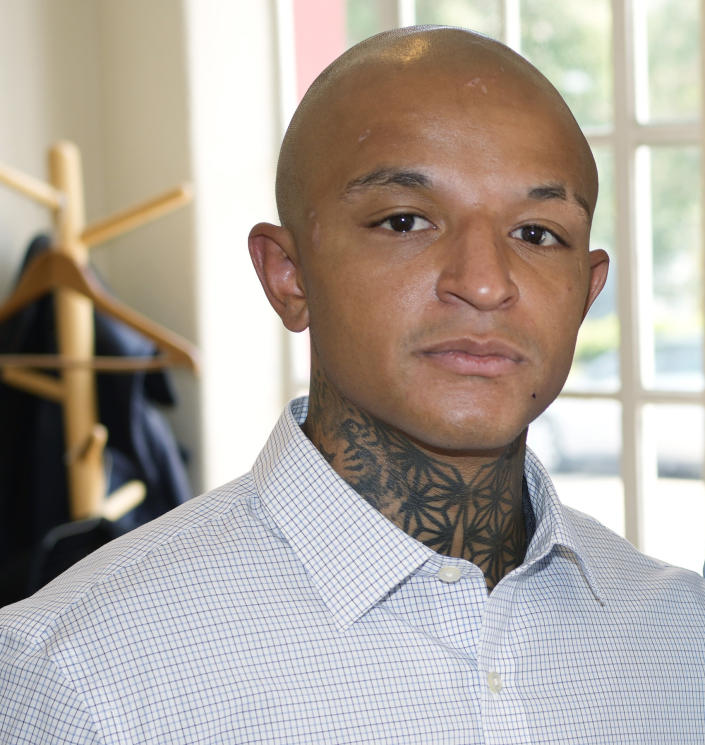
A former Los Angeles police officer accused of sexually assaulting four boys, including family members, died in custody Saturday night, according to law enforcement officials. Paul Razo, 46 — who was charged this month with eight counts of lewd acts upon a child — died at Los Angeles General Medical Center, the Los Angeles County Sheriff’s Department said Monday. Razo was undergoing treatment “for a pre-existing medical condition,” according to a statement from Lt. Michael Gomez of the sheriff’s homicide bureau. He did not answer questions on whether Razo was undergoing a procedure when he died at 7:24 p.m. Gomez noted that an autopsy would be performed to determine the cause of death.
Former LAPD officer Paul Razo, 46, who was charged with eight counts of lewd acts upon a child, died at Los Angeles General Medical Center, according to the Sheriff’s Department. (Los Angeles County Sheriff’s Department)
Razo, who worked for more than 25 years at the Los Angeles Police Department, was arrested May 10 by detectives with the sheriff’s special victims unit. He was accused of sexually assaulting four boys, believed to range in age from 9 to 13, at his Covina home. Two of the boys were his relatives, according to the L.A. County district attorney’s office; the others were the sons of a woman he dated and reportedly regularly spent the night at the home. L.A. County prosecutors alleged that the assaults took place between 2006 and 2017, when Razo was a member of the LAPD. He left the department in April. Razo had been awarded the department’s Medal of Valor for saving a man from a burning car in July 2016 in Glendora.
We reported recently on the Concord police vehicle that passed a stopped school bus; luckily, the bus driver was vigilant, saw a potentially bad situation developing, and ordered the child to stop before he/she stepped off the bus.
This medium supports good policing yet seeks to hold criminal cops accountable. Police officers are people, too. Officers deal with stressful situations each day in their jobs. They also deal with personal matters in their lives as well. I hardly believe that this officer willfully drove past a stopped school bus knowing the danger to children. I, therefore, think this was a moment in which the officer was preoccupied, possibly in thought, about something going on in his life, public or private.
Sgt. Matthew Willet,
This is a teachable moment for the police all across the United States who interact with members of the public. Daily we see police officers berating, disrespecting, brutalizing, and even killing people for the most minute and insignificant thing, things they themselves do without consequence. As I personally chastise police for the god complex, far too many of them develop after they are given a gun and badge; I also urge grace and mercy in the way this officer is treated because I believe his actions were not willful.
.
.
.
Mike Beckles is a former Police Detective, businessman, freelance writer, black achiever honoree, and creator of the blog mikebeckles.com. See Mike’s Youtube channel @ mikebeckles
This happens when white people in positions of power believe they are shielded from the violence police perpetuate against people of color. They are going as far as to roll back rules that make it public when those lying criminal cops commit perjury on affidavits and while testifying in court to the point they can no longer be relied on as witnesses. It is important to understand that rolling back provisions in the law that make it public that cops are lairs and that their testimony cannot be trusted means that cops will become more empowered to lie, plant evidence, and commit perjury to convict people they have as they have been doing for tens of decades. The system of white supremacy unleashed in 2016 by Donald Trump has reignited the old system of racism African-Americans experienced generations ago. Don’t forget also that Florida’s Ron Desantis has ordered Colleges and Universities to end diversity hiring and training. He has also thrown his support behind New York City Subway killer Daniel Penny, the 24-year-old Marine sergeant who murdered Jordan Neeley. The demons are loose. (mb)
By Virginia Bridges
At a time when the public is calling for more police accountability, two organizations are competing for control over the process that gives officers an often career-ending label of being untrustworthy. A bill working its way through the General Assembly has lifted a curtain on a dispute between North Carolina criminal justice stakeholders. The disagreement could help officers deemed untrustworthy on the job land new positions in law enforcement, according to experts. North Carolina’s Conference of District Attorneys and the Police Benevolent Association disagree about who should control a process intended to prevent cops with a history of bias, lying or fabricating evidence from testifying in court. In its current form, House Bill 704 would repeal a section of a 2021 law that requires officials to tell state law enforcement commissions when a district attorney deems an officer or deputy untrustworthy to testify. The law requires officers, their employers, prosecutors and judges to report what are often called Giglio letters. The bill, which passed in the House and has moved to the Senate, repeals a section of a law signed by Gov. Roy Cooper in September 2021. It was part of a bipartisan effort to identify and track bad cops and police use of excessive use of force, a priority for states across the country after the murder of George Floyd in 2020.
The proposed repeal of a portion of the law has vocal critics, including Dawn Blagrove, executive director of civil rights organization Emancipate NC, which is pushing for more criminal justice reform. ”This is disgraceful,” Blagrove said after a reporter informed her about the bill. She described it as a step back for criminal justice reform that decreased transparency about bad cops. Rep. Joe John, a Raleigh Democrat, was a primary sponsor of initial versions of the bill, which gave officers a route to appealing Giglio designations. He removed his name because the bill now focuses on repealing notification requirements, he said. Rep. Hugh Blackwell, a Burke County Republican and a primary sponsor in the House, didn’t respond to multiple requests for comments about the current language.
U.S. Supreme Court rulings since 1963 have required prosecutors to disclose relevant evidence that could raise questions about witnesses’ credibility, bias or motivation. That could include officers previously caught lying in a case or a witness who was offered immunity in exchange for testimony favoring the prosecution. In some cases, district attorneys issue Giglio letters to officers or their employers that outline what information would be disclosed if an officer testified in court. Sometimes the letters say the officers are deemed not credible and are barred from testifying in all cases in that jurisdiction. The letters are often called “death letters” because they can be career-ending. The 2021 law requires officers, agencies and district attorneys to report the letters barring court testimony to one of two North Carolina law enforcement training commissions. In 2022, 15 of those letters were reported, according to the first full-year tally report to a legislative oversight committee, also required by law.
Under the 2021 law, the Giglio letter is placed in an officers’ state certification file. The letters are shared with prospective law enforcement employers when an officer transfers to a new agency and with district attorneys in those locations. After a state certification agency receives a Giglio letter, the agency reviews the information, looking for violations of its rules. If violations are found, officers can face sanctions such as suspension or losing their certification.. The initial version of the current bill, introduced in April, would have required that officers receive notice of a pending Gilgio letter and the opportunity to dispute it. Backed by the Police Benevolent Association, which advocates for 16,000 officers in the state, the bill also created a process where officers could appeal their negative designation to superior court. The earliest version of the bill, circumvented prosecutors’ responsibility mandated by the United States Supreme Court, said Conference of District Attorney executive director Kimberly Spahos. The responsibility includes seeking out and reporting whether a government’s witness suffers from lack of credibility, dishonesty and other issues that will affect their ability to testify, Spahos said.
The authority is given to prosecutors and prosecutors alone and doesn’t give superior court judges or anyone else the authority to preempt or overturn the decision to force someone to call a witness they don’t think is credible, she said. The Police Benevolent Association disagrees with the conference’s stance on how far their authority extends, including the issuance of Giglio letters. The association is challenging officer Giglio designations in two cases working their way through state courts. Under today’s political pressure to hold officers accountable, some district attorneys aren’t gathering all the facts before issuing the letter, association Executive Director John Midgette said. In other cases, they are misapplying Giglio standards or sending the letters in retaliation, he said. Yet there is no way that officers can object to “this badge of infamy,” Midgette said.Representatives from the sheriffs association and police chiefs association said they support due process for officers who receive Giglio letters that is consistent with the Supreme Court decisions.
Representatives from the state sheriffs’ association and police chiefs association said they oppose repeal of the current law. “I think everyone can agree that we don’t want bad actors wearing police uniforms,” said Hendersonville Police Chief Blair Myhand, president of the North Carolina Association of Chiefs of Police. The NC Sheriffs’ Association supports the current law because it allows the commissions to identify problematic officers, said Eddie Caldwell, the group’s general counsel. The law created a process that allowed officers to object to the Giglio designation and officials to review the allegations and determine whether the officer’s certifications should be suspended or revoked, he said. The Police Benevolent Association representative Midgette said they don’t want to eliminate the opportunity to identify problematic officers, but want to give officers some due process in that system. “We just want to have fairness in the system so good officers have the right be heard before their reputations is ruined,” he said. The executive director of the North Carolina Conference of District Attorneys declined to take a stance on the current language in the bill. “What I can tell you is we don’t support law enforcement officers that have credibility issues being able to move around the state and us not know about it,” Spahos said.
An old Jamaican is saying, ‘If you dress up a pig and put it in a church, the pig doesn’t become a Christian; the church becomes a pigpen.’ Shout out to our departed ancestors who had the wisdom to leave us these nuggets. These days there is much conversation about the legitimacy of institutions that were long held to be sacrosanct. We are taught to respect these institutions because they are sacred edifices of Democratic governance. Truth be told, as a person who believes in the rule of law, I fundamentally side with institutions. I guess I could live with the label of institutionalist. The unfortunate downside to institutionalist ideals is that institutions are created and populated with imperfect men. It follows, therefore, that since the creators of our institutions were imperfect, and the people who run them are even more so, it becomes difficult to expect fealty to our institutions when they continue to show us they should not be trusted to do what’s right.
THESUPREMECOURT
Members of the nation’s highest court are appointed by men and women who are far from perfect and are confirmed by people with equally less character. The process of advice and consent is a farcical procedure used by senators to pontificate and bloviate along political lines while the judges seeking confirmation lie through their teeth and are confirmed. Others are allowed promotions to higher courts. Ten times ten is always going to be one hundred, but if you got to the tens incorrectly, the final outcome may add up, but how you got there is fundamentally incorrect. In simple terms, there has been much handwringing about the US supreme court and whether or not it is illegitimate. I have offered my own opinion on this matter in different forums. Sufficient to say that the process of a sitting president appointing justices to the court and they are voted up or down by the Senate is the standard.
When one side decides to thwart that process as Mitch McConnell did with President Barack Obama’s choice of now Attorney General Merrick Garland because they had the numbers in the Senate, is a reason that the high court has no legitimacy. To then add three Neil Gorsuch, Brett Kavanaugh, and Amey Coney-Barrett, three Trump appointees to the court, Barrett just weeks before Trump left office, degrades the legitimacy of the court in more than half of the nation. It is no wonder a Marist Institute for Public Opinion poll found that 62 percent of Americans say they do have much confidence in the court. The Supreme Court’s 1859 decision inDred Scott v. SanfordIn arguably the worst decision ever, the Supreme Court ruled that black people were not entitled to the same right of citizenship as white people. After Dred Scott, a former slave who had lived in the free state of Illinois and free territory of Wisconsin, had moved back to the slave state of Missouri, it was found that he should be returned to slavery. Scott appealed to the Supreme Court seeking his freedom. The court ruled against Scott and also ruled that the 1820 Missouri Compromise was unconstitutional, making slavery constitutionally permitted throughout the entire country and its territories.
The Supreme Court’s 1896 decision in Plessy v. FergusonThis ruling upheld separate but equal and established “apartheid” as the law of the land. The ruling would stand until overturned by Brown v. Board of Education in 1954, and its descendant Jim Crow would remain the de facto law of the South until the Civil Rights Act of 1964. Plessy was a bi-racial man who refused to move from a “blacks-only” railway car in Louisiana. The Supreme Court ruled that Louisiana’s Separate Car Act did not contradict the equal protection clause of the Fourteenth Amendment. The court declared that the Constitution guaranteed legal but not social equality. Although the opinion itself does not contain the language “separate but equal,” legal segregation was the de facto effect. Judge John Marshall Harlan was the sole dissenting vote. In his dissenting opinion Harlan wrote “Our Constitution is colorblind, and neither knows nor tolerates classes among citizens.” Plessey’s civil disobedience was a forbearer of the tactics immortalized by the civil rights movement of the 1950’s and 1960’s including the historical and legendary Montgomery Bus boycott when Rosa Parks refused to give up her seat.
The Supreme Court’s 1883 decision in Pace v. Alabama, In Alabama, interracial marriage was a crime punishable by two to seven years of hard labor in a state penitentiary. Tony Pace, a black man, and Mary Cox, a white woman, challenged the law. The Supreme Court ruled that the law was constitutional because it was “race-neutral” and therefore did not violate the Fourteenth Amendment. The ruling was finally overturned in Loving v. Virginia (1967).
The Supreme Court’s 1944 decision in, Korematsu v. United States, the ruling determined that Japanese internment during World War II was constitutional. Chief Justice Hugo Black wrote that the need to protect American from espionage outweighed the individual rights of Fred Korematsu and the civil rights of all Americans of Japanese descent. The Court refused to address all the other civil rights violations that marked the internment of Japanese Americans during World War II. Korematsu also lost a later ruling that established that individual rights are not absolute and could be suspended during wartime. The Supreme Court case is poignant reminder to anyone that is not concerned with the extent to which the last two administrations have become to scale back on civil liberties as a reaction to the war on terrorism. The Authorization for Use of Military Force grants the president the right to use all “necessary and appropriate force” against any person or country that was involved with the attack on September 11, 2001, including American citizens. The National Defense Authorization Act allows the military to detain United States citizens indefinitely without charge or trial for mere suspicions of ties to terrorism. The Patriot Act allows for warrantless wiretapping and electronic surveillance under the Foreign Intelligence Surveillance Act.
The Supreme Court’s 1986 decision inBowers v. Hardwick,Bowers issued a ruling that sex between gay and lesbian partners was a crime. The court actually narrowed a Georgia sodomy law that found all oral and anal sex to be illegal. All sodomy laws were eventually invalidated by the Supreme Court decision in Lawrence v. Texas (2003).The ruling was made at a time when the court was deeply homophobic and concerned with rulings on privacy matters. Legislating morality from the bench, Chief Justice Warren E. Burger wrote “to hold that the act of homosexual sodomy is somehow protected as a fundamental right would be to cast aside millennia of moral teaching.”
The Supreme Court’s 1978 decision in Federal Communications Commission v. Pacifica Foundation,This ruling gave the FCC regulatory authority over free speech over broadcast media. The case established that certain words, famously George Carlin’s Seven Filthy Words, were not suitable for television. The court held that although the words were not obscene they were indecent. And subject to restriction. The original seven words included “s*it, p*ss, f*ck, c*nt, a*s, b*tch, and tits”, but during his comedy routine, Carlin would also include “c*cksucker, motherf*cker, turd, fart, and tw*t.” Since then some of the words, i.e., b*tch, tits, turd, fart and a*s, have pretty much come off the list but the ruling is still in effect. The ruling of course does not apply to subscription-based, non-broadcast media e.g. cable TV and satellite radio.
As the Supreme Court comes under the spotlight, with the reported Perks Clarence Thomas receiving perks and the wife of John Robert’s entanglements, the real question remains how legitimate is this court/ This is the body that overturned parts of the 1965 Voting Rights Act in 2016 in the befuddling decision in Shelby County, Alabama Vs Holder. This ruling opened the door for massive voter suppression laws that have been passed all across the Republican-run States. This Court upheld Citizens United allowing a flood of dark money into American Elections. This Supreme Court overturned 49 years of precedent on precedent in the Dobbs decision, effectively ending Rove Versus Wade. John Roberts believes that the idea of separation of powers enables the court to do as it pleases and that the people’s representatives in Congress should have no oversight or say-so in how the justices operate. If John Roberts is correct in his and the other eight (8) justices’ assertion, then the Republic is effectively ruled by eight robed kings and queens who have clearly decided they answer to no one.
.
.
.Mike Beckles is a former Police Detective, businessman, freelance writer, black achiever honoree, and creator of the blog mikebeckles.com.
The activists face 20 years in prison for handing out flyers that identified a cop they said was linked to the killing of a protester in the Atlanta forest.
THREEACTIVISTSINVOLVED in the Defend Atlanta Forest movement are facing charges of felony intimidation of an officer of the state and misdemeanor stalking for placing flyers on mailboxes in a neighborhood in Bartow County, Georgia, about 40 miles from Atlanta. The detainees were held for days in solitary confinement, a lawyer working on the case and a relative of one of the activists told The Intercept.
The flyer, according to the lawyer, named a police officer who lives in the area where the activists were arrested and alleged he was connected to the killing in January of forest defender Manuel “Tortuguita” Terán during a multi-agency raid on the Atlanta Forest protest encampment.
A forensics report from the Georgia Bureau of Investigation about guns fired during Tortuguita’s killing named six state patrol officers: Bryland Myers, Jerry Parrish, Jonathan Salcedo, Mark Jonathan Lamb, Ronaldo Kegel, and Royce Zah. According to public records, one of the officers named lives in the area where the activists posted flyers. The report was obtained by the Atlanta Community Press Collective, an abolitionist nonprofit media group, through an open records request.
Julia Dupuis, Charley Tennenbaum, and an activist named Wednesday were arrested at a gas station outside the town of Cartersville on Friday. According to their lawyer, Lyra Foster, the activists drove once through the neighborhood and placed flyers on numerous mailboxes without exiting their vehicle or approaching any residents.
If found guilty, they could each face up to 20 years in prison.
“They were not handing out flyers, they were actually extremely careful in trying to avoid doing anything illegal,” Foster told The Intercept. “They posted the flyers on mailboxes, they did not even get out of the van to put flyers on the doors, and did not open the mailboxes because they thought that was potentially illegal.”
“They posted the flyers on mailboxes, they did not even get out of the van to put flyers on the doors.”
The attorney added that the activists “certainly had no intention to intimidate the officer” and “were trying to spread awareness about the police killing.”
All three arrestees are being held at Bartow County Jail; all were denied bond by a magistrate judge on Monday. None of the defendants has a criminal history, nor is there any allegation of violence in the current charges. “Denying them bond was extreme, in my opinion,” Foster said.
According to Foster as well as Dupuis’s brother, Nicholas Kees Dupuis, the activists were held in solitary confinement until Tuesday; no reasons were given by the jail, according to the attorney.
Spokespeople for the Bartow County sheriff’s office and district attorney’s office did not respond to a request for comment, nor did the Georgia State Patrol.
Last month, an official autopsy report revealed that the unarmed Tortuguita, 26, was shot at least 57 times when police stormed the protest encampment. Repressive policing has escalated in recent months against the movement to stop a $90 million police training center — “Cop City” — from being built atop Atlanta’s forest. Forty-two movement participants currently face state domestic terrorism charges for allegedly engaging in minor property damage – the evidence for which is as flimsy as police citing mud on protesters’ shoes.
Organizers trying to stop Cop City see these latest arrests as part of a pattern of extreme overreach and efforts to silence outrage over Tortuguita’s killing.
“Ever since state police killed Tortuguita, their top priority has been to keep the situation quiet. Now that the public is calling attention to it, police are doubling down,” said Marlon Kautz, an Atlanta-based organizer with the Atlanta Solidarity Fund, which provides bail funds and legal support to protesters. “It’s exactly the same strategy they’ve used before against Stop Cop City protesters: wave around extreme charges, throw activists in jail without bail, and hope the problem goes away.”
Nicholas Dupuis told The Intercept that his family learned of his 24-year-old sister’s arrest upon receiving a call from animal control in Cartersville, explaining that they had her dog, as she had been arrested. While Julia Dupuis, a freelance writer and anti-racist activist, is primarily based in Massachusetts, she had spent a number of months in Atlanta as a part of the Stop Cop City movement.
According to their attorney, Tennenbaum is a camp counselor who works with targeted communities in Atlanta, and Wednesday is an Atlanta-based artist and activist. Both have Atlanta addresses, according to Bartow County Jail records.
Officials in Atlanta, including the police, have sought to demonize forest defenders as “outside agitators”; the attack, historically used to discredit civil rights struggles, has failed to gain popular purchase. The movement, which made a wide call for supporters to join, is explicit in seeking to connect the local fight to stop Cop City and save the Atlanta forest with national and international movements against environmental racism and police violence.
Meanwhile, the Cop City project is hardly local: It is being funded by numerous multinational corporations, including Wells Fargo and Bank of America. The Atlanta Police Department told the Atlanta City Council that it intends to recruit 43 percent of trainees for the planned facility from out of state.
Last month, the Atlanta Community Press Collective released the names of the six officers identified by the Georgia Bureau of Investigation in connection with Tortuguita’s killing and published a link to the GBIreport. GBI spokesperson Nelly Miles said the agency had not released the officers’ names and cited an exemption under state public records law used to redact documents. The names were not redacted in the version of the report obtained by the Atlanta Community Press Collective, which said it got the document from the Dekalb County Medical Examiner’s Office.
“They carefully exercised their First Amendment rights and left the area,” Foster, the attorney, said of the activists’ distribution of the flyers. “An unarmed activist died in a hail of gunfire in the woods and now the state says it’s felony intimidation to even talk about that.” (From the intercept) Police state!!!
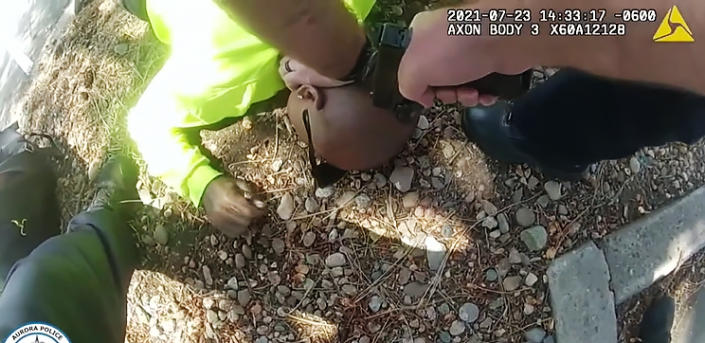
A former Colorado police officer has been found guilty of failing to intervene as another officer pistol-whipped and strangled an unarmed man. Francine Martinez, who worked for the Aurora Police Department, became the first officer in the state to be convicted by a jury under a police accountability law requiring officers to intervene if they witness colleagues using excessive force. The law was adopted in 2020 after the death of George Floyd, a Black man who was killed by a Minneapolis police officer outside a corner store as three other officers stood by. A jury in Arapahoe County District Court determined last week that Martinez stood by as former officer John Haubert struck Kyle Vinson more than a dozen times with his handgun and threatened to kill him in July 2021. Haubert also pointed his gun at Vinson’s head, bodycam video shows. Vinson sustained a cut on his head, and one eye was swollen shut.
Kyle Vinson in Denver in 2021. (David Zalubowski /AP)
Martinez was fired, and Haubert resigned. “This should be a wake-up call for all law enforcement officers that the thin blue line of silence won’t be tolerated in Colorado,” Vinson’s attorney, Siddhartha Rathod, said Tuesday. “Officers have a moral, ethical and legal duty to intervene and to say something when their fellow officers are committing acts of violence or crimes or other wrongdoings.” The former officers were responding to a report of trespassing in the 3100 block of South Parker Road when they encountered three people who had outstanding felony warrants and tried to arrest them. Two of the people ran, but the third, Vinson, did not, police said.
Martinez
Video showed Haubert with his hands around Vinson’s throat for 39 seconds as Vinson appeared to begin to lose consciousness. In an affidavit, a witness, Jamie Bourknight, claims that Vinson kicked one of them; the video does not appear to show it. “We’re disgusted. We’re angry. This is not police work,” then-Police Chief Vanessa Wilson said at the time. “We don’t train this. It is not acceptable.” Phone calls to Martinez and her attorney, David Goddard, were not returned Tuesday.
Officer John Haubert holds a gun to Kyle Vinson’s head on July 23, 2021, in Aurora, Colo. (Aurora Police)
Colorado’s “failure to intervene” law also requires all officers to use body cameras by this July, bans chokeholds, limits potentially lethal uses of force and removes qualified immunity from police, potentially exposing officers to lawsuits for their actions in use-of-force cases. “I watched the majority of it [the body camera video] — not all at once, but it’s kind of hard to take in,” Vinson told NBC affiliate KUSA of Denver. “I’m just thinking I’m thankful I’m still here, because I thought I was going to die or be another Elijah McClain or George Floyd.” Martinez is the first officer to be convicted by a jury under the law.
Violent thug John Hauber. Not all cops are like this, but it has become increasingly difficult to find good officers. Even when they see their colleague committing felonies, they say and do nothing. It is for those reasons that qualified immunity should go, and the Failure to intervene law is so important.
Former Loveland officer Daria Jalali pleaded guilty last year to failing to intervene during the arrest of a 73-year-old woman who had dementia. Jalali, who no longer works for the Loveland Police Department, was sentenced to 45 days in jail. Martinez, who was convicted of a misdemeanor count of failure to intervene for her role in the arrest of Vinson, faces up to a year in jail when she is sentenced on June 2. Haubert is charged with first-degree assault causing serious bodily injury with a deadly weapon, second-degree assault/strangulation and felony menacing, among other counts. His trial is scheduled in November.
This article was originally published on NBCNews.com
Electing Blacks to positions of power does not guarantee change. Hiring more Blacks and Hispanics to be cops does not improve the broken culture of what passes for politics and policing in America. A significant amount of data bears that out, corrupt cops and repreg=hensible politicians come in all colors, and so do judges and everyone else. Hello Clarence Tom-Azz. (mb)
The story By Akela Lacy of the Intercept.
The Minnesota attorney general took over a murder case from Hennepin County Attorney Mary Moriarty, a fellow reformer. She accused him of playing politics.
PROGRESSIVESREJOICEDLAST year when Democrat Keith Ellison won a tight reelection race for Minnesota attorney general against a police-backed opponent who attacked him as being “soft on crime.”
In the same election cycle, Ellison’s ally Mary Moriarty won election as Hennepin County attorney, installing a reform-minded prosecutor in Minneapolis about three years after the city’s police murdered George Floyd. Moriarty, previously the chief public defender for Hennepin County, took office in January and implemented reforms with a focus on correcting failures in the juvenile justice system.
Now, three months into their terms, Ellison and Moriarty are no longer on the same side of the reform platform they once shared.
Late last month, Moriarty’s office issued new guidance on prosecuting children, which was designed to keep as many kids as possible out of the adult criminal system. Before issuing the guidance, Moriarty’s office chose not to charge two teenage brothers accused of murder as adults.
Last week, Ellison’s office intervened in the juvenile murder case. His office described the juvenile charges as “inappropriate” and requested that the governor take the case away from Moriarty’s office and assign it to him. Democratic Gov. Tim Walz, who was reelected along with Ellison and Moriarty last November, assigned the case to Ellison on Thursday — pitting the two would-be reformers against each other.
A source involved in the jurisdictional dispute, who requested anonymity to discuss sensitive private deliberations, said Ellison told Moriarty he needed to appear tough on crime for his next reelection campaign. “The Attorney General denies having said that or anything like it,” said Ellison spokesperson John Stiles.
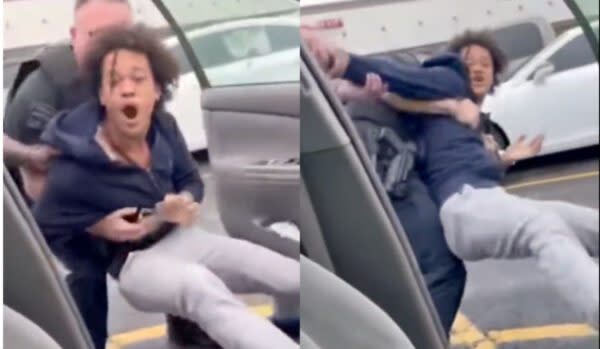
Houston Teen Dragged Out of Car and Violently Arrested While Helping Friend Stuck In Parking Lot Without Gas.
The Harris County Sheriff’s Office announced last week that several of its deputies are under investigation in connection with their conduct during the arrests of two Houston-area high school football players this month. Video of the incident was shared on social media last week and sparked accusations that the deputies used excessive force during the arrests. According to a statement released by the HCSO, the department is launching a probe to see if “any policies and procedures were violated” during the arrest.
Harris County Sheriff deputies drag teens out of a car. (Photo: Sarmad Faiz/Twitter video screenshot)
The video, shot this month in what appeared to be a shopping center parking lot, showed officers arresting Seth Palumbo, a football player at Langham Creek High School in suburban Houston, after he’d apparently been called by teammate Kristopher Willis when Willis ran out of gas, local station ABC 13 reported. Willis had just left school when he ran out of gas and called his two friends to come to help him. “As my friends pulled up, I gave them the bottles I had so they can fill it up with gas so I can make it to the gas station,” Willis told the station. Willis stated that at that time about three or four police units appeared and pulled them over. It is not clear whether Willis and Palumbo’s cars were in the roadway at this point. One video shot by a passenger in Palumbo’s car shows a deputy pulling Palumbo out of his car. The teen is seen shouting that he didn’t do anything as the deputy is dragging him out the car.
In what looks like chaos, the deputy is pulling the senior around and then slamming him on the ground. Other deputies surround the car and even try to stop the arrest from being filmed by Willis, who whipped out his cellphone to record from another angle. The one passenger recording in the car is told to exit the vehicle before his phone is taken. His phone is then placed camera-down by the deputy, obstructing any video for the remainder of the recording. The deputies arrested and originally charged both seniors, Willis and Palumbo, in the altercation. They were also taken to jail. Willis was charged with a misdemeanor count of impeding a roadway. Palumbo faced one count of assaulting a peace officer, a felony charge. On Friday, April 14, a judge failed to find probable cause for Palumbo’s assault charge, leading to its dismissal. In his first interview after the incident, the young man took issue with the deputies being called “peace officers.”
“I feel like police are really supposed to be peace officers. I feel like he just did a lot of aggravation. He wasn’t really trying to be peaceful. I feel like we don’t need people like that in the community,” ABC 13 reported Palumbo said after the judge’s decision. Willis’ misdemeanor was not dropped, and his parents, an elementary school principal (mom) and a high school math teacher (dad) plan to take action after feeling outraged by the turn of events. “I really think the police should be held accountable the same way they are holding my son accountable for a crime he did not commit,” said Kristopher Willis Sr. Willis Sr. actually originally posted the videos on Facebook.
Attorney Antuan Johnson, the lawyer representing the Willis family, said he applauds the young men for not cowering to the badges and shutting off their phones. “The only reason we are here is that he had the courage to get out the phone and record, and by that, we were able to see what happened,” Johnson said. The HCSO released a statement regarding the video and said, “After reviewing the videos, we are investigating the incident to determine if any policies and procedures were violated.” Adding its office has temporarily reassigned a deputy to a different area “pending the outcome of the investigation.” “We take these matters seriously and will ensure a thorough investigation is completed in a timely manner,” the statement said. “Our deputies are held to the highest standard of professionalism, and any employee whose conduct does not align with departmental policies will be held accountable for their actions.”(from Yahoo news)
To add insult to injury, the Harris County Sherrif’s office issued in red form response to the families. Why does the public care about department policies? Each person should be held to the same standard under the law in a democratic society. So no one should care about department policy , if the Sheriff’s thugs broke the laws, they should be vigorously arrested and prosecuted as any other person. Why are they not arrested for assault and kidnapping is the question.? (mb)
Every day average American citizens face these corrupt actors, and they complain if they are lucky to survive the encounter with them. Their complaints usually have to be made to the very same corrupt Agency, albeit another department created to give the illusory effect of transparency and impartiality. Complaints are generally ruled unfounded or unsubstantiated. On the odd occasion that the evidence of wrongdoing is so overwhelming that it cannot be ignored, the offender gets a slap on the wrist; as you will see in the case below that the victory to the abused party is a pyrrhic one. New York City has a Civilian Complain Review Board (CCRB) that is mandated to investigate abuses by the 36,000-plus police department; somehow however,the creators the body forgot to give the board power to punish offenders. So the board’s findings have to be submitted back to the Police Commissioner for action. In case you are wondering why American police officers act with such impunity, wonder no more; they act with impunity because they have near blanket immunity. There are those who believe that adding more officers of color will change the behavior of police, but that is far from the case. In California, the LA Sheriff”s office is populated heavily with Hispanics, and that department is plagued with outright criminal gangs operating in that department under the color of law. In Miami, Florida, the Miami police department is also heavily Cuban American, and that department is probably one of the worst in the country. The cops who murdered Tyre Nichols in Tennesee were all black, and so was Mister Nichols. In incident after incident, we see police of all races acting in ways more unlawful and outrageous than ordinary civilian criminals. In almost all cases, there are other officers standing around or engaging in criminal conduct against civilian members of the public, yet no one intervenes to stop the criminal conduct. Where are the supposed good cops? So the issue is not about just the race or color of police these days. The very construct of policing in the United States is so badly broken that it cannot be repaired; it has to be dismantled and reimagined. They are not about to do that, so the public will continue to be at the mercy of these undisciplined state actors. (mb)
.»»»»»»»»»»»»»»»> By Thomas Tracy New York Daily News.
NYPD Chief of Department Jeffrey Maddrey in Queens on April 14, 2023. (Theodore Parisienne/for New York Daily News)
Police watchdogs hit the NYPD’s highest-ranking uniformed officer with an abuse of authority charge for intervening in the detention of a retired cop accused of threatening a group of teens with a gun. The Civilian Complaint Review Board said Saturday it had substantiated the charge against NYPD Chief of Department Jeffrey Maddrey. Under CCRB guidelines, “substantiated” means the board believes there is “sufficient credible evidence” that Maddrey “committed the alleged act without legal justification. It’s now up to Police Commissioner Keechant Sewell to determine Maddrey’s penalty. If Sewell imposes a penalty, Maddrey could refuse to accept it, triggering a disciplinary hearing, officials said.
Maddrey was accused of showing up at the 73rd Precinct stationhouse on Nov. 24, 2021 following a clash between retired NYPD Officer Krythoff Forrester and three teens in Brownsville. Police had taken Forrester into custody after the teens stated he had chased them with a gun after they struck a security camera at his family’s storefront business with a basketball. Forrester used to work with Maddrey and began dropping his name to arresting officers, according to The City, which first reported the charges. A short time later, Maddrey, who was chief of the NYPD’s Community Affairs Division at the time, and Brooklyn North Deputy Chief Scott Henderson showed up at the stationhouse. Within a few hours, Forrester was let go without charges. Forrester was then sent home, officials said.
An NYPD spokesman said at the time that Maddrey ordered a full investigation, but Forrester was let go after the teens’ allegations couldn’t be confirmed. The department’s Internal Affairs Bureau also investigated allegations that Maddrey ordered Forrester cut loose, but found no wrongdoing. When asked about the incident in March, Mayor Adams backed Maddrey’s intervention, claiming Maddrey had “handled it appropriately.” The CCRB decision counters the NYPD probe. “After carefully reviewing the evidence, the full board deliberated this case and substantiated misconduct against Chief Maddrey,” Arva Rice, interim chair of the CCRB said in a statement Saturday. Working off the NYPD’s disciplinary matrix, which outlines penalties for accused abuses, the CCRB recommended Maddrey receive a command discipline, which comes with a maximum loss of 10 vacation days, CCRB officials said. MK Kaishian, the attorney representing the three teens, called for Maddrey’s resignation.
NYPD Chief of Department Jeffrey Maddrey speaks to the media in Brooklyn on April 13, 2023. (Gardiner Anderson/for New York Daily News)
She said Maddrey “leveraged his power to spring a former colleague who had terrorized children with a gun, but he allowed those same children to be vilified and discredited in the media by his allies in the aftermath of his misconduct.” “It is essential that other concrete steps are taken to address Chief Maddrey’s conduct, which has been defended by police and other influential actors in NYC precisely because selective enforcement is a feature of a system that serves the powerful at the expense of all others,” Kaishian said. Maddrey ran afoul of police department rules in 2017, when he was docked 45 vacation days for failing to report an incident in a Queens park where he waved off responding officers who saw an alleged lover point a gun at him. That case was brought by internal NYPD investigators, without CCRB involvement.
Aside from the case involving the Brownsville teens, Maddrey has been investigated four times by the CCRB during his decades-long police career, city records show. All four cases involved accusations of abuse of force. None of the cases were substantiated. Emails to both Maddrey and the NYPD for comment were not immediately returned. Since being made police commissioner last year, Sewell has reduced, set aside or ignored hundreds of police misconduct penalties recommended by the Civilian Complaint Review Board, according to criminal justice advocates and a study conducted by the Legal Aid Society. In a message to police officers in December, Sewell said she has rejected CCRB discipline recommendations more often than other recent police commissioners, claiming that some of the police watchdog group’s rulings were “manifestly unfair” to officers.
An 80-year-old man filed a lawsuit this week against an eastern Kansas sheriff’s office for allegedly tasing him without warning after officers pursued him for driving three (3) mph over the speed limit. In his federal lawsuit, John Sigg said a lieutenant with the Iola Police Department in Allen County on April 16, 2021, clocked him driving 38 mph in an area where the speed limit was 35 and decided to give “chase.” Multiple police vehicles followed Sigg for a few minutes as he drove to his family’s car lot, although he did not realize he was “the subject of the pursuit,” his attorney wrote. He parked, got out, and was surrounded by officers from several agencies. Two Chanute police officers pulled their guns on Sigg, according to the lawsuit. Looking “quizzically” at them, he raised his hands, which can be seen in a screenshot of body-camera footage of the incident.
“Get on the f — ing ground,” a now-former deputy with the Allen County Sheriff’s Office yelled, according to the lawsuit filed in the U.S. District of Kansas. Without warning, the deputy used a Taser on Sigg — even though the manufacturer of the TASERX2 warns about using it “on the elderly,” his lawyer wrote. Sigg dropped “like a rock,” his attorney said and cut his head. “Sigg mumbled and was hard to understand,” his Wichita attorney, Randall Rathbun, wrote in the lawsuit. “As officers talked with him on the scene, he indicated that he did not know what was going on and did not feel right.”
Rathbun, who served as the U.S. attorney for the District of Kansas from 1993 to 1996, told The Star that Sigg required a trip to the emergency room to remove the taser probes from his body. “To this day, he can’t believe they did it,” he said. Other cops at the scene knew the deputy used excessive force and “were concerned by his conduct,” the lawsuit alleges. The petition seeks a judgment of $250,000 in actual damages and $250,000 in punitive damages. The sheriff’s office did not return a message seeking comment Tuesday afternoon. Court records show Sigg pleaded guilty to failing to yield to an emergency vehicle after the incident. (from yahoo news)
Here we go again with these hammers; everything is a nail. The first option the next option and the last option is to unholster their weapons and open fire. The end results are innocent people dead, even in the sacred sanctum of their homes, having committed no crimes. How long is this society going to pretend that this is normal? In what other society are state agents allowed to murder people in their own homes and pretend all is well? This is a sick, broken system with trigger-happy morons parading as police officers wreaking havoc on a badly broken society.(mb)
Farmington Police Chief Steve Hebbe
Police in New Mexico fatally shot a man Wednesday night after responding to the wrong house during a domestic violence call, authorities said, in what the police chief described as a “chaotic scene.” The shooting took place shortly before midnight on Wednesday as officers from the local Farmington Police department responded to the call, according to a statement released by the state’s Department of Public Safety. The statement said the New Mexico State Police Investigations Bureau had been asked to investigate the incident. “Once on scene, officers mistakenly approached” the wrong address and knocked on the door. The statement from the state public safety authority said the officers identified themselves as police, but no one answered. The statement said officer body camera video shows that as the officers backed away from house, the homeowner opened the screen door armed with a handgun. One or multiple officers fired at least one round, striking the homeowner, who police identified as 52-year-old Robert Dotson.
After Dotson was shot, his wife emerged in the doorway and opened fire with a handgun, the public safety agency said, prompting return fire from the officers. “Once she realized that the individuals outside the residence were officers, she put the gun down and complied with the officer’s commands,” according to the statement. Dotson was pronounced dead at the scene by the Office of the Medical Investigator. His wife, who was uninjured, has not been charged with a crime. In a video statement, Farmington Police Chief Steve Hebbe acknowledged the mistake and said he was “heartbroken by the circumstances.” He said after the officers release statements, body camera video will be released within a few days, showing a “chaotic scene.” Hebbe said it was a “very dark day” for the Dotson family, the community and the police department. “I extend nothing but my deepest condolences to the Dotson family,” he said. “There’s nothing I can say that will make this better. It’s a terrible event, and I’m heartbroken by it.”
A police officer has been found guilty of sexual assault after he pulled a woman out of a hotel bed by her hair. PC Joseph McCabe, 27, based in Harrogate with North Yorkshire Police, was spared jail on Friday during his sentencing at York Magistrates’ Court. He was sentenced to six months in prison, suspended for two years, on condition he undergoes a rehab programme. He was also subjected to a three-year restraining order aimed at protecting the victim. McCabe is currently suspended from duty, but North Yorkshire Police said an accelerated misconduct hearing will now be considered at a “future date”. McCabe had denied sexually assaulting the woman last summer, but was convicted in February following a trial The court heard McCabe and the victim were known to each other and were sharing a hotel room after a social event. The victim said McCabe picked her up during the night and put her on his bed, then stroked her arm.
Police officer Joseph McCabe was found guilty of sexual assault after pulling a woman from a hotel bed by her hair. (SWNS)
She returned to her own bed, but later McCabe pulled her hair with such force she fell out of bed, the court heard. The court was told he also shouted at the victim several times to get into bed with him. McCabe was later interviewed and subsequently charged, the force said. North Yorkshire Police deputy chief constable Mabs Hussain said: “Our communities need to know that they can have complete trust in their police, and that we demand the highest level of integrity from our officers and staff. “McCabe’s disgraceful actions fell far below that standard. “I commend the victim for her courage in coming forward so we could take action. “I also hope the case sends a clear message that there is no place for this behavior in policing – and that we will secure justice against perpetrators, no matter who they are.” (From Yahoonews)
MOREPOLICENEWS
Minneapolis and state agree to revamp policing post-Floyd
Minneapolis Mayor Jacob Frey, right, pats the shoulder of Minneapolis Police Chief Brian O’Hara after O’ Hara spoke during a press conference announcing approval of a sweeping plan to reform policing that aims to reverse years of systemic racial bias Friday, March 31, 2023, at the Minneapolis Public Service Building in Minneapolis. The Minneapolis City Council on Friday approved an agreement with the state to revamp policing nearly three years after a city officer killed George Floyd. (David Joles/Star Tribune via AP) ASSOCIATEDPRESS
The city of Minneapolis and the Minnesota Department of Human Rights signed a “court-enforceable settlement agreement” Friday to revamp policing in the city where George Floyd was murdered by an officer nearly three years ago. The agency issued a blistering report last year after an investigation found the police department had engaged in a pattern of race discrimination for at least a decade. The City Council approved the settlement in an 11 – 0 vote. Mayor Jacob Frey and Minnesota Human Rights Commissioner Rebecca Lucero signed it soon after. “The agreement isn’t change, in and of itself, but it charts a clear roadmap to it,” Frey said at a news conference. Lucero said: “This agreement serves as a model for how cities, police departments and community members across the country can work together to address race-based policing and strengthen public safety.”
The state agency launched its investigation shortly after Derek Chauvin, a white police officer, knelt on Floyd’s neck for 9 1⁄2 minutes on May 25, 2020, disregarding the Black man’s fading pleas that he couldn’t breathe. Floyd’s death sparked mass protests around the world, forced a national reckoning on racial injustice, and compelled a Minneapolis Police Department overhaul. Chauvin was convicted of murder. He and three other officers on the scene are serving prison terms. “We didn’t get here overnight, and change also won’t happen overnight,” Frey said. “This problem that we now face, it has taken hold over many generations, many administrations, mayors and chiefs, and clearly our Black and brown communities have taken the brunt of this.” Lucero said the legally binding agreement requires the city and the police department to make “transformational changes” to fix the organizational culture at the heart of race-based policing. She said it includes measures to ensure force is used “only when it is objectively reasonable, necessary and proportional” and never “to punish or retaliate.” Officers must de-escalate conflicts when possible. There will be limits on when and how officers can use chemical irritants and Tasers.
And training in the disputed condition of excited delirium — a key issue in the confrontation that led to Floyd’s death — will be banned. Stops for broken lights and searches based on the alleged smell of marijuana are banned. Frey, Lucero, and Police Chief Brian O’Hara said the agreement reflects feedback from and the concerns of the community and police officers. “The court-enforceable agreement does not prohibit officers from relying on reasonable, articulable suspicion or probable cause of criminal activity to enforce the law. We want officers to do their jobs,” Lucero said. Civil rights attorney Ben Crump and other lawyers who won a $27 million settlement for the Floyd family called the agreement “monumental” and the “culmination of years of heartbreak and advocacy by those impacted by the poor policies and practices of the Minneapolis Police Department.”The U.S. Department of Justice is still investigating whether Minneapolis police engaged in a pattern or practice of discrimination. That investigation could lead to a separate agreement with the city known as a consent decree. City officials couldn’t provide information on where that stands.
Several police departments nationwide operate under federal consent decrees. Justice Department and city officials asked a judge Tuesday to end most federal oversight of the Seattle police department, saying its sustained, decade-long reform efforts are a model for other cities. The Minneapolis settlement, which requires court approval, also governs the use of body-worn and dashboard cameras, officer wellness, and response to mental health and behavioral crises. An independent evaluator must be appointed to monitor compliance. Several council members criticized the police department and other city leaders. “The lack of political will to take responsibility for MPD is why we are in this position today,” council member Robin Wonsley said. “This legal settlement formally and legally prevents city leadership from deferring that responsibility anymore. And I hope this settlement is a wake-up call for city leaders, who the public has watched rubber-stamp poor labor contracts, have signed off on endless misconduct settlements, and then shrugged their shoulders when residents asked why we have a dysfunctional police department.”
Some activists were upset that the agreement wasn’t posted publicly until after the vote. Michelle Gross, president of Communities United Against Police Brutality, said she would ask the state data practices office whether the council acted legally. She said her group must study the agreement before commenting on its merits. “This is not the way to start this process and vote on something the community’s going to have to live with for the next five or six years,” Gross said. Even council members had only about a day to study and discuss the document. “This is something we’ve been waiting for for a long time, and my hope is the city will act with fidelity, the city will act with integrity, and the city will follow through.” civil rights attorney Nekima Levy Armstrong said. (From Yahoo)
It’s been exactly three years since California Highway Patrol officers pulled over Edward Bronstein for a traffic stop and he died in police custody as he screamed, “I can’t breathe!” while officers restrained him to take a blood sample. You likely noticed the case sounds very similar to the murder of George Floyd? Only difference is that it occurred less than two months before Floyd was killed by police officers in Minneapolis as he also screamed, “I can’t breathe.
On Wednesday, Los Angeles County District Attorney George Goscón chargedseven California Highway Patrol officers and a nurse with involuntary manslaughter over the death of Bronstein. According to the Los Angeles County coroner, Bronstein’s death was caused by “acute methamphetamine intoxication during restraint by law enforcement” But, Goscón argued during a press conference that officers had a “legal duty to Mr. Bronstein” and he believes that “they failed their duty and their failure was criminally negligent, causing his death.”
On March 31, 2020, Bronstein was driving on Interstate 5 in Burbank when Officers Osmanson and Terry pulled him over for suspected driving under the influence. The officers then took Bronstein to a nearby CHP parking lot and obtained a warrant to draw his blood. Bronstein initially refused the blood draw but then agreed to comply as officers pushed him to the ground
The officers charged are accused of pinning Bronstein to the ground as a nurse drew his blood. While he was being forcefully restrained, Bronstein notified officers multiple times that he couldn’t breathe, to the point where he became unresponsive. Nearly 10 minutes after he became unresponsive, the officers attempted CPR, but Bronstein never regained consciousness and was later pronounced dead, according to the Los Angeles County District Attorney’s Office.
Also similar to the murder of George Floyd, an 18-minute video was released a year ago showing what led to Bronstein’s death.
If convicted, the officers face up to four years in prison.
One of the most important underpinnings that gird police violence in the United States is district, appellate, and the supreme court’s willingness to move the goalpost to accommodate police violence. Police officers and their departments know this, so when citizens stand on their constitutional rights, police blatantly tell them they do not care about what they do. Not only are they unfazed by the fact that even if successfully sued, they themselves will not pay a penny of the judgment they are über-confident they will not be prosecuted for their crimes, and if prosecuted, judges will go as far as to vacate a jury verdict to favor them. The calculus for the courts seems to be that despite what the constitution says and how right the citizens are about their rights under the constitution, the right of the state to control the citizenry is more important. Despite the hundreds of thousands of videos on social media that show police clearly brutalizing and murdering citizens, only a minuscule number of them are held accountable, and even when convicted, they are given a slap on the wrist compared to the penalties handed down to ordinary citizens. Black citizens are at even greater peril. Starting with 2015, the average prosecution of criminal cops is up to roughly 13 a year — meaning cops are now prosecuted in less than 2 percent of fatal shootings, up from less than 1 percent. But convictions haven’t increased much yet. Still, even the cases that result in charges are a tiny fraction of fatal police shootings. Even as the United States castigate and penalize other less powerful nations for alleged human rights abuse in their security forces, American police consistently continue to be among the words most lethal and abusive. Mapping Police violence collected data on nearly 1,200 killings by police in 2022. “We compiled this information from media reports, obituaries, public records, and databases like The Gun Violence Archive and the Washington Post. As such, this report represents the most comprehensive public accounting of deadly police violence in 2022. Our analysis suggests a substantial proportion of all killings by police in 2022 could have been prevented and that specific policies and practices might prevent police killings in the future”.(https://policeviolencereport.org)
Additionally, prosecutors’ unwillingness to prosecute crimes committed by the police further emboldens officers to be brazen with their brutality. Some experts looking at this issue have argued prosecutors’ close working relationship with police colors their judgment as it pertains to the prosecution of police officers. I believe it goes much deeper than mere working relationships. Politics and ideology are significant contributors to that dynamic. In June 2020, the New York Times reviewed national dispatch data from the FBI and found that just 4% of officers’ time is devoted to violent crime. Fighting and investigating violent crimes is hardly high on the agenda because it does not generate revenue for cities and municipalities. In fact, it can reasonably be argued cops are more interested in traffic stops to get the identification of drivers so they may generate revenue and check for warrants. This is the feeding tube to the for-profit prisons. So while many violent crimes, including murders and missing person reports, go unsolved, police are busy pulling drivers over because they failed to signal before making a turn. As you digest that, remember that your wonderful supreme court ruled that police have no specific obligation to protect. In its 1989 decision in DeShaney v.Winnebago County Department of Social Services. Yet in another decision, the court ruled local governments don’t owe duties to protect particular individuals,” they owe a duty to the public to protect. But that means that as a community, we have a right for the police to protect us.” The logic here is that collectively, citizens have a right to police protection, but individually we are on our own. It makes a lot of sense, — — –not.
.
.
.
Mike Beckles is a former Police Detective, businessman, freelance writer, black achiever honoree, and creator of the blog mikebeckles.com.
Here again, is a situation in which a little more talking and a little less bravado would have potentially resulted in a far better outcome. Instead, a [female cop], and it’s usually how it gets started, decided to show that she can do the job, so she escalates a situation in which the man experiencing an episode is surrendering to police from all accounts. But she decided to deploy a taser on a complying subject, and that is where things fell apart. Not only is the episodic man dead they almost killed an innocent person in a narrow hotel hallway. Why would a police officer in his right mind be so reckless with a firearm? Maybe it is time that the guns are taken away from them. How reckless is this?(mb)
Newly released bodycam footage shows that Booker T. Pannell III put his hands up and said, “Please, please, I don’t want to die” before Elk Grove police officers chased him down a hotel hallway and shot him Feb. 21. Pannell was pronounced dead at a hospital later that night. He was 40. In a brief phone conversation, his father — who shares his son’s name — said, “He was a good person. He was a good man. That’s all I can say right now.” The Elk Grove Police Department on Friday night released footage from body-worn cameras and a hotel security camera. An investigation into the officers’ use of force is ongoing. Pannell died during a continued local and national reckoning with policing practices fueled by fatal encounters with law enforcement. In January, the death in Memphis, Tennessee, of Tyre Nichols, a Black man who grew up in Sacramento, renewed scrutiny of police violence; five officers face second-degree murder charges for Nichols’ beating death. Mapping Police Violence and local news coverage show that police killed six people in use of force incidents in Sacramento County last year. Internal and outside investigators have not determined whether officers followed proper protocols the night Pannell died.
What led up to Booker Pannell’s death?
According to the video, someone called police Feb. 21 to report a carjacking near Shana Way and Whitelock Parkway. Dispatch received the report at 10:32. In the 911 excerpt in the video, the caller asks police to come to her house. “My husband had an altercation with his friend, and the friend took our car,” the caller says. “And he pulled a gun out on my husband.” An officer went to the house to take a statement from the husband. In the footage, the husband calmly emerges and speaks to the officer. He explains, “My friend and his girlfriend came by, and I was asleep. And long story short, he was having some type of side effects or whatever — I think he was on meth. So he was out here with his girlfriend … he’s been paranoid, saying the cops is looking into drones, stuff like that. So I said, look, let me take you to the hospital. He said he was starting to drive to the hospital with his friend, Pannell, and turned on his blinker to make a left turn on Whitelock when the friend said, “You in on it, too.” He said his friend started screaming, and said, “They’re coming to get me.” He said Pannell pulled out his gun, pointed it at him, and then pointed it at his own head. The husband fled the car. He told the officer, “I thought he was gonna kill me.” Around 11:40 p.m., the video says, officers went to the Holiday Inn Express on Stockton Boulevard and Laguna Boulevard, right off Highway 99. A hotel employee had reported a disturbance. A very short clip of security footage from the Holiday Inn shows a man in the lobby leaning over the front desk; that footage has no audio. When police arrived, they saw the car that had been reported stolen sitting empty in the Holiday Inn parking lot. They determined Pannell was the man in the lobby. In the video, four officers walk through the automatic sliding doors of the lobby and three immediately raise their guns. One holsters her weapon and switches to a taser. Body-worn camera footage shows the officers shouting at Pannell: “Hands up.” He puts his hands up. Multiple officers then yell, “Get on the ground” multiple times, and one of the officers directs them, “One person talk.” Pannell says something inaudible, then seems to say, “There’s people trying to kill me.” A female officer shouts, “You will be tased; get on the ground.”
Taser fired, then shots
Multiple officers shout more commands at Pannell. He keeps his hands stiffly raised out in front of him. Pannell says, “I don’t want to die. Please, please. I don’t want to die. Listen, please. Please.” In response, the female officer shouts, “Taser, taser, taser,” and deploys it. The interaction from the moment that the sliding door opened to the moment that the officer deployed her taser lasted 35 seconds. It’s unclear whether the taser actually hit Pannell. In the video, he runs away from the officers and they chase him down a hallway. In the footage from the chase, it’s difficult to see what happens. One officer says, “He’s running, he has a gun.” An officer fires his weapon five times down the hotel hallway. The video says officers saw Pannell hold the gun to his own head as he was running away. By the time the officer fires the first shot, a little over a minute has elapsed since they entered the hotel. “Stop moving!” one officer shouts down the hallway. Outside the exit door, which has shattered glass likely caused by the gunfire, a bystander is lying on the ground. Officers shout, “Let me see your hands! Hands!” Pannell is lying on the ground, a few feet farther away. The bystander shakily raises his hands. “Are you shot?” an officer asks the bystander. (The video says the bystander was not hit by a bullet.) When the officers approach Pannell, they see that he has two gunshot wounds — in the leg and the head. As a male officer holds one of Pannell’s arms, the female officer takes away his gun. The video says that police officers found one spent shell casing outside the hotel that matched the ammunition in Pannell’s gun; they concluded that he fired only one shot, outside the hotel, after police started shooting at him. Text in the video says it is uncertain whether the head wound was from the police officer’s gun, or whether Pannell killed himself as police were chasing him. A coroner’s report is still pending. The Elk Grove Police Department said it released the video before the investigation into the incident was concluded “in the interest of transparency with the community we serve.” They published the video on YouTube Friday evening, posting a link to Twitter at 7:15 p.m.
We use cookies on our website to give you the most relevant experience by remembering your preferences and repeat visits. By clicking “Accept All”, you consent to the use of ALL the cookies. However, you may visit "Cookie Settings" to provide a controlled consent.
This website uses cookies to improve your experience while you navigate through the website. Out of these cookies, the cookies that are categorized as necessary are stored on your browser as they are essential for the working of basic functionalities of the website. We also use third-party cookies that help us analyze and understand how you use this website. These cookies will be stored in your browser only with your consent. You also have the option to opt-out of these cookies. But opting out of some of these cookies may have an effect on your browsing experience.
Necessary cookies are absolutely essential for the website to function properly. This category only includes cookies that ensures basic functionalities and security features of the website. These cookies do not store any personal information.
Any cookies that may not be particularly necessary for the website to function and is used specifically to collect user personal data via analytics, ads, other embedded contents are termed as non-necessary cookies. It is mandatory to procure user consent prior to running these cookies on your website.