This writer has called for every single one of those proposals over the last decade-plus, on these very pages. Let us finally stop talking about it and get it done.
Prime Minister Andrew Holness called for the death penalty a while back. Before the words could leave his mouth, the pontificating criminal supporting vultures were already on him, picking apart the carcass of his words. For many, this may have come as a surprise, but for me, it was par for the course. I was already wide awake to the reality that there are factions in our country that celebrate the gun culture and the macabre prospect of the wanton killing of our fellow citizens. There has always been a subset within the Jamaican body politic that feels itself insulated from the realities of having their lives snuffed out at a moment’s notice. That subset, mainly from the Mona incubator, interprets its position in academia as a god-given right to dictate to the rest of us how we should secure our country. Tragically, for the ordinary Jamaican, not corrupted and corroded by the Mona incubator, the gunmen are a reality they know and understand all too well. The average Jamaican is forced to live with the pontification and grandstanding that influence the policies and laws that emanate from them.
The Jamaican Prime Minister himself, a product of the Mona incubator, also harbored the worldview that most Jamaicans fed up with crime and violence understand well. However, Andrew Holness was forced to face the reality that talking out of the side of one’s mouth while looking on from the outside is different than governing. What passes for media on the island managed to pull itself away momentarily from glorifying the dancehall murder culture to label the Prime Minister’s call for the death penalty an act of frustration. It may have been an act of frustration, truthfully. After all, the Prime minister is no dummy. He understands that Jamaica is bound by the British Privy Council’s moratorium on the death penalty in 1998. As a nation, we are subject to that moratorium because the leadership comprising the two political parties still has their collective noses up under Charles’ ass. It follows, therefore, that if Jamaica is to establish clear lines of demarcation on the issue of crime, it must do a couple of things. (a) Decouple itself from the shackles that bind our country to the former slave-owning colonizers. (b) Establish a strong legislative framework of laws that makes murderers and violent offenders wish that we had the death penalty. I believe decoupling from Britain and establishing the aforementioned legislative framework are needed. I would argue that the death penalty is final, and because we do not have the foolproof system to establish guilt beyond doubt, we should probably keep the moratorium on the death penalty. Many people to whom I have spoken on this subject in the diaspora want the death penalty precisely because of the love affair many people have with criminals, even those convicted of heinous murders. They feel that the death penalty ends that once and for all. Though frustrated with the lack of progress on this issue, this writer does not share those views.
The governing Administration can no longer afford to dither on this subject. The voting public gave the Jamaica Labor Party a huge mandate to secure the country. There is this misconception that Jamaicans love criminality. I have always disagreed with this point of view. I do understand that the criminal supporters are high profile. I understand that they have loud bullhorns and are influential. But I also know, as a former police officer, that the people who gave me information hate criminals. I know that the majority of the people in the diaspora (those not engaged in sending back guns and money to further criminal behavior, hate the crime on our island. Everywhere I go in Jamaica, I use the conversations I have with the people as a sounding board on the issue of crime and violence. What I hear from the people is what I heard over three decades ago: they do [not] want crime and violence in their country. The silent majority of the Jamaican people believed the Prime Minister would be serious when he said people would be able to sleep with their windows open if they gave him the mandate to lead. I hardly believe they expected that it would be like waving a magic wand and crime would disappear. The present situation did not develop overnight; it will not disappear overnight. The expectation was that the government would be resolute once given the mandate to lead. The Government cannot lay this at the feet of the opposition party. We know that within that political party are convicted criminals with law degrees and others who would be in prison but for the failures of law enforcement. That is not to say there aren’t criminals in both political parties. We know that the opposition party’s reluctance to let go of the issue of crime as a political football has rendered it useless and worthless. The Government must lead based on the mandate it was given.
In a recent address, the PM laid out a series of no-nonsense legislative measures commensurate with some that this writer has demanded for many years on these same pages as a matter of record. I applaud the recognition by the PM. Notwithstanding, words are just words; we need legislative action from this government. There will be howls coming from the opposition party; there will be howls coming from the Mona incubator; there will be howls coming from the foreign-funded criminal rights organizations that have taken root in our country. I call on the Prime Minister to ignore those mongrel dogs and pass his announced legislative agenda. Jamaica is marching into developed nation status; the single largest issue holding us back is the issue of crime. Those funding the criminal rights agenda in our country want to see us fail. It is in their interest to scare their nationals away from coming to Jamaica because if we are unable to control crime, we will perpetually be a beggar/borrower nation beholden to them. It is time for Jamaican leaders to understand what is at play here. Their state departments and home office quickly issue travel advisories on Jamaica aimed at damaging our nation’s economy. Thankfully, the citizens of those countries are not their governments, and as such, people continue to flood our shores to experience for themselves the beauty and joy of brand Jamaica.
.
.
Mike Beckles is a former Police Detective, businessman, freelance writer, black achiever honoree, and creator of the blog mikebeckles.com.
The most significant contributor to the lawlessness in our country is an obstructionist judiciary that harbors the belief that it should be left to operate outside of the control of the people’s elected representatives. The Judges of the Supreme Court are appointed by the President under clause (2) of Article 124 of the Constitution. The President consults with Supreme Court and High Court judges to make informed appointments. The judiciary of Jamaica is based on the judiciary of the United Kingdom. The courts are organized at four levels, with additional provisions for appeals to the Judicial Committee of the Privy Council in London. The Court of Appeal is the highest appellate court. It is important to cast aside the shackles of British Colonial attachments. We must draft, discuss, and ratify a new Constitution with Jamaicans having the final say in our system of Justice. Having said that, I am fully conversant with the propensity of Jamaican authorities to default to corruption. Therefore, the new Constitution must have guardrails and safeguards to ensure that no one picks up the phone to call a colleague to influence the outcome of a matter before the courts. Guardrails must ensure that the chatter at their little country clubs does not influence justice in our country as much as possible.
It is past time that Jamaica shed this yoke of Colonial residualism and forge ahead on the strength of our own energies and intellect. Allowing a bunch of unelected bureaucrats to determine how justice is administered is tantamount to living under a king and his decrees. We must strongly tell Charles we no longer want to buy what he sells. It is quite okay for the British to cast aside capital punishment; their citizens do not have access to guns. Consequently, some of their cops can opt not to carry guns. Jamaica has no such luxury. Our small nation is flooded with illegal firearms, and there is no shortage of mindless potential murderers who are willing to use them to show power. The state cannot continue to be deferential and submissive to the criminals operating in our country. There is no shortage of potential to get this run-away crime and lawlessness under control. There was no shortage of potential during the 1980s when we made them flee to other countries. The problem lies in a corrupt legislative body that lacks the intestinal fortitude to pass appropriate legislation that puts criminals in prison and keeps them there. The judges argue that they grant bail to murderers because it is unconstitutional not to. Let us then change the constitution and remove that excuse from them. Let us ensure that the people who willfully murder others are put away for life. Let us stop fostering the nonsense that they deserve short sentences, as some on the judiciary believe, so they should be let off lightly. Finally, let us ensure that judges get no say in sentencing dangerous killers; let us enshrine it in law that murderers are put away with no possibility of parole. Hardly anyone forces anyone to commit murder, but if it happens, there are mitigating built-ins in the laws to protect those offenders. It is time to stop the charade and seriously send a message to these bleached-out face killers that they will play by our rules, not the other way around. We owe it to our children and grandchildren. We owe it to the survival of our nation…
.
.
.
Mike Beckles is a former Police Detective, businessman, freelance writer, black achiever honoree, and creator of the blog mikebeckles.com.
If you know the name Isat Buchanan, you also know what he is. Writing about the twice-convicted drug courier turned lawyer/lecturer in Jamaica highlights the corruption in the criminal justice system more so than the despicable imbecilic traits in this individual. Built in the Isat Buchanan story are the pertinent questions that the Jamaican authorities must answer. https://mikebeckles.com/352873 – 2/ (1) How could a drug convict have his criminal record purged/expunged, allowing him to travel to the United States? Who sanitized Isat Buchanan’s criminal record and why? (2) After committing the same felony in the United States and spending almost a decade in prison, then deported to the Island, how could the GLC allow Isat Buchanan to practice law? (3)His dishonorable behavior shamed the GLC to hand down a two-year suspension and a monetary fine to Buchanan for conduct the body characterized as“offensive, profane, vulgar, foul, and obscene.” Buchanan, on a podcast, quoted from a recording done by Vybz Kartel in which he instructs the DPP to commit a sexual act. He described the justice minister as “a constitutional pedophile” who “finger fucks the constitution.” Buchanan who was chairman of the People’s National Party’s Human Rights Commission resigned after his outrageous comments.
Buchanan’s disparaging comments about the Director Of Public Prosecution (DPP) and Justice Minister are beneath the dignity of an officer of the court. Isat Buchanan is the lead lawyer representing convicted murderer Adija Palmer, popularly known as Vybz Kartel, on appeal before the British Privy Council. How appropriate. This shamed the GLC into action as it wiped the shit of shame from its collective face. This writer thought that even though the GLC bent the rules for its own reasons to allow Isat Buchanan to the bar, its latest action in sanctioning him removes some of the stench of complicity, corruption, and ignominy from the body. I foolishly forgot that the entire system is a shitstem, a cesspool of back-rubbing and nepotism. I forgot the court system, and that was stupid of me. Even though Buchanan’s attorney, Valerie Neita Robertson, argued her client was genuinely contrite and had learned his lesson, she appealed the decision of the GLC, and why not? The court system is a back-scratching club for the wealthy and well-connected. The Appeals court granted the stay. This writer wishes to register again why I oppose Jamaica becoming a Caribbean Court of Justice member. There is not enough character within the Caribbean legal system for us to trust that decisions coming from that body will conform strictly to our constitution and laws. https://mikebeckles.com/isat-buchanan-dish-cloth-to-table-cover-proved-he-is-dish-cloth-finally-suspended/
Those of you who follow my work also know that Buchanan broad-brushed the police department as dunces who did not understand the Constitution. Of course, like any convicted criminal incapable of taking responsibility, he tried to backtrack, arguing that his comments were taken out of context. But the head of the Police Officer’s Association was not about to allow him to get away with it. “Any police officer can become a lawyer if he so chooses, but Isat Buchanan cannot become a police officer with his criminal record,” said the head of the POA, SSP Wayne Cameron. But if you thought Buchanan’s backtracking was pathetic, it paled to his excuse for despicable behavior toward the DPP. In his response summary to the GLC, Buchanan argued that the show he was on caters to a certain class of Jamaicans, the majority of whom are uneducated people, and if he is not animated and not using profanity, he cannot bring the point home to these persons. These are the statements of a subject who believes he is the smartest person in whatever room he is in. He is a narcissist, a liar, and a very dangerous person. Buchanan’s comments against police officers being not smart or educated enough disparaged the thousands of Jamaicans who are risking their lives against the vicious killers he loves and represents. His comments against listeners of the podcast he was on disparage the entire Jamaica. Unfortunately, like the legions supporting him and his client, the Norman Manley Law School-educated Buchanan cannot understand this. This guy represents the worst of our county. No one should be delusional about the fact that he may have earned an undergraduate degree and later a law degree. The true test of a man is his character. Isat Buchanan was nowhere around when those virtues were being handed out. A dish rag can never be a tablecloth; this may be a lesson lost to the GLC.
.
.
.
.
Mike Beckles is a former Police Detective, businessman, freelance writer, black achiever honoree, and creator of the blog mikebeckles.com.
Including the newly revealed $30 million, the NYPD paid out more than $80 million in misconduct cases so far in 2023
THENEWYORK Police Department has been making headlines for the huge settlements paid out by the city in misconduct cases. In the first half of 2023, New York City paid more than $50 million in lawsuits alleging misconduct by members of the NYPD.
That figure is on track to exceed $100 million by the end of the year — but even that total doesn’t capture how much the city has to spend in cases where its cops are accused of everything from causing car accidents to beating innocent people.
The $100 million figure does not include lawsuits settled by the city prior to litigation, which reached $30 million in the first nine months of this year, according to data obtained from the office of the New York City Comptroller through a public records request. Pre-litigation settlements from July 2022 through September of this year totaled $50 million — meaning the city’s payouts in such suits since July 2022, including those settled after litigation, rose to a total of around $280 million.
“It says something that it’s just such a high amount even before people get to file in civil court,” said Jennvine Wong, staff attorney with the Cop Accountability Project at the Legal Aid Society, which provides public defense in New York City. ”And all it does is it helps obscure police misconduct.”
The information about pre-litigation settlements provided to The Intercept through a public records request included settlements ranging from $1.8 million to $119. The comptroller’s office did not have immediately available data on the amount paid in pre-litigation settlements prior to July 2022.
In response to questions, an NYPD spokesperson pointed to a comptroller report that showed an 11 percent decrease in claims from 2021 to 2022, and a 52 percent drop in claims filed with the comptroller against the NYPD since 2013.
“The NYPD carefully analyzes this information as well as trends in litigation against the Department,” said an NYPD spokesperson who did not provide their name. “When it comes to litigation data, the NYPD is seeing similar success in the declining numbers. There has been a nearly 20% reduction in police action filings against the NYPD from 2021 to 2022, and a nearly 65% reduction since 2013.”
The report notes that while the number of tort claims filed against the NYPD declined from 2021 to 2022, the amount of payouts increased by 14 percent, from $208.1 million to $237.2 million.
Earlier this year, The Intercept reportedthat a new NYPD website dedicated to “transparency” around police misconduct and payouts leaves out cops accused of wrongdoing and only covers a fraction of the millions the city pays out in such cases. The website only includes those cases where there are findings of guilt, even as the police pay out millions of dollars precisely to avoid convictions and other findings of wrongdoing.
Some of the police officers left out of the transparency database have been named in multiple misconduct lawsuits. In some of the cases, rather than receiving public scrutiny through the database, the NYPD cops have received promotions.
In the land of the free, you cannot make this shit up. How intrinsically corrupt the police departments are. No, these things are not happening in Russia, China, Or Iran; they are happening in America.
A Hawaii driver who was falsely arrested for drunk driving in November says a police officer told him to deny further examination at a Pearl City police station. According to Hawaii News Now, the officer gave Ammon Fepuleai that advice under the pretense of saving him time while being booked for the arrest, which proved to be false and ended with prosecutors dropping the case for lack of evidence.
The U.S. is recording alarmingly high cases of false DUI arrests; for the last few years, police departments nationwide have conducted more “emphasis patrols” to curb drunk driving. But these DUI checkpoints are often federally-funded, and the overtime hours they provide are paid for by state and federal agencies rather than the police departments carrying out the patrols
HNN investigated the case, compiling information from Fepuleai’s arrest documents as well as video and audio footage from the officer’s body cam, which the patrolman turned off at one point — a violation of the Honolulu Police Department’s arrest procedures.
What is most striking about the incident is how rote the DUI stop goes, and how blithely police dismissed evidence they collected, which suggested Fepuleai was, indeed, not drunk. It’s almost as if the police knew he was telling the truth, but arrested and processed him anyway just to raise their arrest stats. Per HNN
Right after Fepuleai was cuffed and put in the patrol car, the transporting officer appears to turn off the body camera, even though policy requires it stay on during the ride.
Fepuleai said that’s important because on the way to the Pearl City substation, he said the officer told him to refuse further tests in an effort to save time.
Fepuleai said he listened and posted $500 bail.
He now regrets listening to the officer. “He shouldn’t have given me that advice and I hope that they’re not giving other innocent people the same advice,” Fepuleai said.
[…]
Jonathan Burge, an attorney who specializes in traffic cases, said he has heard from multiple other clients that officers are giving that advice.
Burge said some officers want to get back out to make more arrests.
“When you do the roadblocks, you’re expected to get a DUI arrest because they’re paying overtime,” Burge said, adding “there is pressure for stats.”
DUI checkpoints are often federally-funded.
And similar police behavior has been recorded in other places, such as Fort Collins, Colorado. An investigation carried out by the Coloradoan found that an officer tasked with catching drunk drivers nearly doubled his arrests year-over-year from 50 DUI arrests in 202o, to 90 in 2021, then 190 in 2022.
After a series of lawsuits for wrongful arrests, the officer resigned before the department could fire him for improper conduct — which is encouraged both implicitly and explicitly by the funding tied to these DUI patrols.
Defence attorneys representing three Washington police officers on trial for the murder of a Black man have accused the victim of “creating his own death.” Tacoma officers Matthew Collins, 40 and Christopher Burbank, 38 are facing second-degree murder and manslaughter charges in connection with the 3 March 2020 death of Manuel Ellis. A third officer, 34-year-old Timothy Rankine, is charged with manslaughter in the case. Throughout the nine weeks of trial, jurors have heard from prosecutors that the officers knocked Ellis to the ground, punched and choked him and shot him with a taser until he died. Before he was killed, Ellis whispered to the officers: “Can’t breathe, sir.” Closing arguments started on Monday, with the state arguing that Ellis would be alive today if the officers had done what most people would do if someone was struggling to breathe.
Wayne Fricke
Special prosecutor Patty Eakes said on Tuesday that the officers had “chosen to treat [Ellis] like an animal, in the most dehumanizing position you can imagine.” The defendants’ attorneys have since made controversial characterizations of the circumstances surrounding Ellis’ death, directly blaming him for being “paranoid” and ultimately “[causing] his own death.” “This is a situation where he created his own death,” defense attorney Wayne Fricke claimed during closing arguments on Wednesday, per CBS News. “It was his behavior that forced the officers to use force against him because he created a situation that required them to act.”
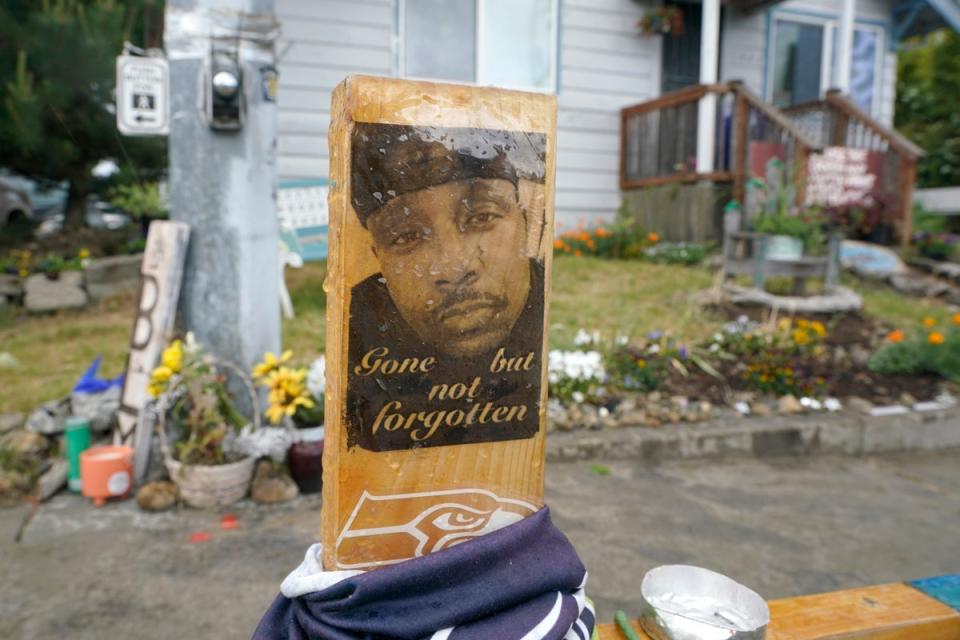
A sign is displayed at a memorial in Tacoma, Washington, where Manuel “Manny” Ellis died (Copyright 2021 The Associated Press. All rights reserved.)
Ellis’ cause and manner of death were ruled a homicide caused by lack of oxygen due to physical restraint. Ellis was on his stomach, with both his legs and arms tied and his body pressed against the concrete while the officers rested their weight on him, The News Tribune reports. However, the defence has focused on methamphetamine levels present in Ellis’ body at the time of his death and an enlarged heart noted in the autopsy report. The defence has said that Ellis was the aggressor and that he attacked the officers with “super-human strength” and eventually died of a drug overdose and a damaged heart. Witness testimony and video presented at the trial suggest otherwise. Three witnesses said they saw the officers sitting in their patrol car as Ellis approached and walked to the passenger side. When Ellis turned to leave, Burbank threw open the door and knocked Ellis to the ground, according to the witnesses. Prosecutors also played video recorded by the witnesses for the jury.
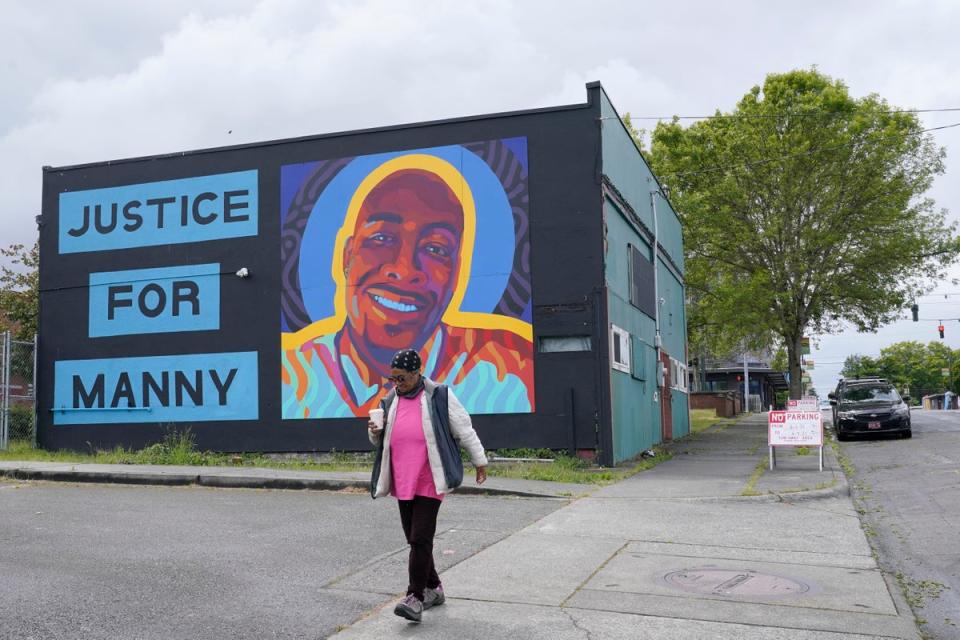
A woman walks past a mural honoring Ellis (Copyright 2021 The Associated Press. All rights reserved.)
Mr Burbank and Mr Collins gave their official statements before they knew there was audio and video of the encounter, Ms Eakes said. They claimed Ellis attacked them violently and relentlessly and didn’t say a coherent word. “But you know that’s not true,” Ms Eakes told the jury. “He did speak after he was pinned to the ground. He said he couldn’t breathe, sir, politely and nicely.” When Mr Rankine showed up and pinned Ellis to the ground, even though he was in handcuffs, Ellis said he couldn’t breathe three more times. Mr Rankine responded by saying, “If you’re talking to me you can breathe just fine.”
The three murderers
After that, they put hobbles on Ellis’ ankles and connected them to his handcuffs. The second-degree murder charges filed against Mr Burbank and Mr Collins, also called “felony murder,” mean a felony was being committed and someone died. In this case, the prosecution argues the officers committed the felony of unlawful imprisonment or assault. Ms Eakes told the jury that they don’t need to unanimously agree on which felony was committed to find the two officers guilty, only that Ellis died during the commission of a felony. They also have the option of manslaughter, which is the charge Mr Rankine faces. Closing arguments continued on Wednesday. The prosecution is now expected to present a rebuttal.
A Mississippi grand jury has declined to indict a police officer who responded to a call, and shot and wounded an unarmed 11-year-old boy inside the home.
The grand jury found that Indianola Police Sgt. Greg Capers did not engage in criminal conduct when he shot Aderrien Murry in the chest on May 20 while responding to a domestic dispute. Murry was hospitalized for five days with a collapsed lung, lacerated liver and fractured ribs from the gunshot wound in his chest.
The Mississippi Attorney General’s Office, who presented the case to a Sunflower County grand jury, announced the decision Thursday. In a written statement, Carlos Moore, Murry’s attorney, said the family would seek accountability through a federal civil lawsuit.
“While the grand jury has spoken, we firmly believe that there are unanswered questions and that the shooting of Aderrien Murry was not justified,” Moore said. “We are committed to seeking justice for Aderrien and his family.”
Reached by phone Thursday, Michael Carr, Capers’ attorney, said the officer had suffered personally and financially due to the case and that the grand jury made the right decision.
“Sgt. Capers is relieved at the result, and he is glad that the citizens of Sunflower County reached the fair and correct result,” Carr said. “He is looking forward to continuing to serve the citizens of Sunflower County and the city of Indianola.”
The Indianola Board of Aldermen voted in June to place Capers on unpaid administrative leave. Capers cannot return to work and get paid unless the Board votes to take him off leave, Carr said.
Indianola is a town of about 9,300 residents in the rural Mississippi Delta, about 95 miles (153 kilometers) northwest of Jackson.
On the May evening of the shooting, Nakala Murry asked her son to call the police around 4 a.m. when the father of one of her other children showed up at her home, Moore said. Two officers went to the home, and one kicked the front door before Nakala Murry opened it. She told them the man they called about had left, and that three children were inside the home, Moore said.
According to Nakala Murry, Capers yelled into the home and ordered anyone inside to come out with their hands up, Moore said. He said Aderrien Murry walked into the living room with nothing in his hands, and Capers shot him in the chest.
The Murry family has filed a federal lawsuit against Indianola, the police chief and Capers. The lawsuit, which seeks at least $5 million, says Indianola failed to properly train the officer and that Capers used excessive force.
With the grand jury’s decision, the Attorney General’s Office said no further criminal action at the state level would be taken against Capers. ___This story has been corrected to show that the grand jury found that Capers did not engage in criminal conduct, not that he had engaged in criminal conduct.
The Jamaica Constabulary Force once had as its Core function three things: (1) The Prevention And Detection Of Crime, The Preservation Of Peace And Good Order, and (3) The Protection Of Life And Property. Long ago, when I served, those were the operating tenets… I must admit it has been many years since I departed, and the Force has gone through many changes even though the fundamental need for police remains under the umbrella of those three foundational principles. If the police department becomes good at those three principles, the nation’s violent crime rate will decrease despite the many attendant contributors to crime.
The Jamaica Constabulary Force has never been good at anything, least of all harnessing the skills of the people within the department to benefit the service. It has never been good at continuity; it has been particularly derelict in dealing with crime and could reasonably be accused of resting on its laurels, awaiting good outcomes. The best thing that has happened to the JCF has been the talented, brave officers who have been a part of the agency from its inception. The worst thing to happen to the JCF has been the ineptitude of the leadership since its inception. I am not naïve to the ever-present and obligatory dark shadow that has hovered over the force that has exponentially hindered the force from carrying out its mandate. This dark shadow of political interference has been both by co-mission and omission. Direct interference, on the one hand, and refusal to pass adequate laws to aid in the reduction of crime have been the crimes of both political parties in our country. The police department must operate under the rule of the constitution with respect for all rights, but the police [must]have a free hand to enforce the laws impartially without favor, malice, or ill will.
The Jamaica Constabulary Force has never had the option of operating without the ever-present dark shadow of political interference. Within Jamaican society, there is a plethora of ticky-ticky fish who harbor the notion that the laws do not apply to them. The list includes politicians, judges, lawyers, public sector workers, their friends and family, and ever damn Tom, Dick, and Harry who knows somebody who knows somebody. Ultimately, there is hardly anyone left for the police to arrest. This has not gone unnoticed by the powerless who don’t know anyone who knows anyone. And so, our little island has become a criminal-free-for-all, a paradise for criminals, police included in the mix. Having said that, the police department can do a much better job than it has done, all things considered. After all, much of what the police are tasked with doing has been done before, and there is a wealth of information on how to do the job more effectively. It has gotten so bad for the country because of the ineptitude of the JCF that murderers now videotape themselves burying the corpses of the people they kill and then do voice recordings explaining the why, what, and how of their actions. The JCF was never an agency that was ever ahead of the criminal networks in our country, mainly because the criminal networks have always had political cover and poor police leadership. Successes of the police over the decades have never been a consequence of top-down leadership and policies but a result of individual officers who laid it all on the line for the country’s good. It made sense, therefore, that the heads of the criminal networks that the nation was rid of were made possible by The American Government and the hard work of the Rank and file of the JCF. I challenge anyone to point me to a major crime syndicate head being chopped off by the Jamaican Government or the High Command of the Police Department. In fact, the Jamaican Government has steadfastly stood in the way of both the hard-working police officers and the American’s effort to root out known crime syndicate heads.
We are in 2023, about to step into a new year, and the most basic steps necessary in law enforcement are still not being pursued by the JCF hierarchy. The nation’s roads are race tracks for taxi drivers, minibusses, and private motorists who overtake long traffic lines around corners, downhill, uphill, and on the sidewalks at breakneck speeds without police crackdown. The Government and the Police commissioner have all but ceded the streets to the lawless drivers. Driving on Jamaican roads is the equivalent of playing Russian Roulette. Every year, hundreds are killed in traffic crashes that the pathetic media calls traffic accidents. Accidents are caused by circumstances outside the victim’s control. Crashes are caused by direct action or inaction of offenders, resulting in the end result. Speeding, and other breaches of the Road Traffic Act. Last year, 2022, 488 Jamaicans perished on the Island’s roads and highways largely because of the actions of moronic Jackasses who breach the road traffic laws without consequence. Where are the traffic cops? As of November 27th, 2023, a total of 373 lives were extinguished on the nation’s roads. This unnecessary loss of life and the trauma is a consequence of excessive speeds, overtaking around corners, driving too fast on wet roads, and driving motorcycles at high speeds without helmets are the main reasons why we are having these fatal collisions,’ on ACP of police told the press. Still no remedial action of note other than begging drivers to stop. The same strategy is employed as it relates to violent crimes. The police have been relegated to begging criminals to stop. Reminds me of Nancy Reagan’s strategy for drug users, ‘just say no’. Laughable.
I am mindful of the concerns of some of my former colleagues, who will chastize me for being so hard on the police when of course, there are other players that are seriously driving the nation’s crime rate, notably the communist judges who seem to have sworn an oath to destroy the country. From the highest perch to the lowest court these communists that emerged from the Norman Manley Law School are dead set on ensuring that dangerous murderers are returned to the streets. More to say about that.…..
.
.
.
.
Mike Beckles is a former Police Detective, businessman, freelance writer, black achiever honoree, and creator of the blog mikebeckles.com.Check mike out on Youtube @ Mikebeckles
Power in the hands of fools is always a dangerous thing. Almost unchecked power in the hands of fools who cannot think and are giddy about using power is even more dangerous. Add qualified immunity (government carte blanch protection) to the two scenarios, and you get American policing. The most disgusting of all is that when they make stupid decisions because they have the power and protection to do whatever they want to citizens, they claim it is their policy. Truthfully, it is government policy to have its agents do whatever they want to the average citizen, including death, so that it can retain [control]. This kind of unchecked power and unrestrained immunity is then unleashed against the poorest and most vulnerable Americans. This group is usually Black. In the same breath, on the rare occasion that the robotic androids step out of line and do the same to a white woman, and her fragility is disturbed, the rules change.…..At least for the highest court. One of the enduring inconsistencies in American legal thinking on policing is that younger people, particularly younger people of color, are undeserving of the same protections under the laws as older, frailer citizens. Every citizen is entitled to the constitutionally protected doctrine of innocent until found guilty. Therefore, police have no legal authority to summarily and arbitrarily determine someone’s innocence or guilt even before a traffic stop is completed based on how they look or the color of their skin. But doing so is standard policing practice in America. It is time for qualified immunity to go. (Editor)
Elise Brown was a little over five feet tall and weighed 117 pounds when she was ordered out of her blue Oldsmobile by police in California in 2019. She was also 83 years old. The officers who pulled Brown over thought the car she was driving had been stolen – mistakenly, it turns out – and, following their protocol, they drew their handguns, handcuffed Brown, and forced her to her knees. A federal appeals court this year ruled that Brown could sue the police for excessive force, waiving a legal doctrine known as qualified immunity that protects police from liability for civil rights violations in many circumstances. On Monday, the Supreme Court let that lower court ruling stand, keeping Brown’s lawsuit alive. At a time when the nation is grappling with fatal police confrontations, the Supreme Court has mostly balked at lawsuits questioning the legal immunity extended to officers. Police organizations have long countered that officers need immunity in cases when they must defend themselves, and split-second decisions can lead to unforeseen tragedy. The Chino Police Department officers argue they were following protocols: traffic stops for potentially stolen vehicles are “high-risk” under city and state standards, they said. Brown was required to kneel for no more than twenty seconds and was in handcuffs for approximately three minutes, they said.
The officers “deployed firearms in states of readiness consistent with their responsibilities on the scene of a high-risk stop,” the police told the Supreme Court. Brown, police said, appeared to “be in her 50s or early 60s” and “appeared not to need any accommodation due to health or frailty.” Brown sued in 2020, claiming the police used excessive force and unreasonably detained her. “Ms. Brown was terrified, humiliated, and emotionally traumatized,” her lawyer told the Supreme Court. “That conduct was not reasonable; it was extraordinarily dangerous and flatly inconsistent with the Fourth Amendment’s prohibition on excessive force.”
The violence you see in the actions of these state agents is protected and made possible by the highest courts and paid for with your tax dollars.
An Alabama police officer is on leave after a video posted on social media showed her cursing at and using a stun gun on a man who was handcuffed and crying. The video begins with a handcuffed man lying in the street as an officer with the Reform Police Department tells him to stand up. The officer then walks the man over to a car, the footage shows. “Stay still,” the officer says as she pushes him against the hood of the car and holds her stun gun to his back. “I ain’t doing s — , bro,” the man responds. “I got a gun right there.” As the officer removes the gun from the man’s pants, she laughs and says, “oh yeah!” “What you saying ‘oh, yeah’ for?” the man asks. The officer responds by using her stun gun on the man, the video shows. “Shut the f— up,” she says.
The man starts crying. “OK, OK, OK,” he repeats. “Oh my God.” “You want it again?” the officer asks as the man continues to cry. “Shut the f— up. You was big and bad, shut your b — - a– up.” The video then ends. It’s unclear what happened before or after the 45-second clip posted to Facebook, and the Reform Police Department has shared very little information about the Dec. 2 incident. In a brief statement, police Chief Richard Black and Reform Mayor Melody Davis said they were aware of the video, and the department is “in the process of turning over all materials related to this arrest to the Alabama State Bureau of Investigation.” “In accordance with City Policy, the officer involved has been placed on administrative leave while the investigation is conducted,” the statement said. Further questions about the incident were directed to the State Bureau of Investigation. NBC affiliate WVTM of Birmingham, Alabama, identified the man as Micah Washington, 24, of Tuscaloosa. His girlfriend, Jalexis Rice, said the officer pulled up as Washington and two other people were changing a tire on their car. Rice said the video made her upset.
“When I seen it, I couldn’t do nothing but cry,” she told the news station. “I couldn’t do nothing but cry.” Online jail records show that Washington was charged with resisting arrest, obstructing governmental operations, possession of marijuana, drug trafficking, and an ex-felon being in possession of a firearm. He is being held at the Pickens County jail on a $505,000 bond, according to jail records. On Monday night, Washington’s loved ones and members of the community gathered near the city hall to protest the arrest and demand accountability, according to WVTM. Black and Davis said they have requested a thorough investigation into the incident.
RANKINCOUNTY, Miss. — For nearly two decades, a loose band of sheriff’s deputies roamed impoverished neighborhoods across a central Mississippi county, meting out their own version of justice.
Narcotics detectives and patrol officers, some who called themselves the Goon Squad, barged into homes in the middle of the night, accusing people inside of dealing drugs. Then they handcuffed or held them at gunpoint and tortured them into confessing or providing information, according to dozens of people who say they endured or witnessed the assaults.
They described violence that sometimes went on for hours and seemed intended to strike terror into the deputies’ targets.
In the pursuit of drug arrests, deputies of the Rankin County Sheriff’s Department shocked Robert Jones with a Taser in 2018 while he lay submerged in a flooded ditch, then rammed a stick down his throat until he vomited blood, he said.
During a raid the same year, deputies choked Mitchell Hobson with a lamp cord and waterboarded him to simulate drowning, he said, then beat him until the walls were spattered with his blood. That raid took place at the home of Rick Loveday, a sheriff’s deputy in a neighboring county, who said he was dragged half-naked from his bed at gunpoint, before deputies jabbed a flashlight threateningly at his buttocks and then pummeled him relentlessly.
The string of violence might have continued unchecked if not for one near-fatal raid in January.
According to a Justice Department investigation, deputies broke into the home of two Black men, Michael Jenkins and Eddie Parker, shocked them with Tasers and threatened to rape them. Deputy Hunter Elward shoved the barrel of a gun into Jenkins’ mouth, not realizing a bullet was in the chamber, and pulled the trigger. Jenkins was grievously injured, the incident was thrust into the national spotlight, and in August five deputies and a police officer pleaded guilty to criminal charges.
Rankin County Sheriff Bryan Bailey said in a news conference this summer that he was stunned to learn of the “horrendous crimes” committed by his deputies. “Never in my life did I think it would happen in this department.”
But an investigation by The New York Times and the Mississippi Center for Investigative Reporting at Mississippi Today reveals a history of blatant and brutal incidents stretching back to at least 2004.
Reporters examined hundreds of pages of court records and sheriff’s office reports and interviewed more than 50 people who say they witnessed or experienced torture at the hands of the Rankin County Sheriff’s Department. What emerged was a pattern of violence that was neither confined to a small group of deputies nor hidden from department leaders.
Many of those who said they experienced violence filed lawsuits or formal complaints, detailing their encounters with the department. A few said they had contacted Bailey directly, only to be ignored.
The Times and Mississippi Today identified 20 deputies who were present at one or more of the incidents — many assigned to narcotics or the night patrol — but also several high-ranking officials: a former undersheriff, former detectives and a former deputy who is now a local police chief.
Brett McAlpin, former chief investigator for the department, was involved in at least 13 of the arrests and was repeatedly described by witnesses as leading the raids. He was named in at least four lawsuits and six complaints going back to 2004. Even so, Bailey named him investigator of the year in 2013. This year, he pleaded guilty to criminal charges for his role in the January raid.
Taken together, the reporting shows how Rankin deputies were allowed to operate with impunity, while racking up arrests for relatively minor drug infractions and leaving entire neighborhoods in fear of violent raids.
Among the dozens of allegations reviewed, the Times and Mississippi Today were able to corroborate 17 incidents involving 22 victims based on witness interviews, medical records, photographs of injuries and other documents.
In nearly half the cases, Taser logs obtained from the department through a public records request helped corroborate the allegations. Electronically recorded dates and times of Taser triggers lined up with witness accounts and suggested that deputies repeatedly shocked people for longer than is considered safe.
The Taser logs also suggest that the scope of the violence may extend much further.
At least 32 times over the past decade, Rankin deputies fired their Tasers more than five times in under an hour, activating them for at least 30 seconds in total — double the recommended limit. Experts in Taser use who reviewed the logs called these incidents highly suspicious.
“This is not typical Taser use,” said Seth Stoughton, faculty director of the Excellence in Policing & Public Safety program at the University of South Carolina. “There’s just no justification for that.”
It is impossible to tell from the logs alone whether a series of shocks were aimed at one target, and whether they all made contact. Incident reports by the deputies offer little clarity, because in nearly every case they failed to mention that a Taser was used at all.
Over the past year, the Times and Mississippi Today have investigated how powerful sheriffs in rural Mississippi have dodged accountability in the face of misconduct allegations. The reporting exposed numerous sexual abuse accusations against two sheriffs in counties near Rankin, along with evidence that Bailey obtained subpoenas to surveil his girlfriend’s phone calls.
Bailey has faced increased scrutiny since the Justice Department began to investigate his deputies’ conduct this year, and the NAACP and local activist groups have called for his resignation. After 12 years as sheriff, he was reelected in November when he ran unopposed.
The deputies accused of being involved in violent arrests declined to comment or did not respond to repeated requests for interviews.
It is not always clear what actions individual deputies took during the incidents. Witnesses often did not know their names and many of the deputies did not wear uniforms or name tags during the raids.
Jason Dare, a lawyer for the department, declined to comment on the Times and Mississippi Today’s findings.
During a brief phone interview Sunday, Bailey repeatedly declined to comment. Told that several high-ranking deputies were involved in arrests that had sparked accusations of brutal treatment, he said, “I have 240 employees, there’s no way I can be with them each and every day.”
On Tuesday, the department announced that it had updated its internal policies and that deputies would receive training on federal civil rights laws.
A statement from the department that referred to the January assault without acknowledging a broader pattern said, “Even though the prior actions were abnormal and extreme, we will make every effort to ensure that they do not occur in the future.”
New Problems, Old Tactics
For most of its history, Rankin County was a rural area dominated by farmland and forests.
That began to change when white flight reached the capital city of Jackson in the 1960s and Rankin’s fields gave way to subdivisions and strip malls.
But tucked among the stately homes and manicured lawns, some of the county’s most impoverished residents live in run-down trailers and makeshift shacks, a few without running water or electricity.
These neighborhoods were hit hard in the early 2000s as meth — cheap, highly addictive and easy to manufacture in isolated places — spread across rural America like wildfire.
Local sheriffs, even in small departments, set up special narcotics units and joined state and federal task forces in the war on drugs. The Rankin County Sheriff’s Department responded by targeting low-income communities and policing them relentlessly.
In an area called Robinhood, residents said home raids became routine and it felt as if they couldn’t go to the corner store without being stopped and searched.
“Once they start picking on you,” said a former resident, Matasha Harris, “they will not leave you alone.”
Though Rankin deputies appear to have targeted people based on suspected drug use, not race — most of their accusers were white — their tactics could have been pulled from the Jim Crow era, when sheriffs and their deputies harassed and beat Black Southerners and civil rights activists.
During that period, deputies coerced false confessions, sometimes using cattle prods or “the water cure”: pouring water into suspects’ nostrils until they complied.
Priscilla Perkins, co-president of the John & Vera Mae Perkins Foundation, a nonprofit based in Jackson that promotes racial reconciliation, said the Goon Squad’s acts reminded her of the reign of terror against civil rights activists that often involved law enforcement officers.
“It’s the hidden shame of Mississippi and America,” she said. “People are still trying to cover it up.”
Among the officers of that era accused of beating Black residents was Lloyd Jones, a state trooper who would become sheriff in nearby Simpson County.
A Justice Department investigation long after his death found that he had bragged to a colleague about fatally shooting a Black man, Benjamin Brown, in the back during a 1967 standoff between police officers and civil rights protesters.
In 1970, Jones participated in the beating of the Rev. John Perkins in the Rankin County jail, which culminated with a deputy jabbing a fork up his nose, according to the pastor and witnesses who testified against the officers.
As sheriff, he gave Bryan Bailey his first job in law enforcement.
“He is on my life’s wall of gratitude and had a huge impact on who I am,” Bailey wrote on Facebook in 2015. “Not a day goes by that I don’t think about him or recall something that he taught me.”
Bailey called him a mentor. But years before, Simpson County residents had begun calling him something else: “Goon” Jones.
Scope of Abuse
It’s unclear when Rankin County deputies adopted their nickname, but last year, they ordered commemorative coins emblazoned with cartoonish gangsters and the words “Lt. Middleton’s Goon Squad.” Lt. Jeffrey Middleton was the squad’s supervisor. He is among the five deputies who pleaded guilty to criminal charges stemming from the January raid on Parker and Jenkins.
A Justice Department investigation this year found that Rankin County deputies chose the name Goon Squad “because of their willingness to use excessive force and not report it.”
The investigation found that McAlpin, along with a narcotics detective, Christian Dedmon, and Goon Squad members burst into Parker’s home, tortured and humiliated the men while demanding to know where drugs were, and then disposed of the evidence.
Across the 17 cases for which reporters found corroborating witnesses and evidence, accusers described similar tactics by deputies, almost always over small drug busts.
Deputies held people down while punching and kicking them or shocked them repeatedly with Tasers. They shoved gun barrels into people’s mouths. Three people said deputies had waterboarded them until they thought they would suffocate. Five said deputies had told them to move out of the county.
Many of the targets teetered on the edge of homelessness and were caught with a few grams of meth or with only drug paraphernalia — a glass pipe or used syringe. Several people sat in jail for days or weeks only to have their charges dropped.
The largest bust among the incidents examined was for a $420 heroin sale.
In 2018, a confidential informant arranged an $80 meth deal at Jerry Manning’s home. Manning, who denies being part of the sale, said he heard deputies burst into his trailer and scream his name.
When he went to investigate, deputies pinned him to the floor. They said they wanted to test their new Tasers on him to see which hurt more, he said.
“They got me in my private parts, they got me in my head,” Manning said. “They kept tasing and tasing and tasing.”
Taser logs indicate that two of the nine deputies involved that night, James Rayborn and Cody Grogan, together triggered their Tasers at least 15 times during the 2 1/2‑hour raid.
As the deputies ransacked his home looking for drugs, Manning said, they wrapped a pair of jeans around his head and punched him repeatedly in the face before using a blowtorch to melt a metal nutcracker handle onto his bare leg as he screamed. On McAlpin’s orders, Manning said, a deputy then forced him to sit, pulled a belt around his neck and yanked it upward, choking him until he believed he would suffocate.
Three other men in the trailer that night described violent attacks. Garry Curro, 64, an Air Force veteran, said deputies handcuffed, beat and shocked him. Adam Porter says McAlpin threw him into a glass mirror, then took Porter’s pocketknife and sliced his pants to ribbons, demanding to know where the drugs were. Manning’s roommate, James Lynch, said McAlpin dragged a blowtorch flame across his feet while interrogating him.
People’s accounts of the raids shared striking similarities, beyond the patterns in the violence.
At least 12 of the 17 cases began as Manning’s did, with a suspect being set up by a confidential informant, someone the deputies had persuaded to stage a drug buy while they waited nearby.
In six cases, people said deputies threatened to continue assaulting them until they disclosed either the name of a drug dealer or the location of drugs. Five people said the deputies ransacked their kitchens and destroyed their food or used it to humiliate them — smashing a cake into a man’s face before arresting him, dumping flour and rice onto a kitchen floor, pouring milk into a freshly cooked dinner. Every Black accuser said deputies had hurled racial slurs at them.
Most of the targets were men in their 30s or 40s with a history of drug use. But in 2009, McAlpin knocked out 19-year-old Christopher Hillhouse’s tooth with a Maglite, he and his mother say. The next year, deputies beat and shocked Dustin Hale, then 17, until he urinated on himself while his girlfriend watched, he said. When his mother and grandmother went to the county jail to pick him up, they said, they hardly recognized him through the bruises and swelling.
The story of Jeremy Travis Paige, who was targeted in 2018, fits a typical pattern described by the accusers.
Paige, a 41-year-old with several arrests, was pulling up to his home in a working-class neighborhood outside Jackson when he realized deputies were there waiting for him, he said.
He drove away, hoping they wouldn’t notice. But McAlpin chased him and pulled him over, then deputies beat him unconscious in the intersection, Paige alleged in a lawsuit against the county.
The suit claimed that he regained consciousness as the deputies dragged him, handcuffed, into his home. McAlpin and another deputy then pummeled him in the living room for nearly an hour, according to Paige and a witness who spoke on the condition of anonymity, fearing retribution from the deputies.
In interviews, Paige said the deputies pulled him into his roommate’s bedroom and sat him upright on the bed, where he felt someone press a knee into his back and stretch a washcloth across his mouth. Then, he said, deputies poured gallon after gallon of water over his face. As he struggled to breathe, he said, one of them pressed a lit cigarette into his thigh.
All the while, they shocked his groin intermittently with Tasers, Paige said. Taser logs show that one of the four deputies who reported being at the scene triggered his Taser during the arrest.
Three people, including Paige, said they had been shocked not only with gun-shaped Tasers — the type issued by the department — but also with small, rectangular ones, suggesting that some deputies used personal stun guns that were not being tracked.
“They had the devil in them,” Paige said. “I thought they was going to kill me.”
Deputies ordered him to send Facebook messages to friends asking to buy drugs. He struck out, and the deputies took him to jail.
Before leaving, they stuffed the blood- and water-soaked bedding in trash bags and removed them from the house, Paige said.
The next day, when Paige was in jail, his son Trace visited the house. He found evidence of the violence, he said, including a bent bed frame where his father had been held down by deputies and a puddle of blood on the floor.
Pictures taken by Paige’s roommate show the bed stripped of linens and blood spattered on the wall.
McAlpin wrote in his report that deputies restrained Paige after he tried to kick them during the arrest, but the detective did not mention the use of Tasers or other force that might explain the blood.
During Paige’s trial for drug sale charges, McAlpin testified that deputies might have injured Paige when they pulled him out of his car, because he was resisting. He denied hurting Paige in his home.
Paige was sentenced to five years in prison. When he sued the sheriff’s department, no lawyer would take his case and he resorted to representing himself. He wrote a letter to the judge explaining that he had only a seventh grade education.
“I don’t know how to present big words or anything like that,” he wrote. “But I do know the truth.”
After he missed several court deadlines, the judge dismissed his case.
Who Knew
Over the years, more than a dozen people have directly confronted Bailey and his command staff about the deputies’ brutal methods, according to court records and interviews with accusers and their families.
At least five people have sued the department alleging beatings, chokings and other abuses by deputies associated with the Goon Squad.
The department settled two of those cases. Two others, including Paige’s, were dismissed over procedural errors by accusers representing themselves.
But the mounting allegations signaled that something was profoundly wrong in the narcotics unit of Bailey’s department.
McAlpin, the department’s former chief investigator who led most of the raids reviewed by reporters, was involved in at least four arrests that prompted lawsuits, court records show.
According to one suit that was settled, McAlpin kicked 19-year-old Brett Gerhart in the face and pressed a pistol to his temple in 2010 during a mistaken raid at the wrong address. In a 2012 case, tossed out because of missed court deadlines, Gary Michael Frith claimed that he had been beaten and choked in the back of a squad car during a drug bust; records show that McAlpin was one of the arresting officers.
McAlpin also figured prominently in complaints lodged with the department. Seven people told reporters they had mailed letters, filed formal complaints or called the sheriff personally to tell him about the abuse they experienced.
Joshua Rushing said he wrote several letters to the department in 2020, after McAlpin and Dedmon drove him to an isolated dead-end road and shocked and beat him. He said he never heard back.
Nicole Brock said that when she went to the sheriff’s office to submit a formal complaint against McAlpin for ransacking her car during a search, he tore up the form, threw it in the garbage and arrested her for a syringe he had found during the car search.
Brock said she left several messages on Bailey’s office phone to report the deputy’s behavior, but he never returned her calls.
Dare, the department lawyer, declined to provide copies of complaints, saying they were considered personnel records protected by state law. When asked to confirm the existence of the seven complaints described by accusers, he said he could not immediately provide it.
Chuck Wexler, executive director of the Police Executive Research Forum, said this long list of complaints and lawsuits should have prompted investigations by the sheriff.
“If you’re getting multiple complaints about the same officers, from different sources, that’s a red flag,” he said. “If you don’t do anything about it, you’re in denial.”
Despite the allegations against him, McAlpin continued to rise through the ranks of the department, winning Investigator of the Year and eventually being promoted to the top investigator position.
Until this year, the Rankin County Sheriff’s Department did not have anyone assigned full time to handle complaints. Instead, supervisors were responsible for investigating the deputies they oversaw, according to four former employees who spoke on the condition of anonymity because they feared retribution from the department.
Among those supervisors were McAlpin and Middleton, who both pleaded guilty in August for their roles in the assault of Jenkins and Parker.
On Tuesday, Bailey announced that the department would allow residents to file complaints against deputies on the department’s website.
Beyond the lawsuits and complaints, there were other obvious signs of the violence, including injuries that would have been visible to jail workers and court officials who saw the injured shortly after their encounters.
Hospital records show that Hobson was treated for a gash over his eye after a 2018 raid in which he says deputies waterboarded him and punched him repeatedly. His face is bandaged in his jail booking photo.
Robert Jones, the man who said deputies rammed a stick down his throat, arrived at the jail with a swollen and mud-streaked face after deputies beat him and threw him into a ditch.
Many of the mug shots from the Rankin County jail feature bandaged faces, swollen cheeks and black eyes associated with drug-related arrests.
But the most glaring evidence of the violence inflicted by deputies has been collecting in the department’s computer files for more than two decades.
The Taser Logs
Every time a Taser is fired, the device keeps a record of it. In Rankin County, deputies upload this data to a computer, compiling detailed departmentwide logs that allow supervisors to monitor deputy Taser use.
The data, reviewed by the Times and Mississippi Today, contained tens of thousands of Taser triggers stretching back 24 years.
The logs supported the accounts of nine people who described being shocked by deputies while handcuffed or held down. In all but three of these cases, the deputies did not report their Taser use, violating department policy.
“I don’t believe I’ve ever come across an agency in which it would be acceptable for an officer to deploy a Taser and not report it in some way,” said Ashley Heiberger, a retired officer and an expert in police use of force.
After several studies linking prolonged Taser exposure to severe medical problems and even death, the Police Executive Research Forum developed national guidelines advising against shocking a person for more than 15 seconds during an encounter.
The logs contain dozens of instances of Tasers being fired for at least double the recommended time limit over the course of an hour. In April 2016, a device assigned to a deputy who participated in Goon Squad raids was triggered nine times in four minutes, delivering 31 seconds of current.
Several experts in police use of force said the logs showed abnormal Taser use that was hard to explain. Seth Stoughton, from the University of South Carolina, said the frequency of the deputies’ Taser triggers suggested they were not using the weapons for their intended purpose: to quickly subdue a combative person.
“It just doesn’t suggest that the Taser is actually being used to induce compliance,” he said.
By comparing the logs to department records, reporters identified four people who claim they were at the receiving end of Taser shocks recorded in the data.
In 2016, Deputy James Rayborn fired his Taser for 20 seconds over the course of 20 minutes during a raid of Samuel Carter’s home.
Carter, 64, an Army veteran, had had previous run-ins with Rankin sheriff’s deputies over alleged drug use. On the night of the raid, he said, deputies dragged him to his bedroom, shocked him and demanded that he open a safe where they expected to find drugs and cash.
Instead, deputies found a tub of cake frosting he had stashed in the safe to hide from houseguests with a sweet tooth.
Carter said they became enraged and shocked him again until his leg began to bleed.
Down the hall, Christopher Holloway, a 26-year-old who had been helping Carter maintain his property, was beaten and shocked until he defecated on himself, he said. Then they dragged him outside and threatened to push him, handcuffed, into Carter’s pool.
Holloway and Carter were charged with paraphernalia and drug possession — Holloway for marijuana, Carter for several grams of methamphetamine.
Like many people targeted by Rankin deputies, Carter said the first raid was just the beginning. Three months later, deputies arrested him again, this time for drinking in front of his home, Carter said. He was arrested four more times over the next year, department records show, mostly for drug or paraphernalia possession.
Ballooning legal fees left Carter unable to pay his bills.
“They had the power,” he said. “And they used it.”
‘I Lost My Life’
The Goon Squad has left a long trail of shattered lives in its wake. Some people who said they were brutalized are jolted awake by nightmares after their encounters with deputies. Four said they fled the county for good. Several are serving lengthy prison terms.
In 2015, Ron Shinstock was struggling with a methamphetamine addiction, even as he raised a family with his wife and ran a mechanic shop with his brother.
Everything changed, he said, after McAlpin led a violent raid of his home, holding his children at gunpoint and forcing him to strip naked in his backyard. The arrest led to a 40-year prison sentence for a $260 meth sale within 1,500 feet of a church.
Shinstock’s wife left him. He is scheduled to be released in 2056, two months before his 82nd birthday.
“I lost my family, I lost my home,” Shinstock said. “I lost my life.”
Andrea Dettore, a former resident of Rankin County, witnessed deputies brutalize three people in two incidents. She said she was there in 2018 when the Goon Squad attacked Loveday, the former deputy, and Hobson.
During a raid on her own home in January, she said, she heard deputies beat her friend, Robert Grozier, behind a closed door, and saw a deputy, Christian Dedmon, shove a sex toy into his mouth, threatening to shock him with a Taser if he spat it out.
Dettore and Grozier were each fined several hundred dollars, and she has since left Rankin County. Hobson sat in jail for six months before his charges were dropped, and Loveday lost his job as a sheriff’s deputy. Court records show he was never convicted of a crime.
After McAlpin arrested Loveday and accused him of consorting with drug dealers, he ordered him to leave town. Loveday fled the state, fearing he would be targeted again. He couldn’t forget that night.
“If they did that to me, how many other people have they done it to?” he wondered.
Before he left Mississippi, Loveday said, he called Bailey personally to warn him about his deputies’ behavior.
But Bailey wouldn’t listen, he said. He called Loveday a dirty cop and accused him of secretly recording the call.
A woman who was shocked in the back with a Taser while lying on the ground in Pueblo, Colorado, last year is suing the police officer who stunned her and the city’s police chief, accusing the police department of failing to report excessive force by the officer to state regulators.
The federal lawsuit filed Sunday by Cristy Gonzales, who was suspected of stealing a vehicle, says the police department found Cpl. Bennie Villanueva used excessive force against Gonzales and another person several weeks later. However, it says the agency withheld the information from a state board which oversees who is qualified to serve in law enforcement. If it had been reported, Villanueva would have lost his certification to work as a police officer for at least a year, the lawsuit said. Gonzales was suspected of stealing a truck in February 2022, and didn’t stop for Villanueva, according to a police investigation. Eventually the vehicle ran out of gas, according to the lawsuit. After she got out of the truck, Villanueva pulled up and ordered her to get onto the ground, according to body camera footage released by Gonzales’ lawyer. After another officer grabbed one of her arms, she got down on her knees and then appeared to be pushed to the ground, when Villanueva deployed his Taser into her back.
According to the lawsuit, Gonzales was hit with two probes in the small of her back near her spine. It says she continues to have numbness and difficulty using her right hand since the Taser was used on her. Telephone messages left for Pueblo police Chief Chris Noeller and the city’s police union were not returned Monday. Villanueva could not be located for comment. After seeing the video of Gonzales’ arrest, the assistant district attorney prosecuting the vehicle theft filed an excessive force complaint, prompting an internal police investigation, according to the lawsuit. After the investigation, Noeller issued a letter of reprimand against Villanueva for his conduct in the Gonzales case as well as for violating department policies in two other cases. In the letter, provided by Gonzales’ lawyer, Kevin Mehr, Noeller said Villanueva appeared to use the Taser on Gonzales “for no apparent reason.” However, he also said that the use of the Taser appeared to be “a result of your reaction to a highly stressful call for service after having been away from patrol duty work for several years.” In a second case, Noeller said Villanueva deployed his Taser on a suspect a second time apparently accidentally while attempting to issue a “warning arc” to get the suspect to comply. In a third case cited in the letter, Villanueva threatened to use a Taser on a suspect in custody who was not cooperating with medical personnel but he did not end up deploying it.
Each year, police departments are required to report to Colorado’s Peace Officer Standards and Training board whether their officers have had any “disqualifying incidents”, including a finding of excessive force, that would disqualify them from being certified to work as police officers in the state, according to the lawsuit. It claims the Pueblo Police Department did not report any such incidents for any of its officers in 2022. “The Pueblo Police Department lied to the POST board, just plain and simple,” Mehr said.
Former Minneapolis police officer Derek Chauvin, who was convicted of killing George Floyd, was stabbed in prison on Friday and is seriously injured, the Associated Press reported, citing an unnamed source. The Bureau of Prisons confirmed to the AP that an inmate was assaulted at FCI Tucson around 12:30 p.m., though the agency did not name the inmate. The BOP also said prison employees performed “life-saving measures” and that the inmate was taken to a hospital. The Bureau of Prisons did not immediately respond to Business Insider’s request for comment on Friday evening.
My friend was livid yesterday about the sentences handed down in the trial of double murderer Richard Brown, who confessed to the killing of Phillip Paulwell’s 10-month-old child and her mother, Toshyna Patterson. My friend does not feel that the sentence fits the crime; I concur. The depraved beast had the gall to pen a letter to the court claiming he was sorry for the heinous act he was a part of committing with the sole intent of exploiting the well-known irrational leniency with which the courts mete out sentences. It worked!!! Thirty (30) years is absolutely not anyone’s idea of a decisive sentence for a man who, with depraved indifference, murdered a young mother and her 10-month-old infant child. If you thought the thirty-year sentence was a slap in the face of our country and the grieving family, Richard Brown was additionally sentenced to one year and ten (10) months imprisonment at hard labor for the kidnapping of the mother and baby. On the kidnapping alone, he should have been given a life sentence, not to mention the double murder.
The sordid tale of the murder of the young 27-year-old mother and her infant child has been all over the media like a soap opera. It involved an American National who happened to be a member of that country’s armed services, a powerful Jamaican politician, jealousy, hatred, and young men and women easily lured into crime by the specter of easy money. And so Toshyna Patterson and her infant child became the victims of jealousy and depraved minds who are quite willing to ‘kill and collect, drink and forget.” For almost two decades, this writer has written hundreds of articles speaking to the lack of real sentencing in Jamaica, a phenomenon that has helped exponentially to embolden the nation’s heartless killers. Additionally, the fact that US Navy Culinary Specialist Seaman Leoda Bradshaw, who also has an eight-year-old daughter with Paulwell and has been charged in the matter, thought she would get away with contracting murder for hire and simply walk away speaks to how they view Jamaica’s justice system… But who can blame them for thinking the Police are dumb or that the judges are in love with murderers? Brown’s accomplice, Roshane Miller, was sentenced to seven-and-a-half years in prison for two counts of accessory before the fact of murder for his role in the crimes. Additionally, he was sentenced to two years and ten months imprisonment at hard labor for conspiracy to kidnap and one year and 10 months at hard labor for misprison of a felony. The sentences are to run concurrently.
This is justice Jamaican style, and please don’t get me started on the high-priced lawyers that these monsters are able to hire when they are caught. Jamaica simply cannot continue this way, but this is a wonderful opportunity for the PNP’s Phillip Paulwell to champion legislation in the House to add teeth to crimes exactly like these. Paulwell, tongue in cheek, issued a statement about being sad at the events. We don’t need Paulwell and the PNP to be sad; we need them to help with legislation with teeth. Stop supporting criminals by blocking tough legislation that would send strong messages that we will no longer tolerate these acts of criminality. Talk is cheap; this is the opportunity for Pualwell to step up or shut up; talk is cheap. We need mandatory minimum sentences of life without parole for crimes of depraved indifference like this one. We do not need judges handing down sentences of 71⁄2 years for conspiracy to murder, which in actuality is murder. We do not need judges handing down sentences of two years and ten months imprisonment at hard labor for conspiracy to kidnap and one year and ten months at hard labor for misprison of a felony. This is a damn disgrace.….
.
.
.
.
Mike Beckles is a former Police Detective, businessman, freelance writer, black achiever honoree, and creator of the blog mikebeckles.com.
Our world is delicately balanced on principles; there is no one staring down and keeping score. Our planet is set up on the simple concept of ‘what you sow, that you shall reap.’ Those who disagree fail to understand that the creator’s time completely differs from our human concept of time. But I digress.(mb)
FBI agents seized electronic devices from New York City Mayor Eric Adams earlier this week, days after a raid on the home of his chief campaign fundraiser, according to an attorney for the mayor’s campaign. Federal authorities are conducting an investigation into whether his 2021 mayoral campaign conspired with a Brooklyn construction company and the Turkish government to funnel foreign money into the campaign through a straw donor scheme, the New York Times has reported. Boyd Johnson, an attorney for Adams’ campaign, confirmed on Friday that Adams had provided the FBI with electronic devices after agents approached the mayor following an event on Monday night. Johnson said the FBI requested the devices after Adams informed investigators of impropriety by an unidentified individual.
“After learning of the federal investigation, it was discovered that an individual had recently acted improperly. In the spirit of transparency and coöperation, this behavior was immediately and proactively reported to investigators,” Johnson said in a statement. “The mayor has not been accused of any wrongdoing and continues to coöperate with the investigation,” the statement said. The FBI declined to comment. The devices seized from the mayor — at least two cellphones and an iPad — were returned within a matter of days, the Times said. Johnson did not provide details about the type or quantity of devices seized. FBI agents had searched the home of Adams’ chief election campaign fundraiser, Brianna Suggs, on Nov. 2, and she was questioned by public corruption investigators, city officials and local media said. Law enforcement officials have investigated several other associates of Adams in recent months. In July, Manhattan District Attorney Alvin Bragg announced the indictment of six people he said had used a straw donor scheme to illegally generate public matching funds for Adams’ 2021 election campaign. All six men have pleaded not guilty.
Adams, who was not accused of any wrongdoing in the indictments, has said he and his campaign team had no knowledge of or involvement in the alleged scheme. Adams’ 2025 election campaign has paid Suggs’s consulting firm, Suggs Solutions, about $98,000 so far, public records show. Suggs has worked for Adams since starting out in 2017 as an intern in his office when he was the Brooklyn borough president, according to her profile on the LinkedIn social media network. While raising donations for Adams’ election campaign, Suggs had also been paid to lobby his administration on behalf of a Manhattan property owner seeking an extension on his lease of a shopping complex in a city-owned building, the New York Daily News reported in April. Adams, a Democrat, had traveled to Washington on Nov. 2 for meetings with U.S. government officials about the city’s shelter crisis for asylum seekers and other recently arrived migrants but abruptly canceled those meetings to return to New York. (Credit Reuters)
Policing and Judging for profit have become a norm in America; somewhere in there is also prosecuting for profit. The rapacious artificial need created by states and municipalities to extract revenue from citizens to fund the police state has made driving down a highway or street a perilous adventure for motorists. Unmitigated and unchecked powers placed into the hands of police officers add to the dangers motorists face merely driving down the street. The desire of states and municipalities to maintain control of the citizenry and to simultaneously extract revenue to fund the police state, coupled with the over-militarization of the police, has left many asking if they are already living in a police state. Whether or not it is a police state is above my pay grade. It is sufficient to say that we are in a dystopian nightmare where the very citizens who are at risk actively cheer on police gunning down other citizens to provide a so-called safe environment. Who is safe when the police are empowered to summarily slaughter innocent citizens who may or may not have transgressed against road traffic laws?
The notion of many who believed that they will not fall to police bullets because of the color of their skin, their slavish obedience to the roving assassins, or both is highly misguided. The dangers posed by the police stretch far outside the narrow confines of the gun violence they engage in, with hardly any consequence. The immoral laws created to give them faux justification to breach the Fourth Amendment right of citizens; laws that they use to target communities they hate have created a widening chasm between them and those brutalized communities. Every stop in certain communities, just or unjust, becomes a dangerous experience for all involved. Pretextual seasons for stopping motorists include broken taillights, tint too dark, unable-to-see license plates, and a litany of other fraudulent claims by cops. The motorist hit a yellow line and swerved. In most cases, the charges are concocted to search the motorist’s vehicle and to see if the driver has a warrant. This is where many who are for the police state argue that these unconstitutional breaches yield results. What are those results? The results, they argue, are that police can find narcotics; usually, the motorist had a little marijuana or a cigar not fully consumed in the vehicle. These are called pretextual stops. For starters, they do not make anyone safer. Rigorous studies have shown that pretext stops produce evidence of non-traffic crimes at very low rates and have no effect on crime rates. These same studies confirm that when cops are allowed to be led by their gut instincts and other unchecked heuristics, people of color are disproportionately affected. Racial disparities in who gets pulled over erode trust in the police and deepen the perception that police use race as a proxy for criminality.
On that basis, police are given unchecked powers to violate the rights of citizens, usually with the blessings of their higher-ups and local prosecutors. In one case, a cop contacted a local prosecutor whom he called by his first name. The cop wanted to violate a citizen’s right, but the man stood his ground and would not relent to the illegal violation. The prosecutor corruptly told the cop to follow the motorist as long as it took to find a pretextual reason for pulling the motorist over. Nothing can justify that kind of corruption in the process of law enforcement; the cop did not suspect the motorist to be a wanted murderer; he merely wanted to flex authority he did not have. The local prosecutor he was buddies with was a willing participant in the scheme. The corruption usually runs from the top down. The anger and resentment this type of policing creates makes it difficult for the police to enforce the laws. It renders legitimate enforcement a dangerous endeavor that gives rise to a sick and convoluted need for more police, more armaments, and more aggression from police. Where it stops is anybody’s guess. The dangers these stupid laws pose to the driving public cannot be overemphasized, but extracting every penny in taxation states and municipalities can is paramount.
As I have said in previous articles, the problem is not the police making; state and local legislatures have created this mess they cannot and do not intend to disentangle themselves from. For example, what harm is done if a motorist does not stop immediately when a cop initiates his lights? Many motorists who, for good reasons, do [not] trust the police not to murder them on a traffic stop have every right to slow down, initiate their hazard lights, and slowly drive to a well-lit area before stopping. Doing that simple, sane thing in many states will get you murdered by the police you were scared would kill you in the first place. Florida is chief among those states. The motorist must pull over immediately because the police need to know that you obey them immediately, fuck your concern for your safety or that of the motoring public. Local moronic politicians with their heads up the asses of the police unions have made that state a death trap for the traveling public. There is an established understanding that there is no well-intentioned law that the police cannot turn into a nightmare. Giving police these unfettered powers to do as they please has been used with disastrous consequences for the public. Cops, in their quest to exert power, pull motorists over on narrow winding roads even at night, presenting grave danger to the driving public. The lives of the citizens do not matter as long as the cop gets to show who is the boss and the state or municipality acquiesces because the fines keep flowing into their coffers. In New York and other States, so-called,*move over* laws make it doubly dangerous, as motorists must move out of the lane where there is police action.
So when that much power is placed into the hands of the least educated, usually most narcissistic, low self-esteem people, the results are tragic — handcuffing a person and placing them in the back of a vehicle and leaving the vehicle on an active train track. Any citizen who commits an act like that would be appropriately charged with attempted murder. A cop does it, and there is no consequence.….….. the sad reality is that the life of individuals, particularly those of color, is of no concern to the legislators who empowers the police.
.
.
Mike Beckles is a former Police Detective, businessman, freelance writer, black achiever honoree, and creator of the blog mikebeckles.com.
About this time last year, photos were leaked of a Colorado Springs Police Officer smiling a little too hard while showing his bloodied knuckles after violently arresting a Black man. He and his colleagues escaped punishment from the police brutality allegations but the DOJ is asking to spin the block with their own probe.
On October 9, 2022, Gadson was pulled over by Officer Matthew Anderson for driving under the speed limit and having no license plate displayed. However, the body camera footage shows Gadson’s vehicle parked and the officer mentioning nothing about the driving speed. At the time of the traffic stop, Gadson was unhoused and suffering PTSD from serving in the Army. Authorities said the responding officers had suspicions of Gadson being under the influence and that he refused to exit the vehicle when asked.
Read from the DOJ’s letter:
The Office of Justice Programs, Office for Civil Rights, has received a Complaint against the Colorado Springs Police Department (the Department). The Complainant, Dalvin Gadson Ochoa, alleged that the Department discriminated against him based on his race. Specifically, the Complainant alleged that the Department’s officers used excessive force during a traffic siop on October 9, 2022. The incident garnered public interest and generated several media reports.
The Complainant also filed a lawsuit in the U.S. District Court for the District of Colorado, Civil Action No. 1:22-cv-03278, which involves similar allegations as his OCR Complaint.” The OCR will suspend its review of the Complaint (23-OCR-0142) during the pendency of the federal court proceedings.
Given the nature of the law enforcement misconduct allegation, we are referring the enclosed Complaint to your office for review and appropriate action.
News of the traffic stop spread quickly after images of Gadson lying bloodied on the ground circulated the media as well as one officer smiling while showing off his bloodied knuckles. His attorneys said Gadson suffered eye injuries, a ruptured eardrum and chest wall contusions, via KOAA. The DOJ’s inquiry comes over a year after an internal investigation cleared the officers of any wrongdoing.
“By referring this case for criminal investigation, the Department of Justice is putting these officers on notice,” said attorney Kevin Mehr. “The CSPD may not take brutality seriously, but the DOJ does.”
We use cookies on our website to give you the most relevant experience by remembering your preferences and repeat visits. By clicking “Accept All”, you consent to the use of ALL the cookies. However, you may visit "Cookie Settings" to provide a controlled consent.
This website uses cookies to improve your experience while you navigate through the website. Out of these cookies, the cookies that are categorized as necessary are stored on your browser as they are essential for the working of basic functionalities of the website. We also use third-party cookies that help us analyze and understand how you use this website. These cookies will be stored in your browser only with your consent. You also have the option to opt-out of these cookies. But opting out of some of these cookies may have an effect on your browsing experience.
Necessary cookies are absolutely essential for the website to function properly. This category only includes cookies that ensures basic functionalities and security features of the website. These cookies do not store any personal information.
Any cookies that may not be particularly necessary for the website to function and is used specifically to collect user personal data via analytics, ads, other embedded contents are termed as non-necessary cookies. It is mandatory to procure user consent prior to running these cookies on your website.