STJAMES, Jamaica — Head of the St James Division Senior Superintendent of Police (SSP) Steve McGregor today disclosed that no permission was given for a motorcade to go through the Flanker community in St James, yesterday. “In fact, there were explicit warnings against it,” SSP McGregor said. In a statement issued by the Corporate Communications Unit on Wednesday, SSP McGregor explained that the warning was necessary because of heightened tensions in Flanker as a result of the shooting death of two men from the community and the injury of three other people at a Jamaica Labour Party mass rally in Sam Sharpe Square on Sunday. However, this warning was not heeded and one man was yesterday killed and three other people were injured in Flanker. They were part of a motorcade on Kodak Street in Flanker. The motorcade reportedly involved Jamaica Labour Party supporters. The deceased has not yet been identified but police say some 12 motor vehicles were damaged in the incident.
SSP McGregor advised that police intelligence assets are on the ground continuously monitoring the situation and that this information informs decisions about the granting of permission for marches and motorcades. “We are appealing to organizers and party officials to heed all instructions and warnings given in the future,” SSP McGregor said. In the meantime, the St James police are again appealing for good sense to prevail during the election campaign season. Read more here: No permission given for JLP motorcade through Flanker — Police
ALTHOUGH all the categories of serious and violent crimes have been on a decline locally, Jamaica still records some of the highest crime stats worldwide.
Minister of National Security Peter Bunting made the revelation while speaking recently at the launch of the Next GENDERation toolkit — an initiative led by the World Bank to support efforts to stem Jamaica’s epidemic of violent crimes. Bunting said that despite efforts to curb these numbers, the Caribbean and Central America continue to top the charts in violent crimes, adding that the problem isn’t only one of law enforcement. “Violent crime is largely a youth-based phenomenon in terms of the perpetrators and in terms of the victims. If I were to look at one of the primary indicators of gender-based violence, which is rape, and I were to go back five years, we have seen rapes in year to date January at about a third of what they were five years ago,” Bunting said.
“So we’ve seen a 60-odd-percent decline in that regard. It has not happened purely by accident’ it has happened by aggressive enforcement work by agencies like CISOCA, OCA, CDA, OCR, and through a lot of the social intervention programmes that have been running by a wide range of agencies across the society.
“But, [though] all the categories of serious and violent crimes have been on a decline — a long-term trend — the challenge is we started from such a high level that even when we have cut it in half, it still leaves us with the highest categories worldwide. “Our region unfortunately, the Caribbean and Central America, is the region with the highest level of violent crimes in the world. It is really a development imperative not just for Jamaica, but for the entire region.” The national security minister said one contributing factor that needs to be addressed in the “most urgent and profound way” is the impact of ‘fatherlessness’ on our children. Bunting, who was quoting statistics he said he received from Dr Michael Coombs, founder of the National Association of the Family, said that based on research done in the United States, United Kingdom and the Caribbean, fatherless children may be the reason for the crime epidemic.
“It indicates that fatherless boys, for example, that’s 50 per cent of our boys in Jamaica, are 11 times more likely to display violent behaviour, nine times more likely to run away from home and become victims or perpetrators of crime, twice as likely to drop out of school, nine times more likely to become gang members, and six times more likely to end up in prison,” he said. Added Bunting: “Fatherless girls are more than twice as likely to experience teenage pregnancies and nine times more likely to be victims of sexual abuse.” Subsequently, he said making this one adjustment and getting fathers involved in the lives of their children could significantly create a shift in the existing social paradigm, leading to a phenomenal change. Additionally, Bunting said he has recognised the influence that gender dynamics has on violence, and his ministry has engaged a gender specialist in phase three of their Citizens Security and Justice Programme to ensure gender sensitivity and equity in all its intervention activities.
“We want to ensure that we have a better understanding of how the risk of violence affects young men and young women differently and to implement that in our various outreach programmes,” he said. Bunting maintained that he, along with the Ministry of National Security, is commited to working with its partners — the world bank, other international and multilateral partners, private sector and civil society — to change the negative social norms that have so deeply scarred many of our young men and young women. Jamaica’s crime stats among highest worldwide, despite reduction
Investigators at the scene where two of their colleagues were shot and wounded in Ferry District Saint Catherine. Observer photo..
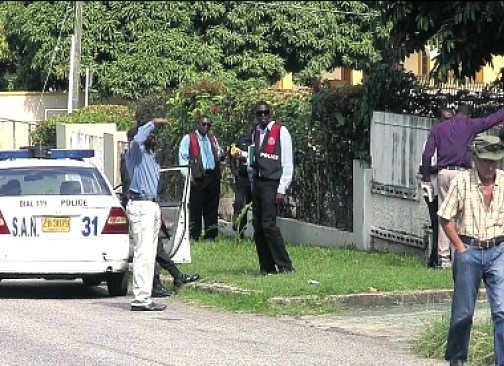
POLICE yesterday confirmed that two men were fatally shot, while two of its members — a corporal and a constable — were shot and injured and two firearms seized during a gunfight in the Ferry district, St Catherine, on Thursday night. The men were not identified up to late yesterday afternoon. The injured policemen were taken to hospital where they were admitted in stable condition. According to the police, a 9mm Browning pistol and a 9mm Sig Sauer firearm along with several rounds of ammunition were seized following the shooting.
The Police Corporate Communications Unit has revealed that there is now a strong police presence in the the Meggie Top community of Salt Spring, St James.
Observer photo.
This after the gruesome murder of three people. Four persons were shot, however one survived. Police reportedly confirmed Tuesday that the four were shot at approximately 11:30 pm. The injured individual is said to be in serious condition.
Two Children and Mother Die From Suspected Carbon Monoxide Poisoning.
Two children and their mother are suspected to have died as a result of carbon monoxide poisoning in Three Hills, St Mary on Thursday, February 4.
According to Loop News, they have been identified as 37-year-old Charla Thompson-Young and her two children- 12-year-old Brandon Young and 4‑year-old Leslie Ann Young, all of Three Hills in St Mary. Reports from the Retreat Police are that about 7:30 am, Mrs Young’s sister went to the house where she discovered the bodies. The Police was called in and the bodies were seen in the house. Preliminary investigations by the Police revealed that a gas generator, which was housed in the living room, was reportedly left turned on overnight with the house locked-up. Gruesome Triple Murder in St James
Former Pennsylvania Senator Rick Santorum ® suspended his presidential campaign on Wednesday. “We are suspending this campaign as of this moment,” he said on Fox News. He also announced that he is endorsing Sen. Marco Rubio (R‑Fla.).
The news, first reported by CNN and the Washington Post earlier on Wednesday, comes after Santorum finished with just one percent of the vote in the 2016 Iowa GOP caucus. The loss had already prompted his campaign to postpone a planned 46-county tour in South Carolina. Santorum had hoped to earn the backing of evangelical Christian voters and peel away supporters from some of his conservative rivals, like Sen. Ted Cruz (R‑Texas). He announced his presidential run on May 27 in a Pennsylvania factory, joining an already-crowded field of GOP contenders. His highly conservative platform, fueled by his own blue-collar roots, rested upon reining in spending and fighting on behalf of the American worker.
Rick Santorum, former senator from Pennsylvania and 2016 Republican presidential candidate, speaks during the Republican presidential candidate debate at the Iowa Events Center in Des Moines, Iowa, U.S., on Thursday, Jan. 28, 2016. Candidates from both parties are crisscrossing Iowa, an agricultural state of about 3 million people in the U.S. heartland that will hold the first votes of the 2016 election on Feb. 1. Photographer: Daniel Acker/Bloomberg via Getty Images
“It’s time to revitalize manufacturing, processing, construction and energy sectors of our economy again so America can once again thrive,” his campaign website said. On some issues, he veered away from many in his party, proposing to raise the minimum wage by 50 cents per year over three years during a CNN Republican debate. Santorum is also known for his hawkish foreign policy. He has staunchly opposed the nuclear deal struck between world powers and Iran, calling it “the greatest betrayal of American national security” in U.S. history. He also advocated for 10,000 U.S. troops to defeat the Islamic State, a terrorist group also referred to as ISIS or ISIL. His run has been marred by controversial comments on abortion, homosexuality and immigration. In August, he said that undocumented parents are “like someone who robs a bank because they want to feed their family.”
Santorum ran in the 2012 presidential election on a similar platform, but with a greater degree of success. He won 11 primaries and campaigned in all 99 of Iowa’s counties on a tight budget, leading him to a very narrow victory in the 2012 Iowa caucus. (He finished 11th out of 12 candidates in this year’s Iowa caucus.) Some of his comments, however, landed him in hot water throughout the campaign. He famously told Fox News’ Chris Wallace in 2011 that gay soldiers “cause problems for people living in close quarters.”
Santorum didn’t drop out of that primary race until April of 2012, after a series of defeats and the hospitalization of his daughter, Bella, who suffers from a rare genetic disorder. At that point, he ostensibly handed the 2012 GOP nomination over to Mitt Romney. Santorum served in the U.S. House of Representatives from 1991 to 1995 and in the Senate from 1995 to 2007. In 1996, he co-authored a GOPwelfare reform bill, which President Bill Clinton ultimately signed into law. Rick Santorum Suspends Presidential Campaign, Endorses Marco Rubio
The National Democratic Movement (NDM) laments the calling of a general election 11 months before it is constitutionally due, without there being a national disaster or crisis. This is the clearest indication yet, that Portia Simpson Miller’s People’s National Party Administration, after four years in office, cannot face the people after the next budget is presented. Hence, the governing party is attempting to trick the people into giving them another term in office, without telling us the truth of the hardships which will be unleashed upon the backs of the poor and middle classes.
The NDM is of the view that the last four years of following International Monetary Fund (IMF) orders slavishly, like a headman on a slave estate, administering lashes on a poor defenceless people, devaluing our dollar to a precipitously low level; demanding more production while making food, health care and social services become less accessible to the people of Jamaica, has not solved Jamaica’s problems. The NDM again calls on the people of Jamaica to demand that the following issues be placed on the table in the upcoming general election: [1] When will tax & pension reforms be implemented, and how many public sector workers will be laid off after the general election?
[2] Fixed date for elections and separate ballots for prime minister and members of parliament.
[3] Members of parliament must serve the people who elect them and make good laws rather than appointments to Cabinet.
[4] Abolish personal income tax (PAYE) and have one equitable General Consumption Tax system.
[5] Focus on the young by facilitating permanent jobs for the main categories of high school and university graduates.
[6] Fix national security and justice with adequate resources and training for the police, the judiciary and implementing a national ID system.
[7] Fix the health sector by simply upgrading the hospitals and making available proper health services by introducing an Ability-to-Pay Basis System.
[8] Fix the education system by refocusing on early childhood education by bringing it within the formal education system.
[9] Dismantle the garrison structure in constituencies (which represent approximately twenty-five per cent of voters).
[10] Create the structure and environment for a fully transparent government and creating the foundation for a real sovereign people.
The NDM believes that the people of Jamaica must demand real systemic change.
The NDM also believes that both the Jamaica Labour Party and the People’s National Party have dug Jamaica into the economic hole in which we have found ourselves and are continuing the same old and unproductive policies directed by the IMF and others.
We have, for the past 72 years, been swapping one set of failed party policies for another, and is of the view that it is mainly some in Jamaica’s private sector and other special interests who fund the old status quo politics that get most of the benefits from the present system of poor governance. PNP can’t face J’cans
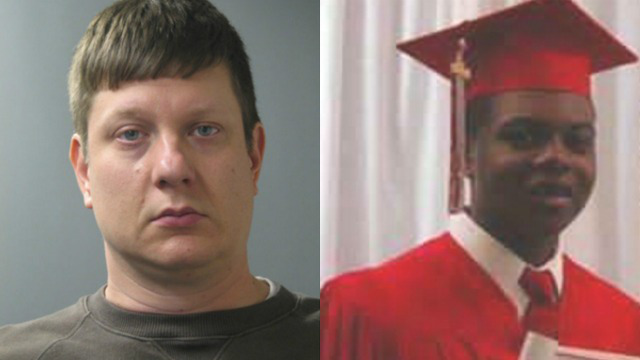
Jason Van Dyke (L) and Laquan McDonald (WGN Screenshots)
The Chicago officer who killed Laquan McDonald never synced his microphone to his dashcam and even intentionally damaged the camera, according to police maintenance logs. What’s worse: He’s not the only officer to do so. Over 1800 logs first obtained by DNAinfo Chicago show that officers regularly damage their cameras or find ways to keep the sound from syncing. Their methods include hiding microphones in glove boxes, pulling out the batteries, damaging antennae, and so on. The logs showed that Jason Van Dyke, the officer involved in the Laquan McDonald shooting, caused “intentional damage” to his dashcam at least once, though the logs indicate that the dashcam was broken multiple times. On the day of the shooting, the audio for the video was not picked up by his car or the one next to his.
One month after the shooting, a Nov. 21 review of 10 videos downloaded from Van Dyke’s squad car determined it was “apparent … that personnel have failed to sync the MICs [sic],” according police records. Of the five police vehicles that were present the night of the shooting, only two had dashcams that actually recorded video, and one of those was reportedly broken. Records show that, five days before the shooting, a request was put in to repair the dashcam, though “no problem” was found with the equipment when it was examined October 31. One week later, the system was reportedly broken again, with a “hardware issue” remaining unaddressed for four months. Three additional dashcams were unable to capture footage the night of the shooting, due to system malfunctions that inclue: “Power issue,” “disc error” and “application error.”
SAVANNA-LA-MAR,Westmoreland — The Westmoreland police have vowed to make an example of a councillor, who will be charged soon, to show that no one is above the law “irrespective of creed, class or social status”. |The councillor’s] behaviour and intimidation cannot stop the police from acting and this is a strong warning that if any political personnel or anybody believe that they can intimidate the police from carrying out their lawful duty, they have another guess coming because we will arrest,” David White, the deputy superintendent who heads the Westmoreland Police Division, told the Jamaica Observer West.
White said the councillor is to be charged with obstructing police and assaulting the police. “We are taking strong actions against him. The Police Federation has been summoned, too, because the police were abused and assaulted by him,” White said. The pending charges against the councillor stem from an incident on the weekend during a police operation to remove illegal vendors from the streets of Savanna-la-Mar, the Westmoreland capital. According to White, members of the Westmoreland police and the Westmoreland Parish Council municipal police were conducting a joint anti-street vending operation when the councillor stepped in and sought to bring the activity to a halt, assaulting the police in the process. “… he came on the scene and started verbally abusing the police, point up his finger in the police face and tell them to low the people dem,” White noted. He said that the councillor’s action resulted in a street brawl which drew a large crowd. He said reinforcement had to be called in.
White said the idea was to arrest the councillor on the scene and offer him station bail but it was decided instead to proceed by way of summons. “We are going to make an example. I don’t know if it is cheap popularity he is trying to seek but the law is saying that no man is exempt, irrespective of your creed, class or your social status. That’s the law,” he added.
“I have never seen this in the history of my policing where a councillor would act in such a manner,” he said.
DSP White, who took over command of the Westmoreland Police Division earlier this year, has said that one of his priorities is to rid the town centres in the parish of illegal vending. White, who is adamant about a link between criminal activities and street vending, earlier this month launched an anti-street vending campaign in the areas of Savanna-la-Mar, Grange Hill and Negril. “We know that a number of our vendors are there as a result of the proceeds from crime. We also know that some of them have been strategically placed by some criminal elements within the town,” he insisted. “There is a very strong link of crime in Westmoreland and vending in the different townships. And, therefore, our activity is to remove many of them to create that public safety within. He added: “Some of them have taken up residence around even the financial institutions and wherever there are shopping centres, and where you have a group of them in between are the criminal elements, who come and prey on the innocent shoppers.” Councillor to be charged
The leaders of the occupation of the Malheur National Wildlife Refuge, including Ammon Bundy, have been arrested after a shootout with law enforcement officials about 15 miles north of Burns on Tuesday night.
One of the militia members was shot and killed during the confrontation, and though the identity of the deceased has not yet been released, many reports on the ground indicate that the deceased is LaVoy Finicum, who spoke at length about how he would rather die than be taken into custody. State Rep. Michele Fiore (R‑Nevada), who speaks directly to the Bundy family, has confirmed Finicum was the casualty in the shootout.
Also among those arrested were Ryan W. Payne, Brian Cavalier, and Shawna J. Cox. They have all been charged with felony counts of impeding officers of the US from discharging their official duties through the use of force, intimidation or threats. Ryan Bundy of Bunkerville, Nevada, suffered a minor gunshot wound but is in stable condition and is expected to be charged with the others.
The FBI, Oregon State troopers, and other law enforcement agencies were all involved in the gunfight and subsequent arrest, but it is unclear who shot first.
The incident apparently began with a traffic stop that occurred while Bundy and his supporters made a trip to a meeting in the neighboring town of John Day. Highway 395 has been temporarily closed between Burns and John Day.
Harney District Hospital, where some of the militants involved in the gunfight have been treated, is also on lockdown.
In a separate incident the same night, Oregon Police arrested Joseph Donald O’Shaughnessy, a supporter of the Bundy occupation.
Ammon Bundy, along with dozens of other armed right-wing extremists, occupied the Malheur National Wildlife Refuge on Jan 2 to protest the government’s treatment of Steven and Dwight Hammond, local ranchers who were convicted of committing arson on federal land adjacent to their property. The Hammonds declined Bundy’s support, and the armed militia group has been criticized and derided by the vast majority of locals in the area. They have also found themselves subject toconfrontations with rival groups, interior conflicts and fistfights, and pranks from detractors as they have continued their occupation.
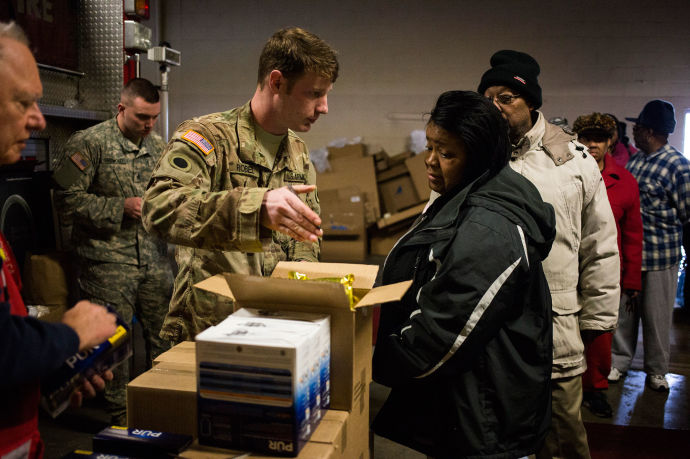
The National Guard has arrived in Flint, Michigan, passing out bottled water and filters in an effort to protect residents from the city’s tainted water supply. CREDITPHOTOGRAPHBYBRITTANYGREESON /THE NEWYORKTIMES /REDUX
Even before the drinking water in Flint, Michigan, was found to be tainted with lead — before water from some areas tested at more than twice the level considered to be toxic waste, and public-health officials said that every last child in the city should be treated as if the child had been poisoned—the governor’s office knew that the water was discolored, tasted bad, smelled strange, and was rife with “organic matter.” They knew, as one memo sent to Governor Rick Snyder in February, 2015, noted, that “residents have attended meetings with jugs of brownish water.” Officials figured that a reason it looked that way was the presence of rust. And they thought that was just fine. They wished, in fact, that the residents would realize how good they had it, when it came to the water’s substance, and stop complaining about its style. Various safe-water laws, the February memo said, “ensure that water is safe to drink. The act does notregulate aesthetic values of water.” The “aesthetics” (the word comes up several times in e‑mails about Flint, which the governor released Tuesday night under pressure) were bad because “it’s the Flint River”; “the system is old”; “Flint is old” — the water, in a word, fit their picture of the city, in which about forty per cent of its hundred thousand people lived below the poverty line (and more than half are black). Until April, 2014, Flint had been part of Detroit’s water system, which had Lake Huron as its source. It was scheduled to be connected to a new pipeline in 2016 or 2017, which would save money; Flint is in such desperate financial straits that it was under the oversight of an Emergency Manager. When that manager felt he couldn’t negotiate a low enough price for Detroit water in the interim, the city was left with the option of drinking from the river that ran by it, and past its active and derelict factories, and had been last regularly used decades before. The city would treat the water itself. All the city had to do was pass a few tests; as long as it did, it didn’t matter if the residents were, in effect, drinking dirt.
But then, almost immediately, the water began to fail the tests. In August, 2014, and again that September, the water was found to have unacceptably high levels of fecal coliform bacteria, and specifically E. coli. Certain neighborhoods were instructed to boil their water, while the city added chlorine to the supply to disinfect it. It took a lot of chlorine — and that may be where Flint’s troubles really began. (NBC has atimeline of the crisis.) The city’s water managers, unaccountably, seem not to have added any anti-corrosion agents to the water. Nor did they check for corrosion issues in a way they ought to have for a city Flint’s size. (In a remarkable memo a year later, Brad Wurfel, the spokesman of the state’s Department of Environmental Quality, said that the staff had “made a mistake,” and followed the wrong protocol.) By October, 2014, General Motors had announced that it would no longer use the water, because it was corroding its equipment. It was also — and this should have been entirely predictable — eating into the lead pipes that delivered the water to people’s homes, causing them to crumble into the water. Flint is old, and its water system took decades to build. It took only months of cheap, corrosive water to mangle and perhaps permanently destroy it. Read more here : http://www.newyorker.com/news/amy-davidson/the-contempt-that-poisoned-flints-water.
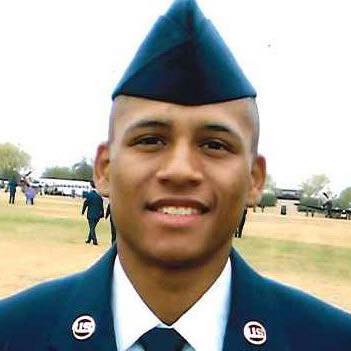
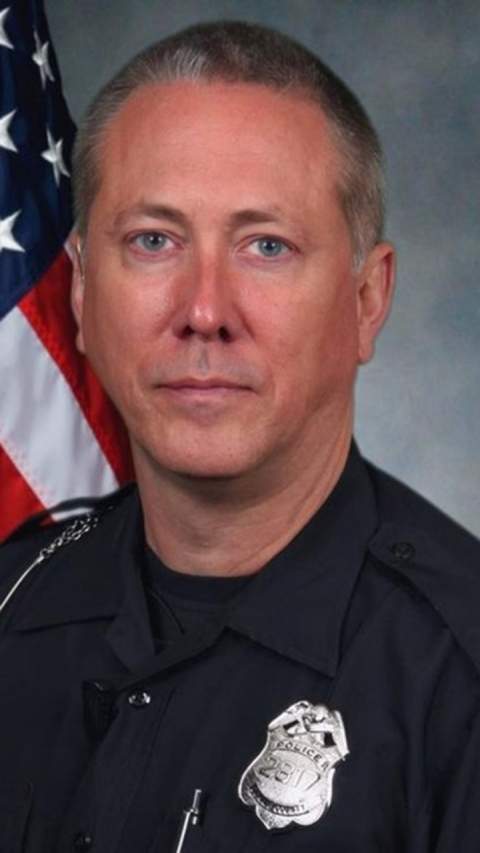
ATLANTA (Reuters) — A grand jury indicted a white police officer on Thursday for felony murder and other criminal charges in the shooting death of an unarmed, naked black man at an apartment complex near Atlanta last March. The charges come as prosecutors face increased scrutiny over how they treat cases of police use of deadly force, particularly against minorities. The Black Lives Matter movement, sparked by police killings of unarmed black men since 2014, has focused attention on race and policing. DeKalb County District Attorney Robert James told reporters that DeKalb County police officer Robert Olsen was indicted on six charges for the March 9 shooting of 27-year-old Anthony Hill.
Hill, a U.S. Air Force veteran who suffered from bipolar disorder and post-traumatic stress disorder, was having a manic episode when he was shot to death while naked in the parking lot of his apartment building, according to his family. Olsen told a civil grand jury last year that Hill was coming at him in a hostile manner and disobeyed commands to stop, making him feel threatened. The grand jury at the time recommended further investigation. Olsen was indicted on two counts of felony murder, aggravated assault, violating his oath of office and making a false statement, James said. “My job as a prosecutor is to seek justice,” James told the news conference.
Robert Olsen indicted for murder of Anthony Hill.
“That’s what we do in every case, and that’s what we did in this case. James said a warrant was issued for Olsen’s arrest and that he expected him to be taken into custody soon. Olsen’s attorney, Donald English, could not be immediately reached for comment. Protesters in Atlanta braved frigid nights and camped out in front of the courthouse this week, demanding justice for Hill. The charges come just weeks after an Ohio grand jury cleared two Cleveland police officers who fatally shot a 12-year-old black child who was playing with a toy gun in a park, sparking widespread anger. Read more here : http://www.huffingtonpost.com/entry/anthony-hill-grand-jury-indictment_us_56a19314e4b0d8cc109992e7
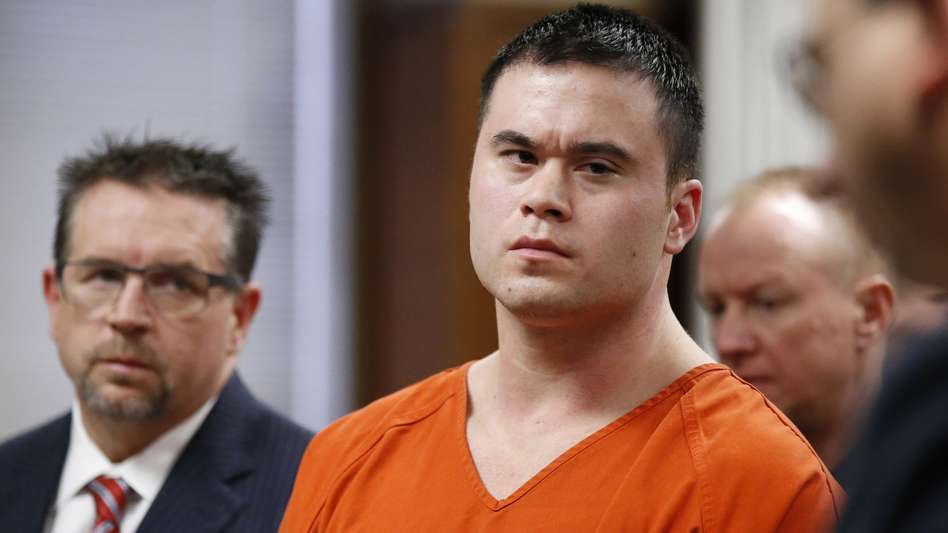
Daniel Holtzclaw (center) listens as Oklahoma County assistant district attorney Gayland Gieger (right) speaks during Holtzclaw’s sentencing hearing in Oklahoma City, Thursday. Holtzclaw, a former Oklahoma City police officer, was convicted of raping and sexually victimizing several women on his beat. At left is defense attorney Scott Adams.
The women were teenagers and grandmothers. Most were living on the margins. All of them were black. And during a month-long trial that became a symbol of police predation, they formed a bleak parade of 13 witnesses who accused a former Oklahoma City officer of using his badge to coerce sex acts and rape.
On Thursday, after 45 hours of deliberation, a jury convicted Daniel Holtzclaw, 29, on five counts of rape and 13 other counts of sexual assault, including six of sexual battery, against eight of the women.
The convictions included four for first-degree rape, which carries a possible sentence of life in prison. He will appear in court on 21 January for sentencing.
Holtzclaw was cleared of a further 18 of the 36 charges he faced, including rape, sexual battery, burglary, indecent exposure and stalking.
His conviction is likely to be viewed as a key moment of accountability for law enforcement officers who abuse their position: out of the hundreds of police officers terminated for sexual abuse in recent years, only a small number faced criminal charges and even fewer were convicted. And black women are especially liable to be their targets.
Still, the case did not attract the level of attention that activists and media outlets have paid to other accusations of rape or police abuse. Some racial justice activists were frustrated that the trial did not generate the same coverage as police-involved shootings that have killed black men. At the start of the trial, in early November, local activists were surprised to find the courtroom empty of the women’s groups that have supported accusers in other rape trials. And major networks carried little to no coverage of the trial or its outcome.
Many attributed the low visibility of the case to the profile of the victims: vulnerable women of color with troubled histories. Holtzclaw, police investigators found, methodically targeted black women with criminal records or a history of drug use or sex work. For all but one of his targets, police investigators said, the former officer used his position on the force to run background checks for outstanding warrants or other means by which to coerce sex.
An advocate who watched the trial unfold said the allegations fit a familiar pattern. “Officers count on no one believing the victim if she reports,” said Diane Wetendorf, who runs a counseling group in Chicago for women who are victims of police abuse. “And [they] know that the word of a woman of color is likely to be worth even less than the word of a white woman to those who matter in the criminal justice system.”
Indeed, Holtzclaw’s choice of victims laid the groundwork for an aggressive defense. His attorney, Scott Adams, aggressively questioned his accusers about their marijuana use, drinking, thefts and suspended driver’s licenses in an attempt to undermine their credibility.
In court and in pretrial testimony, however, the 13 accusers told broadly consistent stories about how Holtzclaw isolated them, assaulted them, and terrorized them into silence.
One woman accused Holtzclaw of driving her to a field, raping her in the back of his squad car, and leaving her there. “There was nothing that I could do,” she testified. “He was a police officer and I was a woman.”
Another of his victims, a 17-year-old girl, testified that Holtzclaw raped her on her mother’s front porch. She said he threatened her with an outstanding warrantfor trespassing. “What am I going to do?” she asked. “Call the cops? He was a cop.” The jury convicted Holtzclaw of every count related to her assault.
Another woman said the former officer forced her to perform oral sex while she was under the influence of drugs and handcuffed to a hospital bed. Holtzclaw, the woman testified, implied that he could have her charges dropped in return. “I didn’t think that no one would believe me,” the woman testified in a pre-trial hearing. “I feel like all police will work together.”
Holtzclaw’s crimes took place over seven months in 2013 and 2014 while he worked the 4pm to 2am patrol.Oklahoma City law enforcement arrested Holtzclaw on 18 June 2014. The previous night, he had pulled over a 57-year-old daycare worker and molesting her during the traffic stop. Holtzclaw then ordered her to perform oral sex, his gun in plain view, she has testified.
The woman made an immediate report to the Oklahoma City sex crimes division. Detectives arrested Holtzclaw in the afternoon. Before long, the investigative team connected Holtzclaw with other reports of sexual abuse against unnamed officers. GPS evidence from his patrol car also linked Holtzclaw to the alleged crimes.
Holtzclaw was fired from the force in January 2015.
“The Oklahoma City police department is pleased with the jury’s decision,” the law enforcement agency said in a statement on Thursday night. “We are proud of our detectives and prosecutors for a job well done … [We] firmly believe justice was served.”
During the trial, Holtzclaw did not contest that he encountered the women, but he maintained his innocence. He had a dedicated contingent of online supporters using the hashtag #FreeTheClaw. The defense called just one witness, a former girlfriend of Holtzclaw’s who testified he never exhibited sexually aggressive or inappropriate behavior around her.
The verdict will surprise advocates who were steeling themselves for an acquittal.
Legal experts noted that Holtzclaw’s defense harnessed powerful stereotypes about rape victims. His attorney noted that his accusers waited months to report his crimes and that they were not “perfect victims” or “perfect accusers”. The case unfolded before an all-white jury. (Court documents indicate Holtzclaw is Asian or Pacific Islander.)
“These cases are so difficult to prosecute because the defense attorneys go after the victims’ credibility in court,” said Wetendorf. “In my experience working with victims of police abuse, officers do target vulnerable women, particularly drug addicts, alcoholics and prostitutes.
“They are confident that ‘no one will believe’ these victims. Where women of color are available as targets, they are even easier prey.”
Rachel Anspach, of the African American Policy Forum, considered it a a sign of progress that Holtzclaw’s case even went to trial. “Historically, we’ve seen the justice system hasn’t protected black women from sexual assault,” she said.
POLICE Commissioner Dr Carl Williams has admitted that not enough is being done to curb corruption within the Jamaica Constabulary Force (JCF).
“Of course not enough is being done,” Dr Williams said last week in response to a journalist’s question on the issue of corruption. “If enough was being done we would not have corruption in the force. It would have been a thing of the past.” The commissioner said the “accountability systems” needed strengthening, and added that “we have to ensure that we change the culture” of the force. “You would have seen in the last years or so where a number of police officers have found themselves on the wrong side of the law. What we found is that several of them are young police officers, between one and five years service,” said the commissioner during a briefing with senior journalists at his Old Hope Road office in St Andrew. “Perhaps some of them have been exposed to a culture in the police force that has caused them to go on the wrong side, but in the majority of cases, these persons came into the force with their deviant behaviour. In other words, they had already had those bad intentions before they came in. We recruited them with those bad intentions, with those bad habits,” Williams added.
Williams said that the polygraphing of all new recruits seeking to join the force will be one way of resolving that issue. The force has intensified its anti-corruption drive since 2007 to weed out corrupt cops and prevent them from moving up the ranks.In a 2013 column in the Jamaica Observer, then Police Commissioner Owen Ellington wrote that anti-corruption policy had helped to rid the force of some 400 individuals of questionable character between 2007 and that year. Updated figures were not available from the police up to press time yesterday. During his outline of the thrust in the 2013 article, Ellington noted that the anti-corruption strategy had “been supplemented by a strengthening and careful application of administrative tools available”, which encompasses areas of the recruitment, promotion and re-enlistment, rotation and separation. Between 2010 and 2013, some 236 members had been denied permission to re-enlist, Ellington wrote. The process of early and retiring police officers in the interest of the public are other well known methods of ridding the force of bad apples.
The force also utilises its Ethics Committee in the fight against corruption. The Ethics Committee allows the Police High Command to confront such members about their conduct, while at the same time providing the member an opportunity to address the allegations. “This allows management to gauge the risk a member may pose to the organisation and take appropriate action. In some instances, this process has led to the voluntary separation by the member, while in others, it has highlighted the need for further investigations, resulting in cases being re-routed to the [Anti-Corruption Branch] and the [National Intelligence Bureau],” Ellington wrote then. In an effort to ensure that the top brass of the JCF isn’t injected with questionable characters, promotions no longer hinge solely on the concept of candidates’ knowledge of the job and being hard workers.
“Not only must they demonstrate knowledge of the job and competence, but their conduct both on and off the job is scrutinised at length. Gazetted officers are held at an even higher standard as they undergo a gruelling process of psychometric evaluation, panel interviews, ethical screening and mandatory polygraph testing. All candidates must be compliant with the provisions of the Commission for the Prevention of Corruption, which stipulates the yearly submission of declaration of assets and liabilities. They must also submit to the High Command, receipts from their last three declarations,” Ellington said then. ‘We have to change the culture’
The Independent Commission of Investigations (INDECOM) has obtained a warrant to search the Jamaica Defence Force (JDF) headquarters at Up Park Camp for mortars and information related to their use during the 2010 police-military operations in Tivoli Gardens.
Major Basil Jarrett, the head of the JDF Civil-Military Coöperation Unit, says the military is aware of the warrant. According to law enforcement sources, INDECOM is also in possession of a number of summonses for several members to appear before the body for interviews. It was unclear when the search warrant and summonses were issued, but sources told The Gleaner Online that they were obtained using information uncovered during the ongoing west Kingston Commission of Enquiry. However, before INDECOM could execute the search warrant attorneys for the JDF went to court seeking to block the search. The matter came up before Justice Bryan Sykes in Chambers this morning. Despite claims by several residents of Tivoli Gardens that they heard “bombs” during the May 2010 operations to capture drug kingpin Christopher ‘Dudus’ Coke, the JDF initially rebuffed the claims. However, testifying before the Sir David Simmons-chaired tribunal, former JDF Chief of Defence Staff Major Stewart Saunders acknowledged that he ordered the use of mortars and that a total of 37 were fired in three open spaces in the west Kingston community. Stewart and JDF Mortar Control Officer Major Warrenton Dixon defended the use of the mortars saying there were used to create a diversion for gunmen who were engaging members of the security forces in fierce firefights and to keep women and young children in-doors and out of harms way. “It’s unfortunate that 70-odd persons lost their lives in there, but I believe strongly in my heart that the use of the mortars saved a lot of lives and I am proud of it,” Dixon testified last month.INDECOM gets warrant to search JDF headquarters.
KINGSTON, Jamaica – The Police High Command says it has increased the reward to J$1.5 million to anyone who can give reliable information leading to the arrest and charge of Marlon Perry otherwise called ‘Duppy Film’, of Phillipsfield, Yallahs, St Thomas. Perry was implicated in the brutal slaying of Corporal Kenneth Davis and Constable Craig Palmer on Tuesday, December 22. The policemen were killed on the Poor Man’s Corner main road in St Thomas. The following individuals are also being asked to immediately turn themselves in to the Yallahs Police. They are: Jason Foster, 21, of East Albion, St. Thomas, and Kevin Eldermire otherwise called ‘Harry Patta’ of a St Thomas address. Anyone with information that can assist the police in their investigations is being asked to contact the Criminal Investigations Branch headquarters at 922‑4741 or 922‑4487, Yallahs Police at 982‑5075, Crime Stop at 311, 811, Stay Alert App, Police 119 emergency number or the nearest police station.
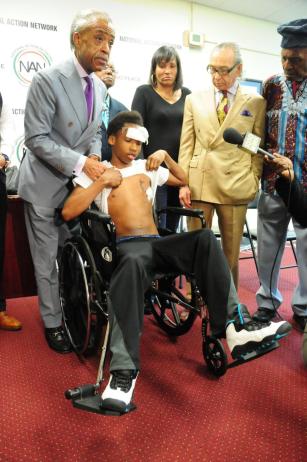
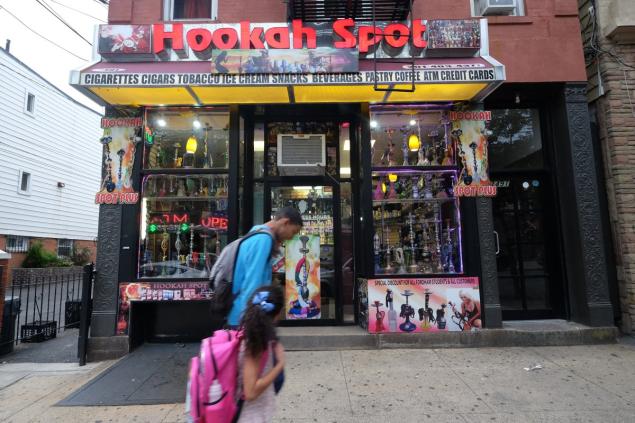
On the eve of testifying at a police tribunal, the teen who nearly died after he was smashed into the window of a Bronx hookah bar by an NYPD sergeant said his assailant should be booted from the force. Javier Payne, 15, is scheduled to appear Wednesday in the NYPD trial room at One Police Plaza where Sgt. Eliezer Pabon is charged with using “unjustified force” against the handcuffed boy on May 17, 2014. “What he did to me wasn’t right and he could do it again,” Payne told The Daily News. “I feel he should lose his job.” The Bronx district attorney declined to press criminal charges against the sergeant because a glazier claimed the window was defective, but the Civilian Complaint Review Board found that the sergeant used excessive force. The incident occurred after Payne and a 13-year-old pal were arrested for punching a man in the face after asking him for a cigarette.
Javier Payne, was critical condition after his head was shoved through a plate glass window of a hookah bar by an NYPD cop.
A surveillance camera at Hookah Spot on Arthur Ave. captured the action as Pabon rushed at the handcuffed youth facing the window, and in a clearly unprovoked action, struck the teen with his left arm. Payne slammed up against the window which exploded on impact. “This department trial will determine how the NYPD polices itself,” said lawyer Sanford Rubenstein, who has filed a $25 million lawsuit against the sergeant and the city.
Sgt. Eliezer Pabon used excessive force, the Civilian Complaint Review Board found, when he pushed then-14-year-old Javier Payne through a window.
Payne, now a 9th grader at Health Opportunity High School in Manhattan, underwent emergency surgery to remove pieces of glass from his heart. The teen said he is self-conscious and embarrassed by the scar on his chest. “I get sharp pains in my chest sometimes because of the way I move my arm,” he said. Pabon’s lawyer declined to comment.
KINGSTON, Jamaica — A Coaster bus driver who confessed to driving over a policeman’s foot and hitting him with his motor vehicle after he was signalled to stop was fined $50,000 when he appeared in the Corporate Area Resident Magistrate’s Court yesterday. Claeon Campbell pleaded guilty to the charges of assaulting a police officer and assault occasioning bodily harm. Reports are that on December 30, the policeman, who was on duty in the vicinity of Manor Park in St Andrew, signalled Campbell to stop. However, Campbell disobeyed. Campbell reportedly swung the bus to the left while the officer was still in front of it, causing the wing mirror to hit the officer and the wheel to go over his foot. When Campbell appeared in court, Senior Resident Magistrate Judith Pusey asked Campbell if there was any reason he should not be sent to jail.
“It wasn’t willfully done,” Campbell said. The policeman told the court that Campbell seemed to have been having a bad day when he signalled him to stop.
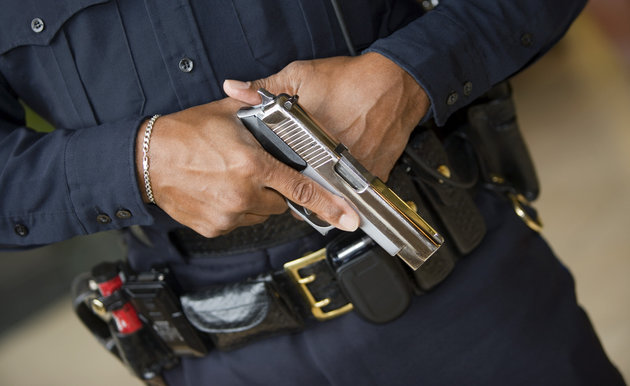
JUPITERIMAGESVIAGETTYIMAGES Police fatally shoot an average of around 1000 people each year, and the criminal justice system holds that almost every single shooting is legal.
Many people viewed 2015 as a year of reckoning for police, with continued scrutiny of the use of deadly force spurring momentum for reform. In reality, however, the road to accountability remains a long one.
That point is clearly reflected in the number of police officers who were convicted on murder or manslaughter charges last year for fatally shooting a civilian in the line of duty.
In 2015, that number was zero.
And that’s not unusual. No officers were convicted on such charges in 2014 either.
In fact, since 2005, there have only been 13 officers convicted of murder or manslaughter in fatal on-duty shootings, according to data provided to The Huffington Post by Philip Stinson, an associate professor of criminology at Ohio’s Bowling Green State University. Stinson’s data doesn’t include cases in which civilians died in police custody or were killed by other means, or those in which officers only faced lesser charges.
One of the last successful convictions came in 2013, when Culpeper Town, Virginia, police officer Daniel Harmon-Wright was sentenced to three years in jail for voluntary manslaughter charges in the slaying of Patricia Cook, an unarmed 54-year-old, a year earlier.
On Feb. 9, 2012, Harmon-Wright responded to a suspicious vehicle call and found Cook parked in a local Catholic school parking lot. In court, Harmon-Wright said when he asked Cook for her driver’s license, she rolled up her window, trapping his arm, before beginning to drive away. Harmon-Wright responded by unloading seven rounds into Cook, with fatal shots hitting her in the back and head. But a jury didn’t find the officer’s testimony credible, returning a guilty verdict on three charges in the shooting death. After serving out his sentence, Harmon-Wright was releasedin 2015.
Some officers in these cases have served out yearslong sentences for their crimes. Others were in and out of jail in months. Some even became police officers again. But only a tiny portion of cops who kill while on duty ever face charges for their actions, much less actual punishment.
The inability to convict police on murder or manslaughter charges for fatal on-duty shootings contrasts with a recent increase in prosecution, Stinson said. In 2015, 18 officers faced such charges, a significant increase from an average of around five officers each year over the preceding decade. Many of these cases involved incidents from previous years and have yet to go to trial, but if history is any indicator, it seems unlikely that many of the officers will be convicted.
The tiny number of convictions in fatal police shootings looks even smaller when you consider just how many cases the criminal justice system considers each year. Although there are no reliable government statistics on civilians killed by police, data compiled independently last year by outlets like The Guardian and The Washington Post, or civilian tracker Mapping Police Violence, have led to estimates of roughly 1,000 deadly shootings each year.
Of that total, prosecutors and grand juries around the nation each year have determined that around five of these cases involve misconduct worthy of manslaughter or murder charges. And in the end, the criminal justice system typically concludes that only around one shooting each year is consistent with manslaughter or murder.
This means the overwhelming majority of police shooting cases are ultimately determined to be justified homicides, in which deadly force was used lawfully, often in what police say was an effort to protect an officer’s safety or to prevent harm to the public.
One reason for the lack of prosecution and subsequent conviction begins with the Supreme Court’s legal standard for use of lethal force. According to Graham v. Connor, the landmark 1989 case that established the standard, each “use of force must be judged from the perspective of a reasonable officer on the scene, rather than with the 20/20 vision of hindsight.” The ruling specifically cautions against judging police too harshly for split-second decisions made in “tense, uncertain and rapidly evolving” situations. All of this gives officers plenty of leeway to explain why their actions were legal.
The trajectory of police shooting cases has long been determined by police departments themselves, which, until recently, were largely able to control the narrative of events that led to a killing. And when cases have gone to trial, judges and juries have exhibited a tendency to side with the police. All of these factors make it exceedingly difficult to convict an officer, in the rare instances in which they face charges at all.
“Only about 20 percent of the officers arrested are ever convicted of murder or manslaughter,” Stinson explained. “Juries and judges seem reluctant to second-guess the split-second life or death decisions of police officers in violent street encounters in the course of their job … and will give the benefit of every doubt to an officer on trial in these cases. That is not so for other types of crimes by police officers, but it certainly is the case in these shooting cases.”
Stinson said that while there is a recent surge in officers charged for murder or manslaughter, it’s too early to tell if the upswing is the beginning of a trend. But he believes newer technology like cell phone video and police body cameras have produced a “tipping point,” leading the public to take a more critical view of the police’s version of events.
While Stinson said he thinks many police shootings are justified, he predicts that we’ll continue to see more officers charged with murder or manslaughter in the coming years. But barring considerable reform of a law and justice system that gives police wide latitude to inflict lethal force upon the public, this may not correspond to a similar rise in convictions. Here’s How Many Cops Got Convicted Of Murder Last Year For On-Duty Shootings There’s something strange about this picture.