During a commencement speech at Tuskegee University on Saturday, Obama spoke frankly about the role her racial identity played during the 2008 presidential campaign. “As potentially the first African-American first lady, I was also the focus of another set of questions and speculations, conversations sometimes rooted in the fears and misperceptions of others,” she told the class of 2015. “Was I too loud or too emasculating? Or was I too soft? Too much of a mom and not enough of a career woman?”
Obama referenced her satirical portrayal on a July 2008 cover of the New Yorkermagazine as a terrorist. “Then there was the first time I was on a magazine cover,” Obama told the graduates at the historically black Alabama college. “It was a cartoon drawing of me with a huge afro and a machine gun. Now, yeah, it was satire, but if I’m really being honest, it knocked me back a bit. It made me wonder ‘just how are people seeing me?’”
During a commencement speech at Tuskegee University on Saturday, Obama spoke frankly about the role her racial identity played during the 2008 presidential campaign. “As potentially the first African-American first lady, I was also the focus of another set of questions and speculations, conversations sometimes rooted in the fears and misperceptions of others,” she told the class of 2015. “Was I too loud or too emasculating? Or was I too soft? Too much of a mom and not enough of a career woman?”
Directing her remarks to her African-American audience, Obama spoke from her own experience on how racial inequality impacts opportunity. “The road ahead is not going to be easy,” Obama said. “It never is, especially for folks like you and me.”Obama then aired a laundry list of slights she said black Americans deal with on a regular basis.
“We’ve both felt the sting of those daily slights throughout our entire lives. The folks who crossed the street in fear of their safety, the clerks who kept a close eye on us in all those department stores. The people at formal events who assumed we were the help,” Obama said. “And those who have questioned our intelligence, our honesty, even our love of this country, and I know that these little indignities are obviously nothing compared to what folks across the country are dealing with every single day. Those nagging worries about whether you’re going to get stopped or pulled over for absolutely no reason. The fear that your job application will be overlooked because of the way your name sounds.”
Officer Benjamin Deen, left, and Officer Liquori Tate.
Three men and a woman have been charged in the fatal shooting of two police officers during a traffic stop in the southern Mississippi city of Hattiesburg, authorities said Sunday. The officers, Benjamin J. Deen, 34, and Liquori Tate, 25, were gunned down Saturday night after Deen pulled over a Hyundai for a speeding violation and called for back up, officials said.
Four suspects, including two brothers, were arrested in different locations after a manhunt that lasted into the early hours of Sunday morning. Marvin Banks, 29, was charged with two counts of capital murder, and counts of grand theft auto and being a felon in possession of a firearm. Joanie Calloway, 22, was charged with two counts of capital murder, while Curtis Banks, 26, was charged with accessory after the fact of capital murder. Cornelius Clark was arrested later and faces obstruction charges, Hattiesburg Mayor Johnny DuPree told NBC News. Clark, 28, was allegedly a passenger in the vehicle at the time of the shooting. The suspects fled, with Marvin Banks alleged to have escaped in one of the officers’ vehicles, said Warren Strain, a spokesman for the Mississippi Department of Public Safety.
DuPree said during a news conference Sunday that the shooting occurred after Tate arrived to provide backup for Deen, who was first on the scene. Other details about how the shooting incident unfolded remained vague Sunday. “We’re piecing all that together at this point. There’s still a good bit of investigating to do — there are several pieces of the puzzle that we need to bring together to bring clarity to what has happened here,” Strain said. The Mississippi Bureau of Investigation has taken control of the investigation, DuPree said. Deen and Tate were the first Hattiesburg cops to die in the line of duty in three decades. Deen was a K9 handler, while Tate had been on the force for less than a year.
DuPree said the loss of Tate, who had an “infectious smile” and Deen, who was a married father of two, was “a tragedy for all Americans.” Tate’s mother, Yolanda Ross, told NBC station WDAM of Laurel that the last words her son spoke to here were “I love you, too, Mama.” “It’s not an easy thing to deal with,” Ross said. “He was a wonderful son. A mother couldn’t ask for anyone better.” DuPree told MSNBC’s Alex Witt on Sunday afternoon that he still couldn’t speculate on the motive of the suspects. “I wish we could get into the head of people who do these kind of things,” DuPree said. “It was a traffic stop, and something happened to make the officer believe he needed to call for backup, which he did.” Mississippi Governor Phil Bryant said in a statement that he was “mourning” the loss of the officers. “This should remind us to thank all law enforcement for their unwavering service to protect and serve,” he wrote.nbcnews.com
In this Aug. 24, 2013, photo made from a police dash camera video and released by the Dover Police Department, Dover Police Cpl. Thomas Webster, center, kicks Lateef Dickerson. (Dover Police Department)
DOVER, Del. –A police dashcam video shows a black suspect being kicked in the face by a white Dover police officer who was charged this week with assault. The video released Thursday by police is part of a lawsuit filed by the American Civil Liberties Union over the August 2013 incident. The video shows Cpl. Thomas Webster IV, who was responding to a disturbance at a gas station, kicking Lateef Dickerson. Dickerson, responding to commands to get on the ground, is on his hands and knees. Webster was arrested Monday after a grand jury indicted him for second-degree assault. A previous grand jury declined to indict Webster last year, and the U.S. attorney’s office found no civil rights violation. The ACLU subsequently sued police on Dickerson’s behalf.
Publisher’s note: I watched this video several times because I wanted to make sure that what I saw was real.
Having being a police officer myself in Kingston Jamaica one of the world’s most violent cities. I was dumbfounded at the level of barbarism and utter depravity, the total disregard for human life and dignity. I was totally enraged at what that Savage disguised as a police officer did. That savage did what he did yet the system refused to indict him, which allowed him come to continue on as a police officer, giving him the opportunity to continue to abuse citizens with impunity. Additionally I find it stunning that this Animal was not prosecuted the first time> A previous grand jury declined to indict Webster last year, and the U.S. attorney’s office found no civil rights violation. What evidence were these morally bankrupt cretins looking at? How could anyone with decision making power look at this and walk away without indicting that savage? Then they wonder why people hate their guts . What we see on this video is not policing. Police and their apologists are making a terrible mistake if the believe this level of brutal assault on people’s person and dignity will stand !
Matthew Ajibade was a 22-year-old Nigerian-born artist and student at Savannah Technical College
Matthew Ajibade was a 22-year-old Nigerian-born artist and student at Savannah Technical College whose creative flair led him to pursuits such as fashion photography and designing t‑shirts. He even had his own print design company called Afridale.
But Ajibade also had bipolar disorder. And now Ajibade is dead.
He died in a Georgia jail cell under mysterious circumstances after police arrested him for domestic battery and resisting arrest. Police say when they came upon Ajibade and his girlfriend on New Year’s day on a Savannah street, her face was bruised and her nose was bleeding. Ajibade was apparently in the midst of a bipolar episode. But instead of taking him to the hospital, police brought him to Chatham County jail, where they say he got into a scuffle with guards.
A day later, his older brother Chris Oladapo got a phone call from someone at the jail, telling him his little brother was dead.
“We want to know why,” Oladapo, 26, said Tuesday surrounded by family and friends at Wright Square in Savannah. “Why is a young, creative soul leaving us so early?”
To get answers, the family has hired Florida-based attorney Mark O’Mara, who became a household name while successfully defending George Zimmerman after he killed Trayvon Martin.
“There’s no blame yet,” O’Mara told savannahnow.com. “There are just a lot of questions.”
His death is being probed by the Georgia Bureau of Investigation, at the request of the county sheriff’s department. O’Mara said he wants it to be fair and transparent.
When a young Black man dies in police custody in Savannah, many observers are going to cast a skeptical eye on law enforcement authorities. This is the same city where a 29-year-old Black man, Charles Smith, was killed in September while in custody in the back of a police car. His death led to outraged protests after police claimed that the 6‑foot‑9 Smith somehow managed to move his cuffed hands to the front of his body and kick out the police car window. And the officers said they suddenly noticed he had a gun, which they apparently missed — so 10-year police department veteran David Jannot shot and killed Smith.
There also have been many other Black men with mental challenges who died in police custody instead of being given access to mental health services.
In Ajibade’s case, his brother and O’Mara asked why the mentally disturbed young man was taken jail instead of a hospital. O’Mara said the girlfriend, who the family said is the person who called police, told them he needed to go to the hospital as she handed them a bottle of his prescription medication, Divalproex, which contained pills to treat bipolar disorder.
But in the police version of events, both Ajibade and his girlfriend refused treatment at the scene and there’s no mention made in the police report that she said anything about bringing him to the hospital.
This is how the initial encounter is described in the police incident report, according to savannahnow.com:
Police say they were called to the intersection of East Duffy and Abercorn streets about 6:15 p.m. Thursday to respond to a domestic incident in which one person was chasing another. Officers saw Ajibade and a woman standing together with a blanket over their heads. Ajibade was holding the woman tightly, but she removed the blanket as police approached. An officer saw the woman’s face was bruised and her nose was bleeding. Police told Ajibade to release the woman, but he refused even after several commands were given. When an officer tried to pull them apart, Ajibade “started to resist apprehension in a violent manner, and was taken to the ground, so that he could be handcuffed,” according to the report.
Police say Ajibade continued to resist arrest, even while on the ground of a parking lot at a convenience store in the 1500 block of Abercorn. Two sergeants came to the scene and medics were called, but police claim both the woman and Ajibade, who wasn’t injured, refused treatment. The woman told police Ajibade had been acting strangely all day, but she did not say why she thought she had been attacked. Police said Ajibade was the primary aggressor, and he was charged with battery under the Domestic Violence Act and obstruction by resisting arrest. The woman gave police a plastic prescription bottle, labeled as Divalproex, that contained pills. Police took Ajibade to jail.
Ajibade arrived at the jail at 6:40 p.m. and was placed in an isolation cell because he became combative with deputies while being booked and his behavior was deemed dangerous, according to Wayne Wermuth, a spokesman for the sheriff’s office. A female sergeant suffered a concussion and a broken nose and two male deputies suffered injuries consistent with a fight. While performing a second welfare check on Ajibade, jail staff found he appeared to be nonresponsive. Medical staff started CPR and administered defibrillation while preparing to take Ajibade to Memorial University Medical Center, but efforts to resuscitate him were not successful, Wermuth said.
Ajibade’s cause of death will not be released until an autopsy, lab results and the GBI’s investigation are completed, officials said, though O’Mara said the autopsy was completed Tuesday.
The jail apparently has a surveillance system, but it’s unclear whether it recorded any of the proceedings. Published reports quote the Chatham County District Attorney’s office as saying a criminal investigation is ongoing and the office will “handle the matter further, should it become necessary.”
Ajibade, who was born in Lagos, Nigeria, was actually studying film at the Savannah College of Art and Design before he became interested in computer science and decided to transfer to Savannah Technical College, according to his brother. The two brothers planned to go into business together and were designing an app.
As he stood in the Savannah square, Oladapo was wearing a t‑shirt designed by his brother, who was known to many by his creative alter-ego, Matt Black.
“Matthew was going places, and they were good places,” O’Mara said. “And we need to know why he’s never going to get there.”
Friends have been using the hashtag #justiceformatt to express their outrage over Ajibade’s death.
Denver, CO — A recently proposed bill in Colorado imposing legal penalties on police officers who interfere with citizens filming them could soon become law. The state’s House Of Representatives passed the bill this week, and it will now move on to vote in the Senate. If it becomes law, the bill would reportedly require police officers to have someone’s consent or a warrant to physically take or destroy a persons camera or footage. If an officer violates this law, the victim would then be able to seek damages up to $15,000 plus attorney fees. This would also be the first law in the country that would guarantee civil damages to people who have their recording rights violated by police.
After passing in the House on Wednesday, Colorado House Bill 15 – 1290 will now make its way to the Senate for a final vote. Police union officials are not happy about the bill, and they say that it treats officers unfairly and holds them to a standard that citizens are not held to, which is ironic because police typically behave as if they were above the law, and not subject to the same standards as everyone else. “The CACP does not believe that the people who put their lives at risk every day should have different standards of liability than anyone else in government,” police union representative AnneMarie Jensen, said in a statement. According to 7 News Denver, Rep. Joe Salazar, co-sponsor of the bill, said House Bill 15 – 1290 has support from both Democrats and Republicans and is not intended to penalize police. “It takes a very special person to be a police officer,” Salazar said. “We want to honor them, but at the same time, we have a few bad apples who need to be aware that their conduct now has major, major consequences.”
One of the incidents that caught the attention of Salazar was the case of Bobbie Ann Diaz. Diaz was trying to film what happened after police shot and killed 17-year-old Jessica Hernandez. As Diaz was trying to film the incident, she says an officer stopped her and threatened her with arrest if she continued to film. “At that time, (the officers) put Jessie down and they were on their knees yelling at Brianna that she better not record. She better not,” Diaz said. “She got scared. She got intimated. These are big officers and she didn’t want to make things worse.” Diaz didn’t know that she was protected by law to film the police as long as she wasn’t interfering with their investigation. Only through shining light into the darkness, i.e., filming police encounters, will enough people finally see how corrupt and violent this system is becoming. Your right to film the police must be protected.
Suggesting that Hamas’ Mashaal is more committed to peace than Netanyahu, Carter says he had no desire to meet with PM during trip.
Former US President Jimmy Carter had harsh words for Prime Minister Binyamin Netanyahu on Saturday, saying a meeting with him would be a “waste of time.”
Carter is in the midst of a three-day visit to Israel working to bring about a two-state solution. He met with Palestinian Authority Chairman Mahmoud Abbas in Ramallah on Saturday, but did not meet with Netanyahu or President Reuven Rivlin.
According to Carter, he had no intentions of meeting with Netanyahu, who refused to meet with him in any case, but would have liked and did request to meet with the President.
Rivlin, however, on the advice of the Foreign Ministry, declined, due to Carter’s staunch “anti-Israel opinions” and known sympathy for Gaza-based terror organization Hamas.
In addition to calling a meeting with Netanyahu a “waste of time,” the former President took another shot at the Prime Minister during an interview with Channel Two News, asserting that peace is not on his agenda.
“The [Elders Group] stands for peace and human rights, and if humanrights and peace are not on Netanyahu’s agenda, I understand why he does not want to meet us,” Carter charged.
Earlier on Saturday, Carter urged Palestinian Arabs to hold elections to end the rapidly growing fierce enmity between Hamas in Gaza and the Fatah-led Palestinian Authority (PA) in Judea and Samaria.
During the Channel Two interview, Carter maintained his stance that Hamas is not a terrorist organization, adding that Hamas politburo chief Khaled Mashaal is “strongly in favor of the peace process.”
While saying he “deplored” criminal acts” by members of Hamas against “innocent” Israeli citizens, Carter claimed not all members of Hamas are terrorists, and that he is seeking the moderate members of the organization.
He was not so complimentary in his assessment of Netanyahu, saying thatthe Prime Minister is not “in favor of a two-state solution” and therefore not committed to peace.
“I don’t see that deep commitment on the part of Netanyahu to make concessions which [former prime minister] Menachem Begin did to find peace with his potential enemies,” Carter said.
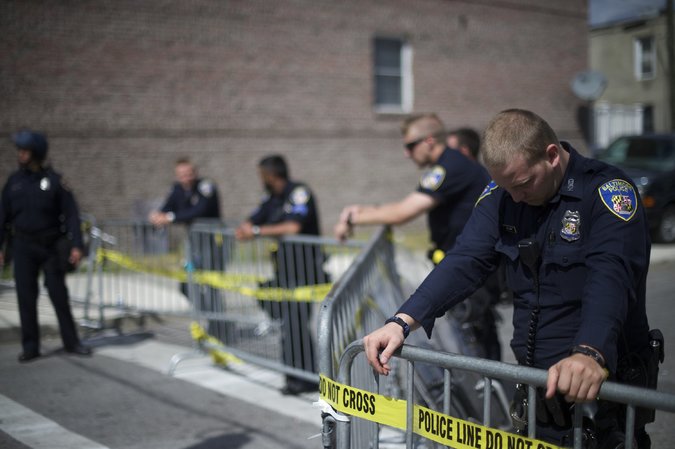
Police officers erecting a barricade in Baltimore on Tuesday. Even before protests about the death of Freddie Gray, complaints were made about a state law that gives special legal protections to officers suspected of abusing their power. Credit Mark Makela/Getty Images
As Justice Department officials began meeting with community leaders in Baltimore this week in the early stages of their civil rights inquiry into the death of Freddie Gray, they heard repeated complaints about a state law that gives special legal protections to police officers suspected of abusing their power. The law is similar to at least a dozen across the country, commonly known as police officers’ bills of rights. But Maryland’s, enacted in the early 1970s, was the first and goes the furthest in offering layers of legal protection to police officers. Among its provisions is one that gives officers 10 days before they have to talk to investigators. “There should be no reason why they should have 10 days to get their story together,” said Tré Murphy, coördinator for the Baltimore United for Change Coalition, who attended one of the meetings. “They are not being held accountable, and frankly, we need to do something about it.”
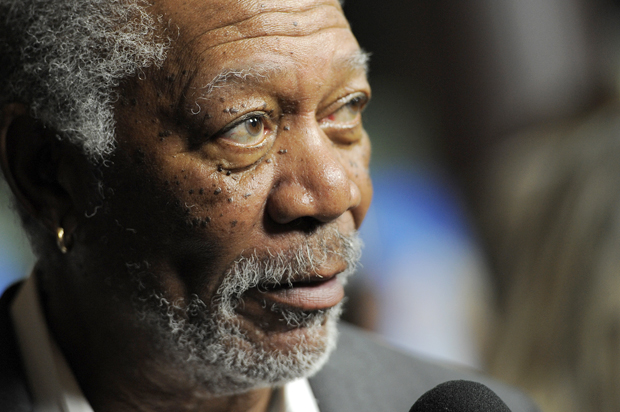
Seventy-seven-year-old Hollywood icon Morgan Freeman has been watching coverage of the protests in Baltimore, and he is far from satisfied with what he’s been seeing. “Look at MSNBC, Fox News, and CNN,” he told the Daily Beast’s Marlow Stern. “Go between those three. There’s a take, there’s a take, and there’s a take. It’s just commentary. CNNwants to be pure news, but the others are just commentary. They’re just commenting on things.”
“Fuck the media,” he added. He did acknowledge, however, that the coverage was better than Ferguson, because at least “some young reporters” are listening to the complaints of the protesters — protesters who, in an interview with Newsweek’s Zach Schonfeld, Freeman said he supported.
“I was watching the news last night,” he said, “and [a protester] said, ‘You know, when we were out here marching peacefully, nobody was here. And now we start burning the place down, everybody is listening. What do you think we’re gonna do to be heard?”
“She’s got a point there,” he added. Freeman continued, noting that technology has it made it possible to document “the terrorism [the black community] suffers from the police.”
“Because of the technology — everybody has a smartphone — now we can see what the police are doing,” he explained. “We can show the world, ‘Look, this is what happened in that situation.’ So why are so many people dying in police custody? And why are they all black? And why are all the police killing them white?”
Freeman added that the most common excuse police have used when involved in fatal shootings is they feared for their safety. “Well, now we know — you feared for your safety while a guy was running away from you, right?”
As he told Stern in the Daily Beast interview, “now, at least, you can see his hands were up in the air. ‘What part of your safety were you afraid of?’ The guy was running away, ‘What part of your safety was in danger?’”
Kevin Moore, pictured here, came forward with the video and later his identity to explain what he saw the day of Freddie Gray’s arrest.
The witness that recorded video of Freddie Gray’s seemingly painful arrest, Kevin Moore, was taken into custody by Baltimore police, according to a report.
In the wake of Gray’s death, Moore came forward with cell phone footage of the controversial arrest and later said police tackled the 25-year-old victim like “a piece of origami.”
It’s believed police detained Moore Thursday night along with two other people after handing over a copy of this video to detectives with the department’s Office of Internal Oversight.
Photography is Not a Crime reports authorities took Moore into custody at gunpoint during a traffic stop. He was released two hours later.
An image from surveillance footage was released by Baltimore police showing Moore at the site of Gray’s capture, an intimidation tactic, Moore believed.
“They plastered my face all over the Internet like (they) don’t know who I am when (they) very well know who I am,” Moore told Photography is Not a Crime after his arrest.
The two suspects, identified as Chad Jackson and Tony White, by Counter Current News, are members of We Cop Watch.
Attempts by the Daily News to reach organizers behind We Cop Watch were not immediately returned.
This is a developing story and will be updated.
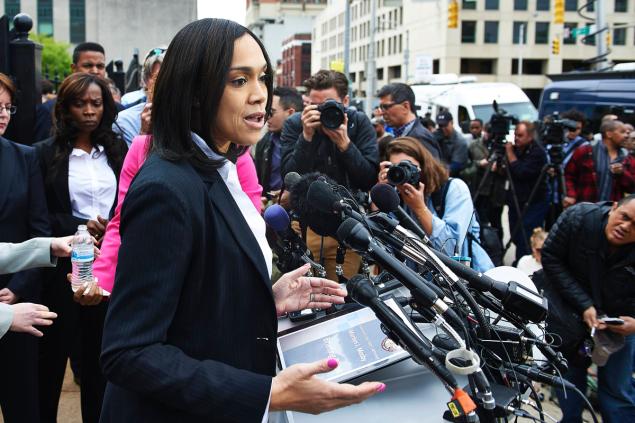
Baltimore State Attorney Marilyn Mosby announces charges during a news conference on Friday,
Marilyn Mosby announces charges during a news conference on Friday,
Baltimore’s chief prosecutor is promising justice for Freddie Gray.
Six cops were charged Friday in the death of Gray, whose fatal neck injury while in police custody has sparked massive protests.
The criminal charges — including murder, manslaughter and assault — were announced by State Attorney Marilyn Mosby during a dramatic press conference in front of City Hall.
“Mr. Gray’s death was a homicide,” she said, prompting some in the crowd to applaud and call out “Justice!” as she announced the prosecution.
The 25-year-old Gray “suffered a severe and critical neck injury” while being driven unrestrained in a police wagon April 12 and “was not breathing at all” by the end of the ride,” Mosby said. He died a week later.
The officers — who detained him even though he committed no crime — also ignored his repeated pleas for help, Mosby charged.
The driver of the van, Officer Caesar Goodson, was charged with depraved murder that carries a maximum sentence of 30 years in prison plus other counts including manslaughter.
Lt. Brian Rice, the highest ranking cop involved, was hit with manslaughter, assault and misconduct charges.
Four others — Officers William Porter, Edward Nero, Garett Miller and Sgt. Alicia White — were variously charged with manslaughter, assault, misconduct and false imprisonment.
They all face up to 10 years behind bars for the top count. The six cops, who’ve been suspended since Gray’s death, are expected to get arraigned Friday afternoon.
Mosby, who at 35 is the youngest top prosecutor of a major city, said the accusations “are not an indictment on the entire force.”
She said they were the result of a thorough investigation by the police integrity unit, investigators and evidence collected by police and the medical examiner.
“I heard your calls of ‘no justice, no peace,’” Mosby said. “Your peace is sincerely needed as we seek to deliver justice for this young man.”
The rallies responding to the police custody death still show no sign of stopping, with Trayvon Martin’s mom arriving Friday for a 3 p.m. rally led by a prominent local pastor.
Freddie Gray, seen here in an image taken by his fiancé Jamiea Speller in the summer 2013, died on April 19th while in police custody in Baltimore.
After Monday’s destructive demonstrations — which led to buildings and cars being burned and at least 20 police officers getting injured — each night has seen increasingly peaceful protests, save for a brief flare-up between protesters and police Tuesday night.
Employees at the CVS that infamously burned down at the start of the riots have been working at other locations and even those who don’t are getting compensation, the company said.
“Given the extraordinary circumstances this week, we are paying our Baltimore employees for their regularly scheduled hours,” said spokesmoman Erin Britt.
On Thursday night, the streets were quiet and calm by curfew time, with reporters on the streets appearing to outnumber protesters. New York Knicks player Carmelo Anthony, a Baltimore native, walked with protesters Thursday and urged his hometown to “rebuild.” Some police officers were seen hugging protesters.
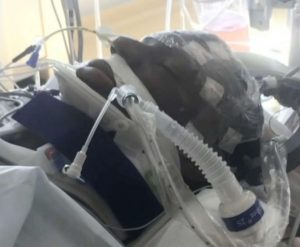
Freddie Gray, pictured in a hospital bed after being arrested by Baltimore City Police, died from injuries sustained while in custody.
Is it possible that Freddie Gray could have severed his own spine and crushed his own voicebox?
From a medical standpoint, it is unlikely that the 25-year-old Baltimore man injured himself in the back of that van. The severity of his injuries seem too grave for him to have done that to himself simply by thrashing around or banging his head on something. It is more likely that there was some type of direct blow to either the front or back of his neck, or somewhere along the spinal cord along his back. How does a spinal cord injury happen? A spinal cord injury is “damage to the spinal cord that results in a loss of function such as mobility or feeling.” This type of injury is most often caused by a traumatic blow of the kind that would be sustained in a car accident, severe fall or an act of violence.
There must be a sudden, traumatic blow to the spine that fractures, dislocates, crushes or compresses one or more of the vertebrae, or when a gun shot or knife penetrates the spinal cord. After a spinal cord injury, bleeding, inflammation and swelling occurs, and fluid builds up in and around the spinal cord.
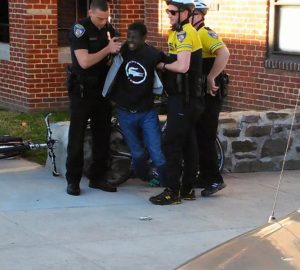
Freddie Gray is pictured being arrested by Baltimore police on April 12. Later, Gray can be seen being dragged by the cops into the van, and it seems as though he was already unable to walk.
Without immediate treatment, this can lead to permanent paralysis, or in Gray’s case, death. Baltimore police officers have already been suspended for failing to get Gray prompt medical care.
The higher in the back or neck the spinal cord injury occurs, the more dysfunction a person will have as a result. So with a spinal cord injury that occurs from a blow to the neck, a person usually loses function in the arms and legs.
The man said he could hear Gray “banging against the walls” of the van and believed that he “was intentionally trying to injure himself,” according to a police document quoted by the newspaper. They were separated by a metal partition, and the man did not actually see Gray trying to harm himself.
As seen in a video taken by a witness who saw Gray being put into the back of the van, Gray was being dragged by the cops into the van, and it seems as though he was unable to walk.
The ability to control your limbs after a spinal cord injury depends on where along the spinal cord the injury took place, and how severe the injury is. If Gray was showing signs of loss of function in his legs before being put in the van, how could the injury have taken place in the van?
There are a number of signs and symptoms that can occur very shortly after a person suffers a spinal injury. These include extreme back pain, pressure in the neck, head or back, weakness, loss of coördination or paralysis in any part of the body, as well as difficulty with balance and walking, impaired breathing after injury and oddly positioned or twisted neck or back.
As seen on the video, Gray was clearly in pain, screaming that he was hurt, and could not walk. He was also having trouble breathing because he kept asking for his inhaler.
Now, let’s talk about the crushed larynx. Also known as a laryngotracheal injury, a crushed larynx is pretty rare in adults, except when there is blunt force trauma to the front of the neck, such as strangulation, or blows to the trachea from fists or feet.
This is usually caused by a car accident when the passenger does not have a seatbelt on, in the front seat, or driving, and there are no protective airbags.
In this case, the person in the front seat or driver is thrown forward and the front of the neck either hits the dashboard or steering wheel.
The direct blow to the front of the neck crushes the larynx against the spine of the neck. This type of injury can also occur during sports, fights, falling forward onto a blunt object such as the handle bars of a bicycle, or during strangulation. Depending on the severity of the impact, the larynx and trachea can compress against the spine.
Is it possible that Gray’s larynx was crushed first, causing the spinal cord injury? Maybe that caused the spinal cord injury. In order for this to happen, there would have to have been a direct blow to the front of his neck, which is unlikely to have been a self-imposed injury in the back of the van.
This could also explain why Gray had trouble breathing. If the blow to the front of the neck is severe and/or low, the larynx and trachea can become completely separated, causing airway obstruction and difficulty breathing.
With this type of injury, the neck must be immediately stabilized to prevent worsening of unrecognized cervical spine injuries. Gray allegedly asked for medical attention multiple times, yet he did not receive it until after he arrived at the police station, where he was found unconscious in the back of the van.
It is unclear which injury happened first, or whether one caused the other, but it seems clear that there was nearly no way he caused the fatal injuries himself.
Dr. Samadi is a board-certified urologic oncologist trained in open and traditional and laparoscopic surgery, and an expert in robotic prostate surgery. He is chairman of urology, chief of robotic surgery at Lenox Hill Hospital and professor of urology at Hofstra North Shore-LIJ School of Medicine. He is a medical correspondent for the Fox News Channel’s Medical A‑Team and the chief medical correspondent for am970 in New York City, where he is heard Sundays at 10 a.m.
KINGSTON, Jamaica (AP) — Jamaica’s most prominent human rights organization has closed its legal department and laid off staff after losing its longstanding status as a charity, a leader of the group said.
Barry Wade, chairman of the Jamaicans for Justice, said the government rejected the watchdog group’s application to renew its charity status, forcing it to dramatically cut its operations and turn down certain grants from international donors. It now also faces some $100,000 in back taxes.
Wade said Tuesday the denial came due to concerns about the group’s advocacy for legislative change, a reason he said is “puzzling.” He also asserts that the decision is “contrary to international norms.”
The government’s Department of Cooperatives and Friendly Societies, which rejected the group’s renewal application, did not immediately respond to requests for comment.
Over the years, police officials have portrayed Jamaicans for Justice as being sympathetic to criminals and some politicians have accused it of trying to make the island look bad. But the group is widely respected among many. In 2008, one of its founders received the United Nations Prize in the Field of Human Rights for her work against police slayings.
Last year, the organization’s reputation took a hit in Jamaica when it introduced a sex education program for children’s group homes that it acknowledged was not properly vetted. The matter made headlines for weeks on the island, in large part because the sex education material for young wards of the state included references to anal sex, which is illegal in Jamaica.
In 2013, the rights group waged a petition and online video campaign demanding reforms in the treatment of children in state care that prompted Youth Minister Lisa Hanna to describe the work as “dangerous and clearly designed to damage the reputation of the country.”
In a Tuesday statement, Jamaicans for Justice said a new board elected over the weekend will focus on getting the group’s charitable status back and hopefully reach a settlement with the government regarding back taxes.
Freddie Gray, arrested by Baltimore police on April 12, died a week later of a severed spinal cord.
Baltimore cops twisted Freddie Gray like “origami,” says the man who filmed the fatally wounded 25-year-old’s arrest. Witness Kevin Moore is speaking out on the confrontation between police officers and Gray, who died of a severed spinal cord. “They had him folded up like he was a crab or a piece of origami,” Moore told the Baltimore Sun. “He was all bent up, and the officer had his knee in his neck. He was just screaming, like screaming for life.“The death of Gray a week after the April 12 bust inflamed tensions between cops and black residents with the police union boss describing protesters as a “like a lynch mob.” Union boss Gene Ryan acknowledged demonstrations had been peaceful but blasted protesters’ “rhetoric” after Gray’s death.
“In fact, the images seen on television look and sound much like a lynch mob in that they are calling for imprisonment of these officers without them ever receiving the due process that is the Constitutional right of every citizen, including law enforcement officers,” Ryan said in a written statement. The controversial description infuriated critics who bashed the union leader as impossibly tone deaf to one of the grimmest reminders of racial injustice in this country’s history. “We’ve been the victims of the lynching and now we’re the lynch mob?” Gray family attorney Billy Murphy told the Baltimore Sun. “The president of the police union called peaceful protests and the anger at the death of a man to severe and unfathomable injuries while in police custody a lynch mob? It doesn’t get more insensitive or insulting than that. These remarks illustrate why black people and the police don’t get along.”
Ryan should rethink his priorities, the attorney said. “He needs to issue an apology at the speed of light and focus on the more important issues of how this black man didn’t deserve to die and have his spinal cord severed and his neck broken — how that happened,” Murphy told the Baltimore Sun. Ryan later backed off the inflammatory language. “Maybe I need to reword that,” he said at a news conference. Gray could be heard in a cell phone video screaming as two officers dragged the handcuffed 25-year-old to a police van and loaded him inside.
The union rushed to support the six officers involved while laying blame for the arrest on Gray, who was carrying a pocket knife when he was stopped.“Had he not had a knife or a an illegal weapon on him, he would have been released after the proper paperwork was done,” union attorney Michael Davey said at a news conference.
Walter Scott’s death in South Carolina, at the hands of now-fired North Charleston police officer Michael Slager, is one of several instances from the past year when a black man was killed after being pulled over while driving. No one knows exactly how often traffic stops turn deadly, but studies in Arizona, Missouri, Texas, Washington have consistently shown that cops stop and search black drivers at a higher rate than white drivers. Last week, a team of researchers in North Carolina found that traffic stops in Charlotte, the state’s largest city, showed a similar racial disparity — and that the gap has been widening over time.
The researchers at the University of North Carolina-Chapel Hill analyzed more than 1.3 million traffic stops and searches by Charlotte-Mecklenburg police officers for a 12-year period beginning in 2002, when the state began requiring police to collect such statistics. In their analysis of the data, collected and made public by the state’s Department of Justice, the researchers found that black drivers, despite making up less than one-third of the city’s driving population, were twice as likely to be subject to traffic stops and searches as whites. Young black men in Charlotte were three times as likely to get pulled over and searched than the city-wide average. Here’s a chart from the Charlotte Observer’s report detailing the findings:
Michael Gordon and David Puckett, Charlotte Observer
Not only did the researchers identify these gaps: they showed that the gaps have been growing. Black drivers in Charlotte are more likely than whites to get pulled over and searched today than they were in 2002, the researchers found. They noted similar widening racial gaps among traffic stops and searches in Durham, Raleigh, and elsewhere in the state.
Black drivers in Charlotte were much more likely to get stopped for minor violations involving seat belts, vehicle registration, and equipment, where, as the Observer’s Michael Gordon points out, “police have more discretion in pulling someone over.” (Scott was stopped in North Charleston due to a broken brake light.) White drivers, meanwhile, were stopped more often for obvious safety violations, such as speeding, running red lights and stop signs, and driving under the influence. Still, black drivers — except those suspected of intoxicated driving — were always more likely to get searched than whites, no matter the reason for the stop.
The findings in North Carolina echo those of a 2014 study by researchers at the University of Kansas, who found that Kansas City’s black drivers were stopped at nearly three times the rate of whites fingered for similarly minor violations.
Frank Baumgartner, the lead author of the UNC-Chapel Hill study, told Mother Jonesthat officers throughout the state were twice as likely to use force against black drivers than white drivers. Of the estimated 18 million stops that took place between 2002 and 2013 in North Carolina that were analyzed by Baumgartner’s team, less than one percent involved the use of force. While officers are required to report whether force was encountered or deployed, and whether there were any injuries, “we don’t know if the injuries are serious, and we don’t know if a gun was fired,” he says.http://www.motherjones.com/kevin-drum/2015/04/north-carolina-traffic-stops
The normalization of U.S.-Cuban relations could mean a drastic change for two most-wanted American fugitives after decades of living free on the island nation.
“We believe that the strong U.S. interest in the return of these fugitives will be best served by entering into this dialogue with Cuba,” Obama said.
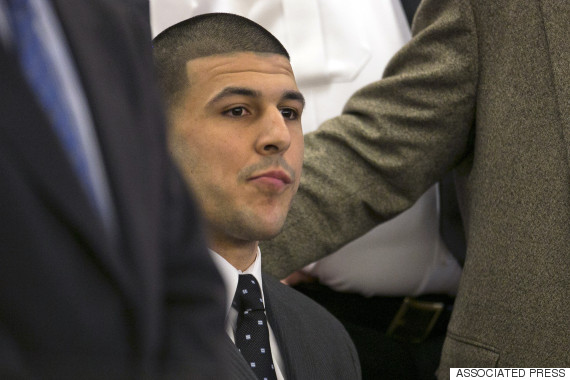
Former New England Patriots football player Aaron Hernandez listens as the guilty verdict is read during his murder trial at the Bristol County Superior Court in Fall River, Mass., Wednesday, April 15, 2015. Hernandez was found guilty of first-degree murder in the shooting death of Odin Lloyd in June 2013. He faces a mandatory sentence of life in prison without parole. (Dominick Reuter/Pool Photo via AP)
A jury has found Aaron Hernandez guilty of first-degree murder in the fatal shooting of semi-pro football player Odin Lloyd.
On Wednesday, Judge E. Susan Garsh sentenced Hernandez, the former New England Patriots tight end, to life without the possibility of parole for killing Lloyd on June 17, 2013. The sentence was mandatory.
The jury found that the ex-NFL player merited the conviction by “reason of extreme atrocity or cruelty.”
Hernandez, 25, and two accomplices picked up Lloyd, 27, a landscaper who played semiprofessional football, at his home on the pretext that they would party together. Instead they drove through the darkness to an industrial park in North Attleborough near the football player’s spacious home, where Hernandez shot Lloyd several times with a .45-caliber Glock pistol, including two kill shots to Lloyd’s chest as he writhed in pain on the ground.
The jury also convicted Hernandez on weapons and ammunition possession charges.
Hernandez’s fiancée, Shayanna Jenkins, wept openly in court after hearing the verdict.
In a statement read after the judge handed down the conviction, Ursula Ward, Lloyd’s mother, called her son the “backbone” of her family.
“My heart stopped beating [when he died],” Ward said. “I wanted to go into the hole [with Odin].”
Deliberations stretched out seven days before jurors in Bristol County Superior Court announced their decision on Wednesday morning. Testimony in the trial lasted about two months and was at times interrupted by severe weather.
A court officer places handcuffs on the wrists of former New England Patriots football player Aaron Hernandez after the guilty verdict was read during his murder trial at the Bristol County Superior Court in Fall River, Mass., Wednesday, April 15, 2015.
Hernandez’s defense admitted that he witnessed the shooting of Lloyd but argued that he has no reason to throw his career away by killing someone. The prosecution was never able to establish Hernandez’s motive, according to WCVB.
“Did he make all the right decisions? No,” his lawyer, James Sultan said during closing arguments. “He was a 23-year-old kid who witnessed something, a shocking killing, committed by someone he knew. He didn’t know what to do, so he just put one foot in front of the other.”
Hernandez’s alleged accomplices, Ernest Wallace Jr. and Carlos Ortiz, will be tried separately.[Huffingtonpost.com]
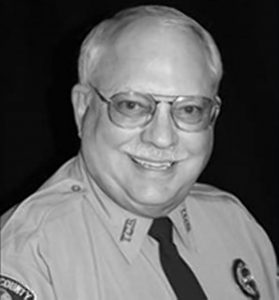
Robert Bates, 73, shot to death suspect Eric Harris in Oklahoma after pulling out his gun instead of his taser, authorities said.
It was a mistake.
That’s the blasé explanation Oklahoma officials gave after the fatal shooting of an unarmed black man by a white deputy who accidentally pulled his gun when he meant to use his Taser. The botched encounter was captured on a disturbing video released by police on Friday — nine days after the fatal Tulsa shooting.
“F— your breath,” a callous officer can be heard saying. “Shut the f— up!”
Reserve Deputy Robert Bates, 73, (below) shouted “Taser! Taser!” before pulling the trigger on his gun, firing a round into Harris.
“I shot him!” the former policeman says, dropping his gun. “I’m sorry.”
Bates was assisting other deputies who were trying to take Harris into custody after the felon fled from police during a sting operation, the Tulsa County Sheriff’s Office’s said.
“You shouldn’t have f — –g ran!” another deputy screams, as Harris is held down by his neck and head.
Eric Harris was shot and killed by a reserve deputy who fired his gun after mistaking it for his taser, according to a statement from the Tulsa County Sheriff’s Office.
Harris, who was in his 40s, was pronounced dead about an hour after the shooting, authorities said.
He had bolted from officers who were trying to arrest him for selling a 9 mm. semiautomatic pistol and ammunition to undercover cops.
Harris, who was unarmed, had reportedly done time for assault and battery on an officer.
He was “absolutely a threat when going down,” Tulsa Police Sgt. Jim Clark said at a news conference.
Sheriff’s Capt. Billy McKelvey claims the arresting officers were not aware Harris had been shot, despite the gunshot noise and Bates’ admission. They called paramedics and firefighters, and rendered aid when they realized, McKelvey said.
“He made an inadvertent mistake,” McKelvey said.
Sgt. Dave Walker told the Tulsa World that police “would not investigate the death unless the sheriff’s office asked them to, and they have not asked us to.”
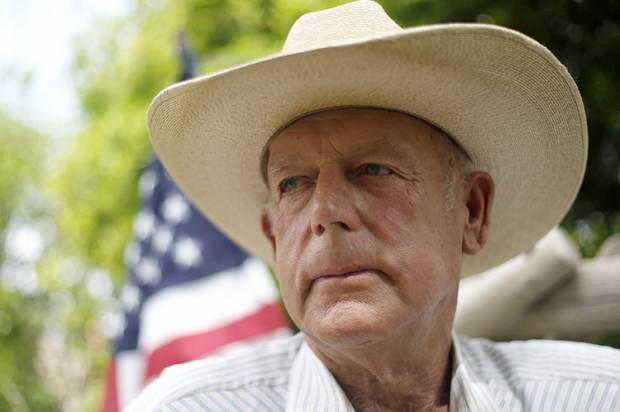
This weekend, the Bundy ranch in Nevada will host a reunion to celebrate owner Cliven Bundy’s continued lawlessness. Bundy became a hero of the far-right a year ago when his refusal to pay 20 years’ worth of federal grazing fees for his cattle — totalling $1.1 million—brought federal agents to collect, which Bundy and several hundred armed right-wing militia members repelled with a show of force. Fox News and other right-wing news outlets raced to the ranch to report on what Bundy supporters called the “Second American Revolution” and the “American Spring,” the moment when the rhetoric of “tyranny” and “totalitarianism” under President Obama would materialize into actual armed conflict against the loathsome federal government.
For anyone confused about whether a political movement which celebrates the Second Amendment and rallies around an iconography of war and rebellion is interested in actual combat against the “liberal” federal government, the Bundy affair answered any remaining questions: Yes, the prospect excites many far right-wing conservatives like nothing else. Fox News’ Sean Hannity was giddy in his initial introduction of Bundy as someone threatening a “range war” against the federal government. Fox News covered the ranch saga daily, with Bundy presented as a hero, and Hannity alone would feature Bundy on his show numerous times over the several weeks of the standoff, at times giving the rebel rancher a primetime microphone multiple times a week to rally right wingers to his cause.
Two extremists, Jerad and Amanda Miller, who traveled to Bundy’s ranch, only to be turned out, would go on to execute two Nevada police officers in June, draping the familiar Gadsden “Don’t Tread on Me” flag over the corpses and pinning a note to their government victims saying, “This is the start of the revolution.” Jerad and Amanda heard the call for a “range war” and took it upon themselves to be the vanguard of the Bundy rebellion.
In the end, the two officers were the only casualties and Bundy’s boys went home with not so much as a band-aid, as federal agents were backed down by a veritable army of militiamen. The government blinked, and Bundy was allowed to continue to flout a law he’d decided didn’t apply to him.
That, ladies and gentlemen, is white power.
And this is black vulnerability: In the intervening year since the Nevada showdown, much of America has become outraged by a series of cases of unarmed black men killed by police. The epidemic of police violence against black men has been ongoing for decades, of course, but a confluence of a new public attentiveness and video evidence in some cases has pushed the crisis into the mainstream discourse.
The latest case, the shocking murder of Walter Scott in North Charleston, SC, should be held up for comparison with the Bundy standoff. Before the video surfaced and contradicted his report, Scott’s killer, Officer Michael Slager, justified his use of deadly force by claiming that Scott gained control of Slager’s taser, thus making him a threat worthy of fatal elimination.
So the threat of a 50-year-old black man with a taser is so great that 8 shots into the back can be justified — but line up hundreds of white men on horseback and armed to the hilt with military-grade weapons, and agents of the government are powerless.
A single unarmed black man in Staten Island selling loosies is considered enough of a threat to be choked to death in broad daylight. Yet armed ex-military men protecting a criminal with high-powered rifles trained on federal agents are not enough of a threat to law and order to similarly merit the use of force.
Is that what we learn when we look at the cases? Does the specter of some imagined violent nature of black men exceed the fear stoked by white men with actual guns, actually pointed at state agents, fingers on triggers?
Or is it that the Bundy army was too much of a threat? The simmering anger on the American right since President Obama’s election has seethed just at the precipice of violence, and for Obama’s troops — as they would be viewed — to rightly fire on white people angry about taxes would have no doubt enraged extremists to a degree unseen since perhaps the 19th century. These weren’t the creepy cultists of the Waco standoff; Bundy was a hero headlining Fox News, the Drudge Report, and the other leading conservative news outlets. He would have been a martyr to Tea Partiers and the far right.
The militia and “Patriot” movements have seen “stunning growth” during the Obama years, according to the Southern Poverty Law Center, a group that tracks violent extremism. Bloodshed at the Bundy ranch could have very well sparked violence elsewhere, just as the federal sieges at Ruby Ridge and Waco during the 1990s animatedthe nascent militia and Patriot movements.
What lesson then have we learned from Cliven Bundy? What lesson do we learn from Walter Scott? Or Eric Garner. Or Michael Brown? Sean Bell?Oscar Grant? Amadou Diallo? Ramarley Graham? Maybe the Huey P. Newton Gun Club in Texas has the right idea. Named after Black Panther Party co-founder Huey Newton, the group takes advantage of open carry laws in the Lone Star State to patrol their neighborhoods in squads of men and women armed with assault rifles, what Newton and the Panthers did in Oakland in 1966.
But while Panther-style armed resistance might protect some victims from police violence, it’s hard to imagine it remedying the underlying problem: white supremacy and the assumption of black men as almost supernaturally dangerous. That’s why Slager’s initial story about Walter Scott would have probably sufficed, were it not for the video; the perceived threat posed by black men is that great. And it’s why Bundy’s men were permitted to point sniper rifles at state officials and still not be considered a threat worthy of elimination.



 Denver,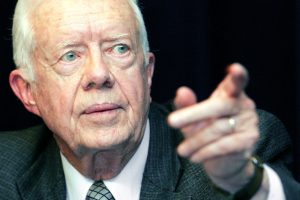



 It is unclear which injury happened first, or whether one caused the other, but it seems clear that there was nearly no way he caused the fatal injuries himself.


 Walter Scott’s death in South Carolina, at the hands of now-fired North Charleston police officer Michael Slager, is