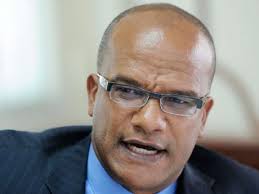
Peter Bunting Minister of National Security Obviously not in command of the facts shows himself less than capable once again
The Jamaica Police Federation says it has accepted the Government’s offer to resume wage negotiations.
Horace Dalley, the Minister without Portfolio in the Ministry of Finance, who is leading the negotiations for the government, wrote to the Federation yesterday inviting it to attend a meeting scheduled at the Ministry for Friday afternoon. Meanwhile, chairman of the police federation Sergeant Raymond Wilson has taken issue with the assertion by national security minister Peter Bunting that police personnel have been offered a 6.5 per cent increase in year one and 5.5 per cent in year two.
Bunting explained the increases for both years include a 3.5 per cent annual increment which every JCF member receives. But Sergeant Wilson says this annual increment is not a new benefit and was already calculated into the level of erosion experienced by cops since their last increase. He says not every member of the force will be entitled to the incremental increase as an individual can only have six such increases at each rank. He says this means that a policeman who has already spent six years at a particular rank will not have this increase to look forward to unless he is promoted or is approved for seniority allowance. Police Federation Accepts Dalley’s Invitation
The Attorney General of Jamaica wishes to advise that an injunction was tonight obtained from the Supreme Court against the Executive Members of the Jamaica Police Federation and all members of the Federation.
Pursuant to the Order of the Court permitting the order to be broadcast over a commercial broadcasting system operating in Jamaica, or by publication in at least one daily newspaper circulating in Jamaica, the Attorney General now publishes the terms of the order as follows: 1. The Respondents be appointed to represent the members of the Jamaica Police Federation.
2. The Respondents be restrained from continuing any industrial action in the form of withholding their services or otherwise.
3. The Respondents and all the members of the Jamaica Police Federation be restrained for a period of twenty eight (28) days from causing and/or attempting to cause and/or carrying out acts to cause disaffection amongst the members of the Constabulary Force and/or inducing and/or attempting to induce and/or carrying out acts to induce members of the Constabulary Force to withhold their services.
4. A mandatory injunction instructing the members of the Force who are withholding their services by way of “sick out” and/or other industrial action to report for their shifts/for work as and when scheduled or due to do so until further order of the court or for a period of twenty eight (28) days whichever is earlier.
5. The Order herein be published, either by broadcasting same on at least two separate occasions over a commercial broadcasting system operating in Jamaica, or by publication in at least one daily newspaper circulating in Jamaica and that this be deemed service of Notice of the said Order on the Respondents and all the said members of the Jamaica Police Federation.
6. The application will be further considered by the Court on the 18th day of June 2015 at 10:00 a.m. or so soon thereafter as counsel may be heard.
The Attorney General reminds the Executive and Membership of the Jamaica Police Federation that failure to comply with the terms of the Supreme Court Order will result in them being in contempt of court and liable to having their assets being confiscated.
Senior police officers on duty in Cross Roads St Andrew Monday as some junior officers staged a sick out
The government has obtained an injunction from the Supreme Court against the Executive of the Police Federation and all its members. The injunction bars them from continuing any industrial action in the form of withholding their services. In a statement issued shortly after midnight, the Attorney General said all members of the Federation are restrained for a period of 28 days from withholding their services.
All police officers who are withholding their services by way of “sick out” and/or other industrial action have to report for work until a further order of the court, or for a period of 28 days, whichever is earlier. The Attorney General has warned the Executive and membership of the Police Federation that failure to comply with the terms of the Supreme Court Order will result in them being in contempt of court and liable to having their assets being confiscated. Gov’t obtains injunction against the Police Federation
The federal agency said the aircrafts are used for specific, ongoing investigations
(WASHINGTON) — The FBI is operating a small air force with scores of low-flying planes across the country carrying video and, at times, cellphone surveillance technology — all hidden behind fictitious companies that are fronts for the government, The Associated Press has learned.
The planes’ surveillance equipment is generally used without a judge’s approval, and the FBI said the flights are used for specific, ongoing investigations. In a recent 30-day period, the agency flew above more than 30 cities in 11 states across the country, an AP review found.
Aerial surveillance represents a changing frontier for law enforcement, providing what the government maintains is an important tool in criminal, terrorism or intelligence probes. But the program raises questions about whether there should be updated policies protecting civil liberties as new technologies pose intrusive opportunities for government spying.
U.S. law enforcement officials confirmed for the first time the wide-scale use of the aircraft, which the AP traced to at least 13 fake companies, such as FVX Research, KQM Aviation, NBR Aviation and PXW Services. Even basic aspects of the program are withheld from the public in censored versions of official reports from the Justice Department’s inspector general.
“The FBI’s aviation program is not secret,” spokesman Christopher Allen said in a statement. “Specific aircraft and their capabilities are protected for operational security purposes.” Allen added that the FBI’s planes “are not equipped, designed or used for bulk collection activities or mass surveillance.”
But the planes can capture video of unrelated criminal activity on the ground that could be handed over for prosecutions.
Some of the aircraft can also be equipped with technology that can identify thousands of people below through the cellphones they carry, even if they’re not making a call or in public. Officials said that practice, which mimics cell towers and gets phones to reveal basic subscriber information, is rare.
In this photo taken May 26, 2015, a small plane flies near Manassas Regional Airport in Manassas, Va. The plane is among a fleet of surveillance aircraft by the FBI, which are primarily used to target suspects under federal investigation. Such planes are capable of taking video of the ground, and some _ in rare occasions _ can sweep up certain identifying cellphone data. (AP Photo/Andrew Harnik)
Details confirmed by the FBI track closely with published reports since at least 2003 that a government surveillance program might be behind suspicious-looking planes slowly circling neighborhoods. The AP traced at least 50 aircraft back to the FBI, and identified more than 100 flights since late April orbiting both major cities and rural areas.
One of the planes, photographed in flight last week by the AP in northern Virginia, bristled with unusual antennas under its fuselage and a camera on its left side. A federal budget document from 2010 mentioned at least 115 planes, including 90 Cessna aircraft, in the FBI’s surveillance fleet.
The FBI also occasionally helps local police with aerial support, such as during the recent disturbance in Baltimore that followed the death of 25-year-old Freddie Gray, who sustained grievous injuries while in police custody. Those types of requests are reviewed by senior FBI officials.
The surveillance flights comply with agency rules, an FBI spokesman said. Those rules, which are heavily redacted in publicly available documents, limit the types of equipment the agency can use, as well as the justifications and duration of the surveillance.
Details about the flights come as the Justice Department seeks to navigate privacy concerns arising from aerial surveillance by unmanned aircrafts, or drones. President Barack Obama has said he welcomes a debate on government surveillance, and has called for more transparency about spying in the wake of disclosures about classified programs.
“These are not your grandparents’ surveillance aircraft,” said Jay Stanley, a senior policy analyst with the American Civil Liberties Union, calling the flights significant “if the federal government is maintaining a fleet of aircraft whose purpose is to circle over American cities, especially with the technology we know can be attached to those aircraft.”
During the past few weeks, the AP tracked planes from the FBI’s fleet on more than 100 flights over at least 11 states plus the District of Columbia, most with Cessna 182T Skylane aircraft. These included parts of Houston, Phoenix, Seattle, Chicago, Boston, Minneapolis and Southern California.
Evolving technology can record higher-quality video from long distances, even at night, and can capture certain identifying information from cellphones using a device known as a “cell-site simulator” — or Stingray, to use one of the product’s brand names. These can trick pinpointed cellphones into revealing identification numbers of subscribers, including those not suspected of a crime.
Officials say cellphone surveillance is rare, although the AP found in recent weeks FBI flights orbiting large, enclosed buildings for extended periods where aerial photography would be less effective than electronic signals collection. Those included above Ronald Reagan Washington National Airport and the Mall of America in Bloomington, Minnesota.
After The Washington Post revealed flights by two planes circling over Baltimore in early May, the AP began analyzing detailed flight data and aircraft-ownership registrations that shared similar addresses and flight patterns. That review found some FBI missions circled above at least 40,000 residents during a single flight over Anaheim, California, in late May, according to Census data and records provided by the website FlightRadar24.com.
Most flight patterns occurred in counter-clockwise orbits up to several miles wide and roughly one mile above the ground at slow speeds. A 2003 newsletter from the company FLIR Systems Inc., which makes camera technology such as seen on the planes, described flying slowly in left-handed patterns.
“Aircraft surveillance has become an indispensable intelligence collection and investigative technique which serves as a force multiplier to the ground teams,” the FBI said in 2009 when it asked Congress for $5.1 million for the program.
Recently, independent journalists and websites have cited companies traced to post office boxes in Virginia, including one shared with the Justice Department. The AP analyzed similar data since early May, while also drawing upon aircraft registration documents, business records and interviews with U.S. officials to understand the scope of the operations.
The FBI asked the AP not to disclose the names of the fake companies it uncovered, saying that would saddle taxpayers with the expense of creating new cover companies to shield the government’s involvement, and could endanger the planes and integrity of the surveillance missions. The AP declined the FBI’s request because the companies’ names — as well as common addresses linked to the Justice Department — are listed on public documents and in government databases.
At least 13 front companies that AP identified being actively used by the FBI are registered to post office boxes in Bristow, Virginia, which is near a regional airport used for private and charter flights. Only one of them appears in state business records.
Included on most aircraft registrations is a mysterious name, Robert Lindley. He is listed as chief executive and has at least three distinct signatures among the companies. Two documents include a signature for Robert Taylor, which is strikingly similar to one of Lindley’s three handwriting patterns.
The FBI would not say whether Lindley is a U.S. government employee. The AP unsuccessfully tried to reach Lindley at phone numbers registered to people of the same name in the Washington area since Monday.
Law enforcement officials said Justice Department lawyers approved the decision to create fictitious companies to protect the flights’ operational security and that the Federal Aviation Administration was aware of the practice. One of the Lindley-headed companies shares a post office box openly used by the Justice Department.
Such elusive practices have endured for decades. A 1990 report by the then-General Accounting Office noted that, in July 1988, the FBI had moved its “headquarters-operated” aircraft into a company that wasn’t publicly linked to the bureau.
The FBI does not generally obtain warrants to record video from its planes of people moving outside in the open, but it also said that under a new policy it has recently begun obtaining court orders to use cell-site simulators. The Obama administration had until recently been directing local authorities through secret agreements not to reveal their own use of the devices, even encouraging prosecutors to drop cases rather than disclose the technology’s use in open court.
A Justice Department memo last month also expressly barred its component law enforcement agencies from using unmanned drones “solely for the purpose of monitoring activities protected by the First Amendment” and said they are to be used only in connection with authorized investigations and activities. A department spokeswoman said the policy applied only to unmanned aircraft systems rather than piloted airplanes.
___
Associated Press writers Sean Murphy in Oklahoma City; Joan Lowy and Ted Bridis in Washington; Randall Chase in Wilmington, Delaware; and news researchers Monika Mathur in Washington and Rhonda Shafner in New York contributed
W YORK, N.Y. — Speaking publicly for the first time since completing gender transition, Caitlyn Jenner compares her emotional two-day photo shoot with Annie Leibovitz for the July cover of Vanity Fair to winning the gold medal for the decathlon at the 1976 Olympics. She tells Pulitzer Prize – winning V.F. contributing editor and author ofFriday Night Lights Buzz Bissinger, “That was a good day, but the last couple of days were better.… This shoot was about my life and who I am as a person. It’s not about the fanfare, it’s not about people cheering in the stadium, it’s not about going down the street and everybody giving you ‘that a boy, Bruce,’ pat on the back, O.K. This is about your life.”
Jenner tells Bissinger about how she suffered a panic attack the day after undergoing 10-hour facial-feminization surgery on March 15 — a procedure she believed would take 5 hours. (Bissinger reveals that Jenner has not had genital surgery.) She recalls thinking, “What did I just do? What did I just do to myself?” A counselor from the Los Angeles Gender Center came to the house so Jenner could talk to a professional, and assured her that such reactions were often induced by pain medication, and that second-guessing was human and temporary.
Introducing Caitlyn Jenner. Read her revealing story and see the exclusive photos — before the issue hits newsstands on Tuesday, June 9. Subscribe for digital access.
Jenner tells Bissinger the thought has since passed and not come back: “If I was lying on my deathbed and I had kept this secret and never ever did anything about it, I would be lying there saying, ‘You just blew your entire life. You never dealt with yourself,’ and I don’t want that to happen.”
Bissinger spent hundreds of hours with the man the world knew as Bruce Jenner over a period of three months, and then countless hours with Caitlyn, also attending the photo shoot with Leibovitz at Jenner’s Malibu home.
Bissinger apologizes to Jenner for repeated pronoun confusion and asks whether she is sensitive about it. “I don’t really get hung up,” she tells him. “A guy came in the other day and I was fully dressed — it’s just habit, I said, ‘Hi, Bruce here,’ and I went, Oh fuck, it ain’t Bruce, I was screwing up doing it.”
Bissinger speaks extensively with Jenner’s four children from his first two marriages — Burt, 36, and Cassandra, 34, with first wife Chrystie, and Brandon, 33, and Brody, 31, with second wife Linda — and describes an insensitive father who had been absent for years at a time. Jenner openly acknowledges mistakes made with them as Bruce, and expresses genuine regret. Says Burt, “I have high hopes that Caitlyn is a better person than Bruce. I’m very much looking forward to that.”
Watch a behind-the-scenes video of Annie Leibovitz’s photo shoot, as Caitlyn discusses how much living fully as a woman means to her.
For the Jenner children, the issue of the transition has become a non-issue. They were already aware of their father’s identity as a woman when he told them individually about the transition — Burt and Cassandra had learned from their mother roughly 20 years earlier, when they were 13 and 11; Brandon had assumed it because of the obvious physical changes he had observed; and Brody was told by his mother when he was 29. They tell Bissinger they feel both happiness for their father and inspiration at his bravery, and they all still see their dad as their dad regardless of any gender label. Brandon said he was a little taken aback when he saw Caitlyn for the first time after surgery and she pulled her top up to reveal her new breasts. “Whoa, I’m still your son,” he reminded her.
As part of the transition, Jenner started hosting small gatherings called “girls’ nights” with wine and food where Jenner could dress as desired and feel natural in the presence of women, and it was there that her daughter Cassandra met Caitlyn for the first time. “I was just nervous that I wouldn’t make her feel comfortable,” Cassandra tells Bissinger. “I was worried I wouldn’t say the right things or act the right way or seem relaxed.” But almost all of it melted away when she got there. “We talked more than we ever have. We could just be girls together.”
Despite the renewed relationship with their father, the Jenner children have refused to participate in Caitlyn’s docu-series for the E! network, set to debut this summer, forgoing financial gain in favor of preserving their father’s legacy. Initially, Caitlyn was “terribly disappointed and terribly hurt,” but has come to accept their decision. For her part, Caitlyn is prepared for the criticism that it’s a publicity stunt: “‘Oh, she’s doing a stupid reality show. She’s doing it for the money. She’s doing this, she’s doing that.’ I’m not doing it for money. I’m doing it to help my soul and help other people. If I can make a dollar, I certainly am not stupid. [I have] house payments and all that kind of stuff. I will never make an excuse for something like that. Yeah, this is a business. You don’t go out and change your gender for a television show. O.K., it ain’t happening. I don’t care who you are.”
In an alley in Denver, police gunned down a 17-year-old girl joyriding in a stolen car. In the backwoods of North Carolina, police opened fire on a gun-wielding moonshiner. And in a high-rise apartment in Birmingham, Alabama, police shot an elderly man after his son asked them to make sure he was okay. Douglas Harris, 77, answered the door with a gun.
The three are among at least 385 people shot and killed by police nationwide during the first five months of this year, more than two a day, according to a Washington Post analysis. That is more than twice the rate of fatal killings tallied by the federal government over the past decade, a count that officials concede is incomplete.
“These shootings are grossly under-reported,” said Jim Bueermann, a former police chief and president of the Washington-based Police Foundation, a nonprofit organization dedicated to improving law enforcement. “We are never going to reduce the number of police shootings if we don’t begin to accurately track this information.”
A national debate is raging about police use of deadly force, especially against minorities. To understand why and how often these shootings occur, The Washington Post is compiling a database of every fatal shooting by police in 2015, as well as of every officer killed by gunfire in the line of duty. The Post looked exclusively at shootings, not killings by other means, such as stun guns and deaths in police custody.
Using interviews, police reports, local news accounts and other sources, The Post tracked more than a dozen details about each killing through Friday, including the victim’s race, whether the person was armed and the circumstances that led to the fatal encounter. The result is an unprecedented examination of these shootings, many of which began as minor incidents and suddenly escalated into violence.
Among The Post’s findings:
About half the victims were white, half minority. But the demographics shifted sharply among the unarmed victims, two-thirds of whom were black or Hispanic. Overall, blacks were killed at three times the rate of whites or other minorities when adjusting by the population of the census tracts where the shootings occurred.
The vast majority of victims — more than 80 percent — were armed with potentially lethal objects, primarily guns, but also knives, machetes, revving vehicles and, in one case, a nail gun.
_Forty-nine people had no weapon, while the guns wielded by 13 others turned out to be toys. In all, 16 percent were either carrying a toy or were unarmed.
The dead ranged in age from 16 to 83. Eight were children younger than 18, including Jessie Hernandez, 17, who was shot three times by Denver police officers as she and a carload of friends allegedly tried to run them down.
The Post analysis also sheds light on the situations that most commonly gave rise to fatal shootings. About half of the time, police were responding to people seeking help with domestic disturbances and other complex social situations: A homeless person behaving erratically. A boyfriend threatening violence. A son trying to kill himself.
Ninety-two victims — nearly a quarter of those killed — were identified by police or family members as mentally ill.
In Miami Gardens, Florida, Catherine Daniels called 911 when she couldn’t persuade her son, Lavall Hall, a 25-year-old black man, to come in out of the cold early one morning in February. A diagnosed schizophrenic who stood 5‑foot‑4 and weighed barely 120 pounds, Hall was wearing boxer shorts and an undershirt and waving a broomstick when police arrived. They tried to stun him with a Taser gun and then shot him.
The other half of shootings involved non-domestic crimes, such as robberies, or the routine duties that occupy patrol officers, such as serving warrants.
Nicholas Thomas, a 23-year-old black man, was killed in March when police in Smyrna, Georgia, tried to serve him with a warrant for failing to pay $170 in felony probation fees. Thomas fled the Goodyear tire shop where he worked as a mechanic, and police shot into his car.
Although race was a dividing line, those who died by police gunfire often had much in common. Most were poor and had a history of run-ins with law enforcement over mostly small-time crimes, sometimes because they were emotionally troubled.
Both things were true of Daniel Elrod, a 39-year-old white man. Elrod had been arrested at least 16 times over the past 15 years; he was taken into protective custody twice last year because Omaha police feared he might hurt himself.
On the day he died in February, Elrod robbed a Family Dollar store. Police said he ran when officers arrived, jumping on top of a BMW in the parking lot and yelling, “Shoot me, shoot me.” Elrod, who was unarmed, was shot three times as he made a “mid-air leap” to clear a barbed-wire fence, according to police records.
Dozens of other people also died while fleeing from police, The Post analysis shows, including a significant proportion — 20 percent — of those who were unarmed. Running is such a provocative act that police experts say there is a name for the injury officers inflict on suspects afterward: a “foot tax.”
Police are authorized to use deadly force only when they fear for their lives or the lives of others. So far, just three of the 385 fatal shootings have resulted in an officer being charged with a crime — less than 1 percent.
The low rate mirrors the findings of a Post investigation in April that found that of thousands of fatal police shootings over the past decade, only 54 had produced criminal charges. Typically, those cases involved layers of damning evidence challenging the officer’s account. Of the cases resolved, most officers were cleared or acquitted.
In all three 2015 cases in which charges were filed, videos emerged showing the officers shooting a suspect during or after a foot chase:
In South Carolina, police officer Michael Slager was charged with murder in the death of Walter Scott, a 50-year-old black man, who ran after a traffic stop. Slager’s attorney declined to comment.
In Oklahoma, reserve deputy Robert Bates was charged with second-degree manslaughter 10 days after he killed Eric Harris, a 44-year-old black man. Bates’s attorney, Clark Brewster, characterized the shooting as a “legitimate accident,” noting that Bates mistakenly grabbed his gun instead of his Taser.
And in Pennsylvania, officer Lisa Mearkle was charged with criminal homicide six weeks after she shot and killed David Kassick, a 59-year-old white man, who refused to pull over for a traffic stop. Her attorney did not return calls for comment.
In many other cases, police agencies have determined that the shootings were justified. But many law enforcement leaders are calling for greater scrutiny.
After nearly a year of protests against police brutality and with a White House task force report calling for reforms, a dozen current and former police chiefs and other criminal justice officials said police must begin to accept responsibility for the carnage. They argue that a large number of the killings examined by The Post could be blamed on poor policing.
“We have to get beyond what is legal and start focusing on what is preventable. Most are preventable,” said Ronald Davis, a former police chief who heads the Justice Department’s Office of Community Oriented Policing Services.
Police “need to stop chasing down suspects, hopping fences and landing on top of someone with a gun,” Davis said. “When they do that, they have no choice but to shoot.”
As a start, criminologists say the federal government should systematically analyze police shootings. Currently, the FBI struggles to gather the most basic data. Reporting is voluntary, and since 2011, less than 3 percent of the nation’s 18,000 state and local police agencies have reported fatal shootings by their officers to the FBI. As a result, FBI records over the past decade show only about 400 police shootings a year — an average of 1.1 deaths per day.
According to The Post’s analysis, the daily death toll so far for 2015 is close to 2.6. At that pace, police will have shot and killed nearly 1,000 people by the end of the year.
“We have to understand the phenomena behind these fatal encounters,” Bueermann said. “There is a compelling social need for this, but a lack of political will to make it happen.”
For the vast majority of departments, a fatal shooting is a rare event. Only 306 agencies have recorded one so far this year, and most had only one, the Post analysis shows.
However, 19 departments were involved in at least three fatal shootings. Los Angeles police lead the nation with eight. The latest occurred May 5, when Brendon Glenn, a 29-year-old homeless black man, was shot after an altercation outside a Venice bar.
Oklahoma City police have killed four people, including an 83-year-old white man wielding a machete.
“We want to do the most we can to keep from taking someone’s life, even under the worst circumstances,” said Oklahoma City Police Chief William Citty. “There are just going to be some shootings that are unavoidable.”
In Bakersfield, California, all three of the department’s killings occurred in a span of 10 days in March. The most recent involved Adrian Hernandez, a 22-year-old Hispanic man accused of raping his roommate, dousing her with flammable liquid and setting fire to their home.
After a manhunt, police cornered Hernandez, who jumped out of his car holding a BB gun. Police opened fire, and some Bakersfield residents say they are glad the officers did.
“I’m relieved he can’t come back here, to be honest with you,” said Brian Haver, who lives next door to the house Hernandez torched. “If he came out holding a gun, what were they supposed to do?”
Although law enforcement officials say many shootings are preventable, that is not always true. In dozens of cases, officers rushed into volatile situations and saved lives. Examples of police heroism abound.
In Tempe, Arizona, police rescued a 25-year-old woman who had been stabbed and tied up and was screaming for help. Her boyfriend, Matthew Metz, a 26-year-old white man, also stabbed an officer before he was shot and killed, according to police records.
In San Antonio, a patrol officer heard gunshots and rushed to the parking lot of Dad’s Karaōke bar to find a man shooting into the crowd. Richard Castilleja, a 29-year-old Latino, had hit two men and was still unloading his weapon when he was shot and killed, according to police records.
And in Los Angeles County, a Hawthorne police officer working overtime was credited with saving the life of a 12-year-old boy after a frantic woman in a gray Mercedes pulled alongside the officer and said a white Cadillac was following her and her son.
Seconds later, the Cadillac roared up. Robert Washington, a 37-year-old black man, jumped out and began shooting into the woman’s car.
“He had two revolvers and started shooting both of them with no words spoken. He shot and killed the mom, and then he started shooting at the kid,” said Eddie Aguirre, a Los Angeles County homicide detective investigating the case.
“The deputy got out of his patrol car and started shooting,” Aguirre said. “He saved the boy’s life.”
- — - -
In about half the shootings, police were responding to non-domestic criminal situations, with robberies and traffic infractions ranking among the most common offenses. Nearly half of blacks and other minorities were killed in such circumstances. So were about a third of whites.
In North Carolina, a police officer searching for clues in a hit-and-run case approached a green and white mobile home owned by Lester Brown, a 58-year-old white man. On the front porch, the officer spotted an illegal liquor still. He called for backup, and drug agents soon arrived with a search warrant.
Officers knocked on the door and asked Brown to secure his dog. Instead, Brown dashed upstairs and grabbed a Soviet SKS rifle, according to police reports.
Neighbor Joe Guffey told a local TV reporter that he was sitting at home with his dogs when the shooting started: “Pow, pow, pow, pow.” Brown was hit seven times and pronounced dead at the scene.
While Brown allegedly stood his ground, many others involved in criminal activity chose to flee when confronted by police. Kassick, for example, attracted Mearkle’s attention because he had expired vehicle inspection stickers. On the day he died, Kassick was on felony probation for drunken driving and had drugs in his system, police and autopsy reports show.
After failing to pull over, Kassick drove to his sister’s house in Hummelstown, Pennsylvania, jumped out of the car and ran. Mearkle repeatedly struck Kassick with a stun gun and then shot him twice in the back while he was face-down in the snow.
Jimmy Ray Robinson, a.k.a. the “Honey Bun Bandit,” had robbed five convenience stores in single a week in central Texas, grabbing some of the sticky pastries along the way. Robinson, a 51-year-old black man, fled when he spotted Waco police officers staking out his home.
Robinson sped off in reverse in a green Ford Explorer. It got stuck in the mud, and four Waco officers opened fire.
“They think they can outrun the officers. They don’t realize how dangerous it is,” said Samuel Lee Reid, executive director of the Atlanta Citizen Review Board, which investigates police shootings and recently launched a “Don’t Run” campaign. “The panic sets in,” and “all they can think is that they don’t want to get caught and go back to jail.”
- — - -
The most troubling cases began with a cry for help.
About half the shootings occurred after family members, neighbors or strangers sought help from police because someone was suicidal, behaving erratically or threatening violence. Sometimes police were called just because someone was worried about someone else’s welfare.
Take Shane Watkins, a 39-year-old white man, who died in his mother’s driveway in Moulton, Alabama.
Watkins had never been violent, and family members were not afraid for their safety when they called Lawrence County sheriff’s deputies in March. But Watkins, who suffered from bipolar disorder and schizophrenia, was off his medication. Days earlier, he had declared himself the “god of the fifth element” and demanded whiskey and beer so he could “cleanse the earth with it,” said his sister, Yvonne Cote.
Then he started threatening to shoot himself and his dog, Slayer. His mother called Cote, who called 911. Cote got back on the phone with her mother, who watched Watkins walk onto the driveway holding a box cutter to his chest. A patrol car pulled up, and Cote heard her mother yell: “Don’t shoot! He doesn’t have a gun!”
“Then I heard the gunshots,” Cote said.
Lawrence County sheriff’s officials declined to comment and have refused to release documents related to the case.
“There are so many unanswered questions,” she said. “All he had was a box cutter. Wasn’t there some other way for them to handle this?”
Catherine Daniels called police for the same reason. “I wanted to get my son help,” she said. Instead, officers Peter Ehrlich and Eddo Trimino fired their stun guns after Hall hit them with the metal end of the broomstick, according to investigative documents.
“Please don’t hurt my child,” Daniels pleaded, in a scene captured by a camera mounted on the dash of one of the patrol cars.
“Get on the f — ing ground or you’re dead!” Trimino shouted. Then he fired five shots.
Police spokesman Mike Wright declined to comment on the case. Daniels said no one from the city has contacted her. “I haven’t received anything. No apology, nothing.”
But hours after her son was killed, Daniels said, officers investigating the shooting dropped off a six-pack of Coca-Cola.
“I regret calling them,” Daniels said. “They took my son’s life.”
- — - -
Washington Post staffers Ted Mellnik, John Muyskens and Amy Brittain contributed to this report.
Shocking body camera video shows two Southern California cops slam an eight-months pregnant woman to the ground after a parking lot dispute started as the woman dropped her child off at school. The city of Barstow, an Inland Empire city in San Bernardino County, defended the officers’ actions, writing in a statement that Charlena Michelle Cooks was actively resisting arrest during the January incident. “The Barstow Police Department continues to be proactive in training its officers to assess and handle interactions with emotionally charged individuals while conducting an investigation, for the protection of everyone involved,” the statement, obtained by the Desert Dispatch, reads. The bizarre confrontation began when Cooks and another woman, a school employee, got into a “road rage” confrontation in the parking lot at Crestline Elementary School, where Cooks was dropping off her second-grade daughter.
The officer, speaking to the other woman, says no crime has been committed and he’ll go speak to Cooks about what happened and “document her name.” As Cooks explains her side, the officer suddenly cuts her off and asks for identification, something he hadn’t done with the other woman. “I don’t even think that that disagreement in the parking lot was enough to warrant a call to the police,” Cooks told the Dispatch. The American Civil Liberties Union of Southern California, which took up Cooks’ case and released the video, says California law does not require someone to identify themselves “for no reason.” Cooks, in the video, tells the officer that she’d like to call her boyfriend and verify the law about identification. But the officer, after first promising to give her “two minutes” to find out whether she must give up her name, walks up to Cooks after 20 seconds and grabs her arm as she wriggles and starts to yell.
“Do not touch me, do not touch me, I’m pregnant!” Cooks begs as she’s pushed against a chain link fence. “What the f – k is going on!” A second officer comes over and the officer with the camera on asks, “Why are you resisting, ma’am?” He and the other officer then took her to the ground, stomach down, and handcuffed her behind her back. “This is ridiculous, what are you doing?” the incredulous Cooks asks. “I didn’t even do anything wrong.” “I don’t think I’ve ever been that terrified in my life,” Cooks recently told the Dispatch. “I never saw that coming. I told him I was pregnant so he could proceed with caution. That didn’t happen and the first thing I thought was I didn’t want to fall to the ground. I felt the pressure on my stomach from falling and I was calling for help. But those guys are supposed to help me. But who is supposed to help me when they are attacking me?”
Cooks was put in the back of a police cruiser and later booked on a charge of resisting or obstructing a police officer, a charge later tossed by a judge. The officer involved in the incident is shown on video recounting for another officer what happened. “I gave her a minute to give up her name and I went to put her under arrest and she resisted arrest,” he said. “That’s all there is to it.” Cooks later gave birth to a heatlhy baby girl, but she’s been banned from the school property and is considering leaving Barstow after the incident. “I’m still trying to process everything and get in a good state of mind,” she told the Dispatch. “I’m in a very fearful state of mind. Barstow is so small and I used to be comfortable living here. Not anymore. I really felt like after all that happened I had some of my everyday freedoms taken from me.” Body cam video captures California cops tussle 8‑months pregnant woman to ground, cuff her for ‘resisting arrest
Two former cops in New Mexico could soon be the ones behind bars after video of the December 2014 beating of a handcuffed arrestee was released and captured the brutal, unwarranted assault. The local district attorney and the state Attorney General plan to present their case against Las Cruces police Richard Garcia and Danny Salcido to a grand jury in June. Both officers, on administrative duty since March, were fired earlier this month after the department finished an internal investigation into the Dec. 23, 2014 beating of 47-year-old Ross Flynn. Flynn is suing the department for $12.5 million. “The allegations against both officers were reviewed and it was found that these officers violated internal policies and procedures which warranted their discharge from employment with the Las Cruces Police Department,” LCPD Chief Jaime Montoya said in a May 19 statement announcing the termination.
Flynn was being arrested two days before Christmas on charges stemming from a dispute with his neighbor when, he says, he asked officers to adjust his handcuffs, which were digging into his wrists. That’s when he lightly kicked a cell door, getting the attention of the two officers, who walked in and immediately started attacking Flynn, who was cuffed to waist chains. The nearly two minute clip shows the officers slam him against the wall, while one grabs him by the head, as they throw him onto a metal bench and one begins to apply knee strikes to the cuffed man’s body. They fling him around and face first into the wall before tossing him on the cell floor, video shows. The officers then drag him over to the bench and prop him against the wall and again pick him up and move him to a second portion of the bench before leaving.
Flynn was later hospitalized with a fractured skull, bleeding on the brain, a cracked cheekbone and cracked rib, according to KVIA-TV.
The officers in their reports on the incident claimed Flynn was struggling and resisting officers during the confrontation.
“We then started struggling with Mr. Flynn in trying to force him to have a seat but he then began to resist and started moving and pushing us around,” Salcido wrote in his report, obtained by the ABC affiliate. “We continued to make every effort possible to try to get Mr. Flynn to have a seat but then he continued to move us around and push us around and continued to move his hands as in a way attempting to grab ahold of us or our equipment.”
Ross Flynn, 47, sued the Las Cruces police department for $12.5 million after being viciously attacked during booking December 2014.
But Flynn’s attorney says the security camera tells a different story.
Flynn’s lawyer said his client was “tossed around like a ragdoll” during the ordeal.
“You can see from the video that Mr. Flynn was helpless, defenseless, he had handcuffs on and he’s being thrown around that cell like a ragdoll,” attorney Jeff Lahann told KVIA. Flynn was booked on charges of aggravated assault with a deadly weapon, assault on a police officer and resisting or obstructing a police officer. It’s unclear what the outcome of the case was, but Flynn said he’s been in fear of police ever since his brutal encounter with the two cops. “The whole thing has been really painful,” Flynn told KVIA. “I used to have a lot of respect for local police no matter where I was. In this case I feel I was ambushed. All my rights were violated. I was beaten while in restraints. The general attitude in the community are that the LCPD are a little bit vicious. I’d like to see more training”.
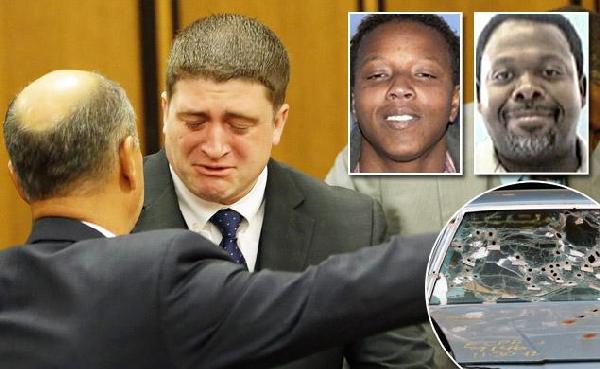
Cleveland Police Officer (Michael Brelo) Found Not Guilty in Shooting Deaths of Unarmed Couple
A Cleveland cop accused of fatally shooting two unarmed people in a 137-shot barrage of police gunfire is not guilty of voluntarily manslaughter, an Ohio judge ruled Saturday. Michael Brelo, 31, was one of 13 officers who unleashed a hail of bullets into the couple’s car during a high-speed chase in November 2012, killing Timothy Russell and Malissa Williams. Prosecutors said Brelo reloaded his gun after they were no longer a threat, mounted the car’s hood and fired 15 rounds into the
windshield. Brelo wept as the long judge’s ruling was read Saturday and at times crossed himself and held his head in his hands. After being declared not guilty, he hugged his attorneys in the crowded courtroom. The verdict capped a four-week trial that ended on May 5.
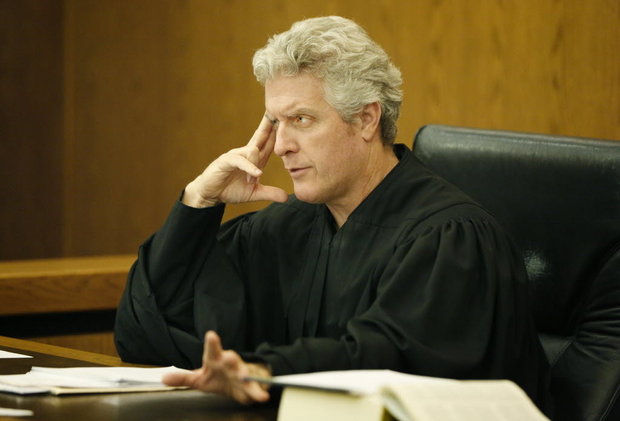
Judge John P. O’Donnell
Russell, 43, and Williams, 30, were each shot more than 20 times in less than eight seconds. The chase began after officers in a patrol car mistook the sound of the couple’s car backfiring for gun shots on Nov. 29, 2012. More than 60 squad cars chased the man and woman for about 20 miles. Five other officers were indicted on lesser charges of dereliction of duty and are awaiting trial. There were weapons found in the couple’s car.
The controversial shooting is one of several noted in a 2014 U.S. Justice Department report that showed the Cleveland Police Department has pattern of using excessive force. “The officers, who were firing on the car from all sides, reported believing that they were being fired at by the suspects. It now appears that those shots were being fired by fellow officers,” the report said of the fusillade of bullets. The ruling follows a year of outrage and demonstrations over police shootings of unarmed black people in Missouri, New York, Baltimore and another Cleveland shooting involving 12-year-old Tamir Rice, who shot to death by police after he was seen playing with a gun, which turned out to be a toy.
Malcolm X, the famed Civil Rights leader and minister of the Nation of Islam, would have turned 90 years old this week. While America annually marks the significance of the life of Dr. Martin Luther King, Jr., it is only in Black communities nationally, and locally in Harlem, that we mark and celebrate the birth of King’s most formidable racial adversary. Undoubtedly this has something to do with the very forthright and unflinching manner in which Malcolm X talked about race in the 1960s. El-Hajj Malik El-Shabazz, as Malcolm X was otherwise known, did not have any hope that white people could or would change when it came to race. Although King was far less optimistic at the end of his life about the capacity of white people to change, too, he still has the March on Washington speech, which represented the zenith of his racial optimism.
Malcolm X was different. His unflinching honesty about the evils of white racism made even King, formidable orator that he was, scared to debate Malcolm in public. Though he eventually toned down his rhetoric about the people that he was known to refer to as “white devils,” he never backed down from holding white people accountable for their investment in and perpetuation of white supremacy. For instance, in a 1963 public conversation and debate with James Baldwin, Malcolm X told him, “Never do you find white people encouraging other whites to be nonviolent. Whites idolize fighters. …At the same time that they admire these fighters, they encourage the so called ‘Negro’ in America to get his desires fulfilled with a sit in stroke, or a passive approach, or a love your enemy approach or pray for those who despitefully use you. This is insane.”
And indeed we did get a front row seat to such insanity this week, when three biker gangs in Texas, had a shootout in a parking lot that left nine people dead and 18 people injured. More than 165 people have been arrested for their participation in this thuggish, ruggish, deadly, violent, white-on-white street brawl but there has been no mass outcry from the country about this. Though these motorcycle gangs were already under surveillance because of known participation in consistent and organized criminal activity, as Darnell Moore notes at Mic, “the police didn’t don riot gear.” Moore further notes that “leather and rock music weren’t blamed,” and there hasn’t been any “hand-wringing over the problem of white-on-white crime.”
White people, even well-meaning and thoughtful ones, have the privilege of looking at deadly acts of mass violence of this sort as isolated local incidents, particular to one community. They do not look at such incidents as indicative of anything having to do with race or racism. But everything from the difference in law enforcement response to media response tells us what we need to know about how white privilege allows acts of violence by white people to be judged by entirely different standards than those of any other group. If a Black motorcycle gang had engaged in a shootout in a parking lot, any honest white person will admit that the conversation would have sounded incredibly different.
Frequently in conversations that I have observed or participated in with white people about race, the claim is levied that it is Black people “who make everything about race.” But this incident in Waco gives lie to that claim. It turns out that when white privilege is in clear operation, white people are invested in making sure that we don’t see race in operation. Charles Mills, a philosopher of race, has a term which I think applies here:epistemology of white ignorance. By this means, he means that white people have created a whole way of knowing the world that both demands and allows that they remain oblivious to the operations of white supremacy, that white people remain “intent on denying what is before them.” Thus even though three gangs have now attacked each other in broad daylight and killed or injured 27 people, there is no nagging, gnawing sense of fear, no social anxiety about what the world is coming to, no anger at the thugs who made it unsafe for American families to go about their regular daily activities without fear of being clipped by a stray bullet, no posturing from law enforcement about the necessity of using military weapons to put down the lawless band of criminals that turned a parking lot into a war zone in broad daylight. More than that, there is no sense of white shame, no hanging of the head over the members of their race that have been out in the world representing everything that is wrong with America.
That kind of intra-racial shame is reserved primarily for Black people.
Most white citizens will insist that this was just an isolated incident, even though the gangs were already under surveillance for consistent participation in criminal activity. And this studied ignorance, this sense in which people could look at this set of incidents and simply refuse to see all the ways in which white privilege is at play — namely that no worse than arrest befell any the men who showed up hours later with weapons, looking for a fight — returns me to the words of Malcolm X. For many Americans, this is just good olé American fun, sort of like playing Cowboys-and-Indians in real life. As Malcolm reminded us, “whites idolize fighters.” So while I’m sure many Americans are appalled at the senseless loss of life, there is also the sense that this is just “those wild Texans” doing the kind of thing they do.
White Americans might also deny the attempt to “lump them in” with this unsavory element. But the point is that being seen as an individual is a privilege. Not having to interrogate the ways in which white violence is always viewed as exceptional rather than regular and quotidian is white privilege. White people can distance themselves from their violent racial counterparts because there is no sense that what these “bikers” did down in Texas is related to anything racial. White Americans routinely ask Black Americans to chastise the “lower” elements of our race, while refusing to do the same in instances like this. Yes, white people will denounce these crimes, but they won’t shake a finger at these bikers for making the race look bad. It won’t even occur to them why Black people would view such incidents as racialized.
Such analyses are patently unacceptable. And they are possible because white bodies, even those engaged in horrendously violent and reckless acts, are not viewed as “criminal.” Yes, some police officers referred to the acts of these killers in Waco as criminal acts and them as criminals, but in popular discourse, these men have not beencriminalized. Criminalization is a process that exists separate and apart from the acts one has committed. It’s why street protestors in Baltimore are referred to as violent thugs for burning buildings, but murderers in Waco get called “bikers.” And if thug is the new n‑word (and I’m not sure that’s precise), then “biker” is the new “honky” or “cracker,” which is to say that while the term is used derisively and can communicate distaste, it does not have the devastating social effects or demand the same level of state engagement to suppress such “biker-ish” activity as we demand to suppress the activities of alleged “thugs” and “criminals.”
How we talk about and understand the problem of violence is actually critical to our ability to make any progress on solving the problem of racism in this country. We have turned the word “criminal” into a social category that acts a site of cultural refuse, where we can toss all of our anger, hatred, and resentment, on a group of people, disproportionately people of color, for abhorrent acts that they commit against us and the state. We get to view them as less than human and treat them as such, while acting as though our indignation is pure, righteous, and without hypocrisy. None of this is true.
With white citizens, officers feel it is their duty to protect the unsafe and de-escalate the situation. With Black citizens, officers, acting out of their own fear, escalate conflicts, antagonize citizens, and move swiftly to the use of tanks, tear gas, and billy clubs to subdue, even lawful and peaceful protests. What Malcolm X pointed to, and what we would do well to recapture on this week, as we, if we are brave enough, choose to remember his life, is that there is something fundamentally dishonest about a society that revels in the violence of one group while demanding non-violent compliance from another. That kind of thinking is unjust, unfair, and unproductive. And for those of us who are not white, white ignorance on these matters is not bliss.
Brittney Cooper is a contributing writer at Salon, and teaches Women’s and Gender Studies and Africana Studies at Rutgers. Follow her on Twitter at@professorcrunk.
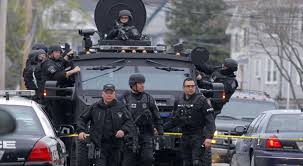
Equipment meant for the battlefield roll out in America cities to put down protest.
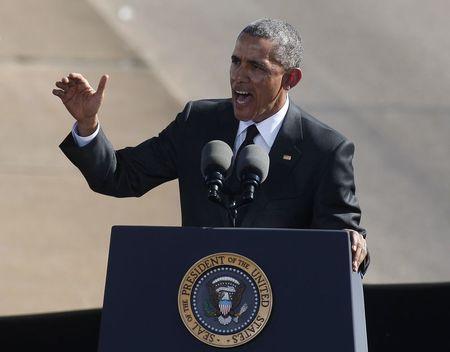
WASHINGTON — In an unexpected move, President Barack Obama on Monday will ban the federal government from providing certain military equipment to police departments. Effective immediately, the government will no longer provide local law enforcement with armored vehicles, grenade launchers and bayonets. Other items like explosives and riot equipment will be transferred to police only if they provide additional certification and assurances that the gear will be used responsibly. The changes stem from recommendations made to the president in a new report produced by a White House working group. Obama created the task force earlier this year via executive order.
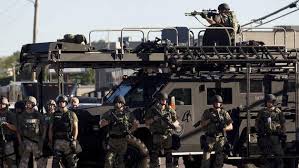
The president’s action is part of a broader effort to relieve tensions between law enforcement and minority communities after the deaths of several black men at the hands of police in Ferguson, Missouri; Baltimore; and other cities. In Ferguson, for example, local police rolled out armored tanks and riot gear in response to protests over the 2014 death of Michael Brown, a reaction that many saw as making the situation dramatically worse.
U.S. President Obama
“The idea is to make sure that we strike a balance in providing the equipment, which is appropriate and useful and important for local law enforcement agencies to keep the community safe, while at the same time putting standards in place so that there’s a clear reason for the transfer of that equipment, that there’s clear training and safety procedures in place,” White House Director of Domestic Policy Cecilia Muñoz said in a Sunday call with reporters.
The reason police departments have access to military-style weapons at all goes back to the government’s initial response to the 9⁄11 attacks. But the working group concluded there is “substantial risk of misusing or overusing these items, which are seen as militaristic in nature,” and that their use by police “could significantly undermine community trust.”
News of the ban on military weapons comes ahead of Obama’s Monday visit to Camden, New Jersey, where he will highlight the success of the city’s police department in building trust with its community. The president will visit police headquarters and meet with officers before giving public remarks. He will also announce $163 million in grants to encourage police departments to adopt the recommendations of the White House working group report.
Beyond Monday’s action, the administration has been taking other steps to promote accountability for
Ask yourselves who is the enemy
law enforcement. The Justice Department earlier this month announced a $20 million grant program for
increasing the use of body cameras by police. Obama has also proposed increasing that amount in his 2016 budget.
“What we’re witnessing in cities across the country is not only about policing, but it’s also about opportunity and creating opportunity for all,” Valerie Jarrett, White House senior adviser, said on the call.
UPDATE: 3:07 p.m. — During his remarks Monday in Camden, Obama explained his reasoning for pulling certain military equipment from police departments.
(ANTIMEDIA) In what could hardly be called a surprise, the UN Human Rights Council chastised the US over its epidemic of police violence, discrimination, needless killings, and general neglect, following through with recommendations made in its first review in 2010.
The Universal Periodic Review (UPR) takes place every four years to scrutinize the human and civil rights practices of each of the UN’s 193 member nations. Delegates from 117 countries took the opportunity to lambaste the US’ record of civil rights violations exacted by its brutal and racist police forces. In an attempt to fend off the inevitable, James Cadogan, a senior counselor in the Department of Justice’s Human Rights Division, saidthe US must “rededicate ourselves to ensuring that our civil rights laws live up to their promise,” listing several“tragic deaths” that sparked numerous demonstrations and wide-scale unrest across the country. However, he seemed to be blind to the fundamental basis for such outrage saying the US wishes to“identify and address potential policing issues before they become systemic problems,”, even asserting a fictitious good record for holding violators accountable. As Mary McLeod, acting legal adviser to the US Dept of State, put it, “We’re proud of the work we’ve done since our last UPR.” Most would disagree.
What the US representatives touted as improvements, actually do more to highlight the systemic issue they claim to be on the lookout for. Cadogan cited 400 instances in the past six years in which charges were brought against law enforcement officials, but this doesn’t figure in the disproportionately light punishment that often results from prosecution of police officers. Even his own preemptive statement, naming Michael Brown and Eric Garner as examples, speaks far more to police impunity than accountability — and is hardly reflective of the totality of incidents.Over 400 people have been killed by police in 2015 alone.
“Chad considers the United States of America to be a country of freedom, but recent events targeting black sectors of society have tarnished its image,”said Awada Angui, the delegate from that country.
The representative from Namibia, Gladice Pickering, echoed the general consensus saying the US needs “to fix the broken justice system that continues to discriminate against [marginalized communities], despite recent waves of protest over racial profiling and police killings of unarmed black men.” Critics across the board urged improvements in training methods and legislation and included goals to eliminate racism and end excessive force. “I’m not surprised that the world’s eyes are focused on police issues in the US,”said Alba Morales of Human Rights Watch. “There is an international spotlight that’s been shone [on the issues], in large part due to the events in Ferguson and the disproportionate police response to even peaceful protesters.” A federal investigation was launched on Friday to determine if police in Baltimore have instituted a pattern of discrimination following reports from residents of brutal abuse before and after Freddie Gray was killed in police custody. Such investigations are often too little, too late for victims and their families, who see them more akin to the cynical joke; “we investigated ourselves and found we did nothing wrong.”
Martinez Sutton, whose 22-year-old sister, Rekia Boyd, was shot by an off-duty Chicago police officer in 2012, observed from the sidelines. He feels that her killer’s acquittal three weeks ago is frustratingly typical: “I do not expect them to do anything because – I mean: Let us be real, it has been going on for years and what has been done? As I stated before, they say the guilty should be punished. I want them to show us instead of tell us. My sister was innocent, so why isn’t anybody paying for her death?” The UN will issue its report on the review along with recommendations on Friday, though its contents probably won’t be of much consequence considering the US“largely failed” to implement any of the 171 changes suggested in the previous report. There isn’t much comfort to be found in an atmosphere where calling the cops for assistance could potentially be your own death sentence. But if our own government doesn’t see a problem with its policing policies, at least 117 other countries around the world are starting to ask questions.
Crime scene in Kingston where an 11-month-old was murdered on Easter Monday.
Jamaica comes in at number 5 on the Homicide Monitor Map by the Igarape Institute of Brazil which reveals the global distribution of homicidal violence. Latin America and the Caribbean dominate the top 10 spots on the state-of-the art interactive map, with three Caribbean countries, namely Anguilla, US Virgin Islands and Jamaica comprising the Caribbean contingent.
On Jamaica, the report notes, “In Jamaica, the government is trying to drive down the rate by using the threat of the death penalty, as well as police patrols, curfews and actions to break up and control gangs.” The Homicide Monitor Map’s data was compiled from publicly reported killing reports from 219 countries from the new century to the latest available year.
Surprisingly, the US Virgin Islands comes up as the third most dangerous place in the world for murder with a rate of 52.6 per 100,000 persons. Half of the victims of the Brazilian study showed they were aged between 15 and 29 with 92 per cent being male. More than 75 per cent were killed by guns.
Honduras has the highest murder rate in the world, with 7,172 killings in 2012 – that’s 85.5 per 100,000 people.
The top 10 countries for murder, according to the new study, are:
1. Honduras 2. Venezuela 3.US Virgin Islands 4. Belize 5. Jamaica 6. El Salvador 7. Anguilla 8. Guatemala 9. Swaziland 10. Columbia
Prosecutor says Madison police officer won’t be charged for shooting Tony Robinson
Tony Robinson
A prosecutor in Wisconsin said that a police officer in Madison, Wis., will not face criminal charges for fatally shooting an unarmed man earlier this year.
The decision came more than two months after Anthony Robinson Jr., 19,was shot by Matthew Kenny, 45, as the police officer responded to calls about a disturbance.
“I conclude that this tragic and unfortunate death was the result of a lawful use of deadly police force and that no charges should be brought against Officer Kenny in the death of Tony Robinson Jr.,” Ismael Ozanne, the Dane County district attorney, announced Tuesday afternoon at a news conference.
Local authorities say they have prepared for protests that could follow the announcement, which comes amid increased scrutiny on how police use lethal force. Over the past several months, protests have erupted in multiple cities — including Madison — after deaths at the hands of police.
Robinson’s March 6 death prompted days of sustained, peaceful demonstrations in Wisconsin’s second-largest city. Police say they were responding to multiple calls about a disturbance involving Robinson, including calls that said he had assaulted other people and run into traffic.
In a brief statement after the shooting, police said that when they found Robinson, “a struggle ensued” and he was shot. Kenny was placed on paid administrative leave, and the police chief apologized for the shooting and asked for patience during the investigation.
Robinson’s death was investigated by the state Division of Criminal Investigation, because Wisconsin has a law requiring an outside agency to look into officer-related deaths. The state’s investigation involved dozens of interviews with witnesses and another series of interviews with residents of the neighborhood, the agency said. Once the agency completed its investigation, it turned over the details to the district attorney to decide whether to file any charges. “At the end of the day, this is a human tragedy for Tony Robinson’s family and for the police officer involved,” Brad Schimel, the Wisconsin attorney general, said in a statement shortly after Robinson’s death.
Ozanne, who was appointed in 2010, is a lifelong Madison resident and the first black district attorney in Wisconsin history, according to his office. He said he viewed his responsibilities through this lens as “a man who understands the pain of unjustified profiling” and described discussions he has had recently with community members who are distrustful of the criminal justice system. “My decision will not bring Tony Robinson Jr. back,” Ozanne said Tuesday. “My decision will not end the racial disparities that exist in the justice system, in our justice system.”He described his review of the evidence as methodical, outlining a process that involved sifting through 800 pages of reports, viewing surveillance footage and interviewing residents, police officers and emergency responders.
Ozanne said that the evening of the shooting, three calls were made to 911 within four minutes, all reporting issues involving Robinson. The first call came from a friend of Robinson’s who reported that the 19-year-old “was tweaking” after taking mushrooms, Ozanne said. The prosecutor also described calls about an unarmed man who matched Robinson’s description punching a pedestrian in the face and another call from someone who said Robinson had tried to choke him. Robinson was also seen trying to assault people on the sidewalk and blocking traffic, Ozanne said.
Toxicology reports later confirmed that Robinson had mushrooms, marijuana and Xanax in his body at the time of his death, according to Ozanne. Kenny, who was interviewed by prosecutors, said he heard “incoherent yelling and screaming” from an upstairs apartment when he arrived, according to Ozanne. Kenny said that when he went up the stairs, Robinson hit him in the head and knocked him into a wall, Ozanne said. The officer said he opened fire after fearing that he would be hit again and his gun could be taken and used to shoot him or others. Kenny fired seven shots in three seconds, and all of the shots hit Robinson on the front of his body, Ozanne said.
After the shooting, Kenny said, he did not know how he got to the bottom of the stairs but that Robinson was still conscious at the time. Kenny said he tried to give first aid to Robinson until the paramedics arrived, Ozanne said. “A young man lost his life far too soon,” Ozanne said. He urged people to respond without any violence. Michael Koval, the Madison police chief, released a lengthy statement after Ozanne announced his decision, again offering his condolences to Robinson’s family. “As a father of two adult sons, I cannot begin to grasp at the magnitude of their loss,” Koval wrote. “The difficulties that they have faced have been formidable and I hope that some measure of healing can begin.”
supporters gathered near home where the deadly shooting took place
Kenny will remain on administrative leave until the police department finishes an internal review to determine whether any of its procedures were violated, Koval said. In his statement Tuesday, Koval wrote that Madison “finds itself at a crossroad” after the decision. Protesters can respond with the property damage and disorder seen in other cities, he said, or they can “take the higher road” of nonviolent civil dissent and civil disobedience. “Unrest like we have witnessed elsewhere in our country cannot possibly aid in constructive engagement and only holds us back,” Koval wrote. “The environment for healing and reconciliation has been forged, owing to the incredible capacity of the Robinson family and their urging of the community to deal with the issues at hand with responsible activism.”
In addition, Koval detailed what kinds of protest activities are legally allowed and what types of activities could lead to fines or jail time for protesters. He wrote that some people will choose to get arrested and called that “a hallmark of civil disobedience,” though he encouraged people to violate city ordinances (which carry fines) rather than committing misdemeanors or felonies (which lead to jail time). The American Civil Liberties Union of Wisconsin said the decision “leaves a cloud of uncertainty” over who is responsible for Robinson’s death. “If Officer Kenny did not violate the law, then is anyone legally responsible for Mr. Robinson’s death?” Chris Ahmuty, the group’s executive director, said in a statement. “Does the criminal law protect individuals like Mr. Robinson from deadly force exercised by police officers? Are police officers above the law?” Decisions not to charge officers in Ferguson, Mo., and New York City last year were followed by heavy protests in those cities. The Young Gifted and Black Coalition, a group that organized protests after Robinson’s death, said it planned to hold a march on Wednesday. The group earlier posted on Facebook that it did not expect charges against Kenny but said it did not plan to lead any activities on Tuesday out of respect for Robinson’s family. [Thousands of police shootings, but criminal charges rarely follow]
Jim Palmer, executive director of the Wisconsin Professional Police Association, released a statement calling the decision “appropriate,” saying that Kenny was acting in response to a deadly threat. City officials said police in Madison have spent weeks preparing for the announcement and meetings with community leaders. “It is our hope — that working together — Madison can come through these challenging days ahead without violence or property damage,” the city said in a statement. In the days after Robinson’s death, protests in Madison stretched into the state capitol, with demonstrators marching from the University of Wisconsin’s campus to the capitol’s rotunda. Madison authorities said they know protests could follow the decision about charges, and they vowed that police will help demonstrators march safely in the city. “It is our belief that Madison can endure without being fractured,” the city’s statement said.
After Robinson’s death, the police chief, mayor and other city leaders described the shooting as a tragedy, promised answers and called for changes. This quick response underscored what observers say is a changed atmosphere since last summer’s initial protests in Ferguson, as authorities have tried to act quickly to avoid unrest. Madison schools are planning on providing “structured opportunities” for students to discuss the decision once it is announced, according to the school district . In addition, the district said that while middle and high school students may want to participate in protests, it has urged parents to encourage their children to remain in class during the school day. “While we have been proud of how responsibly and safely our students have participated in events throughout the community, we also think it is important for you to talk with your child about both their rights and responsibilities as part of a protest if they choose to participate, as well as the consequences of a possible arrest,” Jennifer Cheatham, superintendent of the Madison Metropolitan School District, wrote in a message to families in the community.
Right-Wing Media Accuse “Angry” Michelle Obama Of “Race Baiting” In Tuskegee Commencement Address
First lady Michelle Obama
Right-wing media accused First Lady Michelle Obama of “wasting an opportunity,” “playing the race card,” and reciting a “litany of victimization” after the first lady’s commencement address at Tuskegee University in Alabama.
Bloomberg: Michelle Obama “Spoke Frankly” About The Role Of Race During Her Commencement Address. During Michelle Obama’s commencement address at Tuskegee University on May 9, Obama spoke about the role her racial identity played in the 2008 campaign, slights African-Americans face everyday, and the fact that those experiences were “not an excuse” to “lose hope.” [Bloomberg, 5/10/15]
Right-Wing Media Accuse “Angry” Obama Of “Race Baiting”, “Playing The Race Card”
Daily Caller: Luxurious Life As First Lady Takes Toll On Michelle Obama Because She Is Black, She Complains. A May 10 Daily Caller article accused First Lady Obama of complaining about the “trials and tribulations she believes she has faced as the first black first lady in American history”:
Globetrotting, Ivy League-educated, Marchesa gown-wearing first lady Michelle Obama’s commencement address at Tuskegee University on Saturday described the trials and tribulations she believes she has faced as the first black first lady in American history.
The intense media scrutiny, occasional critical and disparaging remarks — it’s all too much and she said it has led to sleepless nights either in the White House or in posh, five-star hotels where she and her retinue stay, according to The Hill. [Daily Caller, 5/10/15]
Rush Limbaugh
Rush Limbaugh: Michelle Obama Has “A Giant Chip On [Her] Shoulder,” Perhaps Because People Don’t “Fawn Enough” Over Her. During the May 11 edition of Première Radio Networks’ The Rush Limbaugh Show, Limbaugh claimed that Michelle Obama was “doubling down” on “playing the race card,” saying she has “a giant chip on [her] shoulder” that’s “getting worse.” Limbaugh later claimed that Obama is “even angrier” than President Obama and suggested that maybe she “just thought” she’s been treated poorly because people “didn’t fawn enough” concluding that this is all “continuing to roil the culture, rile up people who ought to have a different approach being made to them.” [Première Radio Networks, The Rush Limbaugh Show, 5/11/15]
Ingraham: First Lady Recited “A Litany Of Victimization.” During the May 11 edition of Courtside Entertainment Group’s The Laura Ingraham Show, Ingraham mocked Obama’s comments, saying she was just “angry”:
INGRAHAM: Race certainly kept her out of the wonderful Chicago whiteshoe law firm known as Sidley & Austin. The woman has struggled.
[…]
Laura Ingram
Now was that experience frustrating when you didn’t get into all the Ivys when you applied? Or was it frustrating when you got your first acceptance letter from Princeton? I mean, when exactly was it frustrating?
[…]
I don’t believe that story, never did. A lot of people are raising questions about that very convenient anecdote at Target, that she only mentioned, I believe, when she was on Letterman and People Magazine had written about this. But there’s lots of questions. I went back and looked at the way she was dressed when she went into Target about two years ago now. No one would have mistaken her for a clerk. She was wearing a floral print button-down shirt with a yellow t‑shirt underneath with a baseball cap. Since when do the employees at Target wear any of that? That just wasn’t true. But this is the First Lady of the United States who has reached the pinnacle of success in our country, her husband has, and this was a litany of victimization which is exactly what we want young African-American graduates of a terrific university to take away with. [Courtside Entertainment Group, The Laura Ingraham Show, 5/11/15]
Sean Hannity: Speech Revealed A “Deep Rooted Anger,” “Bitterness,” And
Sean Hannity
“Lack Of Appreciation” By The First Lady. After playing a compilation of speeches made by Michelle Obama during the May 11 edition of Première Radio Networks’ The Sean Hannity Show, Hannity claimed that Obama’s recent speech is “a culmination of anger, deep rooted anger, that has built up in Michelle Obama.” Hannity went on, “It’s kind of sad. There’s a bitterness here to the whole experience of being first lady, a lack of appreciation for the opportunities that they’ve had.” [Première Radio Networks, The Sean Hannity Show, 5/11/15]
Fox News Contributor: Obama’s Commencement Speech Was “Very Divisive” Because Of Its “Race Baiting.” On the May 11 edition of Fox News’ America’s Newsroom, Fox contributor Deneen Borelli called the speech by Obama “a wasted opportunity.” She went on to assert that Obama was “being very divisive” and accused the first lady of “race baiting.” [Fox News, America’s Newsroom, 5/11/15]
Breitbart.com: Michelle Obama Complained During Commencement Speech. In a May 11 post, Breitbart.com claimed the First Lady complained during her remarks and “accused the media of giving her unique attention”:
With less than two years left in the White House, Michelle Obama is taking time to respond to her critics, accusing them of treating her differently because she is the first African-American First Lady.
She made her remarks during a commencement speech at Tuskegee University over the weekend, comparing her experience as the wife of the first African-American president to the experiences of historical civil-rights leaders.
The First Lady recalled her experience on the campaign trail, accusing the media of giving her unique attention thanks to the “fears and misperceptions of others” who questioned whether she was “too loud, or too angry, or too emasculating.”
She alluded to Fox News personalities discussing her “terrorist fist jab” and referring to her on-screen as “Obama’s baby mama” as well as Rush Limbaugh suggesting that she had “a little bit of uppityism” thanks to her nanny state food polices. [Breitbart.com, 5/11/15]
We salute the First LADY, emphasis on Lady, for the LADY-LIKE fashion in which she has conducted herself as a first lady of the United States something her critics can only dream of. We salute her for her role as a wife and mother of two beautiful daughters. We salute her for the way she has lived her life , a model for all women around the Globe. We salute the first lady for being a successful Ivy League educated Lawyer.When the final chapters of history not [HIS-STORY] are written we are confident and enthused that her critics will be mere foot-notes in the narrative, mere references for their ignominy, if at all, while Michelle Obama will be celebrated into perpetuity.
Supreme Court Chief Justice nominee, John Roberts, responds to the spirited questioning of Sen. Joe Biden (D‑DE) during the second day of his confirmation hearing on Capitol Hill, September 13. Roberts was pressed by senators for his views on the strength of established legal precedent with regard to the controversial issue of abortion rights and the landmark Roe vs. Wade abortion case. REUTERS/Kevin Lamarque KL/LA — RTRNUJD
Cue up the sad David Brooks violin playing softly in the corner of a dark alley at 3 a.m., because Americans have no faith in powerful institutions anymore. One of those institutions would be the marbled shrine atop our third branch of American government, the Supreme Court. A new Associated Press poll shows that “only 1 person in 10 is highly confident that the justices will rely on objective interpretations of the [Affordable Care Act] rather than their personal opinions” in the Court’s impending King v. Burwell decision.
To us, that 10 percent figure seems way too high. As far as we can tell, it’s not 1 in 10 Americans who view our Supreme Court as a neutral collection of jurists who just want to call “balls and strikes,” but 1 American total: Chief Justice John Roberts. And maybe even not him? The American people, the always trusty American people, have the Supreme Court’s number here. As with so many cases about why the American people have lost trust in a powerful institution, we can look to some of the powerful institution’s recent actions, going back at least to Bush v. Gore through Citizens United and Hobby Lobby and whatever primetime hit job comes next.
That next hit job may come soon in King v. Burwell, which, if ruled for the plaintiffs, would invalidate premium subsidies for those who’ve purchased individual health insurance plans on federally facilitated exchanges. The expected decision based on tea-leaf readings coming out of oral arguments was 5 – 4 or 6 – 3 in favor of upholding the subsidies, which tells you a lot about how weak the case is. But there is another possible outcome: 5 – 4 to strike down the subsidies, because the Supreme Court is ruled by a five-member majority of conservative justices who think that the Affordable Care Act is dumb.
The last time a legal challenge to Obamacare of this breadth made it to the Supreme Court, four justices voted not just to strike down the individual mandate but the entire law as well, because they believed that the law was dumb. They didn’t like it! Get rid of it! John Roberts originally sided with them but then, to the consternation of his conservative colleagues, switched his vote because such a hackish decision would have made the Supreme Court look too hackish. Roberts contented himself merely to gut the hell out of the Medicaid expansion and force the Obama administration to acknowledge that the individual mandate is a tax.
Very few Court watchers are basing their predictions of the King decision on the merits of the case, and rightly so. If it was being decided on the merits of the case, everyone would be betting that it would be upheld 9 – 0. Does anyone think that’s going to happen? No. It will all come down to how John Roberts, and perhaps Anthony Kennedy, feel about managing the politics. They want to screw over Obamacare but yeeeesh, would that backfire on the Court and conservatives? Would that make life more difficult for the Republican party heading into 2016? On the other hand: Would John Roberts ever eat lunch in Conservative This Town again if he sided with The Libruls to uphold a core component of Obamacare? It’s all about finding the right balance of these competing political considerations. The Democratic and Republican parties rightly recognize the nature of the situation here and have spent months trying to get inside John Roberts’ head. It is what it is.
Let’s consider a more generous version of what’s happened to the Supreme Court of late: that it’s merely followed the broader trend in American politics towards polarization. Antonin Scalia and Ruth Bader Ginsburg might be looking at the same piece of legislation before them but seeing something completely different, so divergent have the liberal and conservative worldviews become. And these are justices who were appointed a generation ago. The next round of justices will have made their careers during this time of high-stakes judicial polarization.
That next round of justices may come very soon, since several Supreme Court justices are approximately one million years old. As Ian Millhiser writes at Think Progress, Rick Perry correctly emphasized the importance of the next presidential election in a speech this weekend:
“Something I want you all to think about is that the next president of the United States, whoever that individual may be, could choose up to three, maybe even four members of the Supreme Court,” Perry told the South Carolina audience. So this election “isn’t about who’s going to be the president of the United States for just the next four years. This could be about individuals who have an impact on you, your children, and even our grandchildren. That’s the weight of what this election is really about.”
State and federal officials are investigating the hanging death of a black man whose body was discovered Monday morning roughly 70 miles east of Atlanta in Greene County, Georgia. The man was identified as 43-year-old Roosevelt Champion III,NBC News reports. Champion was found hanging from a tree behind a residence that was not his own, the Greensboro Police Department told the Atlanta Journal-Constitution. Law enforcement said that Champion was hanging by a strap like those used to secure cargo on car roofs, with no visible wounds and his feet brushing the ground, NBC reports.
Though homicide has not been ruled out, Rusty Andrews, deputy director of investigation at the Georgia Bureau of Investigation, told Action 2 News that investigators initially found no signs of struggle or other trauma to Champion’s body or anything else that would indicate someone other than the victim was involved. Champion had been interviewed in connection with the murder of a woman on May 2 but had not been charged, Andrews told the station.
GBI Special Agent Joe Wooten said that several people have already been interviewedin connection with Champion’s death, according to NBC. “I understand that there is a lot of concern” raised by the news of a black man being hanged in the Deep South, Wooten said. “Because of that, we’re going to be as transparent as we can be.” Over a month ago, Otis Byrd, a 54-year-old black man, was found hanged from a treein Claiborne County, Mississippi. The FBI has disclosed the autopsy results to Byrd’s family but has not said publicly whether his death was by suicide or homicide. Huffingtonpost.com
NEWYORK, NY — DECEMBER 27: Pallbearers carry the casket during the funeral of slain New York Police Department (NYPD) officer Rafael Ramos at the Christ Tabernacle Church on December 27, 2014 in the Glenwood section of the Queens borough of New York City. Ramos was shot, along with Police Officer Wenjian Liu while sitting in their patrol car in an ambush attack in Brooklyn on December 20. Thousands of fellow officers, family, friends and Vice President Joseph Biden arrived at the church for the funeral. (Photo by Kevin Hagen/Getty Images)
The nation focused its attention last year on deaths resulting from some police officers’ controversial use of force. But just as tensions rose between law enforcement and citizens in 2014, so did killings of officers. The FBI released preliminary statistics on Monday showing that 51 law enforcement officers were feloniously killed in the line of duty in 2014. That’s an 89 percent increase in felonious cop slayings compared to 2013. However, the number of officers killed has been declining in recent years. The 2014 figure is well below the 64 officers who were killed on average each year between 1980 and 2014. The year 2013 actually saw the lowest number of officers killed in action in the last 35 years. Only 27 officers were killed feloniously that year, which means that while 2014’s number appears to be a spike, it’s actually lower than the average figure from the past several years.
Some key statistics from the report include:
46 of the 51 officer killings involved offenders using guns;
Of those 46 incidents, 32 of the incidents involved handguns, 11 involved rifles and three involved shotguns;
35 of the 51 officers were wearing body armor at the time;
17 officers were killed in the South, 14 in the West, 8 in the Midwest, 8 in the Northeast and 4 in Puerto Rico;
An additional 44 officers were accidentally killed in the line of duty;
Of those 44 officers, 28 died in vehicular collisions, and only 15 of them were wearing seat belts.
Federal experts have long acknowledged that that estimate is too low, and a handful of more recent, unofficial reports — online databases compiled and fact-checked by volunteers — place the toll much higher, at about 1,100 deaths a year, or three a day. Yet they do not suggest that the pace of police killings or the racial composition of victims as a group has changed significantly in the last two years or so.
The NFL suspended New England Patriotsquarterback Tom Brady for the first four games of the 2015 season Monday as part of sweeping punishment against the organization for its actions in the so-called Deflategate scandal.
The league also fined the Patriots $1 million and docked them two draft picks — a first-rounder in 2016 and a fourth-rounder in 2017 — for violating the playing rules “and the failure to coöperate in the subsequent investigation” co-led by attorney Ted Wells.
Brady was suspended “for conduct detrimental to the integrity of the NFL” after a 243-page report released last week by Wells indicated he was more likely than not “at least generally aware of the inappropriate activities” by two low-level team employees.
Those employees, John Jastremski and James McNally, were suspended indefinitely without pay by Patriots owner Robert Kraft effective Wednesday, the league said, adding that they cannot be reinstated without approval by NFL executive vice president of football operations Troy Vincent.
But most striking was the suspension of Brady, who is virtually certain to appeal. If the appeal fails, Brady would be eligible to play no sooner than an Oct. 18 Sunday night road game against the Indianapolis Colts — the team that first alerted the NFL to the matter of whether the Patriots were using underinflated footballs during last season’s AFC Championship Game.
“With respect to your particular involvement, the report established that there is substantial and credible evidence to conclude you were at least generally aware of the actions of the Patriots’ employees involved in the deflation of the footballs and that it was unlikely that their actions were done without your knowledge,” Vincent wrote to Brady in a letter excerpted by the NFL.
“Moreover, the report documents your failure to coöperate fully and candidly with the investigation, including by refusing to produce any relevant electronic evidence (emails, texts, etc.), despite being offered extraordinary safeguards by the investigators to protect unrelated personal information, and by providing testimony that the report concludes was not plausible and contradicted by other evidence.
“Your actions as set forth in the report clearly constitute conduct detrimental to the integrity of and public confidence in the game of professional football. The integrity of the game is of paramount importance to everyone in our league, and requires unshakable commitment to fairness and compliance with the playing rules. Each player, no matter how accomplished and otherwise respected, has an obligation to comply with the rules and must be held accountable for his actions when those rules are violated and the public’s confidence in the game is called into question.”
Brady has three days to appeal the suspension to Commissioner Roger Goodell or his designee. His agent, Don Yee, said “the discipline is ridiculous and has no legitimate basis” and that Brady will appeal.
“And if the hearing officer is completely independent and neutral, I am very confident the Wells Report will be exposed as an incredibly frail exercise in fact-finding and logic,” Yee said in a statement.
Statement from the NFL
This cheating liar had a chance to come clean when asked about deflate-gate . He chose not tell the truth
“The New England Patriots were notified today of the following discipline that has been imposed for violations of the NFL Policy on Integrity of the Game and Enforcement of Competitive Rules relating to the use of under-inflated footballs in the AFC Championship Game of this past season:
For the violation of the playing rules and the failure to coöperate in the subsequent investigation, the New England Patriots are fined $1 million and will forfeit the club’s first-round selection in the 2016 NFL Draft and the club’s fourth-round selection in the 2017 NFL Draft. If the Patriots have more than one selection in either of these rounds, the earlier selection shall be forfeited. The club may not trade or otherwise encumber these selections.
Patriots owner Robert Kraft advised Commissioner Roger Goodell last week that Patriots employees John Jastremski and James McNally have been indefinitely suspended without pay by the club, effective on May 6th. Neither of these individuals may be reinstated without the prior approval of NFL Executive Vice President of Football Operations Troy Vincent. If they are reinstated by the Patriots, Jastremski is prohibited from having any role in the preparation, supervision, or handling of footballs to be used in NFL games during the 2015 season. McNally is barred from serving as a locker room attendant for the game officials, or having any involvement with the preparation, supervision, or handling of footballs or any other equipment on game day.
Quarterback Tom Brady will be suspended without pay for the first four games of the 2015 regular season for conduct detrimental to the integrity of the NFL. Brady may participate in all off-season, training camp and pre-season activities, including pre-season games.
Commissioner Goodell authorized the discipline that was imposed by NFL Executive President Troy Vincent, pursuant to the commissioner’s disciplinary authority under the NFL Constitution and Bylaws and the Collective Bargaining Agreement with the NFL Players Association.
“We reached these decisions after extensive discussion with Troy Vincent and many others,” Commissioner Goodell said. “We relied on the critical importance of protecting the integrity of the game and the thoroughness and independence of the Wells report.”
PHOTOS: SUPERBOWLXLIX
Patriots corner back Malcolm Butler intercepts a pass intended for Seahawks wide receiver Ricardo Lockette in the closing minute of Super Bowl XLIX at University of Phoenix Stadium in Glendale on Feb. 1, 2015. The Patriots won the game 28 – 24. (Photo: David Wallace/azcentral sports)
The Patriots did not immediately comment on the punishments.