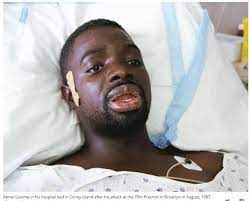
It is difficult to grasp that in 2023 this is happening to human beings, actual citizens of any country, much less in a country that pretends to lecture other nations about human rights. Worse yet, the image of the brutalized citizen is not that of a person who ordinary criminals assaulted; agents of the state brutalized him. No one old enough can forget the images of Haitian immigrant Abner Louima. On the fateful August 9, 1997, evening that Haitian immigrant Abner Louima suffered through the sadistic police brutality of the New York Police Department … After the monsters acting under the color of law arrested mister Louima on petty charges of being engaged in a scuffle outside a nightclub, he was taken to the police station. (During the trip to the station house, officers allegedly stopped twice to beat Louima, who was handcuffed. At the 70th Precinct station house, two officers, Justin Volpe and Charles Schwarz, allegedly shouted racial slurs, and Volpe allegedly shoved a wooden stick (believed to be the handle of a toilet plunger or broom) into Louima’s rectum and mouth. Volpe reportedly borrowed gloves from another officer and walked through the station house with the wooden stick, which was covered with blood and excrement; the gloves were recovered, but the wooden stick was not found on the scene. Louima was placed in a holding cell, where other inmates complained that he was bleeding. An ambulance was eventually requested to take him to a hospital, but he was held for three hours in the cell, bleeding following the alleged beating and torture.80 Once at the hospital, doctors confirmed Louima’s serious internal injuries were consistent with his allegations; internal organs were ruptured, and his front teeth had been broken. For the first three days of his two-month hospitalization, Louima was reportedly handcuffed to his bed) . (hrw.org)
Twenty-six years after Abner Louima’s case, police continue to operate with increased impunity and depravity, in case after case in state after state. The storyline differs, but the victims remain Black men. The depraved monsters doing the assaults and killings remains white American police officers. The seminal question in light of the unchanging reality must be, what is behind police sense of impunity? The answer.…. Racism, protection from corrupt prosecutors and judges, and qualified immunity the doctrine the Supreme Court took upon itself to legislate despite not being a legislative body.(mb)
Abner Louima
NOWTHIS »»»»»»»
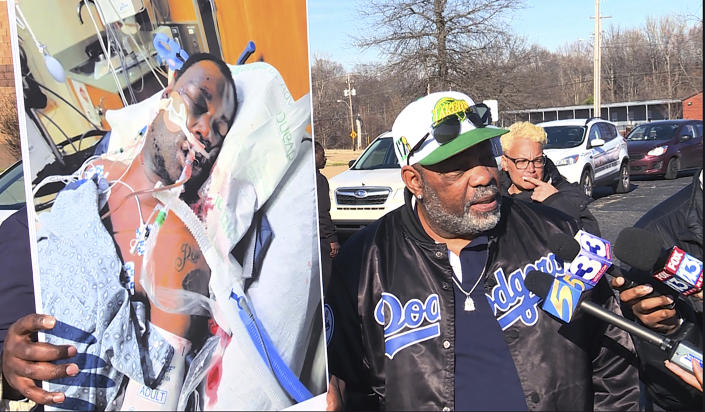
People protested outside a Memphis police station over a man’s death after a confrontation with police officers during a traffic stop. Family, friends, and supporters of Tyre D. Nichols released balloons Saturday to honor the life of the 29-year-old Memphis man and protested outside a police station near the site of the Jan. 7 traffic stop. The Tennessee Bureau of Investigation is conducting a use-of-force investigation at the request of Shelby County District Attorney General Steve Mulroy; bureau officials said last week. Nichols “succumbed to his injuries” on Tuesday, the agency said without describing the nature of his injuries. Nichols, who was Black, was arrested after officers stopped him for reckless driving, police said. There was a confrontation as officers approached the driver, and the suspect ran before he was confronted again by pursuing officers who arrested him, authorities said. “Afterward, the suspect complained of having a shortness of breath, at which time an ambulance was called,” and Nichols was taken to a hospital in critical condition, police said. Due to his condition, police contacted Mulroy’s office, and he requested the state bureau’s investigation, authorities said. Rodney Wells told WREG-TV on Saturday that his stepson ended up suffering a cardiac arrest and kidney failure because of a beating by officers.
In this photo provided by WREG, Tyre Nichols’ stepfather Rodney Wells, right, holds a photo of Nichols in the hospital after his arrest, during a protest in Memphis, Tenn., Saturday, Jan. 14, 2023. (Jordan James/WREG via AP) ASSOCIATEDPRESS.
“When we got to the hospital, it was devastating,” Wells said. “All of that still should not occur because of a traffic stop. You shouldn’t be on a dialysis machine looking like this because of a traffic stop. That’s inhumane.” Protesters said authorities should release body camera footage of the arrest. “The least they can do is be transparent with the mother, father, and the family and show that video to them about what happened to their son,” community activist Kareem Ali told WMC-TV. Nichols’ older sister, Keyana Dixon, said during the balloon release that the officers who pulled Nichols over were in an unmarked vehicle, according to The Commercial Appeal. “If he did run, it was because he was scared,” Dixon said. “A traffic stop is supposed to be a traffic stop for anybody, and they were in an unmarked vehicle, so I already knew what he thought.” The newspaper said it couldn’t independently confirm the details described by the family. The Memphis Police Department referred questions to the state bureau, which said it was still investigating. This story originated @Yahoonews.
Just another iteration of America’s ‘warrior’ cops on American streets acting as if the streets are war zones and they are action heroes. — the way they lie is stunning.
The family of an Atlanta-area 12-year-old killed during a high-speed chase calls for a special prosecutor and federal investigation into a Georgia State Patrol trooper’s actions. During a Jan. 10 news conference, the parents of Le’Den Boykins stood on the steps of the Georgia State Capitol building. They expressed sorrow and frustration patrol officers didn’t do more to save the lives of the children inside the car the night of the incident. “They decided to terminate somebody’s life for a speeding ticket,” Le’Den’s father, Anthony Boykins, said The incident occurred during the early morning hours of Sept. 10, 2021. Charlie Moore, 37, was driving his Kia Sorento with his son and Le’Den Boykins inside. Boykins, who his grandmother was watching at his Paulding County home while his parents were in Michigan at a funeral, had been permitted to go out with his 14-year-old neighbor and Moore, the teen’s father, to earn some money cleaning parking lots on the night of the crash, local station WXIA reported Georgia State Patrol toldNBC Moore “was initially pulled over shortly after 1 a.m. by a trooper for speeding.”
Dashcam video shows the traffic stop where Georgia State Patrol Officer David Petersen approached the driver’s side window of Moore’s vehicle. Petersen claimed Moore tried to evade him. He asked Moore for his driver’s license, which Moore refused to provide, prompting Petersen to ask him to step out of the vehicle. Two Paulding County Sheriff’s deputies arrived several minutes into the traffic stop, and Moore asked for a supervisor and questioned what crime he had committed. At this point, one deputy smashed the driver’s side window, and Moore reacted by speeding away. A high-speed chase lasted roughly eight minutes until Petersen hit the back left bumper of Moore’s Kia Sorento performing the PIT maneuver. Moore and the children inside flipped over into a roadside ditch. Petersen is heard saying, “PIT successful, PIT successful,” as the car goes into the embankment. The PIT maneuver is a method used by police to end pursuits. The method occurs when a police vehicle hits the vehicle it is pursuing near its back left or right tire. The vehicle is struck and then spun around, allowing police to stop the chase. The family claims the troopers should have acted differently because there were children inside Moore’s vehicle. “They could put a roadblock up and protect those kids. They couldn’t figure out any other way than to flip that car over?” Anthony Boykins asked.
Anthony Boykins and Toni Franklin-Boykins stand at a news conference. (Photo: Facebook/Dontaye Carter)
While Georgia’s Department of Public Safety policy does not explicitly prohibit the PIT maneuver because children are in the car, it requires officers to consider children’s safety. The Paulding County Sheriff’s Office on scene toldWANF, “it was 1 a.m., and it was dark, and the troopers were having trouble seeing who was in the vehicle.” “They killed my son, and the first thing they did was lie to me. I asked them specifically, did you know there were children in the car, and they gave a very clear answer, no, we did not know children were in the car,” Anthony Boykins said. Radio traffic shared by Boykins’ attorney, Lee Merritt, indicates officers on the scene knew children were in the vehicle. A dispatcher can be heard on police radio traffic saying, “there are children in the car.” An unidentified officer responds, saying, “There are kids in the car. We’ll try again if I can get up there and pass them.” “There’s the vehicle coming. They better stop before they get put in a ditch,” an unidentified trooper said. Merritt asked for the Paulding County prosecutor to recuse himself and allow a special prosecutor to come in and take over the case last summer. Atlanta NAACP President Gerald Griggs called for Georgia’s attorney general to appoint a special prosecutor again at the news conference. He also called for the Department of Justice to investigate the case. “It’s been almost 500 days, and there’s still been no action. We’re demanding swift and accountable justice in this case. Le’Den was a victim,” Griggs said. “We want justice for our son,” Anthony Boykins said.
Le’Den Boykins, 12, died inside a car that flipped over following a PIT maneuver by Georgia Trooper. (Photo: Facebook/Toni Franklin-Boykins)
Petersen was placed on administrative leave during an investigation by the GBI, then returned to work early last year, WXIA reports. The Georgia State Patrol told Atlanta Black Star, “We cannot comment due to the notice of potential litigation.” The Georgia Bureau of Investigation said its only role in the case was to conduct the autopsy, and Georgia Attorney General Chris Carr’s office said it could not comment. Moore was arrested and booked into the Paulding County jail. He faces a slew of charges, including first-degree vehicular homicide, murder during the commission of a felony, reckless driving, endangering a child while DUI of alcohol or drugs, and fleeing to elude. He still awaits trial.(AtlantaBlackStar).
As a child growing up, I was quickly sensitized to the critical issue of apartheid in South Africa and the racial issues plaguing the former colonies across the African continent. Much of my personal militancy came from my continued interest in learning all that I could about the oppression that those people endured. I also made it my business to inform myself about the racial issues in Jamaica, the western world, and all across the globe where anti-back racism existed. Growing up in the 70s, I was extremely proud of Jamaican leaders’ role in the struggle to free South Africa from the bondage of white minority rule and the ignoble practice of white supremacy. I was blessed to witness the dismantling of white rule in South Africa and the inevitable elections, which saw Nelson Mandela elected President of the new South African State. Since the death of Mister Mandela, the long struggle and the countless lives lost to gain freedom from white oppression have faded from the minds of the new generation. It appears that the same greed, graft, and corruption that caused them to sell their brothers and sisters into slavery remains. The task, the need to build and solidify a strong Afro-centric nation, appears to be outside their capabilities. Consequently, the nation of South Africa may be poised to once again be taken over by the white minority and ruled for hundreds more years as slaves and third-class citizens. If you are a Gazelle on the Serengetti, you will be eaten. A Lion, on the other hand, will always rule. The future of Black South Africans is in their own hands. If and when they are once again subjected to white minority rule, no one should lift a finger to free them from it. Whites living in the new South Africa should assimilate into being like every other South African, no greater, no less; failing to do so, they should find somewhere else to live or face the consequences. When you are in the majority and control the reins of government, you do not beg to stop racism; you crush it like a cockroach and make sure those who would think of it piss their pants just doing so. (mb) https://mikebeckles.com/white-south-africans-show-why-they-do-not-deserve-the-grace-they-received-from-black-leadership/
.
.
.
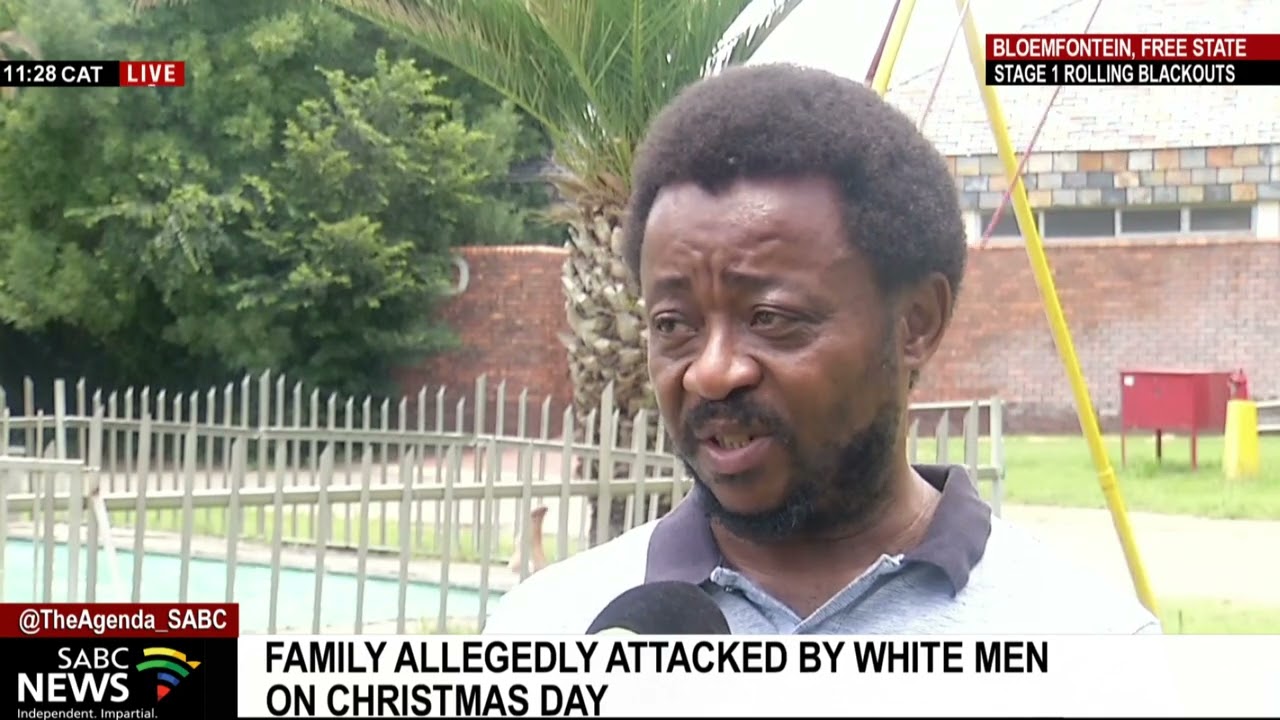
WHITEMENCHOKEBLACKBOYSATSWIMMINGPOOL
A disturbing video clip showing a group of white South African men verbally and physically attacking a group of Black boys has captured the attention of the world as well as the country’s president. The video posted to social media on Christmas Day depicts a few white adult males allegedly trying to prevent or eject a couple of Black boys out of the Maselspoort Resort and Conference Centre’s pool located in Bloemfontein, South Africa, according to Times Live. The nation’s top elected official reasserted the constitution’s aspiration, saying there is no place for racism within the country’s borders, while the public is blasting the men as racists. The video first shows the men telling one of the boys to leave the water. Then the men are seen hitting and pushing the child. Another child jumps in to help and is later grabbed by his neck, while a different man comes up and pulls the kid’s hair. Some of the onlookers attempted to stop the men, but their intervention seemed to escalate the ruckus. At the end of the video, a man is choking one of the boys and then jumping into the water with him. Another man jumps in, and before the 31-second clip is over, he also looks to push him down under the water. One boy’s father described the incident.
“As we were relaxing the boys came and told us that they are being prevented from using the pool by a group of white adult males. They said they were told by the men that the pool is only reserved for people who are booked here,” he said. “We went there with my sister to check on the kids and indeed when we arrived there, we engaged those white folks and they said ‘no, there was a miscommunication with the kids.’” “They didn’t understand,” he continued. “They thought that they were not residents at Maselspoort because the swimming pool can only be accessed by residents and the kids told them we are residents here. I also told them we are residents here and we have paid just as they have paid.” However, the men assaulted the boys after the parents left, the father said. Roy Jankielsohn, leader of the Democratic Alliance Free State, urged the victims’ parents to press criminal charges against the men featured in the footage. At least one family, The Nakedi Family, has moved forward to get justice for the boys, opening a common assault case. The father said he was disappointed that the men were not charged with attempted murder. “One of the guys tried to drown the boy, that is attempted murder and it should have been registered as so but police told us they are only opening an assault case,” he said. A police spokesperson stated the men have been ordered to appear in court.
South African President Cyril Ramaphosa commended the police for pushing the matter forward, creating multiple dockets, and submitting to decide how or if the men should be prosecuted. The president said Black and white South Africans have to work to eradicate racist thoughts in the country. “Our constitution means exactly what it says when it declares that South Africa — and that means all of South Africa — belongs to all who live in it,” Ramaphosa said. “As Black and white South Africans, we should be united in condemning all manifestations of racism and attempts to explain or defend such crimes. Racism is not a problem to be fought by Black South Africans only. The president added it was important for the citizens to come together and “defend” South Africa’s “continuing national mission of ridding [its] society of the divisions and the hurts of [its] past.” “We must also be united in ridding our society of the violence we see in the videos of the incident at the Free State resort, whether such violence comes with racism or not,” Ramaphosa said. “It is deplorable that adults dealing with teenagers resort to violence with such disturbing ease, hurting people physically and offending provisions in our Bill of Rights around the security of the person, including the right to dignity and being free of violence.”
Ramaphosa said the law calls for letting “investigations take their course but under the rule of law we can and must also declare that racism has no place in our society and racists have no place to hide.” While the politicians are calling for people to unify and for justice through the system, people on social media are expressing their outrage. One of the boy’s sister’s video of the scuffle has been viewed over 20 million times. “Trying to strangle and drown children? I don’t care how much they drank. They would never do this to white kids. They are racist. Full stop,” South African Annika Langa tweeted. Another Twitter user, Juwanna Othmani, from Brooklyn, New York, said, “The s – t we as Black people still going through across the world is disgusting. How TF is there still segregation in #SouthAfrica in 2023?!!! This is only days ago. A WHITESONLYPOOL??? Are you sh – in me!!! Community, government and political parties such as the Economic Freedom Fighters and the ANC in the Free State also responded, SABC News reported. A spokesperson from the resort, Nick Mitchell, said the establishment does not practice or allow any kind of segregation or racism. Hoping to distance itself from the ugly incident that happened on its premises, it referred the details of the incident to the police.“At this moment the police are handling the situation. As mentioned, there is the police case opened against the parties involved,” Mitchell said.
As the United States continue to criticize other nations and their law enforcement agencies for what they characterize as human rights abuses these are the incidents that are happening right here in the good old USA. Police officers not only murder people of color for minor traffic infractions, but their superiors also covered it up. Even political leaders help distort the truth and mislead the victim’s families.(mb)
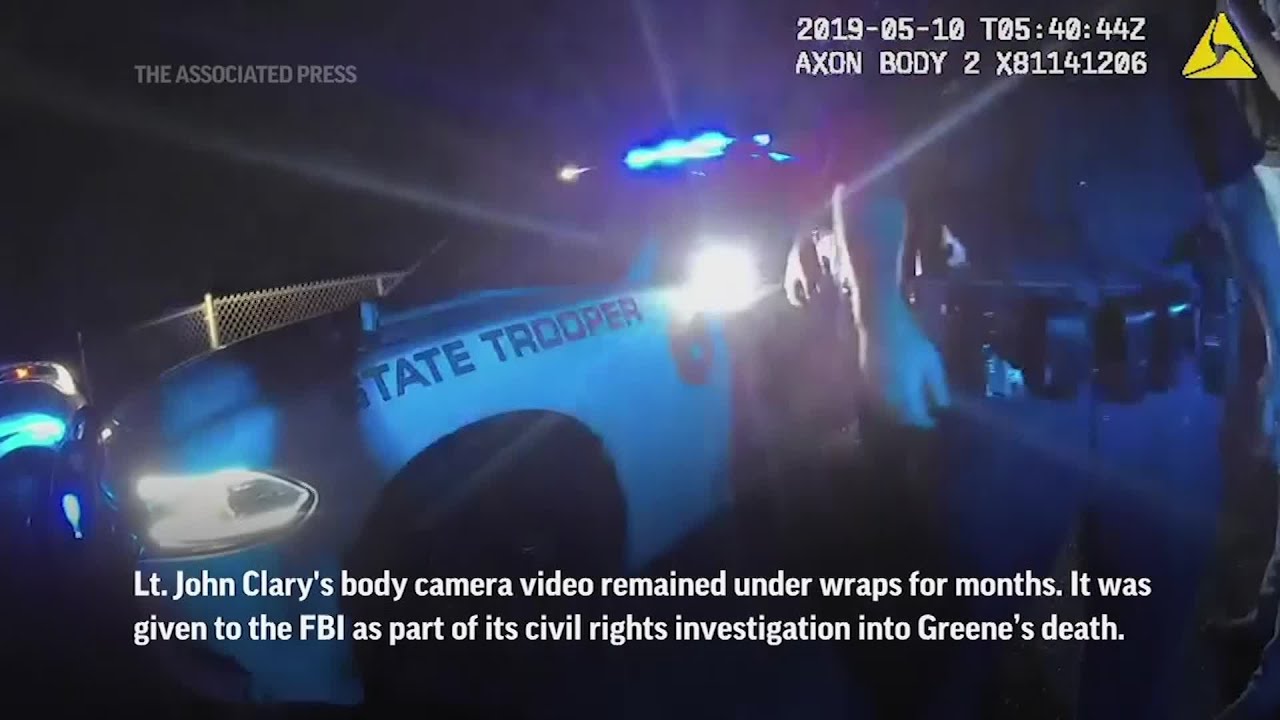
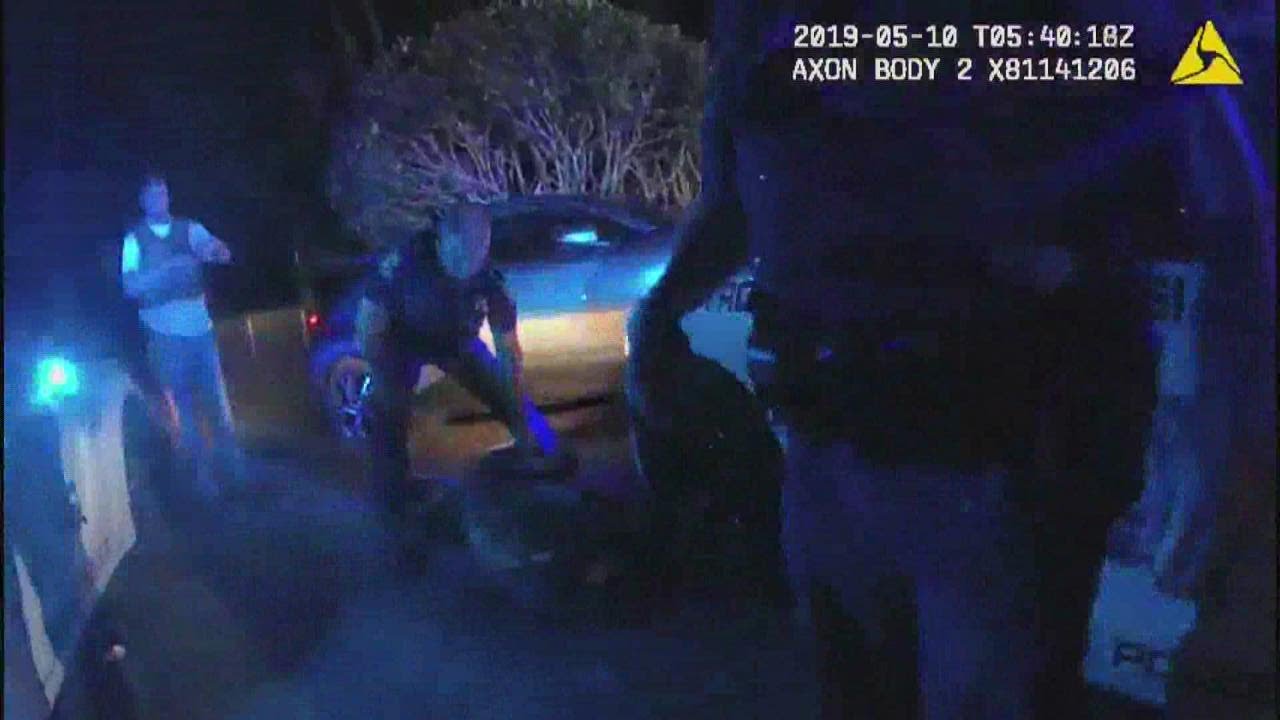
Five Louisiana cops were charged Thursday with state crimes ranging from negligent homicide to malfeasance in the deadly 2019 arrest of Ronald Greene, a death authorities initially blamed on a car crash before long-suppressed body-camera video showed white officers beating, stunning and dragging the Black motorist as he wailed, “I’m scared!” These are the first criminal charges of any kind to emerge from Greene’s bloody death on a roadside in rural northeast Louisiana, a case that got little attention until an Associated Press investigation exposed a cover-up and prompted scrutiny of top Louisiana State Police brass, a sweeping U.S. Justice Department review of the agency and a legislative inquiry looking at what Gov. John Bel Edwards knew and when he knew it. “We’re all excited for the indictments but are they actually going to pay for it?” said Greene’s mother, Mona Hardin, who for more than three years has kept the pressure on state and federal investigators and vowed not to bury the cremated remains of her “Ronnie” until she gets justice. “As happy as we are, we want something to stick.”
Ronald Greene
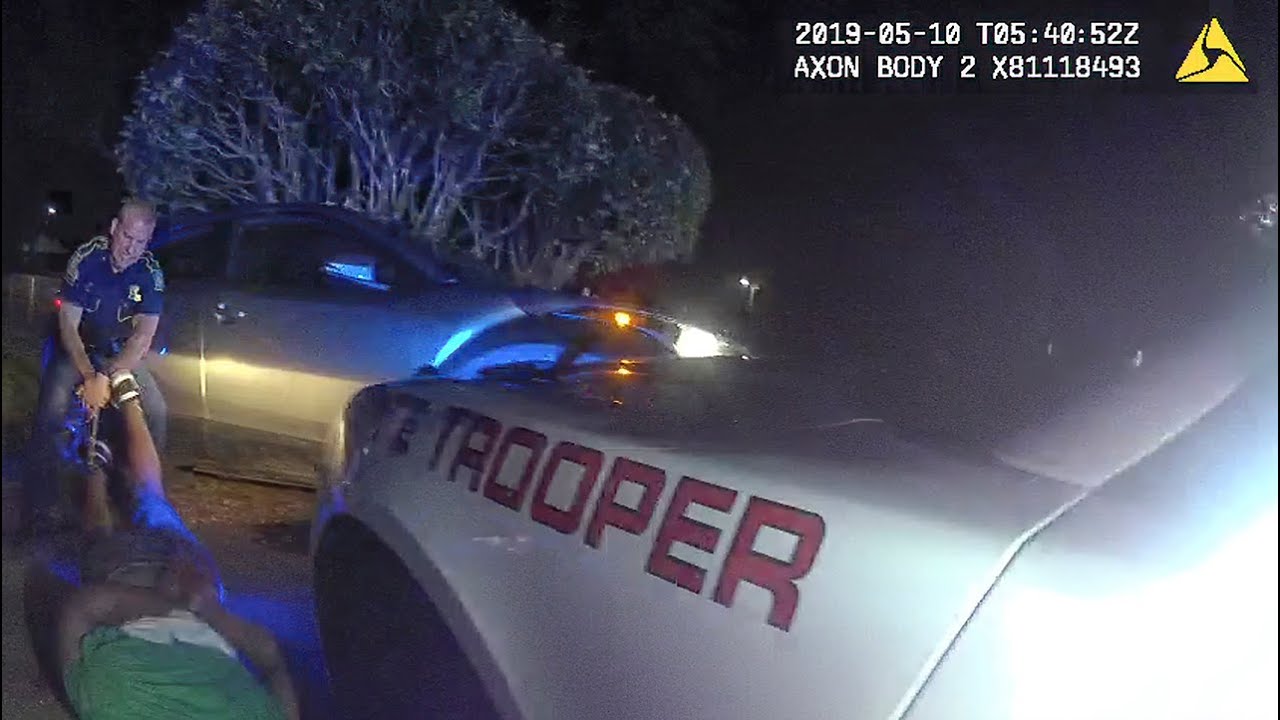
Facing the most serious charges from a state grand jury was Master Trooper Kory York, who was seen on the body-camera footage dragging Greene by his ankle shackles, putting his foot on his back to force him down, and leaving the heavyset man face down in the dirt for more than nine minutes. Use-of-force experts say these actions could have dangerously restricted Greene’s breathing, and the state police’s own force instructor called the troopers’ actions “torture and murder.” York was charged with negligent homicide and ten counts of malfeasance in office. The others who faced various counts of malfeasance and obstruction included a trooper who denied the existence of his body-camera footage, another who exaggerated Greene’s resistance on the scene, a regional state police commander who detectives say pressured them not to make an arrest in the case and a Union Parish sheriff’s deputy heard on the video taunting Greene with the words “s — - hurts, doesn’t it?” “These actions are inexcusable and have no place in professional public safety services,” the head of the state police, Col. Lamar Davis, said after the indictments, adding that his agency has in recent years made improvements aimed at “rebuilding trust within the communities we serve.” Union Parish District Attorney John Belton submitted arrest warrants for all five cops, praising the racially mixed grand jury for hearing the evidence and saying the people had spoken.
Belton had long held off on pursuing state charges at the request of the U.S. Justice Department, which is conducting a separate criminal investigation. But as years passed and federal prosecutors grew increasingly skeptical they could prove the officers acted “willfully” — a key component of the civil rights charges they’ve been considering — they gave Belton the go-ahead this spring to convene a state grand jury. That panel since last month considered detailed evidence and testimony related to the troopers’ use of force and their decision to leave the handcuffed Greene prone for several minutes before rendering aid. And for the first time in the case, a medical expert deemed Greene’s death a homicide. The federal grand jury investigation, which expanded last year to examine whether state police brass obstructed justice to protect the troopers, remains open, and prosecutors have been tight-lipped about when the panel could make a decision on charges. Greene’s May 10, 2019, death was shrouded in secrecy from the beginning, when authorities told grieving relatives that the 49-year-old died in a car crash at the end of a high-speed chase near Monroe — an account questioned by both his family and even an emergency room doctor who noted Greene’s battered body. Still, a coroner’s report listed Greene’s cause of death as a motor vehicle accident, a state police crash report omitted any mention of troopers using force and 462 days would pass before state police began an internal probe.
All the while, the body-camera video remained so secret it was withheld from Greene’s initial autopsy and officials from Edwards on down declined repeated requests to release it, citing ongoing investigations. But then last year, the AP obtained and published the footage, which showed what really happened: Troopers swarming Greene’s car, stunning him repeatedly, punching him in the head, dragging him by the shackles and leaving him prone on the ground for more than nine minutes. At times, Greene could be heard pleading for mercy and wailing, “I’m your brother! I’m scared! I’m scared!” At one point, York orders Greene to “lay on your f — — belly like I told you to!” Union Parish Sheriff’s Deputy Christopher Harpin can be heard taunting, “Yeah, yeah, that s— hurts, doesn’t it?” Attorneys for York and Harpin said both expect to be found not guilty at trial if the charges aren’t dismissed first. Reached by phone, former Trooper Dakota DeMoss, whose body-camera captured much of the arrest, declined to comment, saying “you guys always get it wrong.” Lt. John Clary’s attorney did not respond to a request for comment in the courthouse. Former state police Capt. John Peters declined to comment. Fallout brought federal scrutiny not just to the troopers but to whether top brass obstructed justice to protect them. Investigators have focused on a meeting in which detectives say that state police commanders pressured them to hold off on arresting a trooper seen on body-camera video striking Greene in the head and later boasting, “I beat the ever-living f— out of him.” That trooper, Chris Hollingsworth, was widely seen as the most culpable of the half-dozen officers involved, but he died in a high-speed, single-vehicle crash in 2020 just hours after he was informed he would be fired over his role in Greene’s arrest.
The AP later found that Greene’s arrest was among at least a dozen cases over the past decade in which state police troopers or their bosses ignored or concealed evidence of beatings of mostly Black men, deflected blame and impeded efforts to root out misconduct. Dozens of current and former troopers said the beatings were countenanced by a culture of impunity, nepotism and, in some cases, racism. Such reports were cited by the U.S. Justice Department this year in launching a sweeping civil rights investigation into the Louisiana State Police, the first “pattern or practice” probe of a statewide law enforcement agency in more than two decades. Scrutiny has also turned to the actions of the Democratic governor, who oversees the state police. A legislative panel launched an “all-levels” investigation into the state’s handling of the Greene case this year after AP reported that Edwards had been informed within hours that the troopers arresting Greene engaged in a “violent, lengthy struggle,” yet stayed mostly silent for two years as police continued to press the car crash theory.
Another AP report found Edwards privately watched a key body-camera video of Greene’s deadly arrest six months before state prosecutors say they knew it even existed, and neither the governor, his staff nor the state police acted urgently to get the footage into the hands of those with the power to bring charges. Edwards has repeatedly said he did nothing to influence or hinder the Greene investigation and has described the troopers’ actions as both criminal and racist. But he has yet to testify before the legislative panel, saying he was unable to appear at a hearing last month, instead attending a groundbreaking ceremony for an infrastructure project. “Today’s decision is a long overdue first step toward justice for Ronald Greene’s family and accountability for a broken police system,” said Alanah Odoms, executive director of the ACLU of Louisiana. “Ronald Greene should be alive today.”
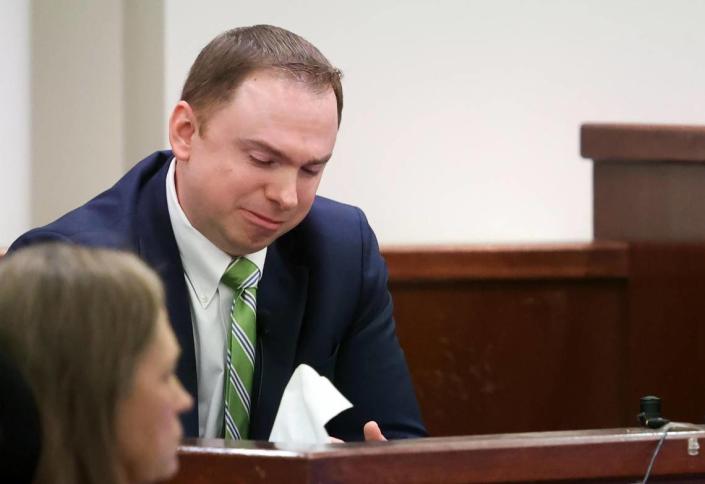
As the murder trial of former Fort Worth police officer Aaron Dean entered its fourth day Monday, Dean took the witness stand to testify in his defense and faced tough questions from the prosecution. Monday morning was Dean’s first time to speak publicly about the case. “Because this jury needs to hear from me and hear the truth,” Dean said at the start of his testimony. Dean recounted the early morning hours of Oct. 12, 2019, and the call that took him to the home on East Allen Avenue where he shot Atatiana Jefferson, a 28-year-old Black woman, through her bedroom window around 2:30 a.m. Dean and another officer, Carol Darch, were responding to a neighbor’s call about open doors at the house It was dark on the street, Dean said. He and Darch went to the wrong house first and had to go back to one of the police cars and get the correct address. Dean said they could see the front door of the house was open, though the glass storm door was closed. He doesn’t remember hearing anything and said he didn’t see signs of forced entry. According to Dean, cupboards and drawers were open and items were “just strewn about inside” the house. It looked to him like someone had gone through the house looking for valuables, he testified. https://mikebeckles.com/fort-worth-police-officer-aaron-dean-resigns-after-fatally-shooting-atatiana-jefferson-in-her-home-could-face-charges/
Dean said he was thinking “that we had a possible burglary at that time.” While looking inside, Dean switched on his body camera. Darch wasn’t wearing a bodycam. She said when she testified Tuesday, on the second day of the trial, that she had reported her camera missing and was waiting for a new one to be issued. When they got around to the side door, Dean testified, there was a screwdriver near the base of the door, which he thought could have been used in a burglary attempt, and lawn equipment on the ground. He said what he saw there reinforced the officers’ mistaken perception that they were dealing with a burglary in progress. When they entered the back yard, Dean said, he went to check the bedroom window. The screen looked intact. He said he looked down to check for pry marks. “As I looked through that window,” Dean said, “low in the window I saw a person.” Dean said he just saw a torso and “the upper arms were moving” like someone was reaching for something. Dean couldn’t tell if it was a man or a woman or what race the person was, he testified.
A photograph of Atatiana Jefferson, taken by family in 2018, was submitted as evidence during her sister Ashley Carr’s testimony on Wednesday, December 7, 2022, in Fort Worth.
“I thought we had a burglar, so I stepped back, straightened up and drew my weapon and then pointed it towards the figure,” Dean said. “I couldn’t see that person’s hands.” Dean, who did not identify himself as a police officer, shouted, “Put your hands up! Show me your hands!” “I needed to see that person’s hands because the hands carry weapons, the hands are the threat to us,” Dean testified. “As I started to get that second phrase out, ‘Show me your hands,’ I saw the silhouette … I was looking right down the barrel of a gun,” Dean said. “When I saw the barrel of that gun pointed at me, I fired a single shot from my duty weapon.” The light mounted on his gun shone in his face when the gun recoiled, Dean said, but when his vision cleared he saw a person. Dean said he saw Jefferson fall and heard her scream. “I knew that I had shot that person,” Dean said, his voice breaking. Read the full story here; https://news.yahoo.com/good-police-prosecution-hammers-aaron-230643217.html
Almost daily, a Black person is murdered by police in the United States. This statement may sound hyperbolic, but it is not, and it is factual. Usually, the victim is unarmed and was stopped or approached by police over something as inconsequential as a loud exhaust, alleged dark tint on an automobile, a supposedly broken taillight, or something so minor that it makes absolutely no sense. A usual outcome is a dead man or woman over something no greater than an infraction. An infraction dredged up by local politicians to extort money from the poor residents they are supposed to serve. The outrageous nature of this illicit scheme is that the police target certain motorists based on their color. They then initiate a traffic stop, and while we are on the subject of traffic stops, it seems that American police officers get a certain type of high from messing with people just driving down the road. I never quite understood the almost insane desire they have to stop and harass motorists. The police initiate a traffic stop on concocted violations; they then harass the motorists with questions about where they are going, where they are coming from, if they have weapons in their vehicle, how long they lived in town, where they have lived before, demand their social security and telephone numbers, all of which they have no right to. The motorists get agitated by the false stop and questioning and are then accused of not cooperating with the illegal inquisition. They are ordered out of their vehicle, handcuffed, and a canine is called to the scene under the pretext that the motorist is uncooperative and combative. The dog hits on the vehicle because it expects a treat, so the victim’s vehicle is illegally searched, which is an end run around the victim’s fourth amendment right to be secure in his possessions and person. Suppose they find no drugs or choose not to plant any. In that case, the victim is usually arrested anyway and charged with several dredged-up offenses, usually Felony obstruction and resisting arrest. The case is then prosecuted by prosecutors just as morally bankrupt as the badged bandits. The really horrible part is that if you thought a judge would see through the lies and injustice, you are sadly mistaken. The misconduct and lies of police and prosecutors are all par for the course. The case result is usually decided before the defendant enters the courtroom. Cop, prosecutor, and judge all feed from the same slop trough. Below is one such outcome. A cop kills an innocent unarmed person of color. The people protest, and the police investigate themselves and find that the officer acted appropriately. The cop is sent on paid leave during the fake investigation, after which they are promoted, and life continues. The government has calculated that it is far more important to subjugate the citizinery than to worry about police violence, and so it continues.
Derrick Kittling was fatally shot during a traffic stop with a white Rapides Parish cop.
Here is one such example. By Phillip Jackson
Louisiana State Police released body camera footage showing a Rapides Parish sheriff’s deputy fatally shooting an unarmed Black man in the head during a traffic stop. The Nov. 6 incident sparked outrage in the predominantly Black city of Alexandria.
In the video, Derrick Kittling, 45, is seen being stopped by Deputy Rodney Anderson in Alexandria, in central Louisiana, while driving a Chevrolet Silverado pickup during the day in a residential neighborhood.
In the body-cam footage, when Kittling steps outside of his vehicle, the deputy tells him to “stay right there” but also says to walk toward his truck, which Kittling was standing beside after getting out of the driver’s seat.
Anderson is never heard saying why Kittling is being stopped. When Kittling asks why he is being stopped, Anderson does not answer.
Anderson then tells Kittling to “walk over here,” but Kittling appears to be confused.
“Walk to your truck,” the deputy says while Kittling is standing by the truck’s door and the deputy remains in his car.
Anderson then steps out of the patrol car and asks Kittling to keep his hands out of his pockets. Kittling then walks to the back of his pickup truck, as directed. Anderson grabs Kittling’s left arm.
“What’s the issue?” Kittling asks Anderson.
Anderson says Kittling isn’t following his orders and tells him to turn and face the truck. Kittling asks the deputy if he can get his phone, but the deputy responds “We will get to that” and stops him from getting his phone.
Kittling appears to remain confused during the entire encounter.
“What I did? What is wrong with you? While are you grabbing on me, man? Why are you grabbing on me, bruh?” Kittling asks Anderson.
“It’s tragic with what happened to Derrick, but unfortunately it is more than likely to happen again.”
- Rev. Randy Harris, Mt. Triumph Baptist Church in Alexandria
The deputy tells Kittling to put his hands behind his back several times, but Kittling, still confused, asks Anderson, “For what?”
At this point, just about 4 minutes and 30 seconds into the interaction — a struggle begins.
The sheriff’s office said that Anderson “lost control” of the Taser and that Kittling retrieved it while it was on the ground during the struggle.
In the video, the deputy can be seen pulling out the stun gun and firing at Kittling. Kittling appears to try to block the Taser before the two end up struggling on the ground. Kittling appears to grab the taser while it is on the ground. It is unclear if Kittling ever points the taser toward Anderson.
The officer is seen fighting with Kittling from various angles. The struggle lasts about one minute, then the deputy fires a shot.
“Shots fired, shots fired,” Anderson says.
From the deputy’s dashboard camera, he is seen carrying the gun and looking at Kittling while he is on the ground.
Anderson then makes a call toward other officers and tells them he shot Kittling in the head.
Col. Lamar Davis, head of the Louisiana State Police, told local media during the press conference that Kittling was stopped for a window tint violation and having a modified exhaust.
When asked by reporters on Sunday, Louisiana State Police did not indicate whether Anderson violated department policy.
“We are also gathering that information with regards to their protocols, their policies, their training and so forth. And we will be able to better determine that information once we receive that,” Davis said at the press conference.
Davis also said the agency had not determined whether Kittling was tased. Davis also would not say if the taser ever struck Anderson during the struggle.
“We can’t say for certain that he was actually tased or whether the officer was tased. There is a lot that goes into researching this.”
Kittling’s family has retained civil rights attorney Benjamin Crump to represent them.
“That sheriff’s department under the current Sheriff Mark Woods has a plethora of problems when it deals with African Americans,” Rev. Randy Harris, an organizer and protester in Alexandria, told HuffPost. “It’s tragic with what happened to Derrick, but unfortunately it is more than likely to happen again. I have zero faith in the sheriff’s department.”
White women have been an integral part of the genocide and abuse of Black people from the start. Today white women continue to be equal partners in the continuation of racist practices and the campaign to continue the practice of white supremacy in America.
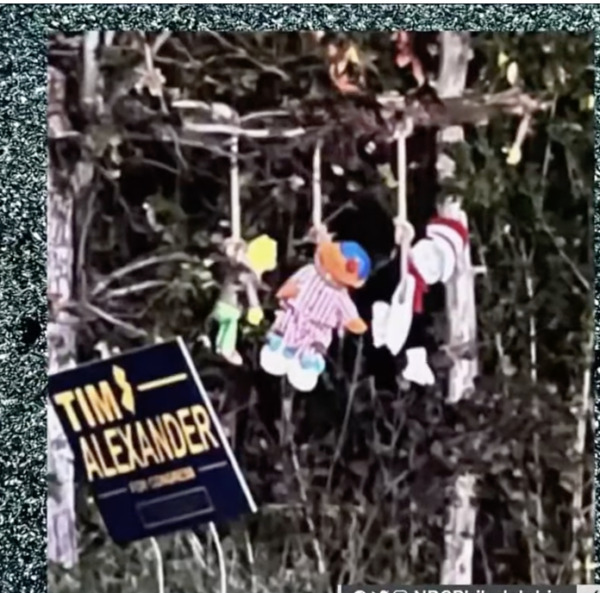
New Jersey authorities are looking for a woman who was caught on video hanging nooses next to a campaign sign supporting a Black political candidate. The Middle Township Police Department said it received a report about three stuffed animals hanging from ropes above a sign supporting congressional candidate Tim Alexander on election day. Later, they found video footage of a white woman with blond hair hanging the stuffed animals from a tree.
A woman is accused of hanging stuffed animals above a campaign sign for former New Jersey Democratic candidate for Congress Tim Alexander. (Photo: YouTube/NBC 10)
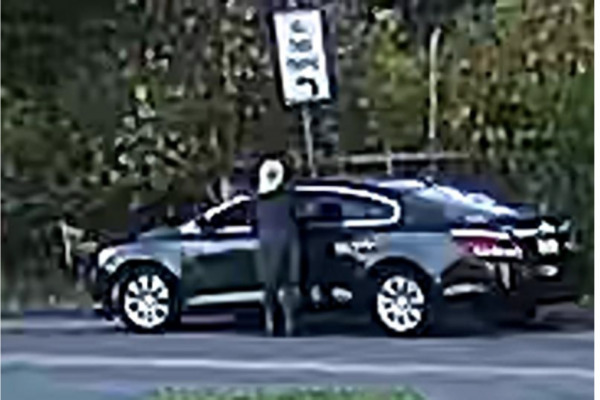
The police department and the county prosecutor have launched a hate crime investigation into the incident. Alexander, who lost his challenge against incumbent U.S. Rep. Jeff Van Drew on Tuesday, said he is “disgusted” by the display. “It was sickening. It really was. It was really disgusting,” Alexander told NBC10. “It really spoke to what I have been talking about on the campaign trail, and that is that we have too much division. We have too much tribalism. We have this sense of us against them.” Authorities have released stills of the video footage and are asking anyone with information to come forward. The woman was driving a dark-colored Buick with chrome trim and tinted windows. She parked in the area where the stuffed animals were hung.
A still from video footage shows a white woman with blond hair exiting a late-model dark-colored sedan and hanging stuffed animals from a tree. (Photo: Cape May County Prosecutor’s Office)
Nearly 11 percent of Middle Township’s 20,716 residents are Black, U.S. Census data shows. Alexander told ABC 7 that community leaders should be responsible for extreme instances of hate. His opponent and other political leaders have condemned the woman’s actions. “The incident that took place is completely unacceptable behavior. There is no place for hate in our country, especially in South Jersey,” Drew told ABC 7. “I do want accountability, and quite honestly, at some point, I just want the person to stand up in court, under oath, and say I did this, and this is why I did it.” Middle Township Mayor Tim Donohue also took to Facebook to denounce the display. “This is not who we are in Middle Township. We stand united against all forms of racism, hate, threats, and intimidation,” he wrote. “If this investigation proves charges are warranted, the perpetrator(s) will be prosecuted to the fullest extent of the law.” Alexander said the woman could have spoken to him in person if she had an issue instead of resorting to the racist display. “You could’ve easily come up to me and said, ‘Here are my concerns,’ ” he said. “But instead, you wanted to send out this hateful, historically hateful, historically intimidating statement by doing these actions.” This story first appeared in the (Atlantablackstar)
“This shameless act of cowardice and hate is designed to get attention and divide us. Our priority is protecting the health and safety of our workforce,” reads a statement from Barack Obama’s foundation.
The firm building the Obama Presidential Center suspended operations Thursday after a noose was found at the site, and it offered a $100,000 reward to help find who was responsible. Lakeside Alliance, a partnership of Black-owned construction firms, said it reported the incident to police and “will provide any assistance required to identify those responsible.
“We have zero tolerance for any form of bias or hate on our worksite. Anti-bias training is included in our onboarding process and reiterated during site-wide meetings. We are suspending all operations onsite in order to provide another series of these trainings and conversations for all staff and workers,” the firm said.
“This shameless act of cowardice and hate is designed to get attention and divide us. Our priority is protecting the health and safety of our workforce,” the statement said. The Chicago Police Department is aware of the noose and the matter is under investigation, said Sgt. Rocco Alioto, a department spokesman. An alliance spokeswoman, Lara Cooper, said she could not comment on whether it suspects a worker at the site and how the pause will affect the work
City work to prepare for construction began in spring 2021 with the an official groundbreaking the following September. The foundation has said the center is slated to open in 2025. Organizers expect it to attract about 750,000 visitors a year.
It will sit on 19 acres (7.7 hectares) of the 540-acre (291-hectare) of Jackson Park, named for the nation’s seventh president, Andrew Jackson. Significantly, it will be located near the Obama family home and where the former president started his political career on the city’s South Side.The city will own the center under the terms of a 2018 ordinance approved by the Chicago City Council.
The initial cost was projected at $500 million, but documents released by the Obama Foundation last summer showed the cost had climbed to roughly $830 million. Funds are being raised through private donations.(AP)
It is immoral, dangerous, and highly destructive to our democracy for any advertiser to fund a platform that fuels hate speech, election denialism, and conspiracy theories. Until actions are taken to make this a safe space, we call on companies to pause all advertising on Twitter.
On Friday, the NAACP joined other civil rights groups in calling for an advertiser boycott of the platform. “It is immoral, dangerous, and highly destructive to our democracy for any advertiser to fund a platform that fuels hate speech, election denialism, and conspiracy theories,” NAACP President Derrick Johnson said in a statement.
In the week since Musk has taken over ownership of Twitter, hate speech has escalated exponentially. Musk has insisted that nothing has changed structurally, but that may not be totally true, as he has long argued that Twitter was suppressing free speech.…..The free speech he alluded to included the increased hate speech on Twitter.
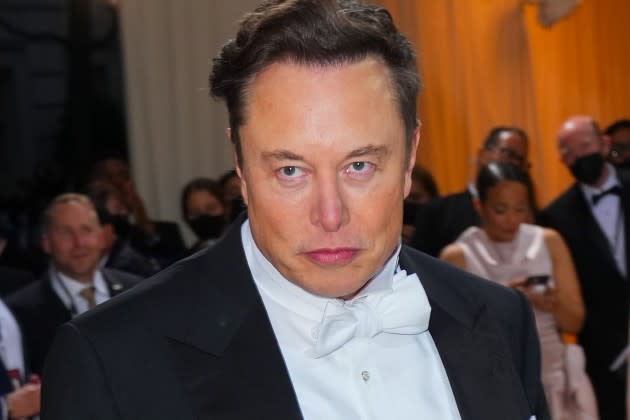
Elon Musk
Musk, the Trump wannabe, is pissed-scared that many major companies have paused ads in recent days, including GM, Audi, Pfizer, General Mills, Volkswagen, and other big names who are wary of potential changes to Twitter’s policies as well as the departure of top executives. Industry groups have also expressed concern about brand safety under Musk, and The New York Times reported this week that “IPG, one of the world’s largest advertising companies, issued a recommendation … for clients to pause their spending on Twitter temporarily.”
I feel a sense of relief that I deleted my inconsequential account on his platform. In the grand scheme of things, my account was like a single drop of water, but little drops make puddles, puddles make bodies of water, and you know the rest.
.
.
.
Mike Beckles is a former Police Detective, businessman, freelance writer, black achiever honoree, and creator of the blog mikebeckles.com.
Tiffany Cross announced Friday that MSNBC canceled her Saturday morning news program after a less than two-year run. The move came after Cross had become a target of attacks from Fox News and pundit Tucker Carlson, Huffington Post reported.
In late October, Carlson aired a segment about Cross that swiftly received criticism from the Anti-Defamation League (ADL). The Fox host told his audience that Cross was fomenting a “race war” against white people. Carlson likened “The Cross Connection with Tiffany Cross” and MSNBC to the Rwandan media outlet Radio Television Libre des Mille Collines, which stoked the 1994 Rwandan genocide.
Tiffany Cross…
Interestingly, MSNBC would bow to the vitriolic slander of a putrid race-baiting demagogue who has spent his entire career spreading lies and fomenting white resentment and grievance. MSNBC President Rashida Jones was “deeply involved” in the call to cut ties with Cross, according to The Washington Post, which said the network allowed the host’s contract to lapse. A rotating cast of hosts will fill Cross’ time slot until a more permanent solution is found, the Post reported.
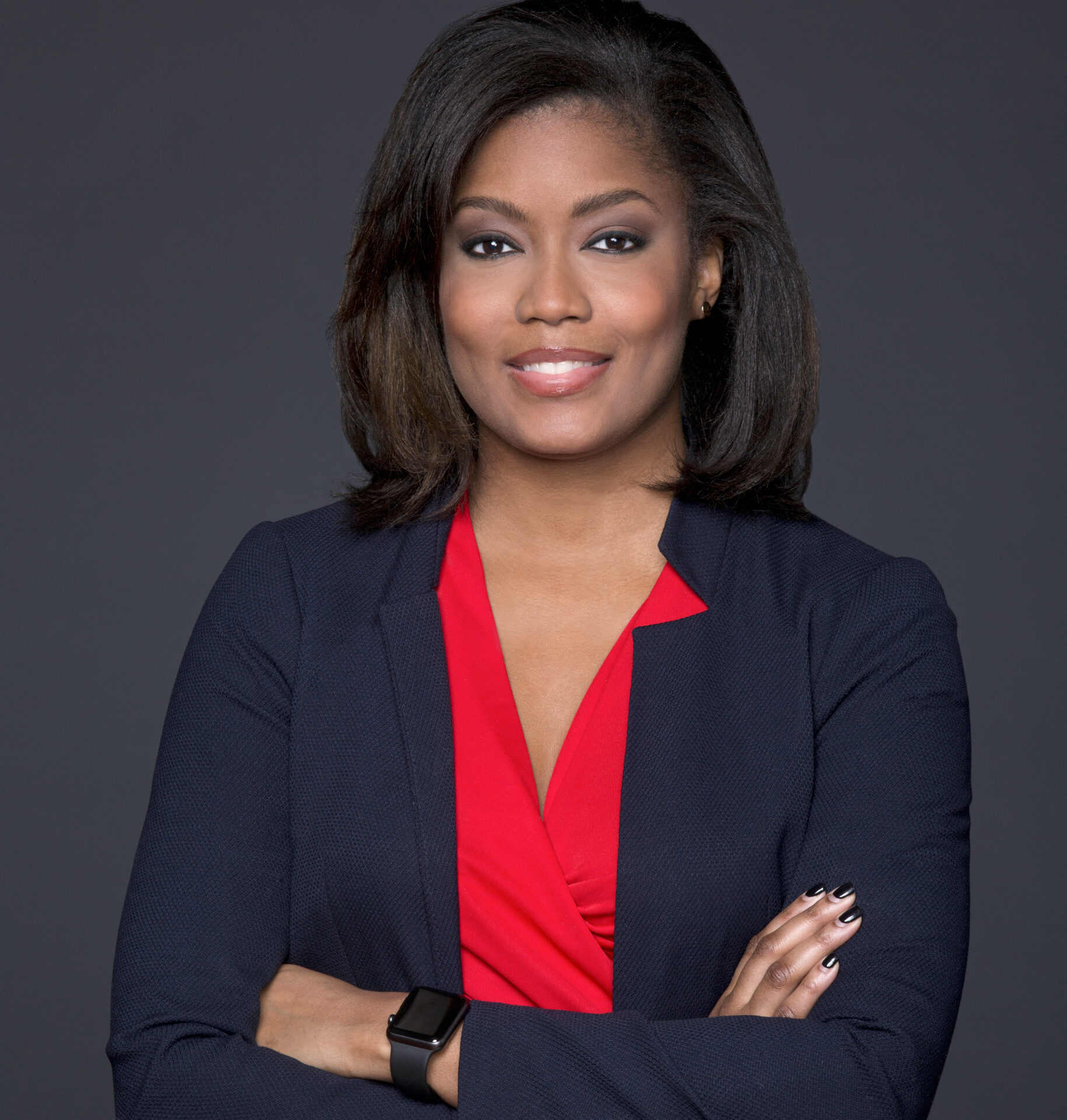
Rashida Jones
Tiffany cross’ firing was immediate and swift after she told a gathering that the state of Florida was the dick of the country. Cross, whose show aired on weekends, had been with the network for two years but, in recent weeks, had reportedly clashed with management over segments on her show. Ratings performance — the most common cause of death for television shows — was not a factor in MSNBC’s decision to pull the plug on The Cross Connection, which aired Saturdays from 10 a.m. to 12 p.m. ET.
Appearing on Comedy Central’s Hell of a Week with Charlemagne, Cross was asked which state Democrats could afford to lose in the upcoming mid-term elections. “Florida literally looks like the d — k of the country, so let’s get rid of Florida,” Cross said. “Let’s castrate Florida.” In the same appearance, Cross said that it was impossible to separate the Republican Party from “right-wing extremists,” saying they had “merged right now”: Huh.… where is the lie? The Republican party is a white supremacist, Insurrectionist fascist movement. Florida is a state filled with old retired and new up-and-coming racists, so what did she say that was a lie? As they say in street vernacular, ‘it be your own people’. It appears Rashida Jones was more concerned about protecting her own job than standing up for Tiffany Cross when she needed to.
Ms. Cross tweeted the following after her abrupt firing»>
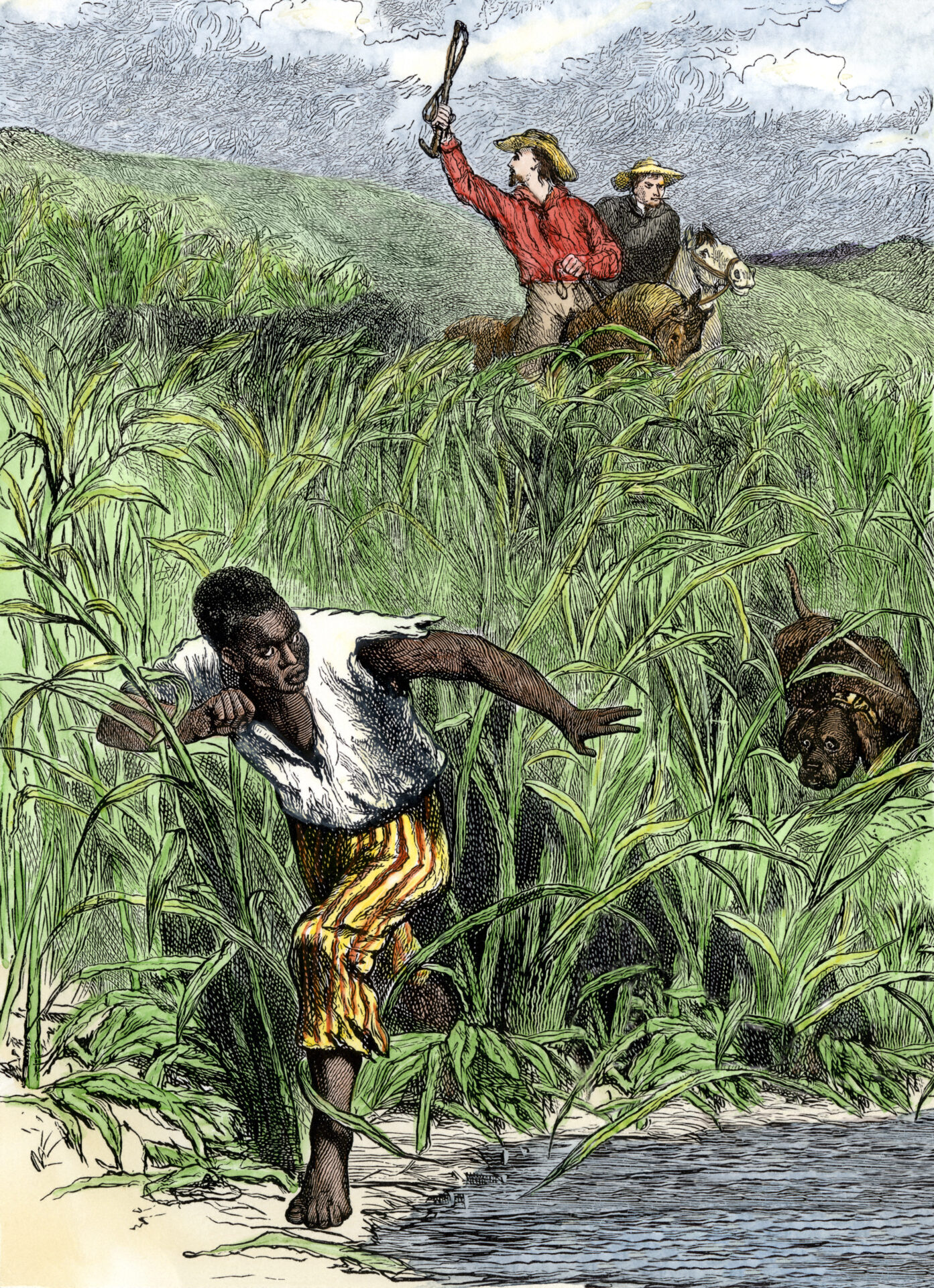
During the summer of 2020, after murderous police lynched George Floyd in the light of day in Minneapolis, Minnesota, there was a mass uprising of American citizens against what they had previously refused to acknowledge; blatant police murder of African-Americans. In the white house as president was Donald Trump, an ignorant and vile racist in the vein of Andrew Johnson, Woodrow Wilson, and a long line of racists to occupy the office of president. Trump, angry that Black people dared to demand equal rights under the laws, warned that “vicious Dogs” would be unleashed on protestors who dared to protest against police violence and murder.
An escaped person trying to elude slave hunters and their dogs. Hand-colored woodcut of a 19th-century illustration. (North Wind Picture Archives via AP Images)
(13 Amendment to the constitution Sections 1 & 2.) Neither slavery nor involuntary servitude, except as a punishment for a crime whereof the party shall have been duly convicted, shall exist within the United States or any place subject to their jurisdiction. Congress shall have the power to enforce this article by appropriate legislation.
After the 13th amendment was ratified, abolishing slavery as it was, slavery by other means rapidly came into effect because of the clause,” except as a punishment for a crime, which was a deliberate inclusion that created another form of slavery albeit by another name. As a result of that wiggle room, African Americans would be tormented through peonage practices, Jim Crow, and other forms of institutionalized Government oppression for over 80 years culminating in the civil disobedience movements that characterized the 1960s. Though significant, the Civil Rights gains of the 1960s did not change many of the structural built-ins that remain a part of the American legal orthodoxy. African people are convinced that they are free citizens of the United States. Still, the 13th amendment, which supposedly ended slavery, is the amendment that memorialized slavery of another kind, in the words “except as a punishment for a crime, “speaking of slavery.
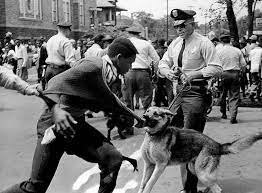
In the 60s, police used dogs as a weapon against peaceful Black demonstrators.
By definition, the very words” except as a punishment for a crime, literally incentivize the mass criminalization and incarceration of Black people, forcing them back into servitude, only by a different name. This is not a practice that came to an end; it is 2022, and police are arguably the greatest danger to black people in the United States. Pew Research noted that Blacks have long outnumbered whites in U.S. prisons, an understatement if ever there was one. But a significant decline in the number of black prisoners has steadily narrowed the gap over the past decade, according to new data from the Bureau of Justice Statistics.
Police use of dogs as instruments of terror against Black Americans has continued from slavery even as slave catching has evolved into policing.
At the end of 2017, federal and state prisons in the United States held about 475,900 inmates who were black and 436,500 who were white – a difference of 39,400, according to BJS. Ten years earlier, there were 592,900 black and 499,800 white prisoners – a difference of 93,100. (This analysis counts only inmates sentenced to more than a year.) The decline in the black-white gap between 2007 and 2017 was driven by a 20% decrease in the number of black inmates, which outpaced a 13% decrease in the number of white inmates. Notably, the number of incarcerated Blacks sentenced to a year or less in prison was not included in the data. Add the number of Blacks incarcerated for petty offenses, stealing a slice of piazza, marijuana possession or sale, inability to pay a traffic fine, inability or unwillingness to pay child support, and offenses of that nature and the data change exponentially.
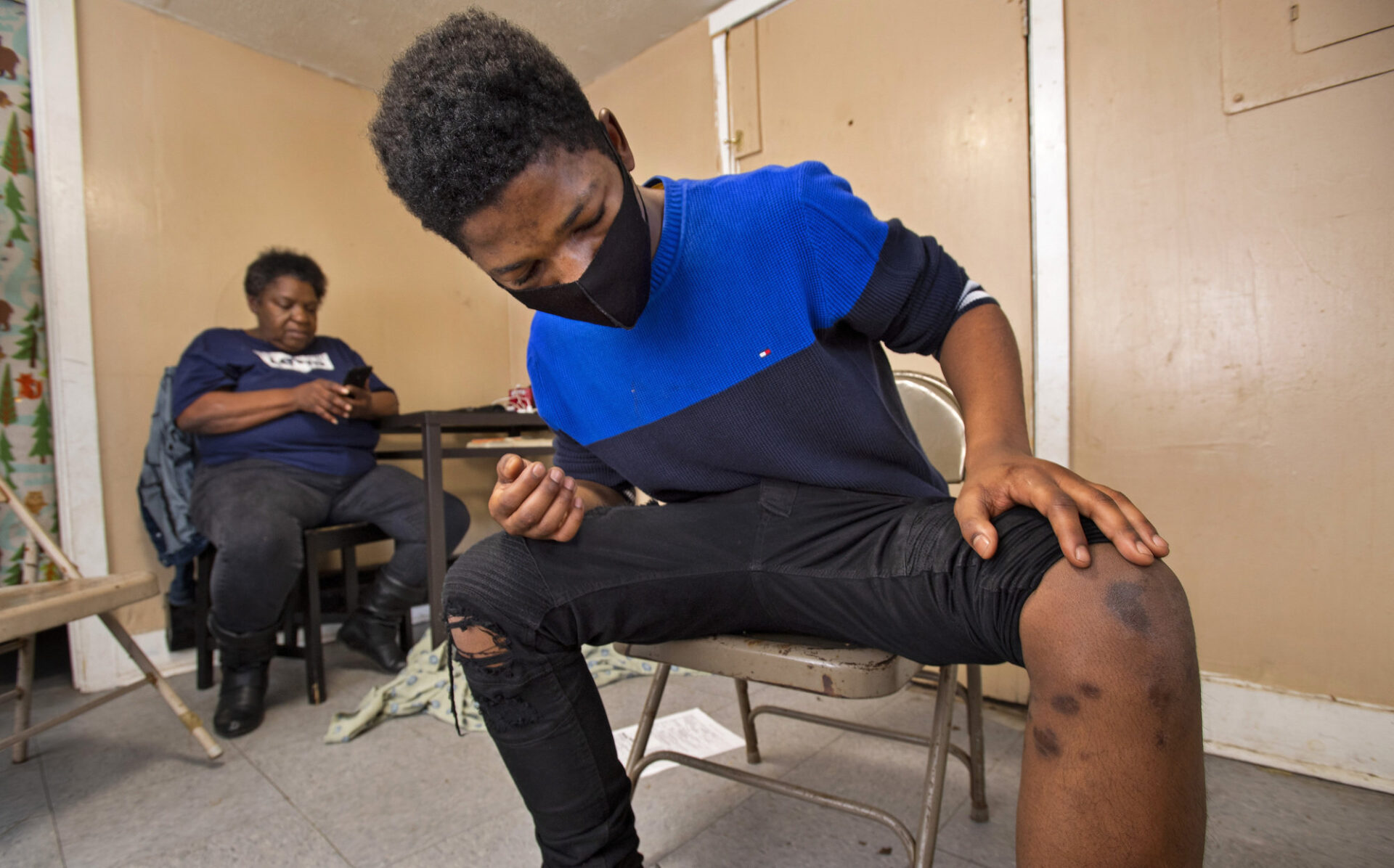
In Baton Rouge, police dogs bite a teenager 17 or younger every three weeks, on average. Charles Carey, 19, shows the scars on his leg from a 2019 Baton Rouge police dog bite. His grandmother Patricia Rogers is at left. TRAVISSPRADLING/BATON ROUGEADVOCATE
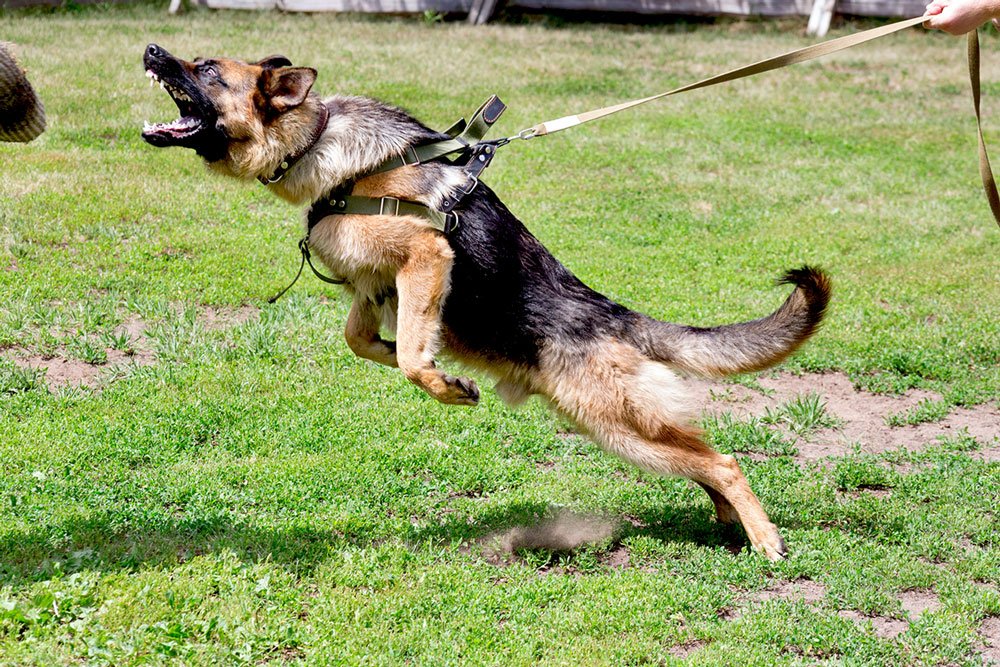
Efforts by Democrats in some states to end cash bail and have non-violent offenders who commit minor offenses be given non-custodial sentences have also played a part over the same decade in lowering the number of Blacks locked up in American prisons. The Republican party, which is now a full-fledged Fascist white supremacist party, is vehemently opposed to these fair and humane gestures by the Democrats. So too, are police and their unions that benefit from the mass incarceration of black people. In a shockingly illuminating article in 2021, the Marshal Project detailed the mind-blowing statistics behind police in Baton Rogue, Louisiana, use of dangerous canines on non-violent Black people with alarming frequency, including children as young as 12 years old. https://mikebeckles.com/cop-charged-by-the-feds-for-stomping-on-a-handcuffed-black-mans-face/ A spokesperson for the department told reporters, “Every single person that we caught was in the process of committing a felony, they were possibly armed, and they were resisting arrest,” said Capt. Wayne Martin, a longtime K‑9 officer and now commander of the Uniform Patrol Bureau. “If any of those things are absent, we don’t use the dogs.”
It goes without saying that advocates have evidence that this cop-splaining are total and utter lies; we know they lie routinely. The irony, many departments do arrest a larger number of armed and violent felons without using dogs to inflict cop punishment on them. Even more significant in America is that the police paid by the public to protect and serve do not see themselves as subject to the dictates of their bosses, the citizens. Police have become powerful overlords that lawmakers are terrified of offending, and this is the definition of a police state. For Black Americans, this is a continuation of the way things were during slavery, sure, some things have changed, but essentially, the more things change in America, the more they remain the same. https://mikebeckles.com/360374 – 2/
.
.
.
Mike Beckles is a former Police Detective, businessman, freelance writer, black achiever honoree, and creator of the blog mikebeckles.com.
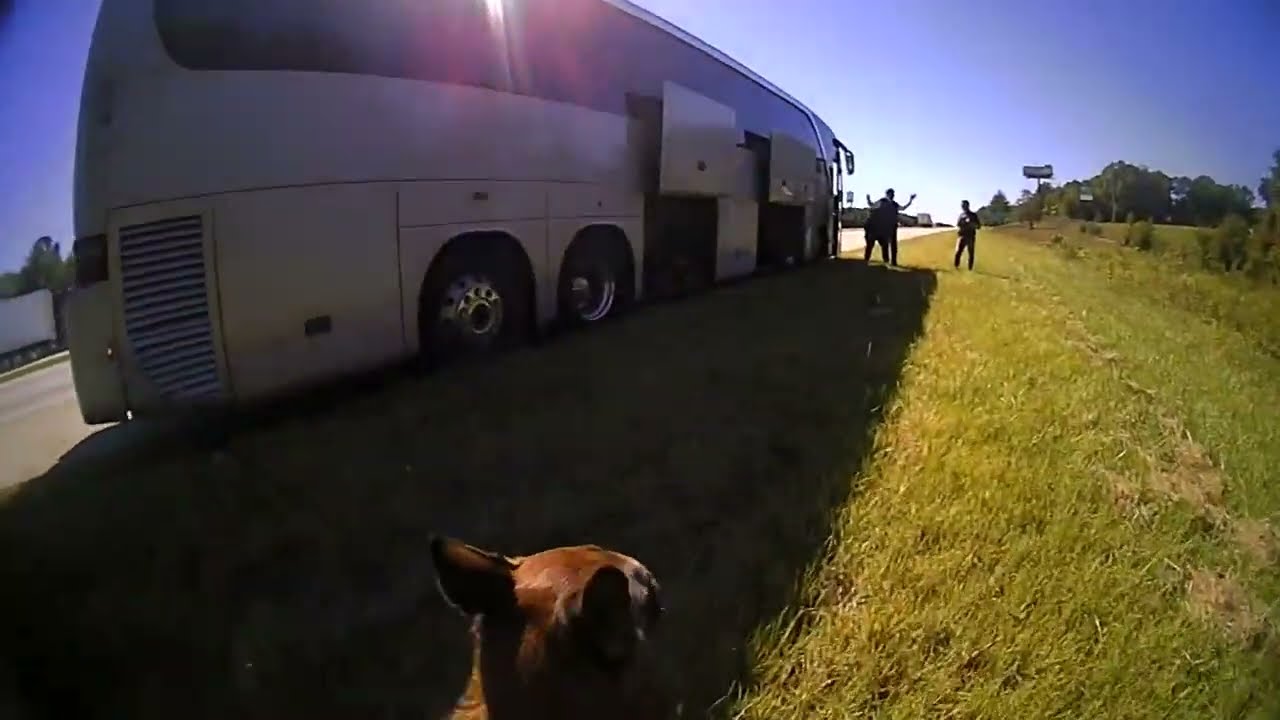
The Sheriff claimed that race played no part in the stop, which may be true, *may be* because the words of police officers in the United States are not worth the paper they are written on, thanks to the Supreme Court; they lie like old dirty rugs, without suffering any consequences. The Sheriff claims officers could not see who was in the bus as the windows were tinted. That may be true, but once they approached the bus and spoke to the driver, they surely saw that the students were Black, and they absolutely knew they were college students. Now, the Sheriff claims he hates racism and cannot practice it as his *jesus* would not allow it; please do not let me laugh until I barf.… No one should be fooled by the presence of the one black officer; they are generally there as window dressing and are not allowed to make any decisions. Worse case is that black cops are worse than white ones, I mean, look at Clarence Thomas (TOMAZZ). Is there a worse judge, jurist, or whatever they call him? He certainly isn’t anything close to justice so.… After the officers saw the students, why did they ask to search the bus? I ask you to suspend your sense of bullshit for a second and be real.…… why did they ask to search the luggage section of the bus? I ask this question as a former police officer who did actual policing, not as a race soldier doing race soldering. As an officer seeing students, I would certainly have spoken to the driver about driving safely, but I damn sure would not have asked to search the student’s belongings; they would have been on their way. It was outrageous that they ran the Dog around the student’s belongings and then rummaged through their most intimate possessions, clearly violating their four amendment rights. This practice of using canines to do end runs around the fourth amendment to the constitution is a practice that has been made possible again by the out-of-control right-wing supreme court. Experts warn that Dogs are wrong up to 70% of the time that they signal a hit, and in any case, they signal a hit because they expect to receive a treat from their handlers. In the meantime, the fourth amendment to the constitution is out the door, and citizens are subject to the Gestapo tactics like we see in Spartanburg county South Carolina. In the end, they found nothing and issued a warning to the driver, so the Sheriff’s response was that the students and the University should have no problem with the stop. The driver had no authority to give police permission to search property that did not belong to him; that is the first order of business. The President of Shaw University, Dr. Paulette Dillard, wrote about how outrageous the stop was and that it was reminiscent of earlier times in the United States when this was the practice of police. The Sheriff argued he wishes racism would die the ugly death it deserves; what the sheriff does not acknowledge is that it is his people, white people, who created it, and it is up to white people to end it. Once the officers saw that it was a busload of students, they [should] have cited the driver, whichever way they chose to, and ended the stop there. Regardless of what police do, no matter how outrageous, there is a segment of the American population that supports it; we are not speaking to those deplorables; we know who they are. (mb)
»»>
A South Carolina sheriff said a historically Black university president’s statement accusing law enforcement officers of racial profiling in a recent bus stop was “just false.”
Shaw University President Paulette Dillard wrote she was “outraged” after law enforcement officers in Spartanburg County on Oct. 5 stopped a contract bus transporting students from the historically Black university in Raleigh, North Carolina to a conference in Atlanta.
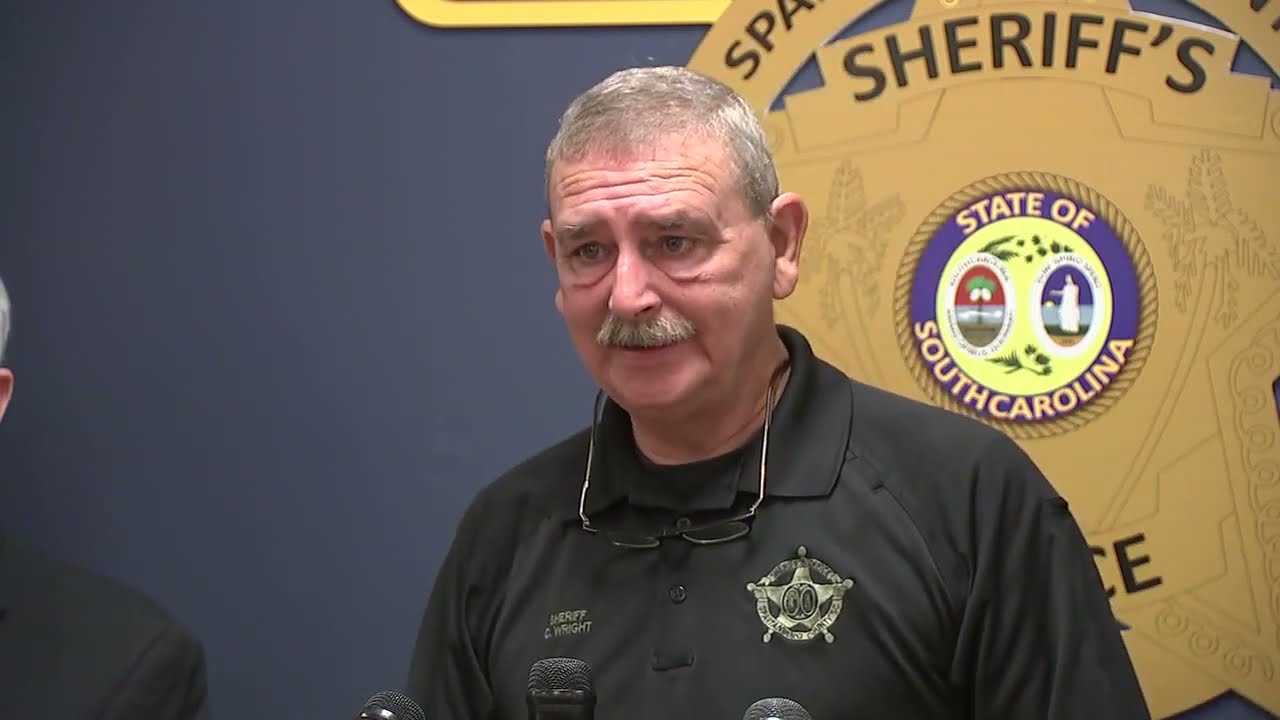
Spartanburg County Sheriff Chuck Wright emphasized at a Monday morning press conference that police officers stopped the unmarked, “Greyhound-like bus” with tinted windows because it had been swerving. The stop occurred as part of “Operation Rolling Thunder,” the department’s annual weeklong anti-drug campaign in which deputies and officers with agencies from around the state patrol the county’s highways.
Democratic members of North Carolina’s congressional delegation last week asked the Justice Department to investigate the incident.
Dillard wrote that the scene was reminiscent of the 1950s and ’60s: “armed police, interrogating innocent Black students, conducting searches without probable cause, and blood-thirsty dogs.”
“This behavior of targeting Black students is unacceptable and will not be ignored nor tolerated,” Dillard wrote. “Had the students been White, I doubt this detention and search would have occurred.”
Wright said that a student helped the driver answer officers’ questions and that none of the students were asked to leave the bus. A leashed dog “ran through the baggage,” turning up nothing illegal, according to Wright. Police body camera footage show officers searching several bags in the bus’ underbelly storage. The driver received a warning.
“I wish racism would die the ugly, cruel death it deserves,” Wright said. “If anything we’re ever doing is racist, I want to know it, I want to fix it and I want to never let it happen again. But this case right here has absolutely nothing to do with racism.”
Cherokee County Sheriff Steve Mueller said the officers “didn’t do anything wrong” and could not have known the races of the people inside the bus when they pulled it over.
Mueller added that the leading cause of death in buses and commercial vehicles is driver fatigue. Interstate 85, the highway where officers stopped the bus, is a “deadly corridor,” according to Mueller.
“If my guys see a bus weaving in their lane, and they fail to stop it to check that driver to make sure they’re not too sleepy, then we could have a busload of Shaw students that was involved in a tragic traffic fatality,” Mueller said.
Body camera footage did not show any Shaw University insignia on the contract bus, which had the words “CHAUFFEREDTRANSPORTATION” printed on its side. The Shaw University Communications Office did not immediately respond to an email seeking comment.
The traffic stop comes after an April incident in Georgia, where sheriff’s deputies pulled over the Delaware State University women’s lacrosse team bus and searched it for drugs. Tony Allen, the president of the HBCU, said he was “incensed” and accused the law enforcement officers of intimidation and humiliation.
Liberty County Sheriff William Bowman, who is Black, said in May that deputies had found drugs on a different bus that same morning. The team’s chartered bus was stopped because it was traveling in the left lane, a violation of Georgia law, according to Bowman, who said deputies searched the bus after a drug-sniffing dog “alerted” alongside it. No one was arrested or charged and the driver received a warning.
Former Michigan cop will face murder trial in the killing of Black motorist Patrick Lyoya.
A judge said that Christopher Schurr, a former Michigan cop who shot a Black motorist Patrick Lyoya in the back of the head, will stand trial for second-degree murder. The deadly confrontation began after mister Lyoya tried to flee from a traffic stop.
Patrick Lyoya, 26, was killed outside a house in Grand Rapids, Michigan. The white officer repeatedly ordered Lyoya to “let go” of his Taser, at one point demanding: “Drop the Taser!” https://www.gofundme.com/f/help-the-lyoya-family-raise-money-for-the-funeral
Patrick Lyoya, a 26-year-old Black man from Grand Rapids, Michigan was shot in the back of the head by Christopher Schurr a cop with whom he struggled, as he had Lyoya face down in the mud.
Time and again in this medium, I have made the point that American policing, or the concept of something known as policing, came from or (evolved) from evolved slave catching. I wanted to use the term evolve but *came from* works better as the very point of this short essay is that it [has not] evolved. Over the last several years, looking at the American body politic, I have ventured to opine to some friends and family members that it would not be too difficult if African-Americans lose focus to find themselves back on plantations as enslaved people. I have been chastised by some who argue that could never happen as this generation would never stand for it. Today, I am here to admit that I was wrong. My statement that Blacks could find themselves back on plantations was completely incorrect because, according to the 13th Amendment to the Constitution, the ignoble practice of slavery has not been entirely abolished. Now, if you are wondering if I just came upon the wording of the 13th Amendment to the constitution, I want to set the record straight and clarify a few points.
THEN…
Thirteenth Amendment
Section 1 Neither slavery nor involuntary servitude, except as a punishment for crime whereof the party shall have been duly convicted, shall exist within the United States or any place subject to their jurisdiction. Section 2 Congress shall have the power to enforce this article by appropriate legislation. »»»»»»»»»»»»»»>
After the so-called abolition of slavery on December 6th, 1865, literally every state immediately began the process of creating another form of slavery. Remember that the 13th amendment to the constitution was written by men, many of whom believed that Blacks were not human beings and that it was their God-given right to enslave other human beings. The wording of the 13th amendment speaks specifically to the fact that they were not done with the issue of slavery, so they wrote into the amendment a clause that would keep slavery intact to this very day. (Neither slavery nor involuntary servitude, except as a punishment for crime whereof the party shall have been duly convicted.) Reconstruction, the period of relative freedom experienced by the once-enslaved population, was truncated when the Republicans sold blacks out to the Democrats after the bitterly contested presidential elections of 1876.
The Compromise of 1877 was an informal agreement between southern Democrats and allies of the Republican Rutherford Hayes to settle the result of the 1876 presidential election and marked the end of the Reconstruction era. Immediately after the presidential election of 1876, it became clear that the race’s outcome hinged largely on disputed returns from Florida, Louisiana, and South Carolina – the only three states in the South with Reconstruction-era Republican governments still in power. As a bipartisan congressional commission debated over the outcome early in 1877, allies of the Republican Party candidate Rutherford Hayes met in secret with moderate southern Democrats to negotiate acceptance of Hayes’ election. (History) It was the death knell for Reconstruction. The Democrats agreed not to block Hayes’ victory on the condition that Republicans withdraw all federal troops from the South, thus consolidating Democratic control over the region. As a result of the so-called Compromise of 1877 (or Compromise of 1876), Florida, Louisiana, and South Carolina became Democratic again, effectively ending the Reconstruction era.
The Republican Rutherford B Hayes became president, and within two years, all Federal troops stationed in the South to protect and look after the rights and welfare of the newly freed Blacks were removed. The treachery between the two political parties against Blacks resulted in a second form of slavery known as Jim Crow that lasted from Hayes took office until the civil rights fights of the early nineteen sixties and to some degree to the present day. Jim Crowe-era laws are still on the books in some southern states and arguably across the country. Laws like loitering made existing in Black skin then a crime; it is the same today. Hundreds of thousands of Black men who were scooped up by police and thrown in prison to join what was called the chain gangs died there and were never seen by their loved ones ever again. Historical recordings said most ended up right back on the plantations they were freed from and were murdered by their white former owners.
A far-right militia member and a police officer in Stone Mountain, Georgia, August 2020(adapted)
It was no crime to murder Blacks because black people were not considered human beings, and according to the laws, they had no rights that a white man must respect. When murdered, the prisons/states would send fresh bodies to work for free. The few Blacks who could purchase their freedom during their slavery had to carry their freedom papers to show to any white man who demanded to see them. I hope you are seeing the nexus now. Many of those supposedly free Blacks had their freedom papers ripped up and were returned to slavery by any bounty hunter, slave catcher, or any other white male who felt like it.
NOW…
It is today as it was during slavery and after the reconstruction period ended. More and more, we see video evidence of militarized white police dressed like they are going to war, pulling up on people, mostly Black Americans, and immediately demanding Identification. You look suspicious; show me your ID. We were called, and someone said they saw you standing around; show me your ID. You are taking pictures, show me your ID. You are videotaping; show me your ID. You are talking back to me; show me your ID. There is no end to the irrational and unlawful demands cops make today; they demand ID from citizens even though, in most states, police cannot lawfully demand identification from someone who hasn’t committed a crime, is about to commit, or is suspected of committing a crime. Yet they do so even when they know they are being video and audio recorded with threats of arrest for non-compliance. This is what they are trained and instructed to do. It is; show me your papers, plain and simple. The American Civil Liberties Union issued the following release to minimize the threat to citizens police pose (usually to people of color).
Know rights. Stopped by Police. Being stopped by police is a stressful experience that can go bad quickly. Here we describe what the law requires and also offer strategies for handling police encounters. We want to be clear: The burden of de-escalation does not fall on private citizens but on police officers. However, you cannot assume officers will behave in a way that protects your safety or that they will respect your rights even after you assert them. You may be able to reduce risk to yourself by staying calm and not exhibiting hostility toward the officers. The truth is that there are situations where people have done everything they could to put an officer at ease yet still ended up injured or killed by the police. It is a sad and searing indictment of the quality of policing that obtains in the United States when citizens need to be cautioned about how to stay alive during encounters with police. The question one must ask as we are confronted with this existential threat to life and limb is whether these are the actions of police officers whose job is to serve and protect or that of race soldiers out to maim and kill. The police now unlawfully demand people’s identification, as a crack addict demands crack. So what is behind this stepped up demands for identification, even when the laws do not authorize it?
The short answer is filling jail cells in the for-profit prison system. You will recall that according to the 13th amendment to the US constitution, Slavery is abolished, except as a punishment for crime whereof the party shall have been duly convicted, shall exist within the United States or any place subject to their jurisdiction. It generally has precious little to do with crimes but minor infractions issued to poor drivers, broken taillight, missed a court date on that, and a warrant is issued for the motorist.…usually poor and Black. Cannot afford to pay the exorbitant fines, and it’s prison for the poor offender. That’s what the demand for identification is about. Additionally, they demand identification so that each encounter is logged in their database to be used against the person at a later date in any future encounter with police, even though the individual had committed no crime. It is the very definition of a police state, but it is being felt by black Americans in ways their white counterparts cannot imagine because it is not executed on whites in the same way.
Your rights
You have the right to remain silent. For example, you do not have to answer any questions about where you are going, where you are traveling from, what you are doing, or where you live. If you wish to exercise your right to remain silent, say so out loud. (In some states, you may be required to provide your name if asked to identify yourself, and an officer may arrest you for refusing to do so.)
You do not have to consent to a search of yourself or your belongings, but police may pat down your clothing if they suspect a weapon. Note that refusing consent may not stop the officer from carrying out the search against your will, but making a timely objection before or during the search can help preserve your rights in any later legal proceeding.
If you are arrested by police, you have the right to a government-appointed lawyer if you cannot afford one.
You do not have to answer questions about where you were born, whether you are a U.S. citizen, or how you entered the country. (Separate rules apply at international borders and airports as well as for individuals on certain nonimmigrant visas, including tourists and business travelers. For more specific guidance about how to deal with immigration-related questions, see our immigrants’ rights section.)
Recently, on talk radio, the issue as to whether or not a police officer could just walk up to anybody and demand that the person present some identification was debated. Some thought that citizens must show identification to police when asked and that it may even be a crime not to have identification on you at all times. Others felt the police couldn’t ask us for identification and that we don’t have to identify ourselves to law enforcement at any time for any reason. After all, we have the right to remain silent and not tell the police anything, including our names, don’t we?
The answer to this question is a definite maybe and depends on the circumstances. Generally speaking, the courts recognize that there are three levels of encounters between police and citizens. The first and least obtrusive is the “consensual encounter”. This is where an officer approaches a citizen and makes a request, i.e., “Can I see your ID?”. The officer in this situation has no reasonable suspicion that the person is committing a crime but, for whatever reason, wants to initiate contact with the person. The citizen is free to comply with the officer’s request, ignore the officer and walk away, or tell the officer there is no way on earth he is giving the officer his or her ID. The officer has the right to ask; the citizen has the right to walk away.
The second level of interaction between citizens and police officers is called an “investigatory stop”. This is when an officer actually detains a citizen, and that citizen does not have a legal right to walk away. For an officer to make an investigatory stop, the officer must have a well-founded, reasonable, articulable suspicion that the person they are detaining has just committed, is in the process of committing, or is about to commit a crime. In this instance, if the officer does indeed have this “reasonable suspicion” that the person is involved in a crime, the officer can detain the person and demand that the person identify themselves. However, since there is no law that currently mandates that we carry personal identification with us at all times (not yet anyway, but I won’t be shocked when that law passes), identification sometimes can simply be accomplished by providing a name and date of birth. However, citizens should not give a false name as many officers have laptops in their patrol cars and can quickly pull the driver’s license photo of the name given. If the photo on the laptop does not match the name given, under certain circumstances, the person could be arrested for giving a false name or resisting arrest without violence. This is true even if it is determined that the officer’s “reasonable suspicion” that the person was committing a crime ended up being not true.
The third and final level of interaction is when the officer is making an arrest. As in the “investigatory stop”, the citizen is required to identify themselves.
So, if you’re approached by an officer who wants to ask you questions and you don’t really want to strike up a new friendship at that moment, simply ask the officer if you are free to leave. If he says yes, you may leave and go about your business (or continue on in your slacking off) and walk away. If you are told that you are not free to leave, ask the officer what reason he thinks he has to detain you. Make sure you let him know that you know your rights and you’re not acquiescing to his unreasonable and unconstitutional demands. Then, when you pick yourself off of the ground and dust yourself off, don’t forget to ask the officer if you can have your ID back.
.
.
.
Mike Beckles is a former Police Detective, businessman, freelance writer, black achiever honoree, and creator of the blog mikebeckles.com.
The publication Complex is reporting that Ye, the artist formerly known as Kanye West, is no longer a billionaire, according to Forbes. According to the hot-off-the-press reporting, Ye’s net worth plummeted to a mere $400M. Now $400M is a lot of money for people like me who have none of it, but for power players like Ye, ouch.…. that gotta hurt. According to the report, the lion’s share of Ye’s wealth was from his deal with the German sports apparel company Adidas, valued at $1.5 billion.
Ye’
The artist has been mired in controversy after he appeared with Candace Owens, a racial provocateur wearing garments emblazoned with the words “white lives matter.” He has also been accused of making a string of anti-Semitic comments against Jewish people and even claimed that the slavery of Black people was a choice. Several companies that did business with the artiste have since distanced themselves from him; however, Adidas’ decision to cut ties with him has got to hurt the most financially. According to the report, Ye told an interviewer that he had about $120 million in his account.
Meanwhile, hate mongers in LA, California, unfurl a racist banner in support of Kanye at an overpass. The only time these despicable cretins would support a black person is if he is stupid enough to parrot their hateful message.
Actions have consequences, as they should. One is free to say whatever one wants, but there is a price to pay for saying whatever comes to one’s mouth unless you are Donald Trump or FOX misinformation. Kanye West has tried to align himself with Donald Trump and the Fox disinformation network and has made outlandish comments that have come back to bite him in the ass. His comments got him kicked off Twitter and Instagram, upon which he expressed an interest in acquiring the hate platform Parler.
Whether or not Kanye, Ye, or whatever he calls himself is having a mental breakdown, it is important that he try to remember that regardless of who he tries to be friends with, when the rubber meets the road, he is still a black man with some money. They gave it, and they can take it away.
.
.
.
Like and share this article.
Mike Beckles is a former Police Detective, businessman, freelance writer, black achiever honoree, and creator of the blog mikebeckles.com.
Publisher’s note: Sgt. Alpha Caldwell, a spokesperson for the Fayetteville Police Department, said Tuesday she did not know when the footage would be publicly released. But of course, I guess it takes time to alter and destroy crucial evidence. As I have said time and again, it is incredibly dangerous that courts continue to accept the uncorroborated word of police as evidence to convict anyone, much less people of color. And to the people who are confused as to why police officers continue to commit these acts of aggression against the public, particularly Black people, ask your elected political representative how they voted on body-cam legislation. Politicians make the laws. Ask them why they voted to make it so that a court order is required to obtain footage that is produced by police body cameras when it is the public that pays for the cameras, the footage, the salaries, and the benefits of the cops. There was absolutely no reason for the cops involved to pull the young woman from her care and handcuff her. Their lying claims that they were looking for a violent person in the area should fool no one. Even if they were looking for a dangerous person, what did it have to do with the young woman they assaulted and brutalized? The sad reality is that they would under no circumstances pull a young white woman from her car and abuse her. They decided to engage her based on the color of her skin. We see this kind of behavior by these moronic racist turds in police uniform. It must come to an end. (mb)
Lexi Solomon, The Fayetteville Observer
Ja’Lana Dunlap
Shortly after a Cumberland County judge ruled Tuesday that body camera footage be released in a case involving a woman who claims she was wrongly detained by police last month, the woman announced she has filed a lawsuit against the city, Fayetteville Police department, officers and police chief.
Ja’Lana Dunlap-Banks, 22, a property manager for AVA Real Estate, says she was unconstitutionally detained and handcuffed by two Fayetteville police officers Sept. 6 while checking on a property in north Fayetteville.
Named as defendants in the lawsuit are the city of Fayetteville, the Fayetteville Police Department, Fayetteville Police Chief Gina Hawkins, Officer Ryan Haddock, Detective Amanda Bell and “John and Jane Doe’s 1 – 100,” Harry Daniels, one of Dunlap-Banks’ lawyers and a prominent civil rights attorney, said during a news conference outside of the Federal Courthouse in Fayetteville on Tuesday. Daniels said the John and Jane Doe defendants are stand-ins for the police officers who were at the scene but have yet to be identified by Dunlap-Banks’ legal team.
“We are here seeking justice on behalf of Ms. Dunlap,” Daniels said. “What happened to her should not happen.”
The lawsuit alleges Dunlap-Banks’ First, Fourth and 14th amendment rights were violated and claims the officers’ actions that day constituted false imprisonment and assault and battery. Additionally, the suit alleges negligence on the officers’ parts and says Dunlap-Banks faced “severe emotional distress” as a result.
“Ms. Dunlap has suffered significantly in this matter,” Daniels said. “I firmly believe that if she was a different color, this would never have happened.”
According to the lawsuit, Dunlap-Banks, who has sickle cell anemia, began to hyperventilate during her interaction with the officers and vomited on herself. Daniels said Dunlap-Banks has not been able to work since the incident, as her job as a property manager requires her to go to private properties and she fears a similar incident would occur.
The news conference came shortly after a Cumberland County Judge Jim Ammons ruled that video taken by police body cameras be released.
The Fayetteville Police Department and Dunlap-Banks filed motions petitioning the court for the release of the footage. In North Carolina, body camera footage can only be released by order of the court.
“I think the interest for both of us is to publicly release,” Michael Rose Whyte, an attorney for the Fayetteville Police Department, said during the brief hearing.
Daniels said he expects Dunlap-Banks and her team would be able to view the footage later Tuesday.
During the news conference, Daniels called for Hawkins and the Fayetteville Police Department to further publicly address the matter.
In an Oct. 11 news release, issued by the Fayetteville Police Department after cellphone video Dunlap Banks filmed of the incident was shared on social media, Hawkins said that the department’s Internal Affairs Unit was expediting an investigation into the matter and that she would be filing a motion with the courts for release of the body camera footage. Hawkins said the encounter with Dunlap-Banks occurred half a mile from a location where a potentially violent person had fled police.
“What is she going to do to these officers?” Daniels said. “Is she going to slap them on the wrist and put them back on the wrist until something else happens? If you don’t address it now, the next press conference we’re going to have, it’s going to be a press conference for something these officers have done (while) armed to somebody till they’re not standing here to have a discussion.”
Dunlap-Banks said she filed the lawsuit to seek justice for herself and others in her position.
“I really just want to speak up for people who can’t speak up for themselves,” she said. “Also, for the people who things happen like this to them and they don’t say anything to nobody and they don’t tell anybody, I just want to make it clear that you have to speak up for yourself. You have to demand respect, whether they wear a badge or whether they’re just regular folks.
“If you’re wearing that badge, if you’re wearing a uniform, then you’re supposed to protect and serve, not harm innocent people.”
Dunlap-Banks’ attorney Xavier de Janon said Fayetteville police officers have a long history of attacking innocent Black and Brown people, and this lawsuit is intended to seek justice for those residents, too. De Janon referenced several Fayetteville residents who died or were injured in alleged police brutality cases, including Jada Johnson, 22, who was shot and killed by police in July, and Justin Livesay, 40, who was fatally shot by police in September.
“This is not an issue of a couple bad apples, because we’re seeing that the tree is rotten,” de Janon said. “We’re seeing that the roots are rotten. So when we demand justice for Miss Ja’Lana, we demand justice for these people, too, and for the other Black and Brown people of Fayetteville who might suffer when they meet the police, again and again and again.”
Daniels, by phone Tuesday, challenged the Fayetteville Police Department’s claim that the officers involved were looking for a violent suspect who had last been seen half a mile away from the property. He said his team obtained police radio traffic implying there were no potentially violent suspects nearby.
“The only person they was looking for was 20 miles away,” he said. Sgt. Alpha Caldwell, a spokesperson for the Fayetteville Police Department, said Tuesday she did not know when the footage would be publicly released.
I expect to be dragged for saying this, but that’s okay. I find it laughable that a police officer who has been found to have ties to white supremacy groups would be given a suspension and allowed to return to policing our streets. Policing is a critical discipline in the system of justice that is necessary for democratic societies. When the police, the first rung in the justice system, cannot be trusted to be fair, just, caring, honest, and upstanding, the system cannot work. When people do not trust the police and, by extension, the justice system, they take the laws into their own hands. Street justice becomes the alternative. In communities of color in the United States, people do not trust the police, they are more inclined to handle things independently, and the results are out in the open for all to see. The high violent crime rate, particularly in the black community, directly results from the justifiable mistrust those communities have for the police, which has never served their interest but has acted as overlords and executioners. No one expects police officers to be perfect; officers are humans who are prone to making mistakes like everyone else. Additionally, police officers are asked to deal with and contain some of the worst actors in our societies. Those are not easy tasks; carrying out those functions is sometimes ugly, messy, and controversial. Regardless of race or station, the average person sympathizes with police officers when they make mistakes or do what society asks them to do, regardless of how ugly the process looks. As a former police officer, I was always conversant that the powers vested in me were given to me by the people and that it was not supposed to be abused or used to abuse the very people who gave them to me. The powers vested in police officers are not and should not ever be so absolute that they render police officers immune from accountability to the point of impunity. The American cop, if not totally at the point of operational impunity, is dangerously close to it, made possible by the United States Supreme Court. Citizens are prepared to give the police the benefit of the doubt when they make mistakes in the execution of their duties and correctly so. After all, all categories of workers make mistakes on the job without being subjected to imprisonment. On the other hand, hardly any other category of workers is vested with the power of life and death over the citizenry; the police have that power. What citizens are justifiably incensed about is that on top of the awesome powers police officers are given, the mechanisms of accountability that have been put in place because police officers and entire police departments abuse their powers don’t even hold police accountable. On simple issues like body-worn cameras, police officers get to determine if they turn on the devices before interacting with members of the public in some municipalities. Police officers turn off their body-worn cameras when they want to abuse citizens and are not held accountable. Police departments get to decide in some cases whether the public that pays for the camera has a right to the footage on said cameras. Police departments are allowed to delete or alter footage they deem not useful to the lies they tell the public. At issue in the United States with policing is that the Republican party does everything in its power to ensure that the broken policing practices are maintained and strengthened. The immense power given to police allows police and prosecutors to frame innocent citizens sending them to prison without the possibility of parole and to the death chamber. It allows cops to murder people of color and then malign their character to justify their demise. This, in effect, is murdering the victims twice while leaving their families without redress in the system. These are not anomalies; they are well-orchestrated policies and practices that have been put in place to keep one segment of the population on top and the other in perpetual subjugation. (mb)
Here is an example.
Chicago police superintendent defends 120-day suspension for officer accused of Proud Boy ties
The discipline of a Chicago police officer who was investigated for alleged ties to a white nationalist group became a flashpoint during Friday’s wide-ranging police department budget hearing, which saw Superintendent David Brown on the defensive over discontent with his public safety plan, ballooning overtime costs and more.
Ald. Jason Ervin, 28th, questioned Brown on why Officer Robert Bakker received only a 120-day suspension over allegations including that he didn’t reveal he was interviewed by federal authorities about his alleged past involvement with the Proud Boys.
Brown defended the choice not to fire Bakker and said the investigation did not turn up sufficient evidence that the officer was affiliated with the organization.
“The Chicago Police Department has zero tolerance for any of its sworn members being members of hate groups or associated with hate groups,” Brown said in his first public remarks on the case. “The allegations put forth on this officer did not support by a preponderance of evidence, which is the legal standard, that this member associated with or was a member of a hate group — Proud Boys or any other hate group.
Brown continued, “I will just say from a personal note, I’ve been Black a long time. I would not tolerate an officer being a member of or being associated with a hate group.”
A “preponderance of evidence” means the allegations being investigated must be more than 50% likely to be true. Brown said that was not the case with Bakker’s ties to the Proud Boys, but there were “minor violations” related to inconsistent statements from the officer to investigators about the extent of his interactions with members of the group
“What we did prove is that this officer failed to notify us that he had talked with federal authorities and some other minor violations,” Brown said. “And because of those minor violations, we mediated a very high level of discipline. One-hundred-and-twenty days is a high level discipline for what we were able to prove.”
In April of this year, the department’s Bureau Internal Affairs resolved the case with a mediation agreement that said Bakker would not contest any of the allegations against him in exchange for the 120-day suspension. The city Inspector General Deborah Witzburg recommended that Brown reconsider that punishment but did not get a response.
On Friday, internal affairs Chief Yolanda Talley gave the surprising assertion that Bakker in fact was the one who requested the 120-day suspension in lieu of the department’s much-shorter expected offer.
“I’m just going to put it to you frankly,” Talley said, getting a nod from Brown to continue. “His suspension would not be more than five days for what we were able to prove. We brought him in for a second interview, and he just felt so bad that he was accused of this, he mediated 120 days. We didn’t offer him 120 days.”
Talley continued by pushing back on the idea of the Proud Boys being a hate group.
“The Proud Boys is not identified as an FBI hate group,” Talley said. “If the Proud Boys were identified as a hate group, this investigation would look totally different.”
In fact, the FBI does not keep a list of domestic groups that have been identified as a hate or extreme group, according to a statement the agency gave the Tribune Friday.
“The FBI does not designate hate groups,” the statement read. “The FBI does conduct investigations of domestic hate groups within guidelines established by the attorney general.”
The organization has been designated a hate group by the Southern Poverty Law Center.
The statement said those guidelines include whether there has been a threat of force, whether the threat can be carried out and whether it violates federal law.
According to published new reports, as well FBI documents available on their website, members of the Proud Boys have, however, been the subject of investigations into violent acts, including in 2018, before the allegations surfaced against Bakker.
The city’s investigation into Bakker’s conduct was not criminal, however. Investigators were seeking to determine if he had engaged in behavior that violated department rules and regulations, including whether the conduct constitutes conduct that is unbecoming to the department.
Bakker’s disciplinary case was first brought up when Ald. Byron Sigcho-Lopez, 25th, was the sole member of City Council to raise his hand in response to a colleague asking the chambers, “Can I get a show of hands of any aldermen in this room who would like to see less police?”
Fellow aldermen piped up, “I’ll take his,” in response. Sigcho-Lopez then left the City Council floor temporarily after shouting, “Take the white supremacists too. … It’s a shame to have white supremacists in the force.”
Also during Friday’s budget hearing, several aldermen pressed Brown on earlier comments he made blaming higher-than-budgeted overtime costs on special events such as next summer’s planned NASCAR takeover of Grant Park. Chicago police has $100 million budgeted for overtime this year but already spent $112 million so far on such costs, with more two months left in the year, Brown said.
“Primarily that’s a function of an increase — really an explosion of — special events across this city since Memorial Day weekend, much more than previous years, much more than pre-pandemic years,” Brown said, citing the Pride parade in June and the 2023 NASCAR street race. “As we add more and more special events that require security, we need to understand that’s additional overtime.”
Special events require organizers to find private security before they get the city’s approval, but that usually is not enough, and Chicago police staffing power is also required. But such events also require police signoff before taking place.
“You guys sign off on this stuff and you’re complaining,” outgoing Ald. Tom Tunney, 44th, noted.
Brown responded: “We’re not party poopers. We’re not going to say you can’t have the extra special events that we’ve had this past year, but it does require security. And so we’re responsible for making sure these events are safe.”
Another City Council member set to retire in 2023, 48th Ward Ald. Harry Osterman, expressed frustration with Brown repeating crime is down while fears of violence remain pervasive.
“I don’t feel that you have a comprehensive plan to address violence that has bought people in,” Osterman said. “Because of the lack of a cohesive plan, we’re an island. … But the violence spreads everywhere and without a cohesive plan with buy in from folks, we’re nowhere.”
Through this month, Chicago has seen double-digit percentage reductions in shootings and homicides — 20% and 18%, respectively — over last year. But since 2019, homicides and shootings in the city were each up by at least 30%, according to official Chicago police statistics.
Literally every day, we see these instances of blatant police brutality, inhumanity, and monstrosity. Despite overwhelming evidence that policing in America the way it was designed to work is no longer tenable, Republicans and Democrats continue to double down on this egregious concept called policing in its present construct.(mb)
By David Mack for Buzzfeed
Bodycam footage captured Sgt. Eric Huxley stomping on the face of Jermaine Vaughn, whom another officer had wrestled to the ground. By David Mack
On Tuesday, a federal grand jury in Indiana indicted an Indianapolis police sergeant for violating a man’s civil rights by using excessive force during an arrest last year.
Body camera footage captured Sgt. Eric Huxley stomping on the face of Jermaine Vaughn, who had been handcuffed with his hands behind his back, on Sept. 24, 2021. Huxley’s colleagues were wrestling Vaughn to the ground in the city’s downtown as they attempted to arrest him for disorderly conduct
“Stop! You’re done! You’re done! You’re done!” Huxley shouts at Vaughn after kicking him in the face.
“There you go. Police brutality,” Vaughn responds as blood pours from his mouth.
Bodycam footage shows the moment that Indianapolis Sgt. Eric Huxley, whose bare legs can be seen, prepares to stomp on the face of Jermaine Vaughn.
Department of Justice officials announced Wednesday that Huxley, 44, had been charged with one count of deprivation of rights under color of law while using a dangerous weapon and resulting in bodily injury.
He could face up to 10 years in prison if convicted. Attorneys for Huxley did not immediately respond to a request for comment.
“This incident was unnecessary and should have never occurred,” Police Chief Randal Taylor said in a statement on Wednesday. “I would not tolerate this behavior from any community member; Sergeant Huxley is no exception.”
In addition to the federal charge, Huxley is also facing two state felony charges over the incident: official misconduct and battery with moderate bodily injury. That case is still proceeding through court.
Taylor suspended the 14-year veteran of the department without pay and recommended to the department’s civilian police merit board that Huxley be fired.
He remains suspended without pay, pending the completion of his criminal trials.
“I’m upset,” Taylor told reporters last week at a press conference last year. “It hurts me to see any of our officers treat someone the way you’re going to see here. There is no excuse for it.”
Taylor ordered a review of past use of force from all three officers involved in this arrest as well as a review of the use of force incidents that Huxley reviewed in his role as supervisor.
“I promised this community and I promised our officers that I would be transparent,” Taylor said. “That’s in good times and bad times. This is a bad time.”( This story originated @Buzzfeed.com)