A partial view taken on October 29, 2014 shows cranes used to construct new buildings in the Israeli settlement of Har Homa, which was originally built in the 1990s, in the annexed Arab east Jerusalem area of Jabal Abu Ghneim. (AFP Photo/Ahmad Gharabli)
US-Israeli relations have sunk to new lows after Obama administration officials were cited calling Israeli Prime Minister Benjamin Netanyahu a “chickenshit” and “coward” engaging in political posturing, instead of efforts at Middle-Eastern de-escalation.
The comments were delivered in a conversation with The Atlantic’s Jeffrey Goldberg on condition of anonymity. To many they symbolize the next step in a “full-blown crisis” of relations between the two, primarily over Netanyahu’s relentless settlement-building in East Jerusalem and the West Bank, and the Iranian nuclear issue.
“The thing about Bibi is, he’s a chickenshit,” said one official, referring to Netanyahu by his nickname.“The good thing about Netanyahu is that he’s scared to launch wars. The bad thing about him is that he won’t do anything to reach an accommodation with the Palestinians or with the Sunni Arab states,” he continued.
Goldberg keeps a running list of all the things US officials have ever called Netanyahu in interviews, and it’s not small. “Aspergery” popped up, among other things. But it is the first time high-ranking officials have expressed their views of the Israeli leader in such a “gloves-off manner. ”Read more @http://rt.com/news/200427-netanyahu-chickenshit-us-interview/
So poisonous has partisanship become in Washington that Arizona Republican Sen. John McCain, normally a beacon of reason, has announced that he’ll vote against confirming Brooklyn federal prosecutor Loretta Lynch as U.S. attorney general.
Not because Lynch is unqualified. She’s superbly capable of serving as America’s top lawyer.
Not because background checks have found untoward behavior by Lynch. Her probity is absolutely unblemished.
Instead, McCain would spurn Lynch as payback for President Obama issuing an executive action to let millions of undocumented immigrants live and work in the country. (A judge has stayed the President’s order.)
Appearing before the Senate Judiciary Committee, Lynch offered no opinion about the legality of Obama’s action, saying only that Justice Department lawyers seemed to have engaged in a “reasonable” discussion about the policy, and that any advice she offered as attorney general would be “thorough,” “objective” and “completely independent.”
Brushing by such nuances, a McCain spokesman said, “No, he’s not voting for her, because she called the Obama executive action on immigration ‘reasonable.’ ”
A senator’s duty when considering a nominee is to ensure that the person is qualified for the post, while accepting that Presidents choose individuals who are in sync with their philosophies. Otherwise, Democrats and Republicans would never approve the other party’s nominees.
Sadly, McCain is breaching his obligation to the nation. His stance is all the more distressing because he was a member of the bipartisan “Gang of Eight” that worked to pass a comprehensive immigration bill in 2013.
For a bit of sanity, here’s what McCain’s colleague Chuck Grassley — one of just four Republicans who have expressed support for Lynch — said at her hearing:
“If we can’t confirm Loretta Lynch, then I don’t believe we can confirm anyone. And I would like to remind my colleagues that the President’s immigration policies are not seeking confirmation today.”
McCain may be running scared because he could face a GOP primary challenge for reelection next year. That could be an explanation, but it is no excuse for imperiling confirmation of an exemplary public servant who would become the nation’s first African-American female AG.nydailynews.com.
Minister Farrakhan speaks about Netanyahu. Speaks about why that Charlatan Benjamin Netanyahu is so intent to use America’s wealth and military might to go against the Islamic Republic of Iran. It was the same Netanyahu who pushed America into a war against Iraq under the pretext that Iraq possesed weapons of mass destruction that wasn’t only an existential threat to The Zionist state of Israel but to America as well. Like goats the American Government , it;s Administration and congresses launched an illegal, illegitimate and unconscionable war against the Iraqi people which killed and mutilated millions of them.
No weapons were found because none existed , Netanyaha and Ariel Sharon laughed at the stupidity of America. As Farrakhan said, Ariel Sharon knew that America is under Israel’s control ‚all of it’s politicians Republicans and Democrats have been bough and paid for with Zionist money.
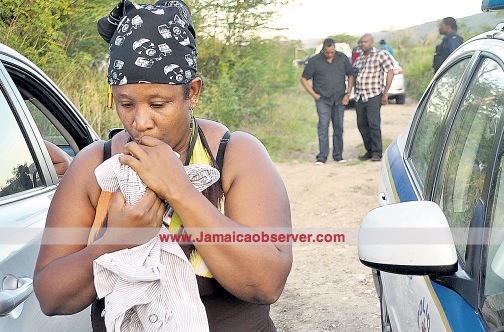
Officer Raynor’s mother grieves for her son. Observer photo
GUNMEN yesterday shot dead a policeman and left his body in an open woodland in the community of Hartlands, St Catherine. The Jamaica Observer was told that 26-year-old Constable Collin Raynor, who was assigned to Linstead Police Station in St Catherine, and his brother were in the remote area close to a fish pond when they were attacked by armed thugs about 3:30 pm. Constable Raynor died on the spot, but his brother, who was also shot, escaped and, according to the police, managed to drive to the main road to call for help.
Officer Raynor’s mother clutches his uniform shirt in utter grief. Observer photo
The brutal murder left several policemen who were at a fun day in Hellshire in shock. Following the incident, Raynor’s mother arrived on the scene and wept. Too distraught to speak, she was seen holding her slain son’s uniform shirt. Marlon Nesbeth, senior superintendent in charge of the St Catherine North Police Division, has launched a probe into the shooting.http://jamaicaobserver.com
“I’m embarrassed for them. For them to address a letter to the ayatollah who they claim is our mortal enemy, and their basic argument to them is ‘don’t deal with our president ‘cause you can’t trust him to follow through on agreement,” Obama said in a trailer for a Vice News interview scheduled to run in full on Monday. “That’s close to unprecedented,” he said.
The letter, warning Iranian leaders that any agreement reached in nuclear negotiations would merely constitute an “executive agreement,” generated a significant backlash in Washington and beyond.
Iran’s foreign minister called the letter “unprecedented and undiplomatic,” while a message from Ayatollah Ali Khamenei’s Twitter account said it “is indicative” of an American “collapse in ethics.”
Germany’s foreign minister weighed in Thursday, saying that to call the letter unhelpful would be “an understatement.”
“It was kind of a very rapid process. Everybody was looking forward to getting out of town because of the snowstorm,” said Sen. John McCain (R‑Ariz.), who also signed, in an interview with POLITICO earlier this week. “I think we probably should have had more discussion about it, given the blowback that there is.”
Republican support for the letter has extended beyond the Senate, with Louisiana Gov. Bobby Jindal signing it Tuesday. Others also have backed the warning to Iran’s leadership, including Wisconsin Gov. Scott Walker, former Texas Gov. Rick Perry and former Pennsylvania Sen. Rick Santorum, all of whom are prospective candidates for the party’s presidential nomination.
Univision has fired one of its most popular talk show hosts after he said on air that Michelle Obama looked like she was part of “the cast of ‘Planet of the Apes.’ ”
The growing American Spanish-language network terminated the employment of Rodner Figueroa on Thursday afternoon, less than one day after he made the racist comment on his popular “El Gorda y la Flaca” program.
In a statement provided to People en Español, the network said there was “no room for racism” at Univision.
“Yesterday during the entertainment program ‘El Gordo y La Flaca,’ Rodner Figueroa made some comments about First Lady Michelle Obama that were completely reprehensible and in no way a reflection of the values and opinions of Univision. As a result, Mr. Figueroa was fired immediately,” the network said.
On Wednesday, during a segment on his show about the use of makeup by celebrities, Figueroa, an Emmy award-winner, said that “Michelle Obama looks like she is from the cast of the ‘Planet Of The Apes.’ ”
The derogatory remarks were widely circulated on social media.
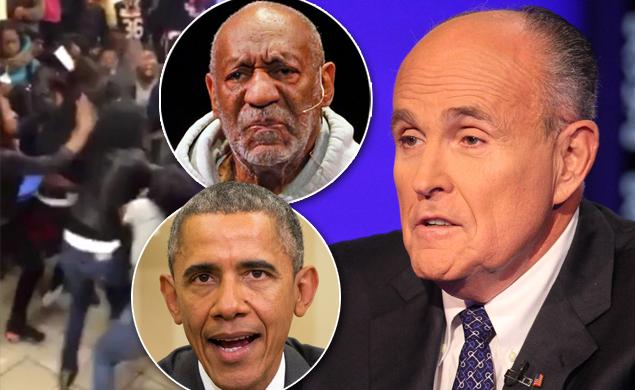
Just when you thought Rudy Giuliani couldn’t get crazier, the former NYC mayor blamed Obama for the brutal beatdown at a Brooklyn McDonalds —and said the president should be more like Bill Cosby.
Obama is ignoring “enormous amounts of crime” committed by African-Americans, Giuliani said Thursday. And he said President Obama is to blame for the brawl inside a McDonald’s in Brooklyn as well as the shooting of two cops in Ferguson because of the anti-police “tone” coming from the White House. The former mayor, speaking on AM970 radio this morning, was asked what he thought about a number of disturbing issues in the news. Host John Gambling asked for Giuliani’s take on the vicious McDonald’s fight, the recent police shootings in Ferguson and NYPD Commissioner Bill Bratton getting booed Thursday at a City Council hearing by protesters.
“It all starts at the top. It’s the tone that’s set by the President,” Giuliani said. He added he just returned from a multi-city trip overseas and the United States is constantly derided there as a “racist state.” “It is the obligation of the President to explain … that our police are the best in the world,” said Giuliani. He also said Obama should have used his “bully pulpit” to stop protests in Ferguson over the summer, but didn’t.
Obama is also not addressing the “enormous amount of crime” that’s being committed by African-Americans due to “historical” reasons, Giuliani said.
“I hate to mention it because of what happened afterwards, but (he should be saying) the kinds of stuff Bill Cosby used to say,” said Giuliani.
Cosby, before his public image was tarnished with a slew of rape allegations, had spoken frequently and often in blunt terms about how African-Americans needed to focus more on education, be better parents and avoid lives of crime.
Giuliani, who was roundly criticized for saying Obama wasn’t patriotic, made a point of saying a few nice things about the President.
“I disagree with Barack Obama on almost everything, but I think he’s a good family man and a good man,” said Giuliani.http://www.nydailynews.com/
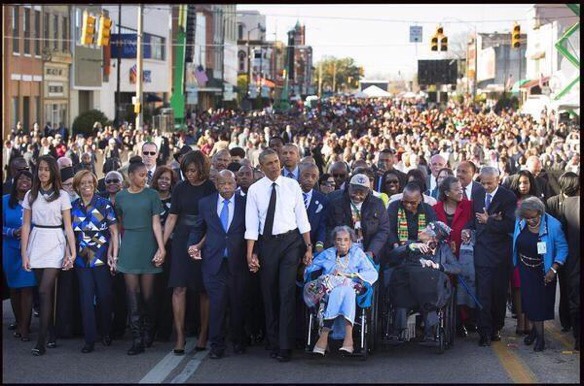
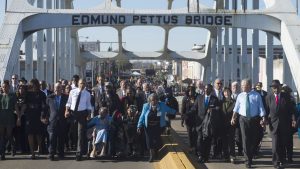
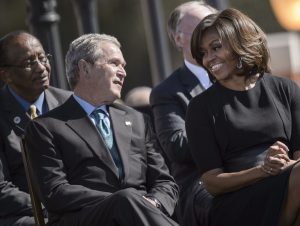
A truly historic moment [adapted]Fifty years after Police bludgeoned black Americans marching across the Edmund Pettus Bridge, the site of the “Bloody Sunday” demonstration of March 7, 1965 , the Nation’s 44th President a black man, commemorated the event with a sea of Americans of all stripes to include President Bush 43rd and his wife Laura.
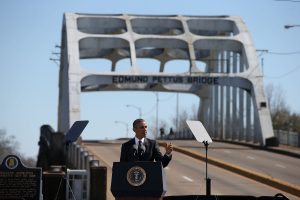
The President’s speech.
It is a rare honor in this life to follow one of your heroes. And John Lewis is one of my heroes.
Now, I have to imagine that when a younger John Lewis woke up that morning 50 years ago and made his way to Brown Chapel, heroics were not on his mind. A day like this was not on his mind. Young folks with bedrolls and backpacks were milling about. Veterans of the movement trained newcomers in the tactics of non-violence; the right way to protect yourself when attacked. A doctor described what tear gas does to the body, while marchers scribbled down instructions for contacting their loved ones. The air was thick with doubt, anticipation and fear. And they comforted themselves with the final verse of the final hymn they sung:
“No matter what may be the test, God will take care of you; Lean, weary one, upon His breast, God will take care of you.”
And then, his knapsack stocked with an apple, a toothbrush, and a book on government — all you need for a night behind bars — John Lewis led them out of the church on a mission to change America.
President and Mrs. Bush, Governor Bentley, Mayor Evans, Sewell, Reverend Strong, members of Congress, elected officials, foot soldiers, friends, fellow Americans:
As John noted, there are places and moments in America where this nation’s destiny has been decided. Many are sites of war — Concord and Lexington, Appomattox, Gettysburg. Others are sites that symbolize the daring of America’s character — Independence Hall and Seneca Falls, Kitty Hawk and Cape Canaveral.
Selma is such a place. In one afternoon 50 years ago, so much of our turbulent history — the stain of slavery and anguish of civil war; the yoke of segregation and tyranny of Jim Crow; the death of four little girls in Birmingham; and the dream of a Baptist preacher — all that history met on this bridge.
It was not a clash of armies, but a clash of wills; a contest to determine the true meaning of America. And because of men and women like John Lewis, Joseph Lowery, Hosea Williams, Amelia Boynton, Diane Nash, Ralph Abernathy, C.T. Vivian, Andrew Young, Fred Shuttlesworth, Dr. Martin Luther King, Jr., and so many others, the idea of a just America and a fair America, an inclusive America, and a generous America — that idea ultimately triumphed.
As is true across the landscape of American history, we cannot examine this moment in isolation. The march on Selma was part of a broader campaign that spanned generations; the leaders that day part of a long line of heroes.
We gather here to celebrate them. We gather here to honor the courage of ordinary Americans willing to endure billy clubs and the chastening rod; tear gas and the trampling hoof; men and women who despite the gush of blood and splintered bone would stay true to their North Star and keep marching towards justice.
They did as Scripture instructed: “Rejoice in hope, be patient in tribulation, be constant in prayer.” And in the days to come, they went back again and again. When the trumpet call sounded for more to join, the people came –- black and white, young and old, Christian and Jew, waving the American flag and singing the same anthems full of faith and hope. A white newsman, Bill Plante, who covered the marches then and who is with us here today, quipped that the growing number of white people lowered the quality of the singing. To those who marched, though, those old gospel songs must have never sounded so sweet.
In time, their chorus would well up and reach President Johnson. And he would send them protection, and speak to the nation, echoing their call for America and the world to hear: “We shall overcome.” What enormous faith these men and women had. Faith in God, but also faith in America.
The Americans who crossed this bridge, they were not physically imposing. But they gave courage to millions. They held no elected office. But they led a nation. They marched as Americans who had endured hundreds of years of brutal violence, countless daily indignities –- but they didn’t seek special treatment, just the equal treatment promised to them almost a century before.
What they did here will reverberate through the ages. Not because the change they won was preordained; not because their victory was complete; but because they proved that nonviolent change is possible, that love and hope can conquer hate.
As we commemorate their achievement, we are well-served to remember that at the time of the marches, many in power condemned rather than praised them. Back then, they were called Communists, or half-breeds, or outside agitators, sexual and moral degenerates, and worse –- they were called everything but the name their parents gave them. Their faith was questioned. Their lives were threatened. Their patriotism challenged.
And yet, what could be more American than what happened in this place?What could more profoundly vindicate the idea of America than plain and humble people –- unsung, the downtrodden, the dreamers not of high station, not born to wealth or privilege, not of one religious tradition but many, coming together to shape their country’s course?
What greater expression of faith in the American experiment than this, what greater form of patriotism is there than the belief that America is not yet finished, that we are strong enough to be self-critical, that each successive generation can look upon our imperfections and decide that it is in our power to remake this nation to more closely align with our highest ideals?
That’s why Selma is not some outlier in the American experience. That’s why it’s not a museum or a static monument to behold from a distance. It is instead the manifestation of a creed written into our founding documents: “We the People…in order to form a more perfect union.” “We hold these truths to be self-evident, that all men are created equal.”
These are not just words. They’re a living thing, a call to action, a roadmap for citizenship and an insistence in the capacity of free men and women to shape our own destiny. For founders like Franklin and Jefferson, for leaders like Lincoln and FDR, the success of our experiment in self-government rested on engaging all of our citizens in this work. And that’s what we celebrate here in Selma. That’s what this movement was all about, one leg in our long journey toward freedom.
A historic day for AmericaA historic day for America
The American instinct that led these young men and women to pick up the torch and cross this bridge, that’s the same instinct that moved patriots to choose revolution over tyranny. It’s the same instinct that drew immigrants from across oceans and the Rio Grande; the same instinct that led women to reach for the ballot, workers to organize against an unjust status quo; the same instinct that led us to plant a flag at Iwo Jima and on the surface of the Moon.
It’s the idea held by generations of citizens who believed that America is a constant work in progress; who believed that loving this country requires more than singing its praises or avoiding uncomfortable truths. It requires the occasional disruption, the willingness to speak out for what is right, to shake up the status quo. That’s America.
That’s what makes us unique. That’s what cements our reputation as a beacon of opportunity. Young people behind the Iron Curtain would see Selma and eventually tear down that wall. Young people in Soweto would hear Bobby Kennedy talk about ripples of hope and eventually banish the scourge of apartheid. Young people in Burma went to prison rather than submit to military rule. They saw what John Lewis had done. From the streets of Tunis to the Maidan in Ukraine, this generation of young people can draw strength from this place, where the powerless could change the world’s greatest power and push their leaders to expand the boundaries of freedom.
They saw that idea made real right here in Selma, Alabama. They saw that idea manifest itself here in America.
Because of campaigns like this, a Voting Rights Act was passed. Political and economic and social barriers came down. And the change these men and women wrought is visible here today in the presence of African Americans who run boardrooms, who sit on the bench, who serve in elected office from small towns to big cities; from the Congressional Black Caucus all the way to the Oval Office.
Because of what they did, the doors of opportunity swung open not just for black folks, but for every American. Women marched through those doors. Latinos marched through those doors. Asian Americans, gay Americans, Americans with disabilities — they all came through those doors. Their endeavors gave the entire South the chance to rise again, not by reasserting the past, but by transcending the past.
What a glorious thing, Dr. King might say. And what a solemn debt we owe. Which leads us to ask, just how might we repay that debt?
First and foremost, we have to recognize that one day’s commemoration, no matter how special, is not enough. If Selma taught us anything, it’s that our work is never done. The American experiment in self-government gives work and purpose to each generation.
Selma teaches us, as well, that action requires that we shed our cynicism. For when it comes to the pursuit of justice, we can afford neither complacency nor despair.
Just this week, I was asked whether I thought the Department of Justice’s Ferguson report shows that, with respect to race, little has changed in this country. And I understood the question; the report’s narrative was sadly familiar. It evoked the kind of abuse and disregard for citizens that spawned the Civil Rights Movement. But I rejected the notion that nothing’s changed. What happened in Ferguson may not be unique, but it’s no longer endemic. It’s no longer sanctioned by law or by custom. And before the Civil Rights Movement, it most surely was.
President Bush and first lay Michelle Obama
We do a disservice to the cause of justice by intimating that bias and discrimination are immutable, that racial division is inherent to America. If you think nothing’s changed in the past 50 years, ask somebody who lived through the Selma or Chicago or Los Angeles of the 1950s. Ask the female CEO who once might have been assigned to the secretarial pool if nothing’s changed. Ask your gay friend if it’s easier to be out and proud in America now than it was thirty years ago. To deny this progress, this hard-won progress -– our progress –- would be to rob us of our own agency, our own capacity, our responsibility to do what we can to make America better.
Of course, a more common mistake is to suggest that Ferguson is an isolated incident; that racism is banished; that the work that drew men and women to Selma is now complete, and that whatever racial tensions remain are a consequence of those seeking to play the “race card” for their own purposes. We don’t need the Ferguson report to know that’s not true. We just need to open our eyes, and our ears, and our hearts to know that this nation’s racial history still casts its long shadow upon us.
We know the march is not yet over. We know the race is not yet won. We know that reaching that blessed destination where we are judged, all of us, by the content of our character requires admitting as much, facing up to the truth. “We are capable of bearing a great burden,” James Baldwin once wrote, “once we discover that the burden is reality and arrive where reality is.”
There’s nothing America can’t handle if we actually look squarely at the problem. And this is work for all Americans, not just some. Not just whites. Not just blacks. If we want to honor the courage of those who marched that day, then all of us are called to possess their moral imagination. All of us will need to feel as they did the fierce urgency of now. All of us need to recognize as they did that change depends on our actions, on our attitudes, the things we teach our children. And if we make such an effort, no matter how hard it may sometimes seem, laws can be passed, and consciences can be stirred, and consensus can be built.
With such an effort, we can make sure our criminal justice system serves all and not just some. Together, we can raise the level of mutual trust that policing is built on –- the idea that police officers are members of the community they risk their lives to protect, and citizens in Ferguson and New York and Cleveland, they just want the same thing young people here marched for 50 years ago -– the protection of the law. Together, we can address unfair sentencing and overcrowded prisons, and the stunted circumstances that rob too many boys of the chance to become men, and rob the nation of too many men who could be good dads, and good workers, and good neighbors.
With effort, we can roll back poverty and the roadblocks to opportunity. Americans don’t accept a free ride for anybody, nor do we believe in equality of outcomes. But we do expect equal opportunity. And if we really mean it, if we’re not just giving lip service to it, but if we really mean it and are willing to sacrifice for it, then, yes, we can make sure every child gets an education suitable to this new century, one that expands imaginations and lifts sights and gives those children the skills they need. We can make sure every person willing to work has the dignity of a job, and a fair wage, and a real voice, and sturdier rungs on that ladder into the middle class.
And with effort, we can protect the foundation stone of our democracy for which so many marched across this bridge –- and that is the right to vote. Right now, in 2015, 50 years after Selma, there are laws across this country designed to make it harder for people to vote. As we speak, more of such laws are being proposed. Meanwhile, the Voting Rights Act, the culmination of so much blood, so much sweat and tears, the product of so much sacrifice in the face of wanton violence, the Voting Rights Act stands weakened, its future subject to political rancor.
How can that be? The Voting Rights Act was one of the crowning achievements of our democracy, the result of Republican and Democratic efforts. President Reagan signed its renewal when he was in office. President George W. Bush signed its renewal when he was in office. One hundred members of Congress have come here today to honor people who were willing to die for the right to protect it. If we want to honor this day, let that hundred go back to Washington and gather four hundred more, and together, pledge to make it their mission to restore that law this year. That’s how we honor those on this bridge.
Of course, our democracy is not the task of Congress alone, or the courts alone, or even the President alone. If every new voter-suppression law was struck down today, we would still have, here in America, one of the lowest voting rates among free peoples. Fifty years ago, registering to vote here in Selma and much of the South meant guessing the number of jellybeans in a jar, the number of bubbles on a bar of soap. It meant risking your dignity, and sometimes, your life.
What’s our excuse today for not voting? How do we so casually discard the right for which so many fought? How do we so fully give away our power, our voice, in shaping America’s future? Why are we pointing to somebody else when we could take the time just to go to the polling places? We give away our power.
Fellow marchers, so much has changed in 50 years. We have endured war and we’ve fashioned peace. We’ve seen technological wonders that touch every aspect of our lives. We take for granted conveniences that our parents could have scarcely imagined. But what has not changed is the imperative of citizenship; that willingness of a 26-year-old deacon, or a Unitarian minister, or a young mother of five to decide they loved this country so much that they’d risk everything to realize its promise.
President Obama delivers speech for the ages
That’s what it means to love America. That’s what it means to believe in America. That’s what it means when we say America is exceptional.
For we were born of change. We broke the old aristocracies, declaring ourselves entitled not by bloodline, but endowed by our Creator with certain inalienable rights. We secure our rights and responsibilities through a system of self-government, of and by and for the people. That’s why we argue and fight with so much passion and conviction — because we know our efforts matter. We know America is what we make of it.
Look at our history. We are Lewis and Clark and Sacajawea, pioneers who braved the unfamiliar, followed by a stampede of farmers and miners, and entrepreneurs and hucksters. That’s our spirit. That’s who we are.
We are Sojourner Truth and Fannie Lou Hamer, women who could do as much as any man and then some. And we’re Susan B. Anthony, who shook the system until the law reflected that truth. That is our character.
We’re the immigrants who stowed away on ships to reach these shores, the huddled masses yearning to breathe free –- Holocaust survivors, Soviet defectors, the Lost Boys of Sudan. We’re the hopeful strivers who cross the Rio Grande because we want our kids to know a better life. That’s how we came to be.
We’re the slaves who built the White House and the economy of the South. We’re the ranch hands and cowboys who opened up the West, and countless laborers who laid rail, and raised skyscrapers, and organized for workers’ rights.
We’re the fresh-faced GIs who fought to liberate a continent. And we’re the Tuskeegee Airmen, and the Navajo code-talkers, and the Japanese Americans who fought for this country even as their own liberty had been denied.
We’re the firefighters who rushed into those buildings on 9⁄11, the volunteers who signed up to fight in Afghanistan and Iraq. We’re the gay Americans whose blood ran in the streets of San Francisco and New York, just as blood ran down this bridge.
We are storytellers, writers, poets, artists who abhor unfairness, and despise hypocrisy, and give voice to the voiceless, and tell truths that need to be told.
We’re the inventors of gospel and jazz and blues, bluegrass and country, and hip-hop and rock and roll, and our very own sound with all the sweet sorrow and reckless joy of freedom.
We are Jackie Robinson, enduring scorn and spiked cleats and pitches coming straight to his head, and stealing home in the World series.
We are the people Langston Hughes wrote of who “build our temples for tomorrow, strong as we know how.” We are the people Emerson wrote of, “who for truth and honor’s sake stand fast and suffer long;” who are “never tired, so long as we can see far enough.”
That’s what America is. Not stock photos or airbrushed history, or feeble attempts to define some of us as more American than others. We respect the past, but we don’t pine for the past. We don’t fear the future; we grab for it. America is not some fragile thing. We are large, in the words of Whitman, containing multitudes. We are boisterous and diverse and full of energy, perpetually young in spirit. That’s why someone like John Lewis at the ripe old age of 25 could lead a mighty march.
And that’s what the young people here today and listening all across the country must take away from this day. You are America. Unconstrained by habit and convention. Unencumbered by what is, because you’re ready to seize what ought to be.
For everywhere in this country, there are first steps to be taken, there’s new ground to cover, there are more bridges to be crossed. And it is you, the young and fearless at heart, the most diverse and educated generation in our history, who the nation is waiting to follow.
Because Selma shows us that America is not the project of any one person. Because the single-most powerful word in our democracy is the word “We.” “We The People.” “We Shall Overcome.” “Yes We Can.” That word is owned by no one. It belongs to everyone. Oh, what a glorious task we are given, to continually try to improve this great nation of ours.
Fifty years from Bloody Sunday, our march is not yet finished, but we’re getting closer. Two hundred and thirty-nine years after this nation’s founding our union is not yet perfect, but we are getting closer. Our job’s easier because somebody already got us through that first mile. Somebody already got us over that bridge. When it feels the road is too hard, when the torch we’ve been passed feels too heavy, we will remember these early travelers, and draw strength from their example, and hold firmly the words of the prophet Isaiah: “Those who hope in the Lord will renew their strength. They will soar on [the] wings like eagles. They will run and not grow weary. They will walk and not be faint.”
We honor those who walked so we could run. We must run so our children soar. And we will not grow weary. For we believe in the power of an awesome God, and we believe in this country’s sacred promise.
May He bless those warriors of justice no longer with us, and bless the United States of America. Thank you, everybody.
A Madison, Wis., police officer who fatally shot an unarmed 19-year-old African American man Friday had been exonerated in a previous fatal shooting, officials disclosed Saturday.
Nineteen-year-old Tony Robinson was not armed when a Madison, Wisconsin, police officer fatally shot him, Police Chief Mike Koval said Saturday. The 2007 shooting involving Matt Kenny, 45, was ruled a “suicide by cop,” said Madison Police Chief Mike Koval in a Saturday press conference. The case was reviewed and audited at the time by the district attorney’s office in Dane County, he said. Kenny, a 12-year department veteran, was the primary responding officer in the incident Friday that resulted in the shooting death of Tony Robinson.
Police said they received several calls about a man who had “battered someone“and had been “out in traffic” and then gone inside an apartment, Koval said Friday. Kenny heard a disturbance in the apartment, forced his way in, and after a scuffle with Robinson in which Kenny received a “blow to the head,” the officer shot Robinson, Koval said.Robinson later was pronounced dead of gunshot wounds at a nearby hospital. Koval did not disclose how many shots were fired, saying the information was part of the shooting investigation, which will be handled by the state’s Division of Criminal Investigation.
Kenny was placed on administrative leave with pay pending results of the investigation, Koval said. He said that Kenny received a commendation of valor for his participation in the 2007 fatal shooting. The state agency will handle the probe of the new shooting in line with a 2014 Wisconsin law that requires all officer-involved shootings to be reviewed by an outside agency. Findings will be turned over to the Dane County district attorney’s office, which will also review the case, Koval said.
Koval said he went to the home of Robinson’s family early Saturday morning to express his condolences and “remorse for the loss of life.” He met Robinson’s grandparents in the driveway, and they spoke for about 45 minutes and prayed together, he said. “To his family, and to his friends, and to this community, that is a loss,” Koval said. “Nineteen years old is too young.”
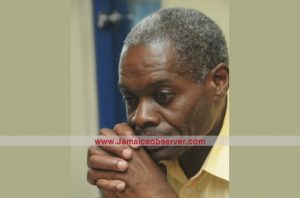
LLOYD Bogle was shopping in Musgrave Market, Port Antonio, Portland on
Friday “about 11:30 am” when he got the phone call that he was anxiously awaiting. On the other end of the line was a representative of the British High
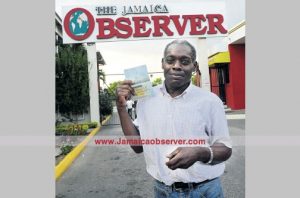
Lloyd Bogle Courtesy photo
Commission who informed him that he had been granted a visa. “When I heard from them that my visa was approved I just dropped everything and shouted out,” Bogle told the Jamaica Observer, his smile stretching from ear to ear. Vendors in the market were left wondering whether Bogle was losing his mind as he jumped for joy. However, the 64-year-old Jamaican-born man who had been stranded here since last October because of his immigration status, said he did not care what the vendors thought as he knew the call meant that his agonising wait to return to England, where he has lived for over 50 years, was now over.
“I am still struggling to find words to describe the moment. I just feel relieved,” he told the Sunday Observer. “When I got the call I just stopped everything that I was doing and rushed back to the house where I was staying in Portland to collect my documents.” Bogle said he then jumped in a taxi and headed for the British High Commission in Kingston, his heart racing with excitement throughout the approximately two-hour drive. When he arrived there, he was told to wait as the authorities completed processing his documents. The few minutes on the outside seemed like an eternity, but it was one that the retired Bogle was willing to sit through. Then came the moment when he was handed back his passport and saw, in it, a multiple entry D‑visa, which states that he has leave to enter England outside of the rules, requires him to register with the police within seven days of arrival in the UK, and has no restriction on employment. Images of his loved ones back home in Manchester and Oldham — who he thought he would never see again — flashed across his mind.
“When I got mi visa I felt like I just wanted to shout out and celebrate,” Bogle said, adding that immediately he took out his cellphone and called his friend, Gloria Thompson, who had stuck with him through the whole ordeal, giving him shelter and who had directed him to the Observer with the advice that the newspaper highlights people and their issues. Thompson, who joined him later in Kingston on Friday, declined to be interviewed. Read more @http://www.jamaicaobserver.com/news/Lloyd-Bogle-relieved – thanks-Observer – supporters-for-help_18278111
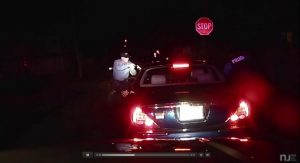
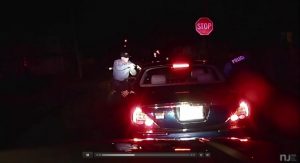
Jerame C. Reid, 36, is seen exiting a vehicle with his hands raised at shoulder height when a Bridgeton police officer opens fire. Reid, who was convicted as a teen for shooting at New Jersey State Police troopers, was repeatedly warned not to move by the cop or ‘you’re gonna be f — ing dead.’
Two Bridgeton, N.J., police officers are seen with guns drawn after a Dec. 30 traffic stop led to the alleged discovery of a handgun in a car carrying a convicted police shooter, who was recognized by an officer.
A newly released video capturing the police shooting death of a New Jersey man shows an officer warning the suspect not to move or he’ll be “f — ing dead” before the man steps out of his car .Jerame C. Reid, 36, is seen exiting the vehicle with his hands raised at shoulder height when a Bridgeton police officer, who recognizes Reid by name, fired at least six times. Reid’s violent Dec. 30 death began as a routine traffic stop before Officer Braheme Days calls to his partner, Roger Worley, “We’ve got a gun in this glove compartment!” “Don’t you f — ing move,” Days warns to Reid and the driver, Leroy Tutt. “I’m telling you I’m gonna shoot you. You’re gonna be f — ing dead.” Tutt obediently holds both hands out of his open window while Days expresses the continuing issue with Reid. “Hey Jerome, you reach for something you’re going to be f — ing dead,” Days warns. “I’m telling you I’m gonna shoot you. You’re gonna be f — ing dead.”
Records show Days was involved in Reid’s arrest last year on charges of drug possession and obstruction. Reid also spent about 13 years in prison for shooting at New Jersey State Police troopers when he was a teen. “I ain’t got no reason to reach for nothing, bro, I ain’t got no reason to reach for nothing,” Reid is heard responding as Days continues to yell to his partner that Reid is reaching for something. “I’m getting out and getting on the ground,” Days is heard telling the officer before indeed opening the car door and stepping out. Days, while shouting, takes several steps back before opening fire upon Reid as he stands with two hands — appearing empty — in the air. The disturbing video was viewed as a horror flick to Reid’s wife, who watched it for the first time Tuesday after its release through open records requests, her attorney told NJ.com.
Dashcam video captured Jerame C. Reid ignoring a police officer’s order to not move or be shot when he stepped out of the car (r.), but with his hands in the air. He was seconds later shot to death.
“It’s traumatic,” Philadelphia-based attorney Conrad J. Benedetto told the paper “She is extremely upset. To see someone that close to you, it is a powerful thing. There is a lot of shock value to it.” The Bridgeton Police Department released a statement Tuesday expressing it was upset over the video’s release, calling it unprofessional and uncompassionate “out of respect for the family.” “Since this remains a criminal investigation being conducted by the Cumberland County Prosecutor’s Office with assistance from the New Jersey State Police the administration of the Bridgeton Police Dept. will refrain from any further comment other than that it fully supports the officers involved as well as the legal process this incident is subject to,” it added. Both officers have been placed on leave while the Cumberland County prosecutor’s office investigates.
Lloyd Bogle a 64-year-old Jamaican, who has been living in England for the past 54 years, is now stranded in the island after enjoying a two-week trip — his first back home in all that time. Bogle said his ordeal started on October 13, 2014 when he got to Sangster International Airport in Montego Bay to take a return flight to England, only to be told by Immigration officials that they could not allow him to leave. “I got the shock of my life when I was turned back and told by authorities that I would have to have a visa to leave the country,” said the distraught-looking Bogle, who added that he was not aware of the travel requirement.
The reason for that is that Bogle, since leaving Jamaica in 1962 when he was seven years old and just before the country achieved political independence from Britain, never applied for British citizenship. In fact, he said he didn’t renew his Jamaican passport until just before he travelled here on September 29, 2014. “Since I migrated at age seven I have never travelled and never had any intention to. It was after I retired I decided to take a trip to Jamaica to see what the country was like,” Bogle told the Jamaica Observer yesterday. “I knew no one in Jamaica; it was the first time I was travelling since I was seven,” Bogle emphasised on the verge of tears. He said the two-week holiday in Portland was like a dream come true, but all of that changed when he got to the airport. According to Bogle, after getting over the shock of being told about the visa, he was on the verge of sleeping on the streets, as he had nowhere to go, neither did he know where he was. He said he managed to contact his mother in England and told her about his situation. She gave him the number for a Jamaican woman who once lived in England and told him to contact her for help. Bogle said it was through the kindness of this woman, who gave him a place to stay, that he has been able to survive.
Acting on the advice from the Immigration officials, he made contact with the British High Commission in Kingston to apply for a visa and was given a list of documents he would need for the process. He said he contacted his mother, who brought the documents to Jamaica. “After I got the documents, I applied for the visa and, after waiting for some time, would receive another shock when I learnt that the visa was not approved,” Bogle told the Observer. He said that no reason was given. Now stranded, running out of money, and with no family in Jamaica, Bogle is desperate. Bogle worked for close to 40 years in England, got married and later divorced. He is the father of two sons, who are both adults. During his time there, he purchased a house and, after achieving most of his life’s dream, decided to take early retirement. Yesterday, when the Observer contacted Bogle’s former boss, Roy Broadeent, in England, he said he was aware of Bogle’s plight. “I have heard of the situation and am really shocked,” said Broadeent, former manager of Broadhurst Engineering, where Bogle worked before going to Manchester City Council. “It is true, I have known Lloyd for over 30 years. He has been a resident in Oldham, Royton for all that time. During that time he worked for me and would later go on to work for Manchester City Council for at least 27 years,” said Broadeent. http://www.jamaicaobserver.com/news/Stranded – _18242166
PUBLISHERSNOTE.
This case is begging for the attention of Jamaican authorities at the highest level . The Jamaican Minister of Foreign Affairs should be in touch with the British home office, not British Immigration officials. Jamaica and Britain are Sovereign nations with a range of mutual interests. Respect and coöperation between them should be mutual not one way. This is a great opportunity for Jamaica to test whether as a nation, it is equal in the sight of it’s former colonizer.
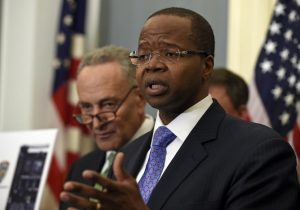
Brooklyn District Attorney Kenneth Thompson announced the investigation Thursday after he had dropped a weapons case involving Jeffrey Herring, who was accused of having a gun outside his East Flatbush apartment.
Brooklyn District Attorney Kenneth Thompson intends on looking into whether NYPD cops are planting guns on innocent people.
The Brooklyn district attorney will investigate disturbing allegations that NYPD cops have been planting guns on innocent people. District Attorney Kenneth Thompson announced the probe Thursday after dropping a weapons case that raised questions about officers’ conduct. The charges against Jeffrey Herring, accused of having a gun outside his East Flatbush apartment in June 2013, were dismissed the day prosecutors were given a last chance to bring forth the informant who purportedly led to the collar — and couldn’t produce him. That suggested the alleged snitch was either unreliable or non-existent. “I dreamed of this day,” said a relieved Herring, 53, who was facing up to 15 years in prison. “I knew I didn’t do anything.” His public defender Debora Silberman has come up with five other past cases that ended with dismissals, acquittals and a plea to time served. In all of them, the same group of detectives from the 67th Precinct made similar allegations using an informant who was never identified or testified and a gun that was found in a plastic bag or bandana without any fingerprints on it. Judges slammed their accounts as “incredible” and one said she believes the cops perjured themselves, records show. “There could be dozens more,” Silberman said in Brooklyn Supreme Court. “Anyone who was arrested by this team — their arrests should be investigated.” Thompson vowed to do so.
“We will investigate the arrest of Mr. Herring and other arrests by these officers because of the serious questions raised by this case,” he said in a statement. The Internal Affairs Bureau was already looking into the cops’ conduct, police have said. Prosecutors were ordered numerous times since last October to produce the informant who police said led them to Herring. They claimed a month ago that he was found, but still didn’t bring him to court. On Thursday, executive assistant district attorney Paul Burns announced that following the prosecutors’ and the defense lawyers’ investigation, “We do not believe at this time that we can prove beyond a reasonable doubt the charges against Mr. Herring so we move to dismiss the indictment.” Justice Dineen Riviezzo ordered the case sealed and added: “I’m glad to hear there is an ongoing investigation into the allegations.” Herring, who’s been out on $3,500 bail during the ordeal, gave a big hug to his lawyer and was all smiles, saying he was looking forward to being worry free when he walks his dog, a Collie mix named Snowy. “I was fighting for my life,” he said. “I didn’t want to go to prison. I love my freedom.”NYdailynews.com.
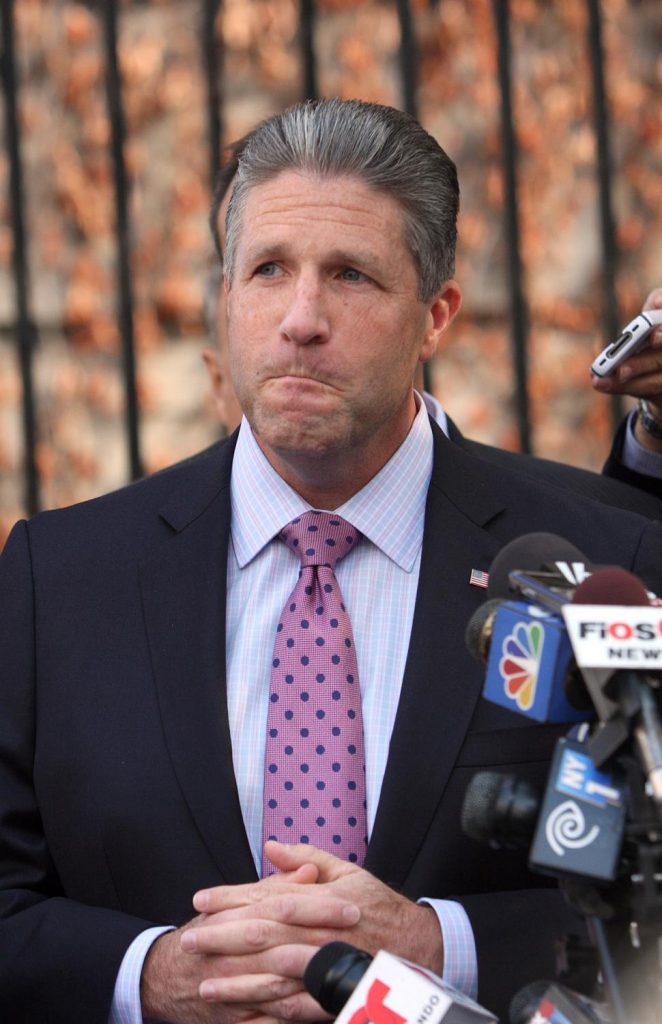
The Patrolmen’s Benevolent Association was not so much on Tuesday as some cops shouted down Lynch regarding his demand that Mayor de Blasio apologize over comments related to race and police relations.9
Patrick Lynch
Not exactly the blueprint for a more perfect union. Members of the Patrolmen’s Benevolent Association nearly came to blows on Tuesday during a meeting of delegates in Queens. There was pushing, shoving and lots of screaming at Patrick Lynch, president of the 23,000-member union. The in-house battle erupted over the issue of what patrol officers really need — an apology from Mayor de Blasio or better equipment and more officers to back them up on the streets. “This is what my members want!” a cop yelled near the end of the raucous meeting. “They want more cars, better vests, more manpower!”
And then the cop — one of about 350 in attendance — took a verbal jab at Lynch, who has called on de Blasio to offer a mea culpa for his continued lack of support for police. “They don’t want an apology,” he said. Not exactly the blueprint for a more perfect union. Members of the Patrolmen’s Benevolent Association nearly came to blows on Tuesday during a meeting of delegates in Queens. There was pushing, shoving and lots of screaming at Patrick Lynch, president of the 23,000-member union. The in-house battle erupted over the issue of what patrol officers really need — an apology from Mayor de Blasio or better equipment and more officers to back them up on the streets. “This is what my members want!” a cop yelled near the end of the raucous meeting. “They want more cars, better vests, more manpower!” And then the cop — one of about 350 in attendance — took a verbal jab at Lynch, who has called on de Blasio to offer a mea culpa for his continued lack of support for police. “They don’t want an apology,” he said. At the peak of the clash, about 100 cops were standing and screaming at Lynch, sources told the Daily News.
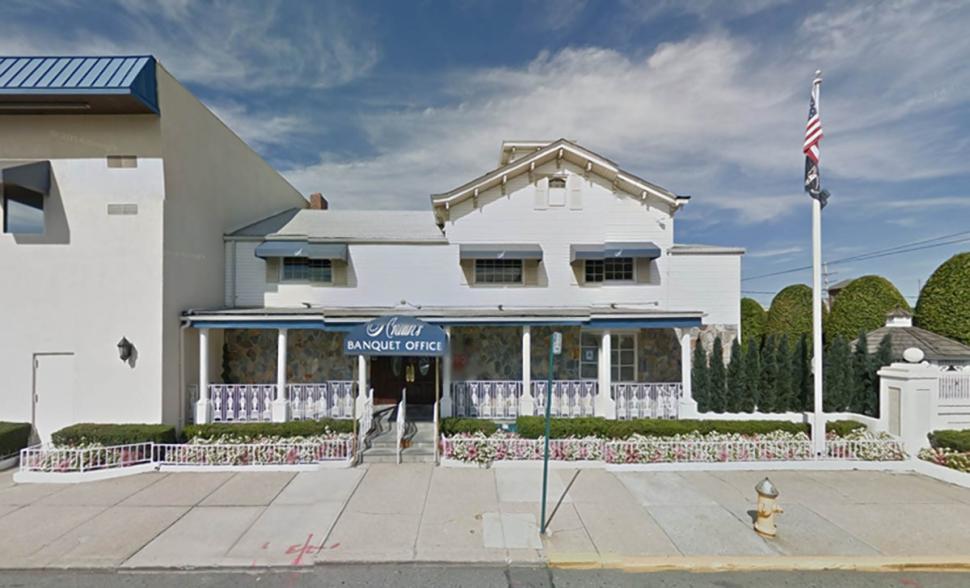
Antun’s in Queens was the scene of Monday’s contentious PBA meeting.
“I don’t care about an apology!” another PBA member shouted. “I want to know what you’re going to do to protect us!” The battle lines were clear when the meeting took an ugly turn. The Lynch supporters were generally from Manhattan and his detractors were delegates from Brooklyn and the Bronx, sources said. “They were screaming,” one of the sources said. “Lynch’s guys got up and there was shoving and pushing.” There were no reported injuries at Antun’s, a catering hall in Queens Village. The fracas was first reported by the Daily News. Some of the delegates at the meeting blamed Lynch for ordering a recent slowdown in arrests and summonses — a claim the PBA boss has denied. And, sources said, they accused him of buckling under pressure once NYPD brass made it clear they expected police activity to return to normal. A source added that delegates have been peppering the PBA leadership for answers. “They want to know if there’s a plan,” the source said, referring to whether cops should make more arrests. Cops also wanted to know what happened at a Dec. 30 meeting of five police union heads, Police Commissioner Bill Bratton and de Blasio at the Police Academy in Queens. Sergeants Benevolent Association President Ed Mullins, right, blamed the decline of NYPD arrests and summons on ‘a hesitancy’ brought on by Eric Garner’s July 17 death in a police chokehold. “They asked Lynch directly: ‘What did you ask the mayor for?’ ” the source added. But Lynch provided no answers.
The yelling and screaming lasted about 10 minutes before Lynch stormed out. “He didn’t want to talk about it,” the source said. “He said, ‘Everything we say gets back to the media.’ ” Lynch wouldn’t directly answer questions from The News either. In a statement, Lynch later blamed the brouhaha on “a few agitators bent on their own self-agendas.” The frustration with the mayor’s policies and concerns for safety continues to be expressed by our members,” Lynch said. “They are rightly angered by the lack of support from City Hall, the dangerous lack of staffing, the lack of proper equipment to deal with the lethal environment we face and the reinstituted quota policies.” Police Commissioner Bill Bratton acknowledged Friday that a “slowdown” in arrests and summonses was reflected in crime stats in the weeks after the Dec. 20 execution of Police Officers Wenjian Liu and Rafael Ramos in Brooklyn. He said Monday that the numbers were on their way back up and has insisted there are no quotas. In a related development on Tuesday, the Lieutenants Benevolent Association delivered a three-page letter to the mayor’s office suggesting ways to “remedy the estrangement” between cops and the administration. The letter says that de Blasio “initiated dialogue” with organizers of the various protest groups as they prepared to disrupt the city after a jury decided not to indict the cop who killed Eric Garner in a chokehold on Staten Island July 17.
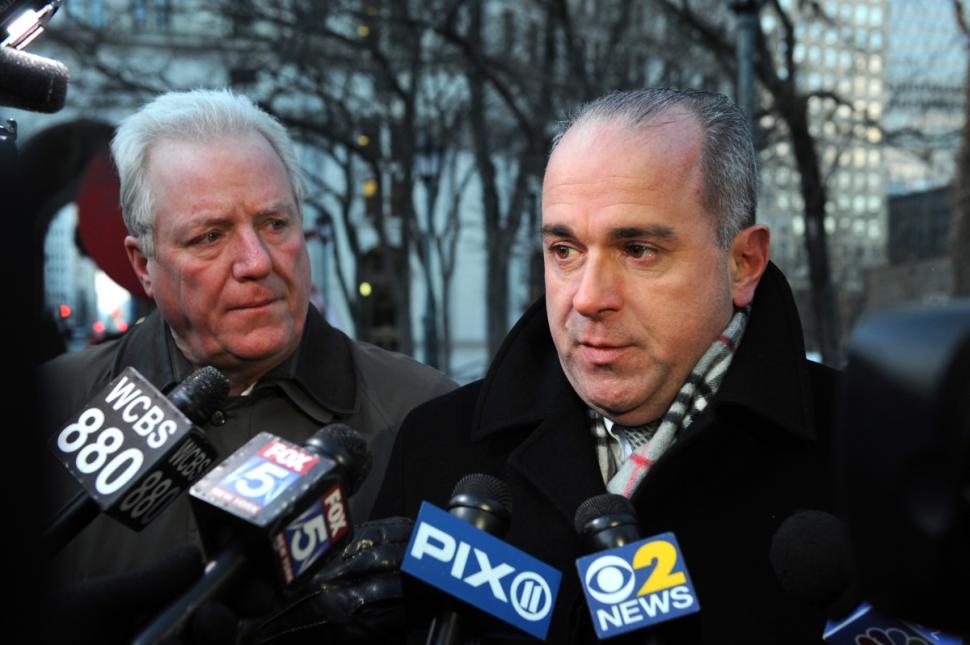
Sergeants Benevolent Association President Ed Mullins, right, blamed the decline of NYPD arrests and summons on ‘a hesitancy’ brought on by Eric Garner’s July 17 death in a police chokehold.
“Mr. Mayor, this led to the perception of you and your administration aligning yourselves with the protesters,” the letter states. Earlier in the day, Sergeants Benevolent Association President Ed Mullins blamed the decline in arrests and summonses on “a hesitancy” brought on by Garner’s death. “What we have is no clarity as to the position of whether we should be fully enforcing these quality-of-life crimes or not,” Mullins said on Geraldo Rivera’s radio show on WABC-AM.Nydailynews.com
The head of the city’s powerful police union has told rank-and-file officers to go back to issuing tickets, summonses and making low-level arrests — but not too zealously, the Daily News has learned. Patrolmens Benevolent Association President Patrick Lynch told union trustees to spread the word, a source said Thursday. “He said they should go back to at least 50% of what they used to do,” the police source said. A second source said the directive was in response to a promise by Chief of Department James O’Neill to start cracking the whip if cops continued with the slowdown, apparently under pressure from his boss, Commissioner Bill Bratton.
Lynch who swore there was no police slow-down now tells cops to go back to doing their jobs
“Bratton has been patient,” the second source said. “His patience is wearing thin.” The same might be said of another top NYPD union leader who reportedly asked Gov. Cuomo to help repair the rift between the cops and City Hall. Sergeants Benevolent Association President Ed Mullins reached out to Albany after a second summit with Bratton — that Mayor de Blasio did not attend — ended in failure. “The mayor is who he is,” Mullins told the Daily News on Thursday. “He’s not going to change his views toward police.” Mullins said he was moved by conciliatory words Cuomo spoke Tuesday at the funeral of his father, former Gov. Mario Cuomo, and “he seemed sincere.”
“The truth of it is this is something that can be fixed in 30 seconds with the mayor giving a public statement, something apologetic, followed by a gesture of goodwill so we can begin to trust him,” Mullins said. There was no response from Cuomo, but Mullins’ appeal came shortly after former President Bill Clinton said he wanted nothing to do with this mess. Clinton “is not going to get involved,” his spokesman, Matt McKenna, told The News. Earlier, both de Blasio and Bratton put the kibosh on either Clinton or Cuomo serving as mediator. “The mayor has immense respect for President Clinton, but what’s needed really here is a continued dialogue,” spokesman Phil Walzak said. “The mayor is going to keep talking to and meeting with these union leaders.” The idea of enlisting Clinton’s help was raised during the Wednesday meeting between Bratton, Mullins, and the heads of the four other police unions.
Mullins himself a sergeant calls the Mayor a nincompoop
In a clear sign that feelings between the cops and de Blasio remain raw, Walzak struck back hard at Lynch’s recent claim that the mayor “supported those demonstrators that were calling for the death of cops.” “That’s just false,” Walzak said. Walzak released a transcript of de Blasio’s remarks from Dec. 22 in which the mayor ripped the rowdies who heaped abuse on police. “There are some people who say hateful things,” the mayor said. “They have no place in these protests.” De Blasio made those remarks two days after a pair of Brooklyn police officers were killed by a cop-hating maniac, a tragedy Lynch laid at de Blasio’s door, saying he had “blood on the hands.” It sparked a work slowdown, with police apparently refusing to make arrests for petty offenses that are the hallmarks of the “broken windows” policing. The number of citywide criminal summonses dropped by 94% for the week ending Dec. 29, and 92% for the week ending Jan. 4, according to crime stats obtained by The News. http://www.nydailynews.com/news/politics/bill-clinton-staying-nypd-de-blasio-feud-article‑1.2070327
Arrests for all crimes have dropped by 56% from this time last year during an apparent police slowdown.
BRATTONMEETSWITHCOPSUNIONS.
NYPD Police Commissioner Bill Bratton met today with the heads of the Unions representing that Agency’s cops. The NYdailynews.com reports Police Commissioner Bill Bratton met with the heads of the city’s five police unions Wednesday in an attempt to put anger with de Blasio aside and continue to keep working to keep the city safe. When asked why he wasn’t at the meeting, the mayor said he is always willing to talk but ‘the vast majority of those communications with those unions, of course, comes from the commissioner, his leadership team.
NYPDCOPSENGAGINGINILLEGALWORKSLOW-DOWN
NYPD sources said Monday that city cops seem to be engaging in a work slowdown to show they’re unhappy with Mayor de Blasio’s treatment of the police force. Police Commissioner Bill Bratton vowed a ‘comprehensive review.’ The number of arrests citywide plummeted by 56% for the week ending Sunday, from 5,448 during the same time period a year ago to 2,401. The number of people slapped with criminal summonses for offenses like drinking in public fell 92% for the same week, from 4,077 to just 347. Just 749 motorists were hit with moving violations, compared with 9,349 a year ago — a 92% drop. And the number of parking summonses issued fell by a whopping 90%, from 16,008 to just 1,191. In Brooklyn’s 84th Precinct, home base for Rafael Ramos and Wenjian Liu, the two hero police officers who were executed by a cop-hating maniac, a grand total of just two tickets were written for moving violations. Not a single parking or Criminal Court summons was issued. Over in the 79th Precinct, the Brooklyn precinct in which Liu and Ramos were killed Dec. 20, just eight parking tickets and two moving violations were written. In all of Brooklyn North — encompassing 10 precincts — police wrote 216 summonses. During the same time last year, they’d written 4,076.
‘I think it defies a lot of what we all feel is the right and decent thing to do,’ the Mayor said Monday during a press conference in which he and police Commissioner Bratton touted a 4.6% drop in crime citywide in 2014. Ironically, the number of summonses issued during the week ending Sunday dropped more than 90% compared to last year in a work slowdown as part of the rank-and-file’s continued protest against de Blasio over perceived anti-cop sentiments. Mayor de Blasio gave the cops who turned their backs on him a good smack Monday. Speaking for the first time about the public dissing he endured at the funeralsof hero cops Rafael Ramos and Wenjian Liu, de Blasio said “they were disrespectful to the families involved.”
The war of words between the mayor and the police unions has led to a major slowdown of police action in the streets, with disastrous consequences for New York City residents, writes Daniel DiSalvo, assistant professor of political science at the City College of New York. For the second week since the killings of two officers in Brooklyn, cops are on the beat but aren’t doing much policing. Officers wrote 90% fewer summonses and traffic tickets than in the same period a year ago. Burglary arrests have dropped 40%. Arrests for all crimes have dropped by 56%. And there have been more murders, robberies and rapes than over the equivalent week last year. The public is being held hostage to a fit of police officer piqué. We know the story. Conflict between de Blasio and the police unions began during the 2013 mayoral campaign, when de Blasio attacked stop-and-frisk.
In 1935, with Hitler and Mussolini forging a historic alliance in Europe and the world sliding toward war, Sinclair Lewis published the satirical novel “It Can’t Happen Here,”which depicted the rise of an indigenous American fascist movement. Lewis is a fine prose stylist, but this particular book has an overly melodramatic plot, and is highly specific to its era. It has not aged nearly as well as “Brave New World” or “1984,” and not many people read it today. (At the time, it was understood as an attack on Sen. Huey Longof Louisiana, the populist firebrand who was planning to run against Franklin D. Roosevelt in 1936, but was assassinated before he could do so.) But certain aspects of Lewis’ fascist America still resonate strongly. His clearest insight came in seeing that the authoritarian impulse runs strong and deep in American society, but that because of our unique political history and our confused national mythology, it must always be called by other names and discussed in other terms.
Oh, yeah — Happy New Year, everybody! Now let’s get back to fascism. When the “Corpo” régime installed by tyrannical President Buzz Windrip in “It Can’t Happen Here” strips Congress of its powers, tries dissidents in secret military courts and arms a repressive paramilitary force called the Minute Men, most citizens go along with it. (Yeah, some of that sounds familiar — we’ll get to that.) These draconian measures are understood as necessary to Windrip’s platform of restoring American greatness and prosperity, and even those who feel uncomfortable with Corpo policies reassure themselves that America is a special place with a special destiny, and that the terrible things that have happened in Germany and Italy and Spain are not possible here. No doubt the irony of Lewis’ title seems embarrassingly obvious now, but it was not meant to be subtle in 1935 either. His point stands: We still comfort ourselves with mystical nostrums about American specialness, even in an age when the secret powers of the United States government, and its insulation from democratic oversight, go far beyond anything Lewis ever imagined.
I’m not the first person to observe that the New York police unions’ current mini-rebellion against Mayor Bill de Blasio carries anti-democratic undertones, and even a faint odor of right-wing coup. Indeed, it feels like an early chapter in a contemporary rewrite of “It Can’t Happen Here”: Police in the nation’s largest city openly disrespect and defy an elected reformist mayor, inspiring a nationwide wave of support from “true patriots” eager to take their country back from the dubious alien forces who have degraded and desecrated it. However you read the proximate issues between the cops and de Blasio (some of which are New York-specific), the police protest rests on the same philosophical foundation as the fascist movement in Lewis’ novel. Indeed, it’s a constant undercurrent in American political life, one that surfaced most recently in the Tea Party rebellion of 2010, and is closely related to the disorder famously anatomized by Richard Hofstadter in his 1964 essay “The Paranoid Style in American Politics.”
There’s no doubt that the NYPD crisis has disturbing implications on various levels. Amid a national discussion about police tactics and strategy, and the understandable grief following the murders of two NYPD officers, it amounts to a vigorous ideological counterattack. In effect, many cops (or at least their more intransigent leaders) want to assert that law enforcement is a quasi-sacred social institution, one that stands outside the law and is independent of democratic oversight. Sometimes this is taken to ludicrous and literal-minded extremes, as in a recent column by Michael Goodwin of the New York Post celebrating the NYPD and the United States military as “Our angels in a time of danger and cynicism.” (Without realizing it, Goodwin was buttressing the conclusions of James Fallows’ must-read Atlantic article about the way American society has become disconnected from the military and sanctified it at the same time.) As Salon columnist and veteran New York reporter Jim Sleeper has noted, this tendency also makes clear how little the tribal, insular culture of big-city policing has changed, even in an era of far greater diversity.
We still don’t know where this confrontation between de Blasio and his cops will lead, or how it will be resolved. (So far, the city has been peaceful – and nobody on my block got a parking ticket all week! So it’s win-win.) But I’d like to strike a counterintuitive position and insist that it’s important not to overstate the threat, or to give an arrogant blowhard like Patrolmen’s Benevolent Association head Patrick Lynch more importance than he merits. My fellow Irish-Americans will recognize Lynch as a latter-day example of the small-minded bigots and “begrudgers” too common in the tribe. But set him against Joe McCarthy and Father Coughlin, and he barely registers on the historical scales of infamy.
In the final analysis I don’t find Lynch and his minions especially terrifying, for exactly the same reasons I don’t find Sen. Ted Cruz especially terrifying. Both may dream of a Corpo America, in which dissent is crushed with an iron fist and our glorious national destiny is reclaimed from the appeasers and multiculturalists and pantywaists. But they lack the political finesse or rhetorical subtlety to make it happen. Ultimately, the real dangers may be closer at hand, and more difficult to see.
With both the disgruntled NYPD leadership and the so-called intellectual leader of the Tea Party, the appeal to fascism – no, excuse me, to “patriotism” and “true Americanism” – is just too blatant, and their rejection of democracy too obvious. Many people inclined to feel sympathy for the police, and skittish about the street protests of recent weeks, were dismayed to see cops turn the funeral of a murdered officer into a petty political confrontation, against the wishes of the dead man’s family. It was, or should have been, a moment of mourning and contemplation, when the city and the nation were poised to reflect on the uniquely difficult lives of police officers, who so often bear the brunt of policies they did not create and attitudes they cannot realistically be expected to escape.
Instead, Lynch and his followers got buffaloed into a political protest that may have served the ends of right-wing strategists, and galvanized the Fox News audience, but is exceedingly unlikely to improve the lives of NYPD officers and their families. Ted Cruz is a craftier character than Lynch, no doubt, but his entire career has been self-serving political theater meant to enhance his star status and thrill his zealous core of followers. He is widely disliked within his own party for his pattern of ideological overreach and political blunders, and many conservatives will never vote for him. He’s not remotely qualified for the role of Buzz Windrip or Huey Long, who had enormous popular appeal and campaigned on a platform of Mussolini-like public handouts. Republican apparatchiks will do everything possible to stop Cruz from becoming the party’s 2016 presidential nominee; if he wins the nomination anyway, he might well lose 40 states in the general election.
As I said earlier, despite their different contexts, the NYPD’s cold war with de Blasio, the Tea Party movement and the not-entirely-fictional American fascism of “It Can’t Happen Here” all have the same philosophical roots. It’s not just about race, although America’s racial divisions play an inescapable and central role. (In Lewis’ novel, Windrip’s movement seeks to suppress blacks and Jews, and revoke female suffrage.) At root it’s also not about police-state policies and tactics, even if those might seem to be the desired outcome. (Tea Partyers claim to oppose those things, with varying degrees of sincerity — except when Muslims or other varieties of dark-skinned immigrants are involved.) Rather, these worldviews rest on the idea that America is not defined by its democratic institutions, but by a mystical or spiritual essence that cannot be precisely described — but is understood far better by some of its citizens than by others. If those attuned to this patriotic frequency overwhelmingly tend to be white males, that is not evidence of racism (they might say) but of the clarity and selflessness of their political vision.
In this view, Lincoln’s “government of the people, by the people for the people” takes a distant second place to John Winthrop’s vision of America as a transcendent “city upon a hill.” This vision does not have to be specifically religious or Christian (though it sometimes is) to be infused with a puritanical sense of manifest destiny, and of the unbridgeable gulf between the elect, who perceive the true nature of America, and the damned, who do not. (I would argue that this kind of American exceptionalism is an inherently religious idea — but that’s a topic for another time.) Democracy is only valued insofar as it produces the “correct” results, and comes to be seen as debased and perverted when it does not. So for the committed patriot of the Pat Lynch/Buzz Windrip/Ted Cruz persuasion, only some democratic outcomes are legitimate expressions of “America” (see Bush v. Gore, 2000), only some elected leaders are worthy of respect, and only some exercises of authority require deference.
I’m no defender of the Democratic Party in general or of Bill Clinton or Barack Obama in particular, a pair of Wall Street flunkies and national-security ridealongs who are both to the right of Richard Nixon on most meaningful issues. But the concerted and unceasing campaign to depict both men as criminals and usurpers, whose spurious claims to the White House could magically be undone with a stained cocktail dress or a Kenyan birth certificate, provides one of the clearest manifestations of America’s proto-fascist disorder. The central issue was never whether Clinton should be impeached for lying about a sleazy affair, or whether Obama qualified as a “natural-born citizen.” (Which he probably would have, even had he been born overseas.) Those things were headline-grabbing expedients, symbolic fictions from the Leo Strauss playbook (Benghazi!), meant to stand in for an esoteric truth the benighted public was incapable of grasping: Those guys were not real Americans. The Force was not with them; they had no right to the throne; any method used to defeat them was justified.
These have been upsetting and dramatic weeks in New York and across the nation, and 2014 is likely to be remembered as a pivotal year in our society’s relationship with the police profession. But I suspect the spectacle of those cops turning their backs on Bill de Blasio is best understood as a rearguard action, a pathetic echo of the campaigns of vilification and de-Americanization conducted against Clinton and Obama. It’s fascist wishful thinking, a nostalgic appeal to a white working-class, “Reagan Democrat” demographic that is fading away. It might yield some short-term political benefits for the Republican operatives who apparently orchestrated it, but it is not the first stage of a putsch.
If there’s an urgent lesson to be drawn from Lewis’ 1930s allegory, it might come from turning its premise upside down. We don’t need an unctuous hypocrite like Buzz Windrip, or a buffoonish blackshirt like Pat Lynch, to end up with something close to fascism. (Lewis was arguably not fair to the real-life Huey Long, who was an exceptionally complicated figure – part Napoleon, part Occupy Wall Street. He would be viewed as a dangerous radical today, not acceptable in either political party.) Congress has already rendered itself irrelevant; any president who stripped it of its powers would be applauded. We already have the secret courts and the secret police, in the form of agencies we do not have the right to know about. Our president is charming and urbane, and despised by the old-school, would-be fascists with the Dad pants and the bad haircuts. So the fact that he has amassed unprecedented executive power he will hand on to his successor, and stands astride a vast subterranean “deep state” no one can see or control, is not something to worry about. This is America, and America is a special place. It can’t happen here.
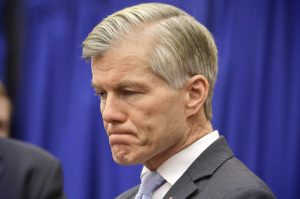
U.S. District Judge James Spencer on Tuesday sentenced former Virginia Gov. Bob McDonnell to two years in prison for political
Bob McDonald
corruption, the latest chapter in the spectacular fall of one of the Republican Party’s former rising stars. In September, McDonnell was convicted on 11 counts of corruption in a case that exposed how he and his wife, Maureen, conspired to promote a dietary supplement marketed by Jonnie R. Williams, Sr. in exchange for $177,000 in loans, vacations, and other gifts from the Richmond businessman. Maureen McDonnell, who was convicted on eight counts, will be sentenced on February 20. Federal sentencing guidelines called for a punishment for McDonnell of between 10 years and 12 years and seven months in prison. Given that judges in Spencer’s district imposed the recommended sentence more than 70 percent of the time in recent years, McDonnell, 60, entered the week staring down the possibility of more than a decade behind bars. But prosecutors on Tuesday lowered their requested sentence to between 6.5 and eight years in prison, and McDonnell’s 24-month sentence falls well short of even that reduced recommendation. Spencer ordered McDonnell to report to prison on February 9.
Elected as Virginia’s chief executive in a 2009 landslide, McDonnell was considered a top prospect to serve as Mitt Romney’s vice presidential running mate in 2012. After Romney lost the election to President Obama, many expected the popular governor to mount a 2016 presidential bid, but his political fortunes rapidly declined in 2013 as the investigation into the McDonnells’ relationship with Williams commenced. Shortly after McDonnell handed the keys of Virginia’s gubernatorial mansion to Terry McAuliffe in January 2014, he and Maureen McDonnell were indicted in the case. The ensuing trial laid bare the rifts in the former first couple’s marriage, and McDonnell testified that he and the onetime first lady no longer lived together. On Tuesday, however, Maureen McDonnell made a surprise appearance at her estranged husband’s sentencing. http://www.salon.com/2015/01/06/bob_mcdonnells_comeuppance_former_gop_rising_star_sentenced_to_two_years_in_prison/