Police are often accused of practicing racial bias. The head of the Monroe County Sheriff’s Office in Florida has been relieved of duty after ordering one of her officers to take that bias to another level.
The Washington Post reports that during a staged traffic stop involving a murder suspect that the police wanted a photo and thumbprint from, but didn’t want to tip the suspect off, Capt. Penny Phelps issued the following order:
She added, “I just want you to be the neo-Nazi who’s picking on the black guy riding the bike.”
As a result, the sheriff’s office removed Phelps from the murder case last month and, after learning of multiple allegations of misconduct, have opened an internal investigation. Phelps was also relieved of her duties as commander of the major crimes and narcotics units.
It’s common for officers to go undercover in order to retrieve information that would otherwise be unattainable, but considering the contentious relationship between police and the black community, Phelps was purposely sowing seeds of mistrust that could yield disastrous consequences.
Spokesman Adam Linhardt declined to confirm if Phelps’s instructions were followed or go into detail about what penalties she is facing. Officials also have yet to determine if Phelps violated department policy and offered no explanation as to why the sheriff’s office waited so long to remove her from command. Despite all this, her $110,000 salary remains unchanged.
So does that mean she’s keeping her job?
“We have to have all the facts first,” Monroe Sheriff Rick Ramsay told the Miami Herald on Saturday, noting that Phelps has worked for the sheriff’s office for almost 20 years.
My Pastor, the Reverend Dr. Jesse Voyd Bottoms consistently preaches a message which stresses that the thing that you need the most from God, is the thing you should give the most. Simply put, if you want love give love. If you want attention give attention to others who need it. If you want patience, demonstrate patience to those who need your understanding. And certainly, if you need to be respected, start by showing respect to others. Obviously, that is a message the Attorney General of the United States, William Barr needs to hear and understand. In seeking to become Donald Trump’s Roy Cohn, Bar has gone over and above the norms to try to gain favor with Trump. From withholding the Muller report, and creating a disingenuous summary, to disagreeing with the Justice Department’s own Inspector General’s finding that there is no evidence that Ukraine had anything to do with the 2016 presidential elections and a raft of other controversial stances. Barr has demonstrated that this is the segment of his life he wants to be judged by.
In a scathing address to the Federalist Society and later as he addressed the fraternal order of police, the Attorney General excoriated social justice reformers, arguing “We must have zero tolerance for resisting police”. This will save lives.” Barr singled out prosecutors, whom he criticized for being “social-justice reformers” and soft on crime. He berated those he deemed, not sufficiently respectful of police, but the Attorney General never once in either address, challenge those within the ranks of police departments who are brutalizing and murdering innocent unarmed citizens. Despite the heightened across the board’s attention being paid to unlawful police killings and abuses, [largely of African American citizens], Barr praised police bravery and suggested that communities that demonstrate against police abuses may see police services diminished. In other words, the Attorney General of the United States is advocating for the police to withhold services to the Black community, which pays the police, to provide policing services. It is an offense to receive payment to do a job and not do the job, and yes that is what the nation’s top law enforcement officer is threatening.
But threatening to withhold police services may not be such a bad thing for the African-American community. In fact, residents may be less afraid of losing their lives at the hands of out of control racist cops who have no respect for neither their dignity nor their humanity. Vice News reported, that after Chicago Police cut down on busting drug possession and prostitution after an officer was sentenced for killing black teen Laquan McDonald, Chicago actually got safer. The gall and temerity of the state police union after the seven-year sentence was handed down to murderer cop Jason Van Dyke, by asking citizens of the city: “Are you ready to pay the price,” of police officers not feeling comfortable doing their jobs. As far as the discredited Police union is concerned, killing a black teen who was walking away from Van Dyke, was [doing their job]. Not having its sons and fathers, uncles and brothers, cousins and husbands murdered by police, means the black community may be better off without the kind of services the police have to offer.
In New York City, the discredited, police unions encouraged their members to defraud the public which pays their salaries and benefits, to embark on work slowdown, after Daniel Pantaleo, the cop who murdered Eric Garner was finally fired. The result, crime went down. True to form the Chicago police department denied that they had been on a work slowdown after their actions blew up in their faces. In fact, an analysis of crime data by VICE News showed a significant reduction in police activity following Van Dyke’s sentencing on January 18. (Arrests by Chicago police officers dropped by nearly 50% citywide the evening after the sentence came down, and almost 25% in the two weeks following. At the same time, total crime as reported by police dropped to the lowest level in at least two decades, a stat consistent with a policing slowdown. Crime reports arising through street stops, such as drug arrests and weapons violations, fell the most precipitously, as officers continued to respond to serious incidents like shootings). [vice news]
Communities need good police officers, they need officers who respect the citizens they serve. From time to time officers will find themselves dealing with unsavory characters who will inexorably cause them to be less than respectful and gentile, that is the nature of the job. Nevertheless, the idea that a community may have more unsavory characters of a particular type, does not give police a pass to be disrespectful of entire communities. Demanding respect is a surefire way to get resentment, hatred, and ridicule. Demanding that an entire community of 47 million demonstrate fealty and reverence to an organ of government that has never shown respect to them is simply laughable.
Mike Beckles is a former Jamaican police Detective corporal, a business owner, avid researcher, and blogger. He is a black achiever honoree, and publisher of the blog chatt-a-box.com. He’s also a contributor to several websites. You may subscribe to his blogs free of charge, or subscribe to his Youtube channel @chatt-a-box, for the latest podcast all free to you of course.
Dothan, AL — 12 police officers in Dothan, Alabama, who were apparently members of a domestic hate group, has been found to have set up and falsely accused over 1,000 Black men with the intention to put them behind bars even though they were innocent.
.According to reports, a narcotics team consisting of at least twelve white police officers supervised by Lt. Steve Parrish, who is now Dothan’s Police Chief, and Andy Hughes, Asst. Director of Homeland Security for Alabama, regularly planted drugs and weapons on innocent Black men.
Once arrested and charged, the wrongly accused Black men were not given due process. District Attorney Doug Valeska, who prosecuted in those cases, was apparently aware of the scam and offered protection for the involved officers instead.
More than 1,000 innocent Black men were falsely prosecuted and most of them are still serving their sentences.
Over the years, the families of the wrongly convicted Black men were calling for justice but it has always been ignored. It was only until a group of conscientious White police officers noticed the cases and alerted the Internal Affairs Division that a full investigation ensued.
Authorities confirmed that an investigation on the cases are currently ongoing and a special prosecutor from outside of Alabama is handling the case.(bbnews.com)
PHOTOGRAPHYBYJOHNATHONKELSO . STORYBY JA’HAN JONES
TALLAHATCHIECOUNTY, Miss. ― In Mississippi, a state where Confederate generals are still vaunted with highways and holidays, there’s an ongoing debate over who, if anyone, gets to tell the story of Emmett Till. Emmett’s lynching in 1955 catalyzed the Civil Rights Movement and shed light on a raft of brutality inflicted on Black people in Mississippi. Many locals want Emmett’s story memorialized, to retell it so that the gruesome truth is never forgotten: The teen’s abduction and murder, coordinated by two white men, is counted among 580 other lynchings that occurred in Mississippi between 1882 and 1968, the most of any state over that span.
That bloodshed and bigotry are woven into the fabric of Mississippi’s history ― they emanate from the poplar trees and cotton clusters, and they weigh heavy on many Mississippians to this day. But others seek to erase this history, repeatedly making their denial known with violent and visceral desecrations of Emmett’s monuments. In June, a photo went viral online depicting three white Ole Miss students cheerfully posing with guns besides a bullet-riddled commemorative plaque to Emmett. Ben LeClere, John Lowe and Howell Logan became the public faces of a wider movement of rage against Emmett’s legacy in the delta, but they were following in others’ footsteps; the sign had previously been shot, scratched and doused with acid.
Opposing these forces is a group of people working to keep Emmett’s story at the forefront of the American consciousness, among them family members, local officials, and members of the Emmett Till Memorial Commission. HuffPost traveled to the Mississippi delta in October to meet them on the shore of the Tallahatchie River, where they unveiled a new, bulletproof memorial to Emmett, bringing national awareness once again to the fight for his memory. That sign, too, was met with bigoted resistance ― white supremacists used it as a prop for a propaganda video in early November. But history shows that this group of historians won’t be deterred. For them, preserving the story of the most famous lynching in American history is not just about atonement, but about ownership of wrongs committed and atrocities inflicted.
Jessie Jaynes-Diming, a member of the Emmett Till Memorial Commission, photographed inside the Emmett Till Interpretive Center.
Jessie Jaynes-Diming, Civil Rights Tour Guide
Jessie Jaynes-Diming conducts tours of civil rights sites in the Mississippi delta and serves on the board of the Emmett Till Memorial Commission. She took us on a tour of Bryant’s Grocery & Meat Market in Money, Mississippi, where Carolyn Bryant, a white woman, falsely accused the 14-year old child of sexually harassing her in 1955. This history, she said, could be lost if it’s not constantly retold.
Bobby Winningham, a tourist from Cookeville, Tennessee, snaps a photograph of a dilapidated building that was once Bryant’s Grocery & Meat Market in Money, Mississippi. Since Emmett Till’s lynching in 1955, the small town of Money, located in Leflore County, Mississippi, has essentially become a ghost town
“I think it’s important to know the history, understand it and create conversations,” Jaynes-Diming said. “The children from here, and a lot of the adults, were not always aware of this history.” She spoke of visitors from across the globe; international tour guests who have a keen interest in civil rights history. As she talked, drivers in all sorts of vehicles stopped at the site, pulling up and craning their necks outside their windows to eavesdrop. She said when she moved to Mississippi from Chicago, where Emmett Till was originally from, she was surprised to learn many people in the delta didn’t know who he was. That discovery inspired her to get involved with the civil rights tours and the memorial commission.
Emmett Till’s cousins, Airickca Gordon-Taylor (left) and her mother Ollie Gordon (right) confront the seed barn where Emmett Till was killed in 1955. Among the many Till commemorative sites in the Delta, this location remains void of any historical marker or sign to tell of its significance to the lynching.
Ollie Gordon and Airickca Gordon-Taylor, Family
Ollie Gordon, Emmett Till’s cousin, lived with Emmett and his mother, Mamie Till-Mobley, for a period when the two were in Chicago. Her daughter, Airickca, runs the Mamie Till-Mobley Foundation, an organization honoring Till-Mobley’s legacy as a mother and activist in Emmett’s honor. They stood in a seed barn located in the small city of Drew, Mississippi ― the exact barn where Emmett Till was tortured and killed before being tossed in the Tallahatchie River. They remembered the sacrifice of their family members and Black community leaders before them, who gave everything to tell Emmett’s story. “When Uncle Mose testified against Emmett’s killers, that was the first time a Black man had ever testified against a white man,” Ollie said. “He had to hide out in the graveyard the night of testimony to get out of there, because they would have killed him.”
A crumpling facade filled through with bullet holes is what’s left of East Money Church of God in Christ where Moses Wright, Emmett Till’s great uncle, once pastored before fleeing Mississippi. When Till’s body was discovered on August 21, 1955, plans were made to have him buried in the cemetery adjacent to the church, and a grave was quickly dug. However, Till’’s mother, Mamie, insisted his body be returned home to Chicago. Ollie Gordon views the newly erected bulletproof Emmett Till commemorative marker for the first time during during a re-dedication ceremony hosted by the Emmett Till Memorial Commission.
Both Gordon and Gordon-Taylor said they’re motivated to continue commemorating their cousin for members of their family who still live in fear of what an association to Emmett might mean in the Mississippi delta. “We have cousins who were witnesses, and they live in fear today. Some of them won’t talk about it and never have,” Ollie said. Airickca added: “I think the bulletproof memorial is just saying you can shoot it, knock it down, you can throw it in the river, you can steal it, but we’re gonna keep replacing it because we’re never gonna forget Emmett Till.” “In defacing it, they’re saying ‘we don’t want to remember what happened to that 14-year-old Black boy from Chicago.’ But we’re not gonna let you forget it.
Emmett Till’s cousins, Ollie Gordon (left) and her daughter Airickca Gordon-Taylor (right), hold hands outside of what’s left of Bryant’s Grocery & Meat MarketAuthor Dave Tell stands in a lower level of the historic Sumner Courthouse where the trial of J.W. Milan and Roy Bryant took place in 1955. Tell wrote the text that accompanies the newly erected Emmett Till commemorative marker which is placed at Graball Landing in Tallahatchie County, Mississippi
Dave Tell, Professor
Dave Tell, a professor at the University of Kansas, walked us through the Sumner Courthouse in Tallahatchie, Mississippi. Here, after a five-day trial, an all-white jury returned a not guilty verdict for Emmett’s killers, J.W. Milam and Roy Bryant. The jury reportedly needed only 67 minutes of deliberation. Tell is the author of “Remembering Emmett Till” and a co-creator of the Emmett Till Memory Project, a digital tour of related sites. His scholarship interrogates the misleading ways Emmett’s story has been told over time, from misplaced markers to misinformation about accomplices.
A historical marker placed in front the historic Sumner Courthouse commemorates the infamous trial of two white men, Roy Bryant and J.W. Milan, who were acquitted of the murder of 14-year-old Emmett Till in 1955. The jury seats located within the historic Sumner Courthouse where on Sept. 23, 1955, an all-white jury took only 67 minutes to deliberate before returning a verdict of not guilty for Roy Bryant and J.W. Milam in the Emmett Till murder case.
Notably, Tell’s dogged research into civil rights commemoration revealed how Mississippi officials used public funds to refurbish a local gas station rather than maintain Bryant’s Grocery & Meat Market, a critically important site in the story of Till’s murder. Today, the gas station, which bears no relationship to the story, looks pristine while Bryant’s Grocery mere feet away falls to pieces, meekly tucked behind a wall of shrubbery. Frequently, passersby mistake the gas station for the historic grocery store, and the roadside marker commemorating the site — confusingly placed between the two — does them no favors. Tell said it’s this sort of research — the story about the story of Emmett Till — that Emmett’s surviving family has come to appreciate. “My relationship with the Till family has been strong because I don’t want to tell their story. I don’t want to pretend to have any authentic sense of what it must have felt like, because that’s their thing. I just want to tell those same stories from the perspective of people who live in their shadow.” Tell’s efforts in researching civil rights commemoration across the South has uncovered repeated instances of local governments misidentifying or mislabeling historical sites in order to direct grants to their cities and towns.
University of Mississippi students Tyler Yarbrough (left) and Curtis Hill (right) carry a bullet-ridden Emmett Till commemorative marker through campus towards a Confederate statue on campus
Tyler Yarbrough is a senior majoring in public policy at the University of Mississippi. After an Oct. 18 panel discussion concerning racism at Ole Miss, Yarbrough and fellow panelist Curtis Hill walked through campus carrying a desecrated marker that commemorated Emmett, before placing it at the base of a Confederate monument nearby. The gesture appeared to link the two objects as parts of the same white supremacist tradition. In July, a photo circulated online depicting three Ole Miss students who are members of a pro-Confederate fraternity standing beside the bullet-riddled sign-carrying guns.
University of Mississippi students (from left to right) Tyler Yarbrough, Isabel Spafford, Curtis Hill, and Yasmine Malone hold a bullet-ridden Emmett Till commemorative marker in front of a Confederate statue on campus. The students carried Emmett Till’s marker through campus to the Confederate monument after a panel discussion hosted earlier that evening by the Emmett Till Memorial Commission
“I just remember a tear falling down my face when we actually got to the statue, because I knew all about how that statue has been a rallying point for white supremacy in our school’s history,” Yarbrough said Ole Miss is in the process of removing the Confederate monument from its campus and placing it in a nearby graveyard after months of student-led protests.
Johnny B. Thomas, founder of the Emmett Till Historic Intrepid Center (E.T.H.I.C. Museum), and the Mayor of Glendora, Mississippi. Thomas’ father, Henry Lee Loggins, was one of the five African-American men listed as accomplices to the kidnapping and lynching of Emmett Till.
Johnny B. Thomas, Mayor
Johnny B. Thomas is the mayor of Glendora, Mississippi, a small, financially-strapped village of fewer than 200 people. Here, he is pictured in the Emmett Till Historic Intrepid Center, a museum he runs in Glendora featuring replica items related to Emmett’s case. His father, the late Henry Lee Loggins, has been tied to Emmett’s murder for years as an alleged accomplice believed by some to have been forced to participate.
An exterior shot of the Emmett Till Historic Intrepid Center (E.T.H.I.C. Museum) which was founded by the Mayor of Glendora, Johnny B. Thomas. Thomas claims that the cotton gin fan used to weigh down Till’s body was stolen from this site in 1955
“I’m thinking [here in Glendora] is where you’re going to find stories of African Americans that were made to participate, such as my father, who I believe was made to participate. African Americans were made to participate [in Emmett’s killing]. And those African Americans died along with Emmett, as far as I’m concerned, but had to stay here and suffer as a result.”
An exhibition on display at the The Emmett Till Historic Intrepid Center recreates the open casket funeral of Emmett Till at Roberts Temple Church of God in Christ in 1955. A replica of the green pickup used in Emmett Till’s lynching titled, “The Truck of Torture”, on display at the Emmett Till Historic Intrepid Center.
The Center is the only museum in the world dedicated entirely to Emmett, according to the Emmett Till Memory Project. In addition to a specially made replica designed to look like Emmett’s body in his open-casket funeral in Chicago in 1955, Thomas also features in his museum a model of the truck J.W. Milam and Roy Bryant used to kidnap him.
Reverend Willie Williams of the Emmett Till Memorial Commission stands outside the Rollins United Methodist Church in Tutwiler, Mississippi, where he is the pastor.
Reverend Williams said his desire to advocate in support of Emmett’s legacy today has largely inspired the fact that Emmett’s story had been hidden and silenced in the Mississippi region for a half-century. “In the delta, Emmett Till was something that had been secret for almost fifty years, man,” he said. “People talked about it, but not publicly. And I’ve never been the type of person who felt like I was a victim. So that’s why I speak out like I do.”We met Rev. Willie Williams, the co-director of the Emmett Till Memorial Commission, at his church in the small northern Mississippi town of Tutwiler.
Williams was born in the Mississippi delta in 1955, two months after Emmett was killed, and his lineage in the delta runs deep. He recalled that few people in the area ― Black or white ― discussed Emmett’s murder when he was a child, fearing what could happen if they’d been associated with the Till family. Reverend Willie Williams of the Emmett Till Memorial Commission inside the Rollins United Methodist Church in Tutwiler, Mississippi.
Reverend Willie Williams of the Emmett Till Memorial Commission inside the Rollins United Methodist Church in Tutwiler, Mississippi
Reverend Willie Williams of the Emmett Till Memorial Commission, parked outside The Tutwiler Funeral home where Emmett Till’s body was embalmed in 1955 before being sent to Chicago. The Emmett Till Memorial Commission erected a historical marker to commemorate the location in 2008.
Reverend Willie Williams of the Emmett Till Memorial Commission, parked outside The Tutwiler Funeral home where Emmett Till’s body was embalmed in 1955 before being sent to Chicago. The Emmett Till Memorial Commission erected a historical marker to commemorate the location in 2008
Atlanta, GA — After the première of the highly anticipated docuseries Copwatch America aired on BET, the City of Atlanta presented Atlanta Police Officer Sung Kim with two alternatives: resign or be terminated. The former APD officer shot and killed unarmed 21-year old Jimmy Atchison in January 2019.
Attorney Gerald Griggs teamed up with BET to produce the docuseries providing unlimited, never before seen evidence to the network. This is the first time in the history of television that a major network was granted exclusive access to an attorney’s investigation.
“It’s going to be raw and uncut, but we are going to elevate the voices of these families. I wanted to show people the problem and then the solution because there is a solution, and that’s the Obama 21st century policing initiative,” said Attorney Griggs.
Former President Barack Obama convened a task force consisting of 150 participates — including representatives from law enforcement, elected officials, and community partners from 40 cities to identify the best practices to improve the relationship between law enforcement and the community. Mr. Obama released their recommendations to the public and their municipalities in 2015. To date, no law enforcement department has implemented all the recommendations, one of the reasons BET decided to begin filming this project earlier this year.
“Far too often, contact between law enforcement and black civilians ends in violence against innocent members of our community. It is our hope that this first-of-its-kind-exposé sheds light on the issue, provides solutions, and fosters a demand for accountability and justice,” said BET Networks president Scott Mills.
The docuseries will also include the cases of Veltavious Griggs, Oscar Caine, Eric Garner, Jamarion Robinson, and Nicholas Bolton. Griggs works alongside Chris “City” Mungin, Yonasda Lonewolf, Shar Bates, and Patrick Newbill.
Attorney Griggs has worked as an activist for over 20 years. His work with Jaheem Herrera’s case launched the National Anti-Bullying Movement and strengthened Georgia’s Anti-Bullying Law. Griggs’ intense investigation into the alleged crimes of R&B Singer Robert Sylvester Kelly led to felony indictments in several states, and Griggs pursuit of justice into the brutal beating of Maggie Thomas in front of her four-year-old daughter ended with Atlanta Police Officer James Hines fired in seven days.
Earlier this month, a mother who was grieving the tragic and shocking loss of her 4‑year-old child, found herself lying face down in the parking lot of a hotel as Arkansas police handcuffed her.
According to Arkansas Democrat-Gazette, Monday, Shawnda Brookshire, whose daughter Nia died in an Interstate 40 wreck two days earlier, was released by authorities without being arrested or charged, after a 20-minute showdown that culminated in her being pulled to the ground and threatened with a taser.
“My family and I flew to Arkansas to be with my sister yesterday, we checked in to the hotel after spending the day getting clothes for my 4‑year old niece’s body today,” her brother, Richard Brookshire, the Director of Digital Strategy at Iraq and Afghanistan Veterans of America, posted on Facebook. “We were exhausted, had just left the funeral home where my sister and I had seen my niece’s body for the first time and had come to the hotel to get some rest.”
“My sister needed to get some fresh air after such an emotional day and was outside speaking on the phone when random officers rolled up flashing lights in her face. She showed them her hotel key and they got out of the car and asked for identification. She said her ID was inside,” he continued. “She asked the police what she was doing wrong, they surrounded her. She immediately called me and my mother on the phone and yelled that she needed help.”
Brookshire then goes on to share a gut-wrenching tale about how he, his mother and his legally blind aunt all pleaded with authorities to show mercy on the woman whose child had just died the day before.
HELP: Yesterday, my niece was killed in a tragic accident, hundreds of miles from home. As my family begins to grieve, a mere 7 days ahead of what was supposed to be her fifth birthday — we need help covering the costs of her funeral arrangements.
In response to the family’s explanation, “the cops said there had been car burglaries in the area days prior and that they were arresting my sister under that suspicion because she was outside pacing back and forth on her phone (talking to my dead niece’s father). Her failure to provide I.D. when asked was enough for them to place her in handcuffs even when they simply could have gone to the front desk and verified that she was in fact a guest at the hotel.”
What makes this story even more disgraceful is that after the family went public, the West Memphis Police Department immediately tried to cover up the incident and protect the actions of its officers.
“I think it’s important to note that the West Memphis PD have already begun to spin/manipulate the story with dishonest recounts – failing to release body cam footage, having released dashboard audio with one minute redacted and deleting their public statement on the matter after pushback for its inaccuracy and callousness,” Brookshire shared while speaking to theGrio.
On the released audio, an officer can be heard joking that the woman’s hoodie alone was probable cause for the stop, and he speculated about how he expected a ruckus once her brother showed up, stating, “Damn, her brother, too – I thought it was about to be on, son.”
In an attempt to hide their lack of compassion, Brookshire alleges authorities also, “falsely stated in a local news interview that they’d not been informed of the death,” but says, “my sister tells them clearly her daughter died, and showed her hotel key to prove she was a guest at the hotel and asked to be left alone because she’d done nothing wrong in the first 2 minutes of being confronted.”
“They also only released hotel video footage from a camera farthest from the scene in order to avoid releasing footage from the camera directly above the encounter, which will dispute their narrative about not slamming my sister to the ground and placing their knee on her shoulder/neck/back,” he concluded.
Brookshire says the family plans to file a formal complaint, but at the moment their main concern is burying his niece. Her funeral is on Monday, just one day after what would have been her 5th birthday. A GoFundMe has been set up for those seeking to provide financial assistance to the family during this incredibly difficult time.
Ashford, AL — Parents and students from a high school in Alabama are furious after a racist chat group of teachers was discovered by a student. The teachers in the chat titled “Bad A B’s” were allegedly talking about Black students, mocking them and calling them the n‑word.
In the leaked portion of the group chat, the teachers were talking about a student named Anastasia Williams who they said was possibly pregnant. Other teachers then commented that she is quiet and also isn’t the sharpest student.
“I guess she mime sex?” one teacher allegedly said.
In another part of the chat, another teacher used the n‑word on Preyun Snell, a former student at Ashford high.
“That n — – so slow he can’t walk and chew gum,” the teacher allegedly said.
Preyun said he knew the teacher who used the slur but he did not expect she would do that. Besides, he also had bad experiences at the school because of racial incidents in the past.
“I don’t like this school, period,” he told WDHN. “They racist, all of these folks racist.”
Moreover, Anastasia said one of the teachers apologized to her after the group chat was leaked.
“She was like she didn’t mean anything that she said or anything like that,” she said.
The student who leaked the messages said he saw the chat when a teacher gave him her phone during school hours. He took a video of it and sent it to numerous people.
Several parents were angry and said the teachers should be fired because they were not setting “good examples” anymore. Some even recalled other incidents in the past where teachers at the school also behaved inappropriately. They said some teachers sprayed chairs of students due to smell and called them less fortunate.
Venissa Wilson, an alumna of Ashford High School, said she experienced issues back when she was a student there.
“I stood up to them,” she said. “I stayed back and forth from alternative school because I came to learn, and with the teachers doing the same thing when I was in, I just did my days and (came) back because you ain’t gonna bully me.”
Meanwhile, Houston County School Superintendent David Sewell said that the teachers, whose names were not released, have been suspended.
“There are a lot of gray areas when it comes to anything that takes place on a cell phone,” Sewell said. “I hate that it happened. We try to put policies and procedures in place to make sure things like this don’t happen. We’ll go back and try to reinforce.”(Black news)
Just when you thought American police cannot get any more reprehensible. I mean they choke people to death in broad daylight. The verdict from Investigators; No wrongdoing. Shoot fleeing unarmed people in the back multiple times. Shoot unarmed citizens multiple times who poses no threat. Sodomize citizens and commit all manner of crimes imaginable against the very same citizens they are sworn to protect. They falsify reports and openly lie in court, when found out, no action is taken against them. In a nutshell, American cops have become a dangerous gang of thugs, that poses an existential danger not just to Black-Americans, but all people of color. The sad reality is that they operate in a system of impunity codified in the legislatures, validated in the judiciary and egged on by the executive branch.
In this latest iteration of the savagery of these brutes, a Pima County deputy brutally attacked a 15-year-old quadruple amputee in Arizona. The child has no arms and legs and he has been arrested and charged along with his 16-year-old friend who recorded the horrific video.
Local news outlet KOLD reported the incident happened in September (the exact date of the video is not clear) while the 15-year-old was living in a group home. He reportedly got upset with a staff member and knocked over a garbage can. The police were called and an unidentified (social media will surely change that) deputy arrived on the scene. The eight-minute video shows him screaming and cursing at the child and eventually wrestling him to the floor.
Bodycam footage shows 19-year-old De’Von Bailey getting shot in the back as he ran from police. A grand jury said the officers were justified in killing him.
COLORADOSPRINGS, Colo. (AP) — A grand jury found that two Colorado police officers were justified in killing a black teenager who was shot multiple times in the back during a foot chase, the district attorney said Wednesday. As a result, no criminal charges will be filed against the officers involved in the Aug. 3 death of De’Von Bailey in Colorado Springs, KRDO reported, citing El Paso County District Attorney Dan May. Bailey, 19, was shot three times in the back and once in the arm. In Colorado, district attorneys can decide to file charges, send a case to a grand jury or determine police were justified in a shooting. “For De’Von’s family, the decision was like a kick in the gut, but of course we are not one bit surprised,” family attorney Mari Newman said. “This is the exact result that the system was designed to yield when a tainted investigation is presented by a biased prosecutor. This is precisely why we have been calling for an independent prosecutor and an independent investigation from the beginning.”
Police body camera footage shows officers talking to Bailey and another man in a neighborhood about an armed robbery that was reported nearby. One officer ordered the men to keep their hands up so that another officer could search them for weapons. Bailey ran as he was about to be searched and was shot after he put his hands near his waistband. The footage shows him falling to the ground and the officers running up to cuff his hands behind his back.
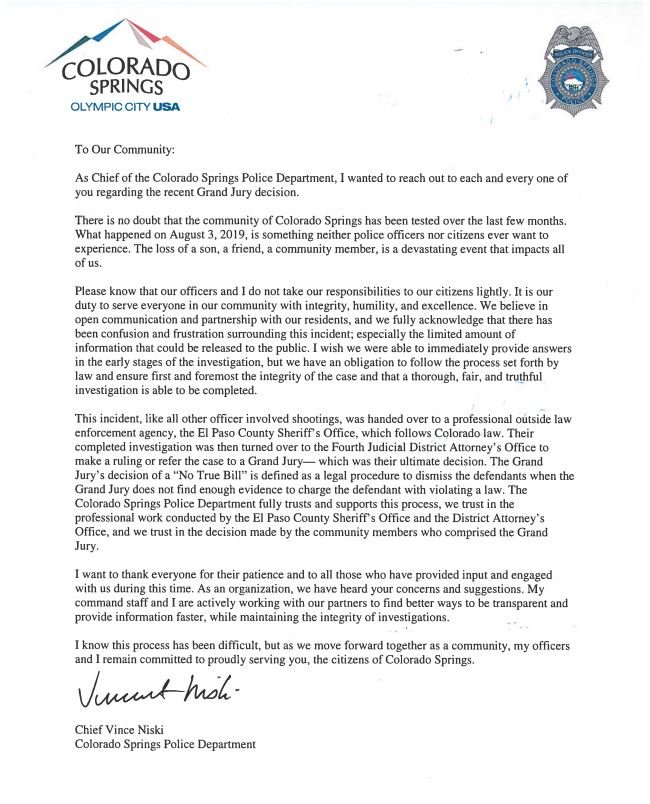
Police said they found a gun hidden in Bailey’s shorts. The shooting “is something neither police officers nor citizens ever want to experience,” Police Chief Vince Niski said in an open letter to the community Wednesday. “The loss of a son, a friend, a community member, is a devastating event that impacts all of us.” He also said he “fully trusts and supports” the investigative process, noting that the El Paso County Sheriff’s Office looked into the death before the district attorney handed the case to the grand jury.
Newman, who was joined by Gov. Jared Polis and Colorado Springs Mayor John Suthers in calling for an independent investigation, said Wednesday she would pursue additional legal action. “The criminal justice system, as we see time and time again, is skewed in favor of the police,” she said. This story originated at the Huffingtonpost.com.
Imagine spending one-third of your life in prison for something you didn’t do. Would you bitter, angry or resentful? For many people of color in America, this is not a mere thought experiment, but a real possibility. According to a report from the National Registry of Exonerations, innocent black people are 12 times more likely to be falsely convicted of a drug crime than innocent white people.
Fulton Leroy Washington of Compton, California, who goes by Mr. Wash, is one of those who were wrongfully convicted of such a crime. In 1997, Washington was sentenced to life in prison for conspiracy to manufacture the drug PCP. His youngest daughter was two years old at the time. For over 21 years, Mr. Wash served time in prisons in Kansas, Colorado, and California. In that timeframe, he taught himself how to paint after his attorney asked him to draw the witness who could help corroborate his story. Then, in May, 2016, Mr. Wash was one of 58 prisoners who had their sentences commuted by former President Barack Obama.
Mr. Wash took to continuing to paint after being released from prison, and to date, he has painted nearly one thousand paintings, including portraits of public figures and prisoners. Perhaps his most well-known painting is his take on Francis Bicknell Carpenter’s First Reading of the Emancipation Proclamation with Abraham Lincoln. In Mr. Wash’s painting, President Obama replaces Lincoln; the emancipated is Mr. Wash.
Now, Mr. Wash’s life story is being told in a short documentary titled “Mr. Wash,” produced by WeTransfer and which can be seen on YouTube. Mr. Wash lives in Compton today, painting and spending time with his family, and headed to Africa to fulfill a prayer request and visions of his dreams (more on that here.). When I sat down to interview Mr. Wash in Telluride at the ideas festival Original Thinkers, he started by interviewing me. “Who are you?” he asked, following up with more questions about my life. “This what happens when you’re in court. When you’re fighting your case and fighting for your life, you learn to get the proper information,” he explained. This bit of wisdom recalls the words printed on a shirt sold on his online store: “Reading can seriously damage your ignorance.”
Here is the rest of our conversation, edited for length and clarity.
So can you share more about what brought you to this festival?
When people hear that a person was wrongfully convicted, and he’s out of prison, I believe that in their minds, they have a pre-existing idea of what type of person that would be. And when they meet me, their whole reality change[s]. This is what I’m hearing from people — is that, “I would have never known that you’d been in prison for many years.” They say: “You are not angry, you are not institutionalized, you have a different type of spirit about you.”
What was that like in 1997 to be wrongfully convicted?
It was unbelievable. It was surreal because I was a person who was raised up to believe in the system. And I still do. But, I always —I watched the conviction, and I thought that it was part of a ploy, that the government used to weed out the truth. And because I’d never been to these places that they went to, and I never committed a crime, I always felt that I was going to go home, once they got everything settled. But, instead, I learned that they actually fabricated the evidence against me to cover their own investigative failures.
Who is “they”?
It would be the team taskforce. A team of federal, state, and local officers and agents comprised of DEA, LAPD, LASD, and BNE.
So, 21 years in jail. Your life changed in many ways. Can share more about what your day-to-day was like, and how that changed in prison?
I think the first year in transition was about letting go. I had a company, I had employees, I had family, and so the first couple of years was letting go of the company, letting go of the responsibility of my employees and their families. Then, while you [do] that, you’re losing your equipment, you’re getting sued for the contracts that you weren’t able to finish, and the companies have to have other people to do it, and now they’re billing you. I had to go through all of that type of stuff, and that was like the first year or two.
And then, following that, the transition was about learning more about the law, a lot of reading. We have a T‑shirt on Wash Wear that says, “Reading will seriously damage your ignorance.” I realized how ignorant I was about the law. And how it had me captivated when I was reading and finding truths. So then, I guess I was coming to an awareness, that, “wow, the system is not what I thought it was.”
Then, from there, it became survival, at the same time. All while this is going on, there’s a survival mode because you’re in a new environment, and time is of the essence. You have to try to prove your innocence by such and such a time. And if you don’t, you lose the opportunity but, you have to survive, while trying to do that, and how you balance the two. It became kind of difficult.
Of course. And is that how you turned to painting?
The art came prior. It came during the time in court. We were having a post-conviction hearing, my attorney asked me to draw people that I worked with, when the government said that I was purchasing chemicals to be used in the manufacture of illegal drugs. And that sketch drawing became a piece of evidence because they found the people from that drawing. And that became a piece of evidence, and that day I cried in court. I couldn’t control it. And I promised God, I would continue to practice that type of art, and to share it, freely.
So then how did your art style change when you were in jail? It seems you advanced from sketching to portraiture, maybe.
During that time of incarceration, I quickly learned that you cannot become emotional in prison. If you become emotional, and show emotion, several things could happen. One, the guys would think that you was wussy or whatever, and then you become a victim, and you [are] subject to everything that you could imagine under the sun; beatings, rapes, and everything else. Two, if you’re especially emotional around the police, the staff or the institution, then their psychiatrist would interpret it as being that you’re mentally unstable. So you have anger issues, or you have [something else] — the psychiatrist will find some kind of box to put you in.
So you have to build your life, your personality around — how you navigate between that, how do you stay strong in front of all the prisoners that you’re with. But also, stay sane in front of the officers.
So the artwork became that vent, that, okay, I’m not going to say what I feel, my feelings are mine but, I’m going to paint them. And then I’ll give the painting to the world, and let you interpret it, you say what it makes you feel It became a way of communication, and it became a storytelling process.
So I think when you look at the work collectively, that’s what you see. If I could ever get all the paintings back, and put them in a line, from the very first one, to the last one, it would be a story that people look at and say, you go in and out of my mind like this, like a wormhole.
I have a hard time remembering what I paint. I don’t know what I paint. If I don’t have a photograph of it, I don’t know, I paint so many because that’s [how I] stay balanced. You have emotional things that come in, and okay, you put it on a piece of paper, fold it up, put it in an envelope. That emotion is safe.
Yeah, and I guess that’s kind of how art is. You put something out in the world, and it’s really up to the people who are taking it in to decide what it means.
Yeah. Speaking of which, I did a couple of pieces, and the institution accused me of trying to escape from prison, and seized all my work and punished me. So then, I became afraid to be expressive, even of art.
How long did that go on for?
That was for ninety days but it was so severe because I was not allowed to paint anything. For a period I was kicked out of the art room. I could only look through the windows. That was, traumatizing.
Were there any points where you felt like giving up?
No, never to the point of giving up. You can’t give up on life. Life only goes in one direction. Definitely, there’s points where you tire down, your body needs to rest, your mind needs to rest, you need to think about something different. And you have those little moments that come in between, from one following to another. You work three or four months on one document, and you want to dot all your I’s and cross all your T’s, so you write it, rewrite it, read more or research new laws come out, and incorporate it into the document. The new law points to the facts and reasons why you shouldn’t be here. And then, once you file it in court, then you know you got to wait. And sometimes the wait can be anywhere from months to years. You never know. So how do you keep sanity in between that time, for me, that’s when I paint.
And I switch around from five days a week, two days painting, to five days painting, two days, reading over case logs. So you get about a month or so of that. One time it went for like … I was in the Supreme court for almost two years, waiting on them. So you just waiting, in limbo. And then what happens, is that, every time you file these types of petitions, and all your family get with you, and everybody excited and they with you, and then when you get denied, they’re hurt so bad, that pretty soon, they never get excited no more, to help you.
Yeah. So what does your art look like now? Has your art changed since now, you’ve been out of prison?
It hasn’t really changed much. I consider myself [s]till in prison. I’m still on parole. I don’t fool myself into thinking that I’m not incarcerated because I’m sitting here in a restaurant with you. I still have to report [to my parole officer]. So I never mistake myself to let myself be part of that delusion, that I’m free. I’m not free.
So that’s what happens when people have that false sense of freedom. They forget. So when you asked about how did my art change now that I’m out — I’m not out, and the art hasn’t changed. I’m doing the exact same thing that I did then. I paint portraits for people. If you want it painted, I’ll tell your story. When it comes to telling my story, I’m still trying to finish telling my story.
What do you hope that people learn from your story?
I hope that they learn [how] to become proactive [e]arly. The youth, when they coming out of high school, pay attention to the law, and change the law. And I think that instead of always looking for news and stuff, to get highlights, you got to read, and get in there to find out your own future.
What’s next for you?
What’s next for me is this, the end of my journey. When I was in prison,. for some reason, the very first painting that I painted was the Amistad, the dead slaves in the ship. At that time, in painting that, I didn’t know I was born on a plantation. Every other picture that I painted of myself, was telling my story and my journey, I was always in shackles and chains. All the way until the last picture, the Emancipation Proclamation.
So with that said, the next step in the journey, is, I told a lot of the inmates, they said, “Mr. Washington, what are you going to do when you get out of prison?” They say, you got life now, I don’t have a life, I’m going to get out. What are you going to do when you get out? “I’m going to Africa,” I’d say. In my mind then, I was going to stay and never come back.I guess a part of me will live in Africa forever in my art, because when I get there I will paint and capture history with my brush. I expect to become a visual voice for those that can’t find the words to speak.
Houston, TX — 42-year old Lydell Grant, a Black man from Texas, has been behind bars for the past 7 years serving a life sentence after being convicted of a murder that he says he did not commit. There has even been a DNA test administered that has proved his innocence, and yet he still remains in prison.
Grant was accused of chasing down and fatally stabbing Aaron Scheerhoorn, a 28-year old man, near a night club in Montrose, Texas in December 2010. Grant was arrested days after the incident because of a Crime Stoppers tip.
During the trial, no one testified about whether the victim and Grant, who was a gang member and has previous arrest records, knew each other before the incident. He has since maintained his innocence and said that he did not commit the crime. But in 2012, Grant was convicted and sentenced to life in prison for murder.
Just recently, new evidence and testimonies prove his innocence. Aside from eyewitnesses who said Grant was not the one who killed the victim, the state DNA expert testified that Grant’s DNA does not match the DNA recovered from below the victim’s fingernails.
Moreover, the DNA test, which was even retested by the Innocence Project of Texas and the DPS crime lab, reveals that the identified suspect still remains at large.
While his release and exoneration are on the process, he could have been released on bond. Last week, Grant was in court for the hearing that would allow him to be released on bond, but the judge ruled he will remain in custody.
Another hearing is scheduled in late November but his family was somehow disappointed that Grant would still have to remain in custody and their reunion was postponed until then.
“We know he’s innocent, and we’re gonna fight to the end,” his aunt, Kitsye Grant, told ABC13. “They really need to go and find the right person. What I feel bad for is the mother of the young man, the victim. They got the wrong person.”
ASIFFERGUSON WASN’T BADENOUGHTOTHIS STATE’S REPUTATIONAS A RACISTBACKWOODSPLACEHEREWEGOAGAINWITHTHESENEANDERTHALS
KANSASCITY, Mo. (AP) — Kansas City voters on Tuesday overwhelmingly approved removing Dr. Martin Luther King’s name from one of the city’s most historic boulevards, less than a year after the city council decided to rename The Paseo for the civil rights icon.
Unofficial results vote showed the proposal to remove King’s name received nearly 70% of the vote, with just over 30% voting to retain King’s name.
The debate over the name of the 10-mile (16.1 kilometer) boulevard on the city’s mostly black east side began shortly after the council’s decision in January to rename The Paseo for King. Civil rights leaders who pushed for the change celebrated when the street signs went up, believing they had finally won a decades-long battle to honor King, which appeared to end Kansas City’s reputation as one of the largest U.S. cities in the country without a street named for him.
But a group of residents intent on keeping The Paseo name began collecting petitions to put the name change on the ballot and achieved that goal in April.
The campaign has been divisive, with supporters of King’s name accusing opponents of being racist, while supporters of The Paseo name say city leaders pushed the name change through without following proper procedures and ignored The Paseo’s historic value.
Emotions reached a peak Sunday, when members of the “Save the Paseo” group staged a silent protest at a get-out-the-vote rally at a black church for people wanting to keep the King name. They walked into the Paseo Baptist Church and stood along its two aisles. The protesters stood silently and did not react to several speakers that accused them of being disrespectful in a church but they also refused requests from preachers to sit down.
The Save the Paseo group collected 2,857 signatures in April — far more than the 1,700 needed — to have the name change put to a public vote.
Many supporters of the Martin Luther King name suggested the opponents are racist, saying Save the Paseo is a mostly white group and that many of its members don’t live on the street, which runs north to south through a largely black area of the city. They said removing the name would send a negative image of Kansas City to the rest of the world, and could hurt business and tourism.
Supporters of the Paseo name rejected the allegations of racism, saying they have respect for King and want the city to find a way to honor him. They opposed the name change because they say the City Council did not follow city charter procedures when making the change and didn’t notify most residents on the street about the proposal. They also said The Paseo is an historic name for the city’s first boulevard, which was completed in 1899. The north end of the boulevard is listed on the National Register of Historic Places.
The City Council voted in January to rename the boulevard for King, responding to a yearslong effort from the city’s black leaders and pressure from the local chapter of the Southern Christian Leadership Conference, a civil rights organization that King helped start.
U.S. Rep. Emanuel Cleaver, a minister and former Kansas City mayor who has pushed the city to rename a street for King for years, was at Sunday’s rally. He said the protesters were welcome, but he asked them to consider the damage that would be done if Kansas City removed King’s name.
“I am standing here simply begging you to sit down. This is not appropriate in a church of Jesus Christ,” Cleaver told the group.
Tim Smith, who organized the protest, said it was designed to force the black Christian leaders who had mischaracterized the Save the Paseo group as racist to “say it to our faces.”
“If tonight, someone wants to characterize what we did as hostile, violent, or uncivil, it’s a mischaracterization of what happened,” Smith said. “We didn’t say anything, we didn’t do anything, we just stood.”
The Rev. Vernon Howard, president of the Kansas City chapter of the SCLU, told The Associated Press that the King street sign is a powerful symbol for everyone but particularly for black children.
“I think that only if you are a black child growing up in the inner city lacking the kind of resources, lacking the kinds of images and models for mentoring, modeling, vocation and career, can you actually understand what that name on that sign can mean to a child in this community,” Howard said.
If the sign were taken down, “the reverse will be true,” he said.
“What people will wonder in their minds and hearts is why and how something so good, uplifting and edifying, how can something like that be taken away?” he said.
But Diane Euston, a leader of the Save the Paseo group, said that The Paseo “doesn’t just mean something to one community in Kansas City.”
“It means something to everyone in Kansas City,” she said. “It holds kind of a special place in so many people’s hearts and memories. It’s not just historical on paper, it’s historical in people’s memory. It’s very important to Kansas City.”
A 61-year-old man has been arrested by Milwaukee police in an acid attack on a stranger who said the assailant told him to “go back to your country.”
Police said they’re investigating Friday night’s attack, which left Mahud Villalaz with second-degree burns to his face and vision problems, as a hate crime and expect the district attorney to bring charges within a week. Police didn’t release the name of the man they arrested on Saturday.
Villalaz, 42, described how he parked his car outside a restaurant and was approached by the assailant, a white man upset that he was too close to a bus stop.
“He started talking like, ‘You don’t respect my laws. You can’t invade my country, so go back to your country,’” Villalaz, who is a U.S. citizen and Latino, told NBC News.
A Milwaukee police spokesperson characterized the crime as aggravated battery. Alderman Joe G. Perez said he has been assured the suspect will face hate crime charges.
This “was a heinous crime that will have a long-term impact on the life of the victim,” Perez said in a statement. “We as a community need to come together to work through our differences and learn to respect one another and diffuse conflict.”
Mahud Villalaz, 42, said he was accused of being an illegal immigrant before he was splashed with the liquid, which burned his face.
Villalaz said he moved his car after the man’s outburst. But the assailant, he said, was still there ― and still angry.
Surveillance video shows the two men facing one another on the sidewalk when the assailant, wearing a hooded coat, suddenly splashes Villalaz with a cup of liquid investigators believe was battery acid. Villalaz quickly covers his face and lurches backward, out of the camera’s view, as the assailant, still holding the cup, calmly steps toward him.
“I don’t want this guy near my kids, near my family,” Villalaz, fighting back tears, told reporters on Saturday. “My son calls me today, ‘Daddy what happened to you?’ What do I tell him? Some crazy guy did this to me?” https://www.huffpost.com/
The white, former regional manager claims racial discrimination in her firing, which came after the arrests of two black men in a Philadelphia Starbucks sparked protests.
People enter the Starbucks in Philadelphia’s Center City to participate in staff training to prevent racial discrimination on May 29, 2018. The arrest of two black men at the Center City Starbucks sparked local and national outrage. Jessica Kourkounis /Reuters
A white former regional manager for Starbucks alleges in a lawsuit that she was a victim of racial discrimination when the coffee giant fired her after the arrests of two black men in a Philadelphia store last year sparked local and national outrage.
In the suit filed Monday in the U.S. District Court for New Jersey, Shannon Phillips alleges she was a 13-year employee of Starbucks, overseeing stores in southern New Jersey, the Philadelphia area, Delaware and parts of Maryland, when employees at a Philadelphia store called 911 in April 2018 to say two black men were trespassing.
The men, who an attorney said were at the store for a business meeting, were arrested.
They were eventually let go after about eight hours in police custody, with a district attorney’s spokesman saying there was a “lack of evidence” of a crime.
Starbucks did not press any charges, but rather apologized and, on one morning the following month, closed its more than 8,000 stores across the country for racial sensitivity training.
Phillips says in her lawsuit that after the arrests she “immediately took steps to learn additional information about the events … address strong community reaction” and “ensure the safety” of Starbucks’ employees and customers.
She also “took steps to ensure that the retail locations within her area were a safe and welcoming environment for all customers, regardless of race,” the suit says.
About a month after the arrests, Phillips was ordered to suspend one of her subordinates, a white 15-year employee, who was a Starbucks manager but had nothing to do with the arrests or the store where they occurred, the suit says. The manager who was responsible for the store, who is black, was not penalized.
Her bosses told her that nonwhite employees at the store whose manager they wanted her to suspend had been paid less than white employees. Phillips objected, pointing out that store managers have nothing to do with determining salaries, which are set by a different division of the company, according to the lawsuit.
The next day, Phillips was fired, with managers telling her “the situation is not recoverable.”
Phillips claims in the suit say that she regularly “received positive performance evaluations and related merit driven bonuses and salary increases.” She says she would still have her job if she were not white.
A Starbucks spokesman told NBC News the company denies the lawsuit’s claims: “We do not believe there is any merit to it and we’re prepared to present our case in court.”
Phillips is seeking a jury trial and compensatory and punitive damages. First appeared on https://www.nbcnews.com/
I never could quite put my finger on exactly what it was about the Vermont United States, Senator Bernie Sanders which scares the s**t out of me. Maybe it is his dogged pursuit of the presidency even at the age of 78. It just seems too narcissistic, and overly ambitious to me. Maybe it is because his one claim to fame is that he marched with Doctor King. Or maybe it’s the fact that he did not stand up for his state’s only black female lawmaker, state Rep. Kiah Morris, who stepped aside due to racist threats against her and her family.
Morris wrote that political discourse had become “divisive, inflammatory and at times, even dangerous.” One white supremacist even threatened her life. Morris and her attorney have accused the local police of not responding adequately to her concerns. Despite being an elected official, she told the newspaper, “I couldn’t even find the protection and the justice that my family deserves.” She called the situation “stunning,” according to (NPR). It may also be that Bernie Sanders a Brooklyn Jew, one of those who never fail to remind us of the holocaust, opposes reparations for African-Americans who forcibly gave free service to America, arguably for hundreds of years.
With all of that, I may very well have been wrong about Bernie Sanders. After all, his seeming obsession with a couple of issues at the expense of others may be just the way socialists are. But then during a question and answer session at a Historically Black College and University, Benedict College on Saturday, a young black man, a student, asked the Senator how he should handle getting pulled over by a police officer. In typical whiteness, the senator and presidential candidate responded; “respect what they are doing, so that you don’t get shot in the back of the head.”
This response though incredibly ignorant, fully explains how white people simplistically and dismissively see the murders and assaults on black people as not the fault of the racist monsters in uniform, but that of the victims themselves. Because of course, all of the innocent Black people who have been stopped and murdered by police, from Philando Castille who was murdered while driving with his fiancé and stepchild, to Michael Bell who was murdered by NYPD uniformed killers on the very day he was to be married, did cause their own deaths.
We do understand that slavery as an institution persisted somewhere between 246 and 400-years in America because of the lack of character and decency by not just those who owned slaves, but by whites who did not. Most whites did not own slaves, but those who didn’t, did not care that their fellow humans were held in servitude against their will. As long as it wasn’t them being treated that way they did not care. That ought to put to rest the alternative fact[sic] idea, that it was their goodness which caused slavery to be abolished, it wasn’t.
The fact that a candidate running for the Democratic nomination in 2019 could offer up a solution as infantile as the one Sanders did, on the seminal issue which plagues blacks, the base of the Democrat party, is rather telling. For as long as this country has existed as a nation, and even before, black people have borne the brunt of abuse from white people. Let us stop pussyfooting around this issue. We have victims and we have perpetrators. White people do not get to hide or dictate how we speak about this issue, or whether we speak about it at all. From the plantations to slave patrols, to what we now know as policing, black Americans have been hounded abused and murdered, and it persists today. Show me your papers! Let me see your ID! It’s all the same thing.
Bernie Sanders believes that all Black people have to do is to continue to bow down to their oppressors who abuse and kill them under the color of law. I wonder whether he would have had the same advice for the practicing Jews to Hitler’s assault? On second thought, I know he would not. You see, in the same way, Sanders does not believe reparations which are owed a million times over and with interest, should be paid to African-Americans, why would he care whether they are murdered by police? It is for those reasons that black voters should tell Bernie Sanders to go to hell.
Throughout the late 19th century racial tension grew throughout the United States. More of this tension was noticeable in the Southern parts of the United States. In the south, people were blaming their financial problems on the newly freed slaves that lived around them. Lynchings were becoming a popular way of resolving some of the anger that whites had in relation to the free blacks.
Whenever you wonder about the hatred and disinterest which exist as black people are murdered today, look at these monsters at this lynching
From 1882 – 1968, 4,743 lynchings occurred in the United States. Of these people that were lynched 3,446 were black. The blacks lynched accounted for 72.7% of the people lynched. These numbers seem large, but it is known that not all of the lynchings were ever recorded. Out of the 4,743 people lynched only 1,297 white people were lynched. That is only 27.3%. Many of the whites lynched were lynched for helping the black or being anti lynching and even for domestic crimes.
Was lynching necessary? To many people, it was not, but to the whites, in the late 19th century it served a purpose. Whites started lynching because they felt it was necessary to protect white women. Rape though, was not a great factor in the reasoning behind the lynching. It was the third greatest cause of lynchings behind homicides and ‘all other causes’.
A typical lynching and burning
Most of the lynchings that took place happened in the South. A big reason for this was the end of the Civil War. Once blacks were given their freedom, many people felt that the freed blacks were getting away with too much freedom and felt they needed to be controlled. Mississippi had the highest lynchings from 1882 – 1968 with 581. Georgia was second with 531, and Texas was third with 493. 79% of lynching happened in the South.
Of the lynching that did not take place in the South, mainly in the West, were normally lynchings of whites, not blacks. Most of the lynching in the West came from the lynching of either murders or cattle thieves. There really was no political link to the lynching of blacks in the South, and whites in the West.
Not all states did lynch people. Some states did not lynch a white or a black person. Alaska, Rhode Island, New Hampshire, Massachusetts, and Connecticut were these few states that had no lynchings between 1882 – 1968.
Although some states did have lynchings, some of them did not lynch any blacks. Arizona, Idaho, Maine, Nevada, South Dakota, Vermont, and Wisconsin were some states that did not lynch any blacks to record.
Quite a few states did, in fact, lynch more white people than black. In the West, these greater number of white lynchings was due to political reasons, not racial reasons. California, Colorado, Indiana, Iowa, Kansas, Michigan, Minnesota, Montana, Nebraska, New Mexico, North Dakota, Oklahoma, Oregon, Utah, Washington, and Wyoming lynched more whites than blacks.
It’s sad to think that we look at other countries and deem them immoral for killing their own people, but we overlook the fact of what happened in the late 1890s to the late 1960s. This is something that we cannot overlook and do not need to try to overlook it. http://www.chesnuttarchive.org/classroom/lynchingstat.html
MAY 19, 1918
Walter White was sent by the NAACP to investigate lynchings in Brooks- Lowndes County, Georgia. The lynching of Mary Turner was one of the investigations. Abusive plantation owner, Hampton Smith, was shot and killed. A week-long manhunt resulted in the killing of the husband of Mary Turner, Hayes Turner. Mary Turner denied that her husband had been involved in Smith’s killing, publicly opposed her husband’s murder, and threatened to have members of the mob arrested. On May 19th, a mob of several hundred brought her to Folsom Bridge which separates Brooks and Lowndes counties in Georgia. The mob tied her ankles, hung her upside down from a tree, doused her in gasoline and motor oil and set her on fire. Turner was still alive when a member of the mob split her abdomen open with a knife and her unborn child fell on the ground. The baby was stomped and crushed as it fell to the ground. Turner’s body was riddled with hundreds of bullets.
Black veterans were targeted and lynched
TENNESSEE 1918
Walter White, The Crisis, May 1918
(Of fair skin and with straight hair, Walter White, assistant secretary for the NAACP, used his appearance to increase his effectiveness in conducting investigations of lynchings and race riots in the South. He could “pass” and talk to whites, but identified as Black and could talk to members of the African American community. Through 1927 White would investigate 41 lynchings.)
Jesse McIlherron was prosperous in a small way. He was a Negro who resented the slights and insults of white men. He went armed and the sheriff feared him. On February 8, he got into a quarrel with three young white men who insulted him. Threats were made and McIlherron fired six shots, killing two of the men.
He fled to the home of a colored clergyman who aided him to escape, and was afterward shot and killed by a mob. McIlherron was captured and full arrangements were made for a lynching. Men, women, and children started into the town of Estill Springs from a radius of fifty miles. A spot was chosen for the burning. McIlherron was chained to a hickory tree while the mob howled about him. A fire was built a few feet away and the torture began. Bars of iron was heated and the mob amused itself by putting them close to the victim, at first without touching him. One bar he grasped and as it was jerked from his grasp all the inside of his hand came with it. Then the real torturing began, lasting twenty minutes.
During that time, while his flesh was slowly roasting, the Negro never lost nerve. He cursed those who tortured him and almost to the last breath derided the attempts of the mob to break his spirit. https://www.naacp.org/history-of-lynchings/
In this Nov. 14, 2018 photo, East Hampton Police Chief Dennis Woessner addresses the Town Council in East Hampton. Woessner has concluded that an officer’s membership in a far-right group infamous for engaging in violent clashes at political rallies didn’t violate any department policies. Woessner said that officer Kevin P. Wilcox is no longer associated with the Proud Boys group. (Jeff Mill/AP)
Michael Harriot
What would happen if a police chief found out one of his officers was a part of a white nationalist organization known for violent attacks? What if a jury had already determined that the officer was guilty of violating a citizen’s constitutional rights in a violent attack? What if someone could prove this cop had actually paid dues to the violent, white supremacist organization? Could you imagine what would happen? Well, if this happened in the lily-white village of East Hampton, Conn., the answer is:
Or, if you just happen to be cruising through Connecticut, you can just stop in East Hampton and ask to meet officer Kevin P. Wilcox.
In June, Kristen Clarke, president of the Lawyers Committee for Civil Rights Under Law, sent a letter to East Hampton Police Chief Dennis Woessner notifying the department that Wilcox, a 10-year-veteran of the force, was a known white supremacist. The June 24 letter also noted that a federal grand jury had determined that Wilcox violated the constitutional rights of Alan P. Clark during a 2008 incident that somehow resulted in Clark getting beat in the head with Wilcox’s flashlight. The city eventually reached a confidential settlement in that case and Wilcox continued his employment as an officer.
“Officer Wilcox’s association with white supremacists on public platforms, as well as his history of violence, risks interfering with your department’s operations by disrupting the working relationships between the East Hampton Police Department and the community it serves,” wrote Clarke in her letter to Chief Woessner.
In response, the chief’s position was basically: “Yeah, but why y’all always bringing up old shit?” explaining that Wilcox has retired from racism.
The East Hampton officer, Kevin P. Wilcox, “stopped his association” with the Proud Boys in February, about five months before the Lawyers’ Committee for Civil Rights Under Law inquired about his social media connections with other group members, Police Chief Dennis Woessner said.
In a letter to the Washington-based civil rights group, the police chief acknowledged that Wilcox had been a Proud Boys member and made online payments to a group leader. The rights group described those publicly visible, online transactions as monthly dues that helped fund the Proud Boys’ “violent or otherwise illegal” activities.
But the chief said he reviewed the matter, received an “explanatory report” from Wilcox and closed the department’s inquiry as being “unfounded,” with no evidence to support a policy violation. Wilcox “adamantly denies being associated with white supremacists’ groups,” the chief wrote in a letter dated Sept. 13.
Woessner claims “there’s no question” that Wilcox is not a white supremacist for a number of reasons:
First of all, Woessner said he investigated the Proud Boys’ history of violence and hate by using a groundbreaking investigative technique: He Googled them. That’s not a joke. When reporters asked the goddamn police chief what he knew about the organization that has terrorized people across the country for years, the chief responded:
“Only what I searched on the Internet.”
Ok, to be fair, maybe Chief Woessner used Bing. Proud Boys say they aren’t racists, they are “anti-political correctness” and “anti-white apologists.” The chief also claims he looked at all of the stops Wilcox made since 2018 and noted that Wilcox has only stopped white people.
Oh.
Maybe I was wrong. Maybe Wilcox isn’t racist and this is proof. I would expect that a racist police officer would probably target black people all the time, so I agree with Chief Whitesplainer that Wilcox might not be a white supremacist. Of course, the fact that East Hampton is 88 percent white and only 1 percent black probably has nothing to do with that.
The Lawyers Committee is demanding that the city conduct a thorough review of Wilcox’s traffic stops and any complaints that may have arisen before the officer turned in his letter of resignation to the Proud Boys. The group also wants Wilcox fired and a Department of Justice investigation into whether anyone’s civil rights have been violated.
“The infiltration of white supremacists into police departments is a national crisis,” Clarke said in a statement. “As communities contend with rising hate crimes, it is critical that African Americans and people of color have faith in local law enforcement. Police officers who affiliate with white supremacist groups contribute to a climate of fear and mistrust, infect the ranks with bias and racism, and exacerbate the divides between communities of color and the police.”
Although Chief Woessner’s logic makes no sense, I would like to declare to the East Hampton Police Department and racist cops everywhere that I have formally resigned from being stopped, frisked, arrested and shot by white supremacists with badges.
A Fort Worth police officer who fatally shot a woman in her home while she played video games with her 8‑year-old nephew has resigned from the force but still could face criminal charges, the interim police chief said Monday.
Chief Ed Krauss said Aaron Dean, who is white, would have been fired and is considered dishonorably discharged from the department. Krauss also said the U.S. Justice Department will examine the case for possible civil rights violations.
Atatiana “Tay” Jefferson, 28, was shot through her bedroom window early Saturday by an officer conducting a welfare check. Hours before Krauss spoke Monday, family members held their own news conference demanding that the officer be fired and criminally charged.
Ashley Carr told reporters her sister was killed by the “reckless act” of the officer and said the federal government should take over the investigation.
“There is simply no justification for his actions,” she said. “We demand justice for Atatiana thorough an independent and thorough investigation.”
Added Jefferson’s brother, Adarius Carr: “This man murdered someone. He should be arrested.”
Investigators were scheduled to interview the officer Monday, police Lt. Brandon O’Neil said. Police also released audio of a neighbor’s calm call to a non-emergency phone number that sent police to the home.
Jefferson, who was black, worked as a pharmaceutical sales representative. The officer has served on the force for 18 months, police said. The shooting took place less than two weeks after former Dallas police officer Amber Guyger was convicted of murdering Botham Jean, a black man shot in 2018 as he ate ice cream in his home.
S. Lee Merritt, a lawyer for Jefferson’s family, said police not only violated Jefferson’s rights but also made “common sense” mistakes. And he called the release of a photo of a gun found in the bedroom “obscene,” saying no connection had been made between the gun and the shooting.
“Why this man is not in handcuffs is a source of continued agitation for this family and for this community,” Merritt said
Mayor Betsy Price, speaking before Krauss, agreed Monday that the gun found in Jefferson’s home was “irrelevant.”
“Atatiana was a victim… unjustly taken from her family,” Price said.
Merrit said the victim’s nephew told him the duo had been up late playing “Halo” – with the doors open to enjoy the cool fall breeze – when they heard noise outside her bedroom window.
“They looked at each other and listened more intently when they heard it again,” Merritt said in a social media post. “Someone was outside.”
Merritt said the nephew described how his aunt went to the window to see who was there.
“Suddenly a man’s voice was screaming something he couldn’t make out, and then ‘bang,’ ” Merritt said. Jefferson fell to the floor. Merritt said he didn’t ask the child what he saw next because he didn’t want him “to have to relive that” with him.
Neighbor who called the police non- emergency number over after seeing an open door late at night
“I’m hurt. I’m angry. I’m a little afraid when I’m honest,” Merritt said. “I hate this happened to (the nephew). I hate it happened to Tay and her beautiful family. This has to stop now. Enough.”
O’Neil said neighbor James Smith called police at 2:23 a.m. Saturday morning, telling the dispatcher it was “not normal” for his neighbors to have the doors open and lights on at that hour.
Two officers arrived six minutes later. They did not park in front of the house, O’Neil said. Body camera video released by police shows officers, armed with guns and flashlights, circling the home. An officer stops at a window.
The video ends with an officer shouting, “Put your hands up, show me your hands” before the sound of one gunshot. Jefferson was killed with a bullet fired through her bedroom window.
O’Neil confirmed what the video appeared to show – that the officer never identified himself as police. He also confirmed that Jefferson’s nephew was in the room.
Activist Cory Hughes said the community wanted more than a suspension for the officer.
“What we are looking for is for this officer not only to be fired but to we are demanding that his officer be charged as well, like the criminal that he is,” Hughes said. “This life mattered.
We use cookies on our website to give you the most relevant experience by remembering your preferences and repeat visits. By clicking “Accept All”, you consent to the use of ALL the cookies. However, you may visit "Cookie Settings" to provide a controlled consent.
This website uses cookies to improve your experience while you navigate through the website. Out of these cookies, the cookies that are categorized as necessary are stored on your browser as they are essential for the working of basic functionalities of the website. We also use third-party cookies that help us analyze and understand how you use this website. These cookies will be stored in your browser only with your consent. You also have the option to opt-out of these cookies. But opting out of some of these cookies may have an effect on your browsing experience.
Necessary cookies are absolutely essential for the website to function properly. This category only includes cookies that ensures basic functionalities and security features of the website. These cookies do not store any personal information.
Any cookies that may not be particularly necessary for the website to function and is used specifically to collect user personal data via analytics, ads, other embedded contents are termed as non-necessary cookies. It is mandatory to procure user consent prior to running these cookies on your website.