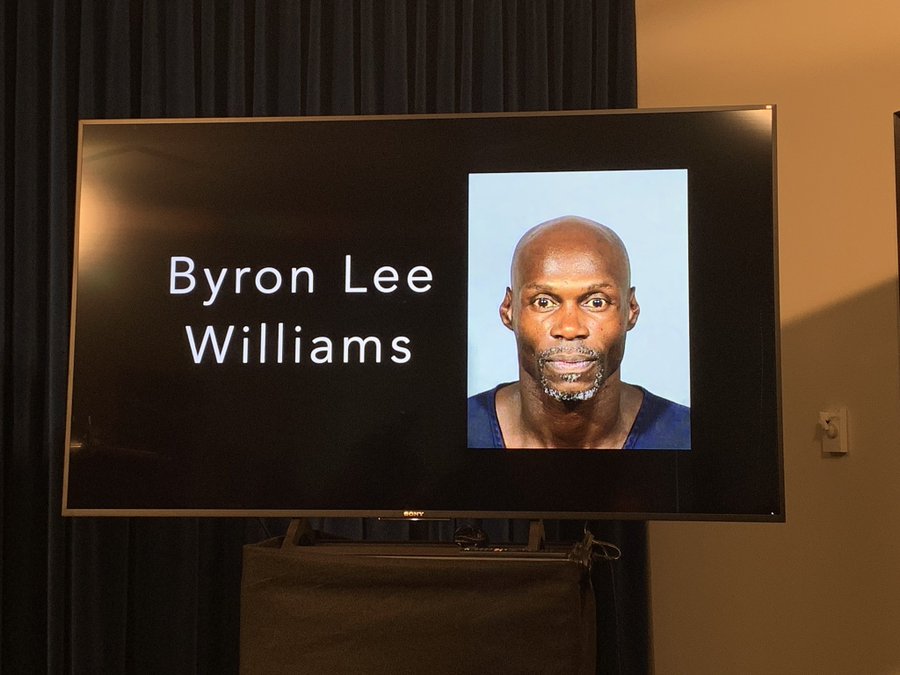
Byron Lee Williams was unarmed and died less than an hour after contact with police.
Byron Lee Williams was on riding his bicycle in Las Vegas, Nevada when he was stopped by police. Less than an hour later, he was dead and his family is now speaking out. On Sept. 5, around 6 a.m., Williams was riding his bike that allegedly didn’t have a safety light. According to KTNV, when two officers, Benjamin Vazquez, 27, and Officer Patrick Campbell, 28, tried to stop him, he took off and eventually began running on foot.
The officers caught up to him and told Williams to get on the ground. While being cuffed, Williams told the officers he couldn’t breathe. The Las Vegas Sun reports an officer was heard telling him: “Yeah, because you’re tired of (expletive) running.” Williams was allegedly straddled by one of the officers, who had his knee pinned against Williams. “Pressure on your butt, that’s all,” said one of the officers. Williams continues to complain about not being able to breathe.
“As they were taking him to the patrol car, Williams appeared to pass out. Officers called for assistance and the Las Vegas fire department arrived several minutes later,” KTNV reports. The 50-year-old later died in hospital. Williams was armed and the police claim he had drugs in his possession as well.
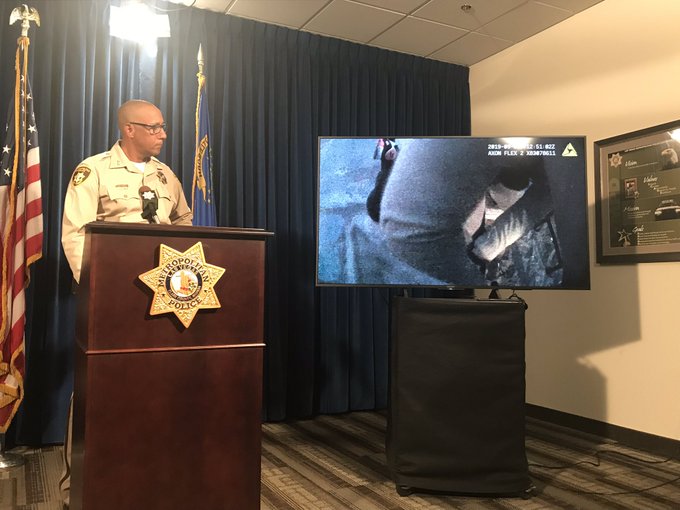
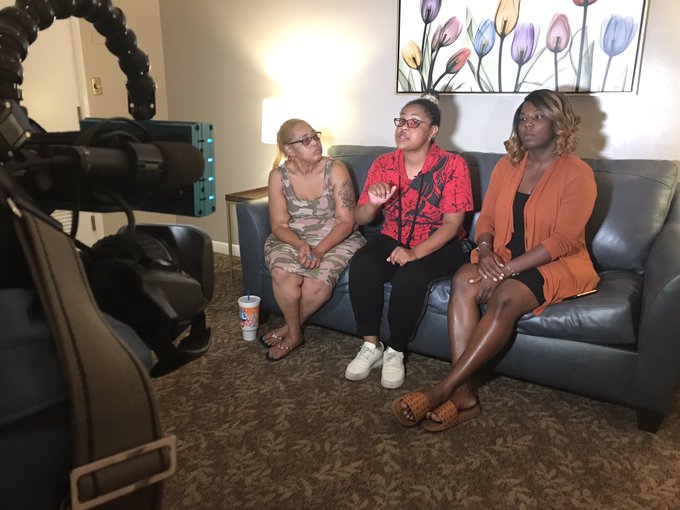
The family is saying the death was unjustified. At a press conference, his daughter said, “Byron Lee Williams did have people who cared about him.” His niece also added, “He was loved, he was a changed man, it needs to be known that he changed his lifestyle.” At the press conference, where body cam footage was showed, Asst. Sheriff Hank decided to focus on Williams’ “extensive criminal history.” He also claimed he had “absconded from electronic monitoring and police were looking for him.”
Jeffrey E. Thompkins, who is identified as Williams’ stepson, claimed the footage the family saw was “doctored” and “that up to 40 minutes had elapsed between the traffic stop and images that he said showed his stepfather lifeless on the concrete, meaning that he didn’t die on the way to the hospital, as the family was told.” The officers were placed on routine leave as the family is asking for the investigation to continue. See the press conference below:
MINNEAPOLIS (AP) — The live-streamed video of the final minutes of Brian Quinones’ life before he was fatally shot by police shows him calmly driving a car and listening to music, running at least one red light as he leads officers on a chase through two Minneapolis suburbs. At one point, the video shows, Quinones got out of the car with what appears to be a knife. Moments later, someone shouted an unintelligible command and multiple shots rang out. Quinones, 30, died at the scene. His brother said afterward that Quinones had been having suicidal thoughts. The shooting sparked a protest and raised questions about whether police were too quick to shoot Quinones, and whether they could have used another means to stop him or help him if he was in crisis.
Shawn Price, 35, stopped Monday to pay his respects at a makeshift memorial near where Quinones was shot. Price says based on what he heard in Quinones’ video, the number of shots fired seemed to be “completely in excess,” and he wonders if police could have done more to de-escalate the situation. “There was no attempt at Taser or to do any other method that would have prevented, you know, this young man’s life being taken,” Price said. Investigators released no new information about the case Monday, including how many times Quinones was shot, or whether there was any attempt to use a stun gun. About 12 shots can be heard in the Quinones’ video. Craig Futterman, a University of Chicago law professor, said deadly force should be a last resort and police need to assess a developing situation and look for a way to de-escalate.
“Could they have responded to the situation in different ways that would not have put their safety in danger?” Futterman asked. He said police are trained to use tactics such as time and distance to avoid the need to use deadly force. National best practices call for training officers on how to work with people who may be in crisis. It also has become best practices for many departments to have crisis intervention teams to work with people who are in trouble. Authorities began chasing Quinones late Saturday after they say he ran a red light and wouldn’t pull over. In the Livestream video, Quinones, who is from Puerto Rico but had lived in Minnesota for many years, can be seen glancing in the rearview mirror, and sometimes rapping along with the music before he gets out of the car. Before starting the live stream, he posted on Facebook, “So sorry.”
His younger brother, Joshua Quinones, told Minnesota Public Radio News on Sunday that he spoke to his brother before the pursuit and could hear the “sadness in his voice.” He said his brother had suicidal thoughts and “had it all planned out.” After Brian hung up, Joshua and his sister went to Brian’s apartment. He wasn’t there, but they found his live stream on Facebook. Joshua Quinones said his sister had texted her brother things like, “Don’t do anything stupid.”
“I just think that (police) could have done better. At least tase him with a Taser,” Joshua Quinones told MPR. “But really, shoot him … That’s just too much.” No police officers were hurt. The Hennepin County Sheriff’s Office is investigating and declined to comment on Monday. A statement released Sunday by the city of Edina says Quinones “confronted officers with a knife,” and the county medical examiner said Quinones died of multiple gunshot wounds. Five officers — three from Richfield, two from Edina — were placed on paid leave, city officials said.
Quinones’ video has been removed from Facebook but portions of it are on YouTube. It doesn’t show the shooting. Authorities haven’t said whether there is squad car or body camera video of the incident.
Bob Bennett, an attorney who represents Quinones’ wife, said he wants to see those videos. He could not confirm whether Quinones’ family called police about his mental state, and Joshua Quinones declined to talk to a reporter Monday.
David Klinger, chairman of the Criminology and Criminal Justice Department at University of Missouri-St. Louis, said that while the mental state of an individual should play a factor in how police manage and control a situation, it’s immaterial when an officer is faced with an imminent threat.
“What difference does it make if the reason why a man is trying to kill you is because he hates you or because he thinks you are a demon who has been sent from another dimension … if he is trying to kill you, you have a right to protect yourself,” Klinger said.
Torri Hamilton, a civil rights attorney in Chicago, said police dispatch recordings would be key to finding out if family members called police and if police were made aware of concerns. She said any police video from squad cars or body cameras would also be important.
She pointed to the case of Laquan McDonald, who had a knife in an interaction with police in 2014, and was shot 16 times as he was walking away. In that case, Chicago police officer Jason Van Dyke was convicted of murder.
“Unless they are confronted with deadly force, they cannot use deadly force,” Hamilton said.
There are different ways to say the same thing. Some say what they want in direct inartful ways. Others are more articulate, more nuanced, more tactful in what they say even as they convey the very same message in what they say. You decide.…
Neil Gorsuch
“I’d say to anybody who questions what a wonderful inheritance we have in our courts and the rule of law in this country, go spend six weeks in a court in another country of your choice and come back and tell me what you think about our courts in this country.”
–if you’re not happy here you can leave. That is what I say all of the time. That’s what I said in a Tweet which I guess some people think is controversial, a lot of people love it by the way. A lot of people love it but if you are not happy in the U.S. if you are complaining all of the time very simply you can leave. You can leave right now. Come back if you want, don’t come back, that’s okay, too. But if you are not happy you can leave. https://time.com/5626813/donald-trump-racist-tweets-transcript/
Two men who attempted an armed robbery at a Cash Pot on Molynes Road, taking several hostages in the process, locked themselves into the business place as the police arrived in quick time. The police have confirmed that the drama ended when two men who were inside the building, surrendered after more than an hour. A senior police commander on the ground could be heard in a video on social media, pleading with the gunmen to exit the establishment.
The senior cop could be heard telling the men that the JCF is a [professional body], an obvious attempt to convince them that they would not be harmed, (something I believe could have been done without). The whole thing sounded like an indoctrinated man speaking for the cameras, rather than to the men locked inside the establishment. Police have no duty to preach professionalism to criminals, they only need to professionally carry out their duties and let the chip fall where they may. All in all, this incident ended with none of the hostages being harmed and both gunmen apprehended. A good day for policing and the Jamaican people.
It is now onto what passes for courts, where they will promptly be released onto the streets, despite the seriousness of the crimes they committed. Either way, they will be given a slap on the wrist and it will be business as usual. Jamaica’s crime problem will continue to metastasize because the criminal courts have a sizeable cadre of judges, and magistrates who are hell-bent on subverting the rule of law. There are judges and magistrates who are collecting payments from criminal defense lawyers, and are meting out sentences which are unrelated to the serious crimes the offenders have committed. They are doing serious damage to the crime-fighting efforts on the Island. This medium is once again calling on the Jamaican government to investigate these ridiculous sentences, and the granting of bail to murderers, particularly in western Jamaica.
An independent judiciary does [not]mean a judiciary answerable to no one.
Mike Beckles is a former Jamaican police Detective corporal, a business owner, avid researcher, and blogger. He is a black achiever honoree, and publisher of the blog chatt-a-box.com. He’s also a contributor to several websites. You may subscribe to his blogs free of charge, or subscribe to his Youtube channel @chatt-a-box, for the latest podcast all free to you of course.
North Buffalo, NY — Jeffrey Calhoun, a 62-year old white man, is facing several charges of hate crime after he allegedly harassed Jeanneie Muhammad, a Black woman, during a recent road rage dispute. Witnesses say he bit her and called her a racial slur after she accidentally bumped his car.
The encounter reportedly started after Muhammad bumped into the car in front of her. She got out of the car and then Calhoun, who was driving the other car, suddenly attacked her. He bit her and displayed a handgun, as seen on a cellphone video captured by a bystander. They also said Calhoun used a racial slur on her. Calhoun was indicted on two felony charges — unlawful imprisonment and menacing — both as hate crime. He was also indicted on a felony count of impersonating a police officer and a misdemeanor count of third-degree assault. Calhoun pleaded not guilty of all the charges and is still out of prison on $75,000 bail.
Erie County District Attorney John J. Flynn filed hate crime charges against Calhoun, which is the first time he did during his term as DA. “I firmly believe that race was a motivation here in Mr. Calhoun’s alleged actions,” Flynn told local media. “I believe I have the evidence that backs up my belief. Is it a slam dunk, though? It’s not.” Flynn further explained that while hate crime “is not in and of itself a crime,” it can be used to increase the jail time of the defendant. In Calhoun’s case, if he is convicted of first-degree unlawful imprisonment which is the most serious of the charges he is facing, he could be sentenced to up to seven years in prison.
Moreover, Calhoun was initially charged with attempted robbery for allegedly taking Muhammad’s keys and trying to take her purse. But Flynn decided to drop that charge as the investigation found Calhoun did not intend to permanently take those items. Evidence rather proved that he used a racial slur on her even though it was not seen on the video. “In this case here, the totality of circumstances, the context of the entire incident with his use of the alleged racial slur, is what I believe elevated it to a hate crime,” Flynn said. “Buffalo is a city of good neighbors. Buffalo is a city of love. When someone chooses hate, they have to face the consequences. Mr. Calhoun is now facing the consequences.”
Alvin Kennard Bessemer, AL — Alvin Kennard, a Black man from Alabama who has been in prison for 36 years serving a life sentence without parole for stealing $50.75 from a bakery, is set to be released from prison after being resentenced to time served.
Kennard was only 22-years old when he was convicted of first-degree robbery in 1983. He was sentenced to life imprisonment under Alabama’s Habitual Felony Offender Act, also known as the “three strikes law,” as he had been previously convicted of burglary and grand larceny.
However, in 2013, the sentencing guidelines in Alabama were changed. Under the new guidelines, Kennard would just have received a 20-year maximum sentence. Kennard, who is now 58-years old, told the court before his resentencing, “I just want to say I’m sorry for what I did… I take responsibility for what I did in the past. I want the opportunity to get it right.”
His attorney, Carla Crowder, said that Kennard was “overwhelmed” by the resentencing. “What’s extraordinary about Mr. Kennard is that even when he thought he was going to be in prison for the rest of his life, he really turned his life around,” she said. “He is overwhelmed at this opportunity, but has remained close with his family, so he has incredible support.” Kennard’s release from prison will be processed out by the Alabama Department of Corrections. It’s unclear what the specific date, but he would be returning home “within a few days.”
70-Year Old Granny Who Pulled a Gun on Black Couple Will Not Go to Jail
Ruby Howell Starkville, MS — Ruby Howell, a 70-year old white woman who was convicted of a misdemeanor charge for threatening and pointing a gun at a Black couple last May, was found guilty of threatening exhibition of a weapon. Even though she could have accidentally (or intentionally) killed the couple, she will not be jailed.
Howell was reportedly only fined $250 and ordered to pay $182.50 in court fees. Aside from that, there will be no other punishment given to her in connection with the incident. The incident was caught on a now-viral video wherein Howell, an employee of Kampgrounds of America, can be seen approaching Jessica Richardson and her husband Franklin. She was brandishing a gun while telling them to leave campground because they had no reservation.
The couple learned later on from Howell’s husband that a reservation was not actually necessary to access the campground. Shortly after the incident, KOA confirmed that the woman was fired and said that KOA “does not condone the use of a firearm in any manner on our properties or those owned and operated by our franchisees.” Although Mississippi is an open-carry state, it is illegal to brandish a weapon in a “rude, angry or threatening manner in the presence of three or more persons.” Those who were found guilty can face a $500 fine, three months in jail, or both with prosecutors regardless if the weapon was “charged, loaded or in a condition to be discharged.” https://www.blacknews.com/news/alvin-kennard-man-life-sentence-for-stealing-50-dollars-released-prison/
If the way PNP delegates voted on Saturday is indicative of the wider electorate which supports that party, the nation may be in for decades and decades of mediocrity and stagnation if the PNP is returned to office. Given a clear choice between a young leader who wanted to make a clean break from the failed ideology of [democratic socialism](sic), and the status quo, which has been an abject failure for the country, they chose the status quo.
The greatest nonsense against Bunting’s candidacy, both by (first )Peter Phillips, his “one PNP” campaign, and local media, is that (second) Peter Bunting and his “rise united” campaign was engaged in vote-buying. The hypocrisy of that argument is lost on only the most hardcore supporters of Peter Phillips, and others who may not follow Jamaican politics. There has been no election on the Island in which vote-buying has not played a part in the decision of the poll. Worse yet, as Peter Phillips sat in a radio studio and bitched about the practice, he as the leader of the party presides over one of the most intransigent garrisons operated by the PNP. As a member of parliament who comes from a garrison, No one, Phillips included, has any greater validity than members who pay electors to vote for them. Vote buying is reprehensible, but voters have a choice to take the money and vote for whomever they choose. That may have happened to Bunting if reports of vote-buying are true. People in Garrison communities who are forced to vote for a particular candidate at the peril of death, is a whole different kettle of fish.
Peter Phillips
That aside, Peter Phillips and the old cabal of (eat-a-fooders) who presided over 22 plus years of Jamaica’s decline has been validated by the party’s delegates. The lesson inherent in the Saturday vote is that at the critical delegate level of the party, there is no recognition that the PNP desperately needs to change. Many supporters of the governing Jamaica Labor Party (JLP) sees the affirmation of Peter Phillips to head the PNP as a gift to their party’s chances when next general elections are held. However, the much-needed transformation of the PNP from an old tired out-of-touch leftist party, to a 21st-century party, representative of the needs of the country, far exceeds any benefits the JLP may derive from Phillips’ affirmation.
Jamaica has all of the components to position itself as a nation headed for full first-world status in 20 to 30 years. As such the two political parties which share power and governance must both be agents of progressive empowerment if those goals are to be accomplished. A political party which is still stuck championing failed big-government policies is bound to wipe out any gains that the present party may accomplish. Even after an unprecedented 221⁄2 year run by the PNP, Jamaicans still do not have clean running water in their pipes. Local roads are like the moon’s surface and still, in some areas, there are no roads at all. Hospitals are veritable hospices of death, and there was no building of schools worthy of mention. In fact, the only thing that the PNP can be credited with is the out of control crime and the denigration of our culture.
The Police Department was allowed to deteriorate to the point that it became totally ineffectual. At every turn, the PNP’s tenure in leadership has been a colossal nightmare for the country, even if not for its cultish supporter. In 221⁄2 years, the PNP was not able to identify a single infrastructural project and complete it on behalf of the Jamaican people. On what basis would they expect the people to return that party to power?
Peter Bunting
It is for those reasons that I believe, that though Peter Bunting is a member of that party, his opposition to socialism as a direction for the PNP was a valuable first step for the party and country. Unfortunately for the country and party, PNP delegates decided to stick with an old disjointed and corrupt out-of-touch political party whose time has come and gone.
Mike Beckles is a former Jamaican police Detective corporal, a business owner, avid researcher, and blogger. He is a black achiever honoree, and publisher of the blog chatt-a-box.com. He’s also a contributor to several websites. You may subscribe to his blogs free of charge, or subscribe to his Youtube channel @chatt-a-box, for the latest podcast all free to you of course.
The People’s National Party is today Saturday, set to have a leadership election between Dr. Peter Phillips MP, the current leader of the party and Peter Bunting MP, who is challenging for leadership of the party under his campaign slogan “Rise United”. The new leader is to be selected by delegates within the party. Both men are former ministers of government under past PNP administrations. In fact, both men have served as ministers of national security in different PNP administrations.
Peter Phillips is 70-year-old, while Bunting is 59-years-old. Past leaders of the PNP Michael Manley, Percival Patterson and Portia Simpson Miller all past Prime Ministers of that party were at Phillips’ age looking to exit the stage. Asked about his decision to contest this challenge to his leadership at a time when past leaders were looking to retire, Peter Phillips told the interviewer he could not just walk away simply because someone thought he was old.
Insofar as age goes, it really does not matter, how old a person, is as long as they are able to coherently articulate policy directions which are cogent and representative of the future, not stuck in the past. Having never sat down with either man to talk about their views, it is difficult for me to form an opinion of either, sufficing to say that the People’s National Party under its present leadership is still stuck in the hyperbolic leftist failed ideology of the ’70s. With clenched fists and reference to each other as “comrades”, the PNP exudes vestiges of a time , progressives and educated Jamaicans want to put in their rearviewmirrors.
Communism is a failed political ideology, so too is socialism. The Soviet Union and China were the two bastions of Communism in the 20th century. Today, the Soviet Union does not exist, former states, with the exception of maybe one or two, are independent states which have largely adopted western-style democratic market-driven policies. Russia and China have both deregulated their economies allowing for market forces to provide wealth and opportunities for their people. In actuality, not only has Communism failed, so too has the concept of democratic socialism. It is to this sinking ideology that the present PNP under Peter Phillips has continued to tether itself.
To his credit, Peter Bunting is a younger leader who has credible private sector bona fides. Bunting is a wealthy former businessman whom I believe Is the better choice of the two, given his opposition to democratic socialism as a political direction. The present JLP administration under the leadership of Prime Minister Andrew Holness is a party which understands,( to some degree) how the private sector is supposed to work for the betterment of the country. The PNP seeming still struggles to understand that citizens are not supposed to depend on Government for jobs and or handouts. A PNP under Peter Bunting in my estimation, will give our country two parties with bright young leaders who understand that the Government should not be an enabler but a facilitator.
It is with that in mind why I hope the delegates in that party select Peter Bunting to lead the party into the future and away from the old ways of the past.
RIP. Robert Mugabe. For all of the negative things which will be said about Robert Mugabe, by those against whom he stood tall, as a bulwark of black pride against white domination. For all of his failings and frailties as a human being, he will forever be a champion of black intellectualism and strength against colonial domination.
Robert Mugabe became prime minister of Zimbabwe in 1980 and served as the country’s president from 1987 until his forced resignation in 2017.
Who Was Robert Mugabe?
Robert Mugabe was born on February 21, 1924, in Kutama, Southern Rhodesia (now Zimbabwe). In 1963, he founded ZANU, a resistance movement against British colonial rule. Mugabe became prime minister of the new Republic of Zimbabwe after British rule ended in 1980, and he assumed the role of president seven years later. Mugabe retained a strong grip on power, through controversial elections, until he was forced to resign in November 2017, at age 93.
Early Years and Education
Robert Gabriel Mugabe was born on February 21, 1924, in Kutama, Southern Rhodesia (now Zimbabwe), just months after Southern Rhodesia had become a British Crown colony. As a result, the people of his village were oppressed by new laws and faced limitations to their education and job opportunities.
Mugabe’s father was a carpenter. He went to work at a Jesuit mission in South Africa when Mugabe was just a boy, and mysteriously never came home. Mugabe’s mother, a teacher, was left to bring up Mugabe and his three siblings on her own. As a child, Mugabe helped out by tending the family’s cows and making money through odd jobs.
Although many people in Southern Rhodesia went only as far as grammar school, Mugabe was fortunate enough to receive a good education. He attended school at the local Jesuit mission under the supervision of school director Father O’Hea. A powerful influence on the boy, O’Hea taught Mugabe that all people should be treated equally and educated to the fulfillment of their abilities. Mugabe’s teachers, who called him “a clever lad,” were early to recognize his abilities as considerable.
The values that O’Hea imparted to his students resonated with Mugabe, prompting him to pass them on by becoming a teacher himself. Over the course of nine years, he studied privately while teaching at a number of mission schools in Southern Rhodesia. Mugabe continued his education at the University of Fort Hare in South Africa, graduating with a Bachelor of Arts degree in history and English in 1951. Mugabe then returned to his hometown to teach there. By 1953, he had earned his Bachelor of Education degree through correspondence courses.
In 1955, Mugabe moved to Northern Rhodesia. There, he taught for four years at Chalimbana Training College while also working toward his Bachelor of Science degree in economics through correspondence courses with the University of London. After moving to Ghana, Mugabe completed his economics degree in 1958. He also taught at St. Mary’s Teacher Training College, where he met his first wife, Sarah Heyfron, whom he would marry in 1961. In Ghana, Mugabe declared himself a Marxist, supporting the Ghanaian government’s goal of providing equal educational opportunities to the formerly designated lower classes.
Early Political Career
In 1960, Robert Mugabe returned to his hometown on leave, planning to introduce his fiancée to his mother. Unexpectedly, upon his arrival, Mugabe encountered a drastically changed Southern Rhodesia. Tens of thousands of black families had been displaced by the new colonial government, and the white population had exploded. The government denied black majority rule, resulting in violent protests. Mugabe too was outraged by this denial of blacks’ rights. In July 1960, he agreed to address the crowd at the protest March of 7,000, staged at Salisbury’s Harare Town Hall. The purpose of the gathering was for members of the opposition movement to protest the recent arrest of their leaders. Steeling himself in the face of police threats, Mugabe told the protestors about how Ghana had successfully achieved independence through Marxism.
Just weeks later, Mugabe was elected public secretary of the National Democratic Party. In accordance with Ghanaian models, Mugabe quickly assembled a militant youth league to spread the word about achieving black independence in Rhodesia. The government banned the party at the end of 1961, but the remaining supporters came together to form a movement that was the first of its kind in Rhodesia. The Zimbabwe African People’s Union (ZAPU) soon grew to a staggering 450,000 members.
The union’s leader, Joshua Nkomo, was invited to meet with the United Nations, who demanded that Britain suspend their constitution and readdress the topic of majority rule. But, as time passed and nothing had changed, Mugabe and others were frustrated that Nkomo didn’t insist on a definite date for changes to the constitution. So great was his frustration, that by April of 1961, Mugabe publicly discussed starting a guerilla war — even going so far as to declare defiantly to a policeman, “We are taking over this country and we will not put up with this nonsense.”
Robert Mugabe talks with his team during the second day of the FAO Summit in Rome, Italy, on November 17, 2009. Photo: Thierry Tronnel/Corbis via Getty Images
Formation of ZANU
In 1963, Mugabe and other former supporters of Nkomo founded their own resistance movement, called the Zimbabwe African National Union (ZANU), in Tanzania. Back in Southern Rhodesia later that year, the police arrested Mugabe and sent him to Hwahwa Prison. Mugabe would remain in jail for over a decade, being moved from Hwahwa Prison to Sikombela Detention Centre and later to Salisbury Prison. In 1964, while in prison, Mugabe relied on secret communications to launch guerrilla operations toward freeing Southern Rhodesia from British rule.
In 1974, Prime Minister Ian Smith, who claimed he would achieve true majority rule but still declared his allegiance to the British colonial government, allowed Mugabe to leave prison and go to a conference in Lusaka, Zambia (formerly Northern Rhodesia). Mugabe instead escaped back across the border to Southern Rhodesia, assembling a troop of Rhodesian guerrilla trainees along the way. The battles raged on throughout the 1970s. By the end of that decade, Zimbabwe’s economy was in worse shape than ever. In 1979, after Smith had tried in vain to reach an agreement with Mugabe, the British agreed to monitor the changeover to black majority rule and the UN lifted sanctions.
By 1980, Southern Rhodesia was liberated from British rule and became the independent Republic of Zimbabwe. Running under the ZANU party banner, Mugabe was elected prime minister of the new republic, after running against Nkomo. In 1981, a battle broke out between ZANU and ZAPU due to their differing agendas. In 1985, Mugabe was re-elected as the fighting continued. In 1987, when a group of missionaries were tragically murdered by Mugabe supporters, Mugabe and Nkomo at last agreed to merge their unions into the ZANU-Patriotic Front (ZANU-PF) and focus on the nation’s economic recovery.
Presidency
Within just a week of the unity agreement, Mugabe was appointed president of Zimbabwe. He chose Nkomo as one of his senior ministers. Mugabe’s first major goal was to restructure and repair the country’s failing economy. In 1989, he set out to implement a five-year plan, which slackened price restrictions for farmers, allowing them to designate their own prices. By 1994, at the end of the five-year period, the economy had seen some growth in the farming, mining and manufacturing industries. Mugabe additionally managed to build clinics and schools for the black population. Also over the course of that time, Mugabe’s wife, Sarah, passed away, freeing him to marry his mistress, Grace Marufu.
By 1996, Mugabe’s decisions had begun to create unrest among the citizens of Zimbabwe, who had once hailed him as a hero for leading the country to independence. Many resented his choice to support the seizure of white people’s land without compensation to the owners, which Mugabe insisted was the only way to level out the economic playing field for the disenfranchised black majority. Citizens were likewise outraged by Mugabe’s refusal to amend Zimbabwe’s one-party constitution. High inflation was another sore subject, resulting in a civil servant strike for pay increases. The self-awarded pay raises of government officials only compounded the public’s resentment toward Mugabe’s administration.
Objections to Mugabe’s controversial political strategies continued to impede his success. In 1998, when he appealed to other countries to donate money for land distribution, the countries said they wouldn’t donate unless he first devised a program for helping Zimbabwe’s impoverished rural economy. Mugabe refused, and the countries refused to donate.
In 2000, Mugabe passed an amendment to the constitution that made Britain pay reparations for the land it had seized from blacks. Mugabe claimed that he would seize British land as restitution if they failed to pay. The amendment put further strain on Zimbabwe’s foreign relations.
Still, Mugabe, a notably conservative dresser who during his campaign had worn colorful shirts with his own face on them, won the 2002 presidential election. Speculation that he had stuffed the ballot box led the European Union to place an arms embargo and other economic sanctions on Zimbabwe. At this time Zimbabwe’s economy was in near ruins. Famine, an AIDS epidemic, foreign debt and widespread unemployment plagued the country. Yet Mugabe was determined to retain his office and did so by any means necessary — including alleged violence and corruption — winning the vote in the 2005 parliamentary elections.
Refusal to Cede Power
On March 29, 2008, when he lost the presidential election to Morgan Tsvangirai, leader of the opposing Movement for Democratic Change (MDC), Mugabe was unwilling to let go of the reins and demanded a recount. A runoff election was to be held that June. In the meantime, MDC supporters were being violently attacked and killed by members of Mugabe’s opposition. When Mugabe publicly declared that as long as he was living, he would never let Tsvangirai rule Zimbabwe, Tsvangirai concluded that Mugabe’s use of force would skew the vote in Mugabe’s favor anyway, and withdrew.
Mugabe’s refusal to hand over presidential power led to another violent outbreak that injured thousands and resulted in the death of 85 of Tsvangirai’s supporters. That September, Mugabe and Tsvangirai agreed to a power-sharing deal. Ever determined to remain in control, Mugabe still managed to retain most of the power by controlling security forces and choosing leaders for the most vital ministry positions.
At the end of 2010, Mugabe took additional action to seize total control of Zimbabwe by selecting provisional governors without consulting Tsvangirai. A U.S. diplomatic cable indicated that Mugabe might be battling prostate cancer the following year. The allegation raised public concerns about a military coup in the event of Mugabe’s death while in office. Others voiced concerns about the possibility of violent internal war within the ZANU-PF, if candidates sought to compete to become Mugabe’s successor.
2013 Election
On December 10, 2011, at the National People’s Conference in Bulawayo, Mugabe officially announced his bid for the 2012 Zimbabwe presidential election. The election was postponed, however, as both sides agreed to draft a new constitution, and rescheduled for 2013. People of Zimbabwe came out in support of the new document in March 2013, approving it in a constitution referendum, though many believed that the 2013 presidential election would be marred by corruption and violence.
According to a Reuters report, representatives from nearly 60 civic organizations within the country complained of a crackdown by Mugabe and his supporters. Critical of Mugabe, members of these groups were subject to intimidation, arrest and other forms of persecution. There was also the question as to who would be allowed to supervise the voting process. Mugabe said that he would not let Westerners monitor any of the country’s election.
In March, Mugabe traveled to Rome for the inaugural mass for Pope Francis, who was newly named to the papacy. Mugabe told reporters that the new pope should visit Africa and stated, “We hope he will take us all his children on the same basis, basis of equality, basis that we are all in the eyes of God equal,” according to a report by The Associated Press.
In late July 2013, amid discussion regarding the current and highly anticipated Zimbabwean election, an 89-year-old Mugabe made headlines when he was asked whether he planned to run again in the 2018 election (he would be 94 then) by a reporter from The New York Times, to which the president responded, “Why do you want to know my secrets?” According to The Washington Post, Mugabe’s opponent, Tsvangirai, accused election officials of throwing out nearly 70,000 ballots in his favor that were submitted early.
In early August, Zimbabwe’s election commission declared Mugabe the victor in the presidential race. He earned 61 percent of the vote with Tsvangirai receiving only 34 percent, according to BBC News. Tsvangirai was expected to launch a legal challenge against the election results. According to the Guardian newspaper, Tsvangirai said the election did “not the reflect the will of the people. I don’t think that even those in Africa that have committed acts of ballot rigging have done it such a brazen manner.”
Arrest of American Citizen
In November 2017 an American woman living in Zimbabwe was charged with subverting the government and undermining the authority of — or insulting — the president.
According to prosecutors, the defendant, Martha O’Donovan, a project coördinator for the activist Magamba Network, had “systematically sought to incite political unrest through the expansion, development and use of a sophisticated network of social media platforms as well as running some Twitter accounts.” She faced up to 20 years in prison for the charges.
The arrest raised concerns that Mugabe’s government was attempting to control social media ahead of the 2018 national elections.
Military Takeover and Resignation
Meanwhile, a more dire situation was emerging in Zimbabwe with the onset of what appeared to be a military coup. On November 14, not long after Mugabe’s dismissal of vice president Emmerson Mnangagwa, tanks were spotted in the country’s capital, Harare. Early the following morning, an army spokesman appeared on TV to announce that the military was in the process of apprehending criminals who were “causing social and economic suffering in the country in order to bring them to justice.”
The spokesman emphasized that this was not a military takeover of the government, saying, “We wish to assure the nation that his excellency the president… and his family are safe and sound and their security is guaranteed.” At the time, Mugabe’s whereabouts were unknown, but it was later confirmed that he had been confined to his home.
The following day, Zimbabwe’s The Herald published photographs of the elderly president at home, along with other government and military officials. The officials were reportedly discussing the implementation of a transitional government, though no public statement had been made on the matter.
On November 17, Mugabe resurfaced in public at a university graduation ceremony, an appearance believed to mask the turmoil behind the scenes. After initially refusing to coöperate with proposed plans to peacefully remove him from power, the president reportedly agreed to announce his retirement during a televised speech scheduled for November 19.
However, Mugabe made no mention of retirement during the speech, instead insisting he would preside over a December congress of the ZANU-PF governing party. As a result, it was announced that the party would launch impeachment proceedings to vote him out of power.
On November 22, shortly after a joint session of the Zimbabwean Parliament convened for the impeachment vote, the speaker read a letter from the embattled president. “I have resigned to allow smooth transfer of power,” Mugabe wrote. “Kindly give public notice of my decision as soon as possible.”
The end of Mugabe’s 37-year tenure was met with applause from Parliament members, as well as celebrations on the streets of Zimbabwe. According to a spokesman for the ZANU-PF, former vice president Mnangagwa would take over as president and serve the remainder of Mugabe’s term until the 2018 elections.
Just before the elections on July 30, 2018, Mugabe said he could not support his successor, Mnangagwa, after being forced out by the “party I founded,” and suggested that opposition leader Nelson Chamisa of the MDC was the only viable presidential candidate. That drew a strong response from Mnangagwa, who said, “It is clear to all that Chamisa has forged a deal with Mugabe, we can no longer believe that his intentions are to transform Zimbabwe and rebuild our nation.”
Tensions over the elections also spilled out into the public, with demonstrations turning violent over what was announced to be the ZANU-PF’s parliamentary victory and Mnangagwa’s triumph. MDC Chairman Morgan Komichi said his party would challenge the outcome in court.
Death
Mugabe died on September 6, 2019, at Gleneagles Hospital in Singapore where he was under observation for several months for an undisclosed illness. “It is with the utmost sadness that I announce the passing on of Zimbabwe’s founding father and former President, Cde Robert Mugabe,” Zimbabwe’s President Emmerson Mnangagwa wrote on Twitter. “Cde Mugabe was an icon of liberation, a pan-Africanist who dedicated his life to the emancipation and empowerment of his people. His contribution to the history of our nation and continent will never be forgotten. May his soul rest in eternal peace.” https://www.biography.com/political-figure/robert-mugabe
I just read a quote ‘I’m still here, so please don’t call my nest empty. My wallet is certainly empty, but not my house!’. After reading that, my mind began to reminisce over my life as a parent. I would go further and say that my nest is not empty, but my nest and heart FULL.
I’m not ashamed to say that the tears came to my eyes as I began to think of my life as a Mom. These were not tears of sadness-not at all! They were actually tears of gratitude and joy, as I thought about the years of parenting that I have had. When the children were younger, and the house was full of kids, it was a time that was busy, bustling, boisterous, and yes-beautiful! Lest you think I seek to paint a picture of perfection, I want to also let you know that it was also a time of noise, worry, trouble, questions, , sleeplessness, and yes-some arguments.
Laughter filled the house, and so did slammed doors, along with periods of punishment. Grief so strong and deep that you wonder if you’ll ever laugh again. Then laughter to the point that you think you may have to seek medical attention! You know: LIFEWITHCHILDREN. And then life with young adults. And then life with young adults who think they are adults renting space in your house, making up their own rules to fit their lifestyles. Numerous phases and stages. I say all of that to say that I am so grateful for the privilege to have had a ‘full nest’. And that it is still full; full of the life I have had as a MOM, WIFE, and CAREGIVER. It’s just me, hubby, and Bud (our 7 year old lab mix who thinks he runs our lives, so I guess we have one last child at home:). a strange feeling.
We miss the ‘boys’ as we call them. We especially miss Kodi, the other child, who will never walk through the doors of our home again (at least not on this side of life). We miss and continue to grieve his physical presence. We miss their daily comings and goings, involvement in their extracurricular activities, and our daily dinners together, when we would spend so much time talking, laughing and sharing. You listen to a sound and think-oh, that must be one of the boys then you realize it was just the wind, or the house adapting to its ‘normal’ of less bodies. Mike and I look at each other with that knowing look of ‘it’s just you and me now, baby’. Then we laugh, and say something like-‘let the games begin!’.
This change reinforces the fact that our children are truly not ours. They are lent to us for a season; we are mere stewards of them for a time. They are a garden to be tended, fertilized, watered, pruned, and then cut to be given back to the Father for their purpose to be fulfilled. Each step of the way and every day, we must remind ourselves of our purpose as parents. We pray to God for a beautiful harvest. We do the work, with His help and grace, and then sit back and wait for Him to reveal HIS best work through them. We may never even see it in our lifetime. We just thank Him for the privilege of trusting us as parents, and pray that our children walk in the purpose and calling that He has for them. So I am not an empty nester. Call me ‘full’. For I am joyFUL, peaceFUL, grateFUL, and yes, hopeful. For short you can just call me ‘full’!
THEJAMAICANPRIMEMINISTERANDREWHOLNESSHASONCEAGAINDECLAREDSTATESOFEMERGENCIESINTHEPARISHESOFSAINTCATHERINEANDCLARENDON. These new declarations are in addition to states of emergencies in the western parishes of Hanover, Westmoreland and Saint James. Clearly, this strategy is not working as crime continue to increase in other areas and generally only subside a bit even in the areas in which these declarations are made.
There have long been whispers that judges in the western parts of Jamaica are on the take. Several gangsters have bragged about paying off judges and being able to walk free. Over the years the police have been extremely vocal about the rather light sentences being meted out to criminal gunmen across the Island, but by judges in Saint James in particular. In the most recent example of this crisis, the police issued a statement which did not address the seriousness of the issue, but left little doubt they were as pissed as I and countless others are about this. “The police remains committed in creating safer communities for our citizens to enjoy and will continue to put forward good criminal cases before the courts”, said the police.
The criminal loving justice minister, Delroy Chuck has been a staunch defender of the criminal supporting corrupt frauds on the bench who continue to make a mockery of the work of the police by turning loose criminals who are arrested with illegal weapons.
Why would anyone have an illegal weapon, unless they intend to commit crimes with that weapon? Even as the country is awash in guns and ammunition and people are afraid to walk the streets of the tiny Island, judges continue to dishonor their oaths by accepting payments and turning dangerous criminals back onto the streets, further frustrating the efforts of the police. How much longer will the justice minister allow himself and the people’s ministry to be a shill and a mouthpiece for these corrupt judges who are destroying the justice system? Where is Horace Chang the Minister of National Security , he should be a strong advocate for the people of Jamaica who pay his salary? Or, is he too chicken shit a coward to speak out at these sacred cows that continue to make a mockery of our justice system?
The most recent iteration of this abuse of our justice system by these criminals, posing as jurists.
(1) Michael Scott, a 29-year-old security guard, was charged with two counts of illegal possession of a firearm and illegal possession of ammunition. He was sentenced to a fine of $200,000 or 18 months for each firearm and 3 years probation for the ammunition, the police said.
(2)Cardell Spence, otherwise called ‘Bredda’, a 19-year-old carpenter, was sentenced to three years probation on each count for illegal possession of firearm and ammunition.
(3) Dantae Thorpe, 19, was sentenced to a fine of $400,000 or two years in prison for illegal possession of firearm and three years probation for illegal possession of ammunition.
(4) Kirk Russell, 43, was also convicted robbery with aggravation. He was sentenced to 18 months at hard labor, each for illegal possession of firearm and robbery with aggravation.
The only way to stop this gross abuse of the system by these corrupt, on the take judges is truth in sentencing. We always knew there was corruption in the system, some of us who have served in law enforcement knew that some of these judges were throwing cases and collecting cash from the equally criminally complicit defense attorneys. It is important to understand that we tend to look at corruption when we look at dirty cops, as police officers tend to be the face of government. However the real corruption which is making an equal mockery of the system and driving crime is the corruption behind those long robes.
Having seen first hand how cancerous these immoral acts by the judiciary can be, I have called for truth in sentencing laws. It is time for the morons in the legislature to stop banging on the damn desks and pass mandatory minimum sentences for certain category of crimes. Since we can no longer trust the judges the legislature must move to take out of their hands the ability to return armed violent offenders to the streets as they see fit. This is no joke, these left wing judges are wrecking havoc on our country, by imposing their idealistic left-wing politics rather than follow the laws.
There are states of emergency in the western parishes of Hanover Westmoreland and St James. On Thursday morning the Prime Minister Andrew Holness declared two more states of emergencies across the parishes of Saint Catherine and Clarendon. Where are the additional security force bodies supposed to come from? As this writer, and this publication has maintained, states of emergencies and zones of special operations are not real solutions to the Island’s crime problem. The soft nature of the Island’s crime strategy is itself an accelerant to crime.
The police and soldiers who place their lives on the line to remove these dangerous weapons and criminals from the streets, damn sure deserve better than these judges kicking over the milk of their efforts. The Government literally have the hands of the security forces tied behind their backs. The judges return the killers back onto the streets as soon as they are arrested. The spread of crime across the country may be traced back to the direct actions of the leadership of the country at the time, when they warned gangsters in Tivoli Gardens, that the security forces were coming. The proliferation of guns and ammunition in the country has made the lives of ordinary Jamaicans a living hell. It is unconscionable that a few un-elected bureaucrats can circumvent the will of the Jamaican people, who are overwhelmingly demanding that these criminals either face the hangman or stay in prison. These gunmen who are being fined, never mind the paltry sums they are being fined) are murderers, that is the reason their lawyers are paying judges to release them back onto the streets. Where is Chief Justice Byron Sykes, a man of character in this?
Mike Beckles is a former Jamaican police Detective corporal, a business owner, avid researcher, and blogger. He is a black achiever honoree, and publisher of the blog mikebeckles.com.
MILWAUKEE (AP) — Milwaukee city officials are offering Bucks guard Sterling Brown $400,000 to settle his lawsuit accusing police of using excessive force and targeting him because he’s black when they confronted him over a parking violation. The city’s Common Council authorized the offer Wednesday during a closed session. Brown has 14 days to accept or decline it. Brown’s attorney didn’t immediately comment, but he planned to address it at a news conference later Monday morning. Brown illegally parked in a disabled spot outside a Walgreens on Jan. 26, 2018, and was talking with a group of officers while waiting for his citation when the situation escalated. Officers took him down and used a stun gun because he didn’t immediately remove his hands from his pockets, as ordered. https://blackamericaweb.com/2019/09/04/milwaukee-offers-bucks-player-400k-to-settle-police-suit/
“Crime deh ever weh,” says the people, when we talk about the high murder rate. “Why weren’t you talking about it during the PNP’s reign”? The inference being if I talk about an issue which needs addressing, I am automatically a member of whatever party is in opposition at the moment. Our political discussions have become that binary. It has become increasingly difficult to argue against the entrenched narrative that crime is everywhere these days, but those who see things through political lens do not care that there is ample evidence that I have been talking about crime across multiple administrations of both political parties. “The police have the appropriate training”: Says the police and their apologists, when we say “police training is not commensurate with what’s needed today”. Even when the incidents we see playing out in front of our eyes indicate that the training is spectacularly lacking. Others contend that officers receive the proper training but they are not utilizing the training they received. How can one argue that officers are trained in the correct techniques if [the brain], the very part of the body, which should kick in, does not automatically default to the training when the need arises? So we are back to where we started, [the inadequate nature of the training]. However, talking about that issue is tantamount to flogging a dead horse.
Over the years I have become more and more skeptical of the police ability to be effective in crime reduction in Jamaica. It goes without saying that there are forces working against the police doing the job they should be doing under normal circumstances.
For example, the very [Government] comprising both political parties which ought to give the police the tools they need legislatively and physically, have spent more time and effort drafting laws which enhance the escalation of crime on the Island. On the other hand, the police have demonstrably shown that they are woefully incapable of doing even the simplest task professionally and without looking like cartoon characters, as demonstrated above. In fairness to these two constables, or should I say one and one-half officers, this incompetence runs the gamut? The media gleefully piled onto ACP Welsh for his attempt at forgiveness, after all, poor Bishop Welsh had not taken into consideration that the very people who said “Hosannah, Hosannah, glory to God in the highest “, to Yeshua, days later said “crucify him, crucify” him to Pontious Pilate. Every single person who berated Gary Welsh for trying a new approach with the motorist, (wrong or right) would have loved to have received a reprieve as the BMW driver did were they in his position. Because it wasn’t them on the receiving end of Welsh’s largess, they wanted his head on a platter.
And when Welsh shifted gears to show the iron hand of the law, the very same people said: “Off with his head”. There was much to debate in the actions CP Welsh took, but the flash mob which came out with carving knives and pitchforks was more visceral than even Welsh must have imagined. Curiously, the anger, derision, and venomous stench unleashed against ACP Welsh, seemed to have completely missed Commissioner of Police Antony Anderson, who was the one responsible for the placement of ACP Welsh. But ACP Gary Welsh must have thought that his little media event with that motorist would endear him further with the media which the upper echelon of the JCF seems to believe are their friends. Gary Welsh had no idea that that little media event would have been turned into the faux pas of the decade by the same vultures in the media. After all, the hierarchy of the JCF has traditionally allowed the media to drive a wedge between the gazetted and rank and file of the force. As such the gazetted ranks have no compunction about throwing their subordinates to the very same vultures in the media just to curry favor. I really had to smirk at the nonsensical gibberish of those who argue that Commissioner Anderson shares no part of the blame. Antony Anderson is the captain of the team, he makes personnel decisions, how can he be held blameless, to the extent there is blame to go around? Antony Anderson placed Gary Welsh in the position he fired him from. Before Gary Welsh messed up to the extent that he is perceived to have done so, Antony Anderson messed up by choosing a total [command novice] to head a highly operational division. For that Antony Anderson, Commissioner of Police failed the country and the JCF. But the larger problem here is something to which I have spoken for a long time. It is the whole bunch of people running around with all kinds of laurel wreaths, stars, and crowns all over their stupid looking uniforms and they have zero policing experience. UWI police I call them, the JCF has now co-opted the fakery, lock stock and barrel from Mona, even the accents are fake as well.
The transformation of the JCF from an effective force against crime, to the courtesy corps desired by the Jamaican political and criminal class, to the extent there is a difference, is all but complete. What exists today are high flung concepts and showy departments and sub-departments with long names. In the end, the JCF has become the Barney Fyffe of police departments across the region and indeed the rest of the western world. As a consequence, ZOSO’s and areas designated under the States Of Emergency, continue to experience varying degrees of bloodletting, despite the large amounts of security personnel in the areas in which they are designated. As I have maintained for years these strategies, SOE’s, and now ZOSO’s are band-aid approaches to crime. What is needed is a systemic, dedicated and determined anti-crime process which sends a clear message that violent crimes of all nature will be dealt with in the harshest possible way under the law. Instead, what we have is a criminal centered approach which [first] takes into consideration the rights and feelings of the criminal without even a thought for crime victims. In the meantime, the police are incapable of making a simple arrest.
Officer Jon Crowder with the North Little Rock Police Department was arrested and charged with misdemeanor Battery 3rd.
NORTHLITTLEROCK, Ark. — On Thursday, June 27, Officer Jon Crowder with the North Little Rock Police Department was arrested and charged with misdemeanor battery for his actions stemming from a call for service that occurred August 27, 2018, according to the department. According to an arrest affidavit, during this interaction and arrest, Officer Crowder utilized a level of force which resulted in injuries to a subject who was arrested on felony charges. While conducting his law enforcement duties, Crowder responded to the SuperStay Motel at on West Pershing Boulevard to assist another officer on a call. The initial responding officer stated over the radio a male suspect involved in the incident was attempting to leave in a blue car.
The dashcam video from Crowder’s patrol car shows him conducting a traffic stop on a blue vehicle at the entrance of West Pershing location. Crowder had the male suspect step out of the vehicle and move to the rear of the car. Crowder then placed the suspect’s hands behind his back, with the assistance of another responding officer, and was able to place him in handcuffs. During the course of the arrest, the dash camera video shows Crowder lift the man’s arms up behind his back, pinning his torso to the car. Crowder then transported the man to the North Little Rock Police Department Detective Division.
While at the station, the suspect complained of a pain in his arms and was transported by another officer to Baptist Health Spring Hill Emergency Room where he was diagnosed as having mildly displaced features of the ulna bone in both elbow joints. After this encounter, a Subject Control file was created per departmental policy and reviewed by supervisory personnel. It was determined that policy violations occurred and resulted in disciplinary action being taken against Crowder.
Crowder was suspended for a period of 30 days starting on October 25, 2018. Upon reviewing the initial felony case file for the arrested subject, the Pulaski County Prosecutors Office found that the officer’s actions while affecting the arrest rose to a criminal level. The Office of the Chief of Police was notified that the Pulaski County Prosecutor would be seeking charges against the officer.
Upon learning this information, Crowder was immediately removed from patrol and placed on modified duty. A criminal investigation was initiated and an affidavit was completed and submitted to the Pulaski County Prosecutor on Wednesday, June 26, 2019 at which time, an arrest warrant was issued for misdemeanor Battery 3rd. The warrant has since been served. Crowder was charged through the Pulaski County District Court. Chief Mike Davis has provided the following statement regarding the incident:
“Protecting the community is at the core of what we do. Ensuring our officers undergo extensive training that emphasizes the need to understand and appreciate their authority and limitations is paramount to ensure we fulfill our mission. We serve at the will of our citizens and we are accountable to our community. Giving officers the authority to use reasonable force and protect the public requires monitoring, evaluation and careful balancing of all interest. As always, we realize that to be effective in an ever-changing world, training and education must continue throughout an officer’s career.”
Even as there is a concerted push to realign what they see has institutionalized disenfranchisement against their gender, women certainly have no problem when issues are slanted in their favor. As mothers of our young men, we certainly have not heard them speak out about the crisis our young men are facing. This reveals a sense of hypocrisy in women, which causes me to think that what women want is not parity but total control. The nations crime rate is directly related to the disillusionment of our boys who have been for decades left to fend for themselves while the families resources are invested in the education of girls. This is not to say that there are not instances where girls are abused and mistreated.
Jamaica is a case study in this dysfunction which began as a push to grant women autonomy and parity, not just in the workplace but across the broader society. Today, despite the evidence that the one-sided approach is having a negative effect on the small country of 2.8 million, there is hardly a whimper as the people who now hold the power are the people who are benefitting from the disparity. The University of the West Indies reporting on student intake year over year, shows that female students admitted to that institution more than doubles the number of male students admitted. Who are these educated young women going to marry, or is marriage between a man and woman soon to be tossed out with all other traditional norms? This is not accidental, the number of all-girls high schools far outstrips that of all-boys schools. Social organizations are installed and funded not just by the government, but by private institutions in a kind of knee-jerk response to the supposed problem of discrimination against women and girls.
The truth of the matter is that in many cases in a household in which there are a boy and girl, and resources are scarce, the default option is for the girl to be educated and the boy left to fend for himself. Women and girls experiencing issues may go to any number of places to get help, including (1) The Bureau of Gender Affairs (2) Woman Incorporated (Crisis Centre). (3) Sistren Theatre Collective (4) Women’s Centre Of Jamaica Foundation. (5) Women’s media watch. (6) Women’s Resource And Outreach Centre (WROC. And much more.
Look around you and tell me where you see a men’s crisis center geared toward the upliftment of boys and men. There has never been a systemic policy to keep women disenfranchised contrary to the feminist dogma being fed the public by the mouthpieces on radio and television. Sure, Jamaica was not exempt from the traditional unwritten understanding that men went out to work and women stayed home with the children. However, neither has Jamaica been exempt from the radical shifts which have changed that paradigm, not the least of which are economics and feminism. As a consequence, women in Jamaica has increasingly occupied offices of political and executive power since the Island was jettisoned from the coat-tails of Britain. In fact, Jamaica is one of the leading nations as it relates to female empowerment across the globe. But this has not come without a price. Our boys have been forgotten in the process and the nation’s crime rate is a direct reflection of that.
Malahoo-Forte
The nation’s attorney General Marlene Malahoo Forte today reported that up to 80% of young girls first sexual interaction is forced,(meaning they were raped). The attorney general says the Andrew Holness led administration takes the issue of sexual violence seriously and is committed to doing all it can to ensure that the right laws and penalties are in place. The Government may be best advised to look at the neglect of our young men and the lack of care being placed in their education and well-being. If we do not arrest these disparities, I am afraid that the level of toxic masculinity being experienced in the rapes and killings thus far, will only be the tip of the iceberg.
Mike Beckles is a former Jamaican police Detective corporal, a business owner, avid researcher, and blogger. He is a black achiever honoree, and publisher of the blog chatt-a-box.com. He’s also a contributor to several websites. You may subscribe to his blogs free of charge, or subscribe to his Youtube channel @chatt-a-box, for the latest podcast all free to you of course.
Stories you did not see in the corporate US media. This publication has consistently pointed to the hypocrisy of the UN and the Human Rights Agencies which seem powerless, deaf, blind and dumb when it comes to the human rights abuses committed by American police. On the other hand, they are wide-eyed at the slightest infraction poor developing countries commit. The question is this, why is the UN and the International Human Rights Agencies refusing to place a spotlight on the crimes being committed on people of color in the United States? The issue is not whether one agrees with the methods of Rodrigo Duterte. In fact, this publication does not support the arbitrary killing of human beings, regardless of what they are alleged to have done. It is for the courts to decide the punishment that should be meted out in a uniformed, fair and just way in which all citizens are given the very same due process. That is hardly what Rodrigo Duterte is doing in the Philippines. Nevertheless, the parallel he drew regarding the killing of unarmed black people in the United States is indisputable.
Rodrigo Duterte, President of the Philippines, has responded to “concerns” from the United States and the United Nations about his war on drugs in his country which has so far killed about 1,000 drug lords. But Duterte says he is equally concerned about the killings of “black people” in the U.S.
When asked to comment on the issue, Duterte replied: “Here comes the UN, easily swayed, and coming with a very stupid proposition. Why would the United Nations be so easily swayed into interfering in the affairs of this republic?” He said that while the UN was quick to criticize his administration, they seem to be “keeping silent” on the violence in the Middle East and police brutality in the United States. He added, “The Philippine government is worried about what is being done to the Black people there in America, being shot even while lying down. Why are the blacks being killed on trumped-up charges? There’s a hatred there being sowed by their government.”
Duterte, who is 71-years old, recently won the May election after promising to wage a war on illegal drugs and high crime in the Philippines. He says that there are 3 million drug addicts in his country, and that millions more are being “devastated by drugs”. And most Filipinos are huge supporters of what he is doing. Meanwhile, Black Americans are also applauding him for being one of the few international leaders that have also spoken out against the ongoing discrimination and police brutality in the U.S. In 2015 alone, according to The Washington Post, more than 250 black people were shot dead in the U.S. by police officers. In 2016, the number of similar incidents so far are just as high.
There is an idea that public safety cannot exist without the presence of police and law enforcement; however, the history of policing will show a different story. The concept of police officers was established by Europeans who immigrated to Turtle Island (later known as the United States). Federal law enacted these white people as vigilantes who were required to report, catch and punish any enslaved people who ran away from plantations during slavery. As police forces became more established, officers included property crimes into their repertoire, where “property” included enslaved people. Even after the abolition of slavery, Black people were policed by federal and state laws that restricted both their movement and rest. With private police forces protecting corporations and landowners from workers’ revolts and prospective Black renters, harsh policing was always forced onto the everyday lives of Black people.
Historically speaking, police have actually brought in more violence because they were originally intended to be an enforcement of racist laws and practices. According to Mapping Police Violence, there were only 23 days in 2018 where people in the United States were not killed by police. Black people made up 25% of those killed, even though they make up only 13% of the U.S. population. In today’s world, community members know their neighbors and neighborhoods better than law enforcement, and recently, there have been more instances of neighbors banding together to take care of each other in the face of police violence. For example, when ICE started raids to deport undocumented folks, there were reports of neighbors physically blocking entrances to prevent ICE officers from entering. After the resistance, officers had no choice but to drive off without capture. Read more here; https://blavity.com/blavity-original/we-dont-need-police-in-our-neighborhoods-heres-how-you-can-stay-safe-without-them
We use cookies on our website to give you the most relevant experience by remembering your preferences and repeat visits. By clicking “Accept All”, you consent to the use of ALL the cookies. However, you may visit "Cookie Settings" to provide a controlled consent.
This website uses cookies to improve your experience while you navigate through the website. Out of these cookies, the cookies that are categorized as necessary are stored on your browser as they are essential for the working of basic functionalities of the website. We also use third-party cookies that help us analyze and understand how you use this website. These cookies will be stored in your browser only with your consent. You also have the option to opt-out of these cookies. But opting out of some of these cookies may have an effect on your browsing experience.
Necessary cookies are absolutely essential for the website to function properly. This category only includes cookies that ensures basic functionalities and security features of the website. These cookies do not store any personal information.
Any cookies that may not be particularly necessary for the website to function and is used specifically to collect user personal data via analytics, ads, other embedded contents are termed as non-necessary cookies. It is mandatory to procure user consent prior to running these cookies on your website.